


2: INCREASING RETURNS
Lower tipping points also mean that the threshold...
...of significance--the period before the tipping point during which a movement, growth, or innovation must be taken seriously--is also dramatically lower than it was during the industrial age. Detecting developments while they are beneath this threshold of significance is essential.
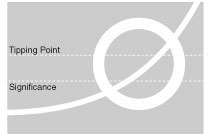
During the exponential gains peculiar to networks, compounding effects can pass a point of runaway growth. But it is before this point, before momentum builds, that one needs to pay attention.
Major U.S. retailers refused to pay attention to TV home-shopping networks during the 1980s because the number of people watching and buying from them was initially so small and marginalized that it did not meet the established level of retail significance. The largest U.S. retailers work in the realm of hundreds of millions. The first TV home shopping was dealing in the realm of thousands. Retailers discovered that shoppers would watch 50 hours of home-shopping programs before making their first purchase. The retailers considered this horrible news. But it turns out "watching others do it" was an initiation ritual. Shoppers trust other shoppers. Once shoppers were "invested" in the process by watching many others do it successfully, they kept coming back. So small numbers grew steadily and then rapidly as more shoppers brought in yet more shoppers. Instead of heeding the new subtle threshold of network economics, the retailers waited until the alarm of the tipping point sounded, which meant, by definition, that it was too late for them to cash in.