
Reduced to a Prop
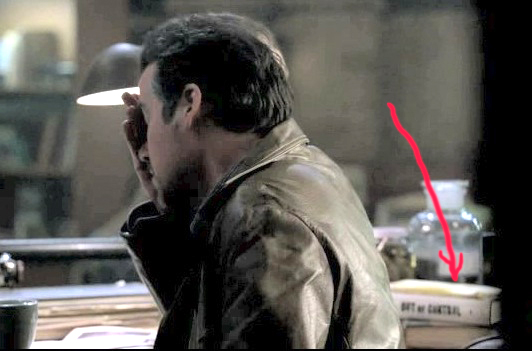
A friend spotted my book OUT OF CONTROL on the desk of in Episode 21 of Season 3 of the TV show “Fringes.” Wikipedia says:
The series follows a Federal Bureau of Investigation “Fringe Division” team based in Boston, Massachusetts under the supervision of Homeland Security. The team uses unorthodox “fringe” science and FBI investigative techniques to investigate a series of unexplained, often ghastly occurrences, which are related to mysteries surrounding a parallel universe.
I guess I should take this as a compliment. It’s the hardcover of the book, long out of print, so either they found it in the remainder bin, or else I have an early fan working in Hollywood.
(Good eyes, Dan Kendall.)
Futurama Death Clock
Matt Groening, creator of the Simpsons and Futurama, once told me that he was inspired by my countdown clock, and wanted to use it in Futurama. In my version I found actuarial tables to calculate my average longevity and devised a countdown clock aimed at my roughly estimated day of death. Since I am not a regular watcher of the show I had never seen what happened to the idea.
A profile of Groening in Wired catches him as he plays with the idea, and you can see how he immediately spots the ridiculous and funny:
Back at Groening’s studio, he is talking up an idea he had for another episode inspired by Kevin Kelly’s death clock. Kelly recently calculated how much longer he had to live — he estimates around 23 years — and posted his own personal life countdown clock online. “I started thinking, wouldn’t it be cool if you had a death wristwatch?” Groening says.
He and Cohen bat around the story potential of the death wristwatch. Surely, by the year 3000, a gadget like that could recalculate the time of your death on the fly, beeping if you are in imminent danger of dying? They start toying with the concept: Wouldn’t it be funny if the death wristwatch were running fast? What if the battery died?
I only recently became aware that the death clock was ridiculous enough to make it to one episode of Futurama. The final version was a table clock. You stick your finger into the hole on top and it reads out the exact time of your death. Apparently Professor Farnsworth invented the clock twice because of his senility.
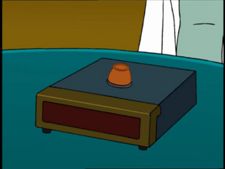
Leela: Does it really work?
Professor: Well, it’s occasionally off by a few seconds, what with “free will” and all.
Fry: Sounds like fun. How long do I have to live? [jabs finger into the machine]
[The Death Clock dings and the professor whistles]
Bender: Ooh! Dibbs on his CD player!
My own countdown death clock is a web app and desktop widget. It’s the first thing I see on my computer. I take it pretty seriously. Right now my clock reads 7,853 days left.
New, New Rules for the New, New Economy
The thesis of my book New Rules for the New Economy, published in 1998, is that we are now living in an economy based on ideas and communication rather than energy and atoms. Further, this “new” economy has distinct laws or rules so it behaves differently than the previous industrial economy. To do well in the new regime, we need to grasp the new dynamics of information. I reduce the emerging principles to 10 guidelines, and suggest a few strategies for businesses based on each principle.
I wrote New Rules in the late 1990s during the dot-com boom. At that time many reviewers convinced themselves the book was about the dot-com revolution. But in fact I avoided the dot-coms, never even mentioned them, and instead focused on the communication revolution. I talked about network effects, using the free economy, sharing, social media (not called that then), and many of the other developments now underway.
I did not talk about the stock market, either its ups or downs. Or crazy faddish gimmicks. In fact, I believe New Rules could be released today for the first time and still be extremely useful.
So that is what I am doing. Starting today, on its 10-year anniversary, I am re-issuing New Rules for the New Economy as a blog. Twice a week I will post the next section of the book on my New Rules blog.

Ten years is a long time in internet time. A lot has happened in that digital century. Many folks did not have email in 1998, and few were using the web daily. But I stand behind my analysis and today, 10 years later, I don’t retract a single word of the book. If I were to change anything I might be persuaded to rename the book “New Rules for the Network Economy” (which was an alternative title at the time), but other than some stale examples of companies no longer around in the book, the text is as pertinent today as a decade ago.
From day one, I practiced what I preached in New Rules: this book has been available free on my website for the past ten years. I know that this freemium increased sales of the book. However the book is now out of print, so I have released a free PDF version of the book, which you can download here. As an experiment it contains opt-in contextual ads. For the diehard there are used paper copies of the book available on Amazon for cheap. The choice of format is yours: paper book, website, daily blog, or PDF.
In any case, your chance to comment on specific parts of the book (and I hope you do) is here on this blog. I read every comment and will endeavor to reply as much as I can. There are many places in New Rules that I know could be updated with more current examples: I’ll leave those to you, the collective readers, to do — as I say in the book, no one is as smart as everyone.
Loosely Joined Thoughts
While at the Web 2.0 conference I was musing aloud on ways in which our web culture encourages new attitudes toward social-isms. We are constructing Socialism 2.0, I joked. Joshua Ross of O’Reilly media filmed the conversation, which he has edited, and uploaded. Other topics covered in this rambling encounter: the thin line between the wisdom of the hive mind and stupidity of the mob; the difference defaults make; what technology wants; how technological evolution differs from biological evolution, and living in an always-on society.
(One correction: I said there were more people making arrowheads now than in Indian days, but what I meant to say, was that more arrowheads were made now than back then. Contemporary flint knappers churn out many more arrowheads than they use, or than any hunter would ever use.)
Note: Lots of disjointed thoughts loosely joined.
Web 10.0
I gave a talk yesterday at the Web 2.0 Summit. It’s a short talk, only 10 minutes long, so I decided to skip Web 3 – Web 9 and just speak about the upcoming Web 10.0 and what I think will happen in the next 6,500 days.
Technology as a Spiritual Force
The other day I was interviewed by Ken Wilber, a new age theorist. I had not read any Wilber before the interview, nor had ever met him, but I had heard his name over the years while I edited the Whole Earth Catalogs. He had a reputation for a holistic framework for spirituality that appealed to those whole wanted spirituality without religion. I gathered Wilber was into evolution as a spiritual force so I thought it would be an interesting conversation. His organization Integral Life set up the phone interview which lasted several hours. We got pretty light-headed as we went along, getting into late night dorm-room speculations about the larger meaning of life. I had a chance to try out my emerging understanding of some of the more cosmic implications of technology. And Wilber was a good partner to blue sky with. I call myself a techno-transcendentalist and Wilber encouraged me to philosophize in that direction. I must have said something interesting since Wilber is posting an audio file our conversation in three parts on his Integral website. Regrettably, the dialog has not been edited, or condensed (at least the part I checked), in the way a tight text Q&A might be, so you’ll have to slog through the whole thing to get to the highlights.
Here is what Corey deVos, Integral’s Editor says about the interview:

Exploring The Technium.
Part 2. Spiritual Machines.
Kevin Kelly and Ken WilberIn the second installation of this extraordinary dialogue, Kevin Kelly and Ken Wilber discuss the nature of evolutionary emergence—the mysterious process by which new wholes manifest in the universe, each greater than the sum of their parts. They speak about humanity’s role in this evolutionary process, especially in the creation of new types of intelligences: living, breathing, thinking machines.
“Our job is to surprise God.” — Kevin Kelly
In this very special dialogue, Kevin Kelly and Ken Wilber discuss the spiritual implications of this mysterious process, what Kevin refers to as “up-creation.” While humanity can be currently seen as the pinnacle of evolution in this corner of the universe, we are by no means the final word in this extraordinary story, and will one day be inevitably subsumed by something greater than ourselves—something that will undoubtedly emerge through us, while becoming something much more than us. Humanity represents a process of evolution becoming self-aware, which means that we are now actively participating with evolution, midwives to a future that simultaneously transcends and includes the entire human condition.
I should also mention that ordinarily Integral charges a subscription for access to their material, but as part of the condition of the interview I insisted that our conversation be available openly, for free. Which it is.
Part One.
Part Two.
Part Three.
Old Rules for the New Economy
I have mixed feelings about the award of a Nobel prize to economist Paul Krugman. I am happy that a person I tried to hire as a columnist for Wired in the mid 1990s eventually won the highest honor in his field. I was originally interested in Krugman because of his work in non-linear economics. Complexity and non-linear dynamics seemed to be an approach Krugman dabbled in with his book “The Self Organizing Economy.” I felt (and still feel) that something large was stirring in the emerging digital economy, and that Wired would be a good place to write about it. Paul declined my offer to write for Wired back then because he was looking for a venue larger than tech. A year later he wound up at Slate.com. Later he become famous for his New York Times column.
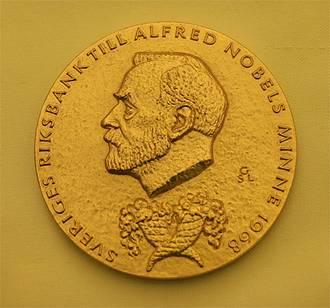
But after investigating self-organization, Krugman must have decided it was not worth following up on, because for the most part he abandoned this computational approach. He may even gained a distaste for it. He got into a famously personal and toxic feud with economist Brian Arthur, of the Santa Fe Institute, who was gung-ho on the role of increasing returns and network effects in the economy. I don’t know what came first, Arthur or network effects, but Krugman acquired an allergy to both.
I also am very glad the Nobel prize is going to someone who acknowledges the role science fiction has had on academia. A while back Krugman said he got into economics from reading Asimov’s Foundation series. Hari Seldon’s pschohistory is the sort of probabilistic forecast a super economist would love to make. Krugman also writes science fiction himself — always a plus in my book. While at Yale as an assistant professor in 1978 he wrote “The Theory of Interstellar Trade” (PDF). It is less hard science fiction and more a tongue-in-cheek speculation about the problems of calculating interest at near-light speeds. Do you use the clock on the ship with the cargo or the clock on the shipper’s home planet? Each clock suggests different business strategies.
On the other hand, Krugman reviewed my book New Rules for the New Economy for Slate (a while after I tried to hire him), and overall he was not impressed. As far as I can tell, his main complaint was that my new rules were not new. As evidence he suggest that the “old” Hollywood movie business follows the new rules. In the review Krugman says:
In fact, by my reckoning, the movie business handily fits 11 of Kelly’s 12 rules.
I, of course, agree 100%. The intangible nature of films absolutely follow the new rules. This is one of my main claims in the book: The value in material things will increasingly be their information and design. Krugman’s mistake was to think, as many folks did at that time, that I was talking about the dot.coms, when I kept repeating that I was not talking about dot.coms, not just software, and not just informational industries. Krugman ends his review like this:
So think of it this way: While the prophets of the “new economy” [that would be me] may seem to be telling us that we’re heading for a future in which every industry looks like Silicon Valley, what they are really saying is that we are on our way to an era in which there’s no business that isn’t like show business. Let’s hope they’re wrong.
Yes, I did say exactly that: we are heading into a future in which every industry obeys the laws of information. And yes, it looks a lot like the business of films — things which cost a lot to make and virtually nothing to copy. Krugman and others may hope that hunch was wrong, but as far as I can tell, they are wrong and we are right. In short, I think Krugman just doesn’t get it. His economics seem very old school – but maybe that is what wins you a prize. According to him I should have titled my book Old Rules for the New Economy.
I may be biased, but to my eye the New Rules for the New Economy hold up quite well. It was published 10 years ago, and I would not retract a single thing from it. In fact, there’s very little I would change if I had to published it now. Sadly, the book is out of print, with no hope of a re-issue. The only new rule that Krugman dismissed as “basically silly”, is probably the most valid one: Follow the Free. (Chris Anderson, of Long Tail fame, is writing his second bestseller about the force of the free.)
I take it as an honor that a Nobel laureate in Economics reviewed my book on the new economy. That he didn’t think much of it was “new” is probably par for academics. At the least I got a blurb out of it in case Penguin reprints the book. Paul Krugman, Nobel in Economics says: “He is actually on to something–though not something new.” If this were Hollywood — and didn’t Krugman say that is where we are headed? — I would reduce his comment to a positive blurb: “Kelly is on to something.”
Don’t take my or Krugman’s word. You can read the book yourself — for free (isn’t that “silly!”) — via this PDF, or on the web. I am interested to hear from readers which rules still work.
The Future of Motion Pictures Video
It feels entirely appropriate to discuss the future of motion pictures in video format. I gave a keynote last spring at the 51st San Francisco International Film Festival. Billed as their annual “State of Cinema,” I was told I was the first one to give the address using pictures of any sort! Mere slides, but visual enough. Captured here is a raw, not very sharp, video feed of the talk. The audio is low, so it needs to be dialed up. Film people are often not very filmic in their own processes.
A Blurb From the Past
My first book Out of Control was not widely reviewed. I was an unknown first-time author. My huge sprawling book was too big to scan quickly and frustrating to summarize. It got only a very few mentions in the press. Some friends wrote blurbs for it, but that was all for publicity. The book also debuted at a very hectic time right after the launch of Wired, when I and the whole world were running dizzy at internet speed.
Science fiction legend Aruthur C. Clarke was, naturally, a boyhood hero. What kid was not impressed by his imagination and scientific sensibilities? I sent him a manuscript not expecting any reply. He simply was the smartest author I could think of. Sometime during the Wired startup chaos, I got a letter from Clarke, which included a standard form stating his inability to blurb books. I received his note just after the book reached bookstores. I put it aside in a pile of papers on my very messy Wired desk and somehow forgot about it. When I left Wired in 1999, I dumped all my papers into a box, which I finally got around to cleaning out from the garage last weekend. Somehow I had not noticed his letter (I think I focused on his form letter) and while reading it this time I found a blurb for Out of Control that I don’t remember seeing before.
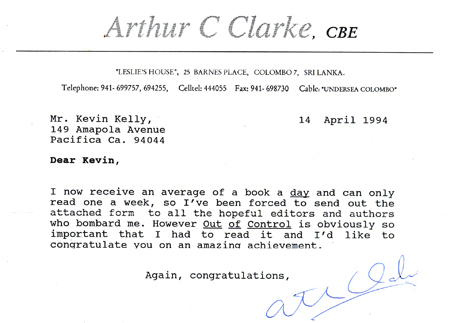
“An amazing achievement.” — Arthur C. Clarke. I’ll take that one! Wish I had used it back then.
Clarke was exactly the kind of person I want to write for. Someone who reads a lot, knows a lot, is easily bored, and wants to hear something new. His praise means a lot. I’ll keep aiming high.
History of Wired
To celebrate its 15th anniversary, Wired sent a film crew around to some of its former co-founders so we could reminence on tape. They came to my studio this spring and I talked about why the magazine was started and why I still read it and write for it. They edited the footage as a commercial for their ad sales efforts. I just noticed it was up on YouTube. (Louis Rossetto’s is here.) Naturally they cut out the interesting stuff, but I did enjoy the little fragments and glimpses of the early Wired days.