


Making the Inevitable Obvious
A Proposal for Universal National Service
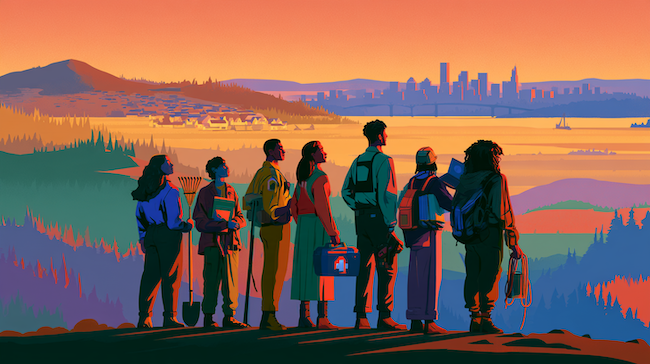
Every young person between the ages of 18 and 21 should provide 2 years of mandatory national service. Accepted service goes beyond military service and includes civilian service like teaching, or construction, or emergency response. Everyone serves. There are no exemptions for wealth or connections, or even handicaps; service would be matched to ability, not waived. This would be good for them, good for their country, and good for the world.
There are several main benefits:
- This duty partially offsets some of the rights citizens enjoy.
- Useful societal work is gained that may not be as well served in the marketplace.
- There is a meaningful mixing of people from diverse backgrounds, helping political unity.
- Kids get a gap year, in the work space, that makes them better students in higher ed.
- They may get training, but surely get a sense of service and accomplishment.
I am an American, so I will make this argument primarily in American terms, but examples of this exist in part in other countries of the world.
The Work
To satisfy the requirement, a young person can join the military, in all branches. They would get training in a skill, and be under military command. With the advent of such a program there could be an expansion of forces, such as coast guard, space force, and cyber force to accommodate and harness youthful energy and enthusiasm.
Civilian tasks could include emergency response work, helping out in the inevitable natural disasters, from providing food and health care, to construction of temporary housing.
Outdoor labor in our parks and vast government lands is badly needed. Much of the western US is owned by the government. Fuel reduction to reduce wild fires is long overdue. Like the CCC in the past, crews of young people could be clearing brush, making trails, serving in state and national parks.
The best way to learn is to teach. Recent high school graduates have much to teach younger kids. Tutoring is underappreciated and very effective. Teaching is needed in rural and city, and is also helpful overseas. An expansion of the Peace Corps is also national service.
Not all jobs would be manual labor. A great benefit to the country would be to scan, digitize, train, and organize historical data from local municipalities, overlooked archives, city governments, etc. This data is useful on its own and for model training towards a public AI. There is also the need to monitor, track, catalog wildlife species and ecosystems in order to manage our lands.
Public health outreach and education is also badly needed and can be helped by newly trained volunteers.
The Payoff
Mandatory service when you are 18-21 creates a productive gap in education that comes at the right time. Many college teachers observe that kids who return after a gap year or two are more motivated, more committed, and more likely to graduate than those who come directly from high school. The break gives perspective, and the experience in the world gives reasons and directions to pursue higher learning.
The jobs that are outdoors allow kids to get out of their heads and off their screens. Their bodies respond, and their minds follow. It’s not uncommon that people bond to the places they work in. The parks and lands benefit later as those kids become adults who still care about the land.
There may be nothing as effective in countering political polarization as working with people from vastly different childhoods. Neither colleges, nor workplaces, would mix people more thoroughly as mandatory service (no exceptions) would. The result would be life long friendships and admiration between adults who otherwise would not engage with each other.
The Costs
The main drawback of this scheme is the cost. Today there are about 18 million 18-21 year olds in the US. With each serving two years, about 9 million would be in service at any time. At roughly $50,000 each, that’s about $450 billion a year, about 60% of what the US spends on all military compensation, including veterans’ benefits. Giving them all a job would be like hiring 5% of the nation’s workforce.
Notably, some of these outdoor, healthcare, and data collecting tasks will likely be among the last jobs to be replaced by AI, so I would argue they will be well worth paying for.
There are other costs: corps labor would compete with paid workers, and compulsory civilian service would face a constitutional test the military draft never did. Both challenges are solvable, but real.
About 60 countries have some form of mandatory military service, mostly for males. Fewer than half offer a civilian option, usually structured as a conscientious objector alternative, a sort of second-best choice, and often deliberately longer than military service. I am aware of no country today that requires universal service of all young men and women with civilian options as equals.
I think the value of such a program would immediately pay off in better education results, less polarity, and more committed citizens, and it would compound over the years.
Weekly Links, 10/23/2026
- The internet archive’s Wayback Machine library is a planetary treasure. It preserves the archive of the web. Don’t let publishers take it down. Why the Internet Needs a Memory
- PDOOM is a great music video slopcore with a very SILO like ending. These are getting so good. Astra Blue AI – P Doom (Official Music Video)
Most Improbable Agent of You

It is commonly said that AI today is the worst it will ever be. This is true. AI today is probably the most centralized it will ever be as well. Currently the most reliable way we know how to make AIs smarter is to make them bigger. This principle is called the scaling law. To improve the current best AIs, which are transformer neural nets, we need to increase the scale of their training data, the scale of their compute, and the scale of their inference, or delivery. That scaling results in massive computer processing centers, running millions of chips, with trillions of parameters, powered by gigawatts of energy, costing tens of billions of dollars. Very few can afford this scale of system, so this AI power is concentrated into a very few organizations.
On the other hand, each one of us runs a very powerful (better than most AIs), very tiny (big as your skull), very energy efficient supercomputer running only on 25 watts at the end of our necks. There are some 8 billion of these tiny supercomputers spread around the planet, interconnected via the internet. We have an existence proof that biological intelligence does not need to be centralized.
Today, because of rapid innovation in AI architectures and training formulas, the amount of compute an AI needs to deliver a given capability has been cut roughly in half every 8 months. Combine that with the hardware gains of Moore’s Law, and the cost per capability halves roughly every 6–7 months. Assuming Moore’s Law continues, within a few years, a model as capable as today’s leading LLM – let’s call it Opus – could run on a device you own. Within about a decade, the cost of training one from scratch would be affordable by an individual, and fine-tuning your own copy would cost far less.
That means everyone could own and control an AI like today’s Claude or ChatGPT or Gemini. You would not have to ask permission to do things, or be obligated to train it with certain guidelines, nor have to accommodate the preferences and sensitivities of others. The AI could reflect you.
This kind of shrinkage should not surprise us. It seems insane that a multibillion-dollar data center occupying a vast brown field could be reduced to an orb that sits in your hand, but consider what has already happened inside your phone. Twenty-five years ago, the graphics chip alone in today’s iPhone would have filled a large room. Your phone’s AI chip would have required acres of computer cabinets. It is likely that the entire controversy around massive data centers disappears because they disappear; they were a temporary scaffolding needed for the first round of tech, just a blip in the history of technology.
Of course in 10 years, you would be stuck with today’s AI – which as I began – is the worst it will ever be. But at some point in the very near future the amount of AI that you need for 99% of most jobs could be provided by a local device. It is similar to bandwidth. At a certain point, most tasks you have can be done with a gigabit connection. And once you have a gigabit connection, you are happy. Maybe when we have the metaverse, or the mirrorworld, or augmented reality, we’ll elevate that minimum, but the point is that it will be good enough. At some point the smartness of consumer AI will be good enough for 99% of what you need, and that smartness will be able to run in something you own and could also train.
Many of the issues that people have with AI today would be resolved if the AI were not only available from a huge massive monopolistic tech company, but instead was generated, delivered, overseen, and maintained by individuals. A lot of the criticism of AI today is really just a criticism of capitalism. There is the question of who benefits from the value being created, who controls who gets what (the best AI models may be kept for internal use by some companies), who gets to train the AI mind, and supervise what it is trained on, and who decides what it is used for.
Not all issues are resolved by individualized AIs (they will still have tricky trust issues), and some new problems are created. But I find a vision of a billion AIs running the world much preferable to 3 or 4 of them running the world. Decentralization spreads power, but more importantly it can deliver something a central AI never can: an AI as unique as you. Here is my ideal hope:
I hope that every person born (and yet unborn) can be on a path through their lives to become the most improbable version of themselves. (See my manifesto Your Most Improbable Life). The idea is that you become unique, with a unique set of talents and experiences, occupying a niche in the world that you create. You slowly invent your job. You are not the best, you are the ONLY.
This kind of self fulfillment is possible because we have technological agents that relieve us of the tasks anyone can do, leaving us with the tasks only we can do. While there will be billions of ordinary and commodified agents (bots and robots) that perform these everyday tasks, the best of the AIs will be those we tailor to ourselves.
I want a personal AI that I have trained myself on all my life’s experiences, all the influences I have had, all the work I have done, and all the people I most admire. There will be advice and schools for training your personal AI to become the most useful to you. In fact there will be teacher AIs who educate personal AIs, and people will hold opinions on the best way to educate your personal AI and what kind of AI teachers you want. You want the teachers weird but not too weird. You may want to train your personal AI on the classics, rather than everything. The current frontier models are trained on everything and they are aimed at everyone for all problems. They are by default, generalists hitting the average in the middle of the mainstream.
But we want a personal AI, an exoself, that is as unique as we are. We don’t want the best AI, we want the ONLY AI. We want an AI that is as improbable as we are, and improbable in the same unique direction that we lean. We’ll want to curate the education of our AI.
At least I do. I want to work with my exoself AI agent to co-create, co-manage, co-invent my life. I don’t want to use the same AI that 8 billion other people use. How can that help me to be unique? In order to be creative, my AI exoself also needs to reflect my own uniqueness, doing its own AI thing with distinction. It should be as weird as I am.
The art of training your own personal AI to be weird yet useful will become one of life’s skills. An entire section of YouTube and self-help programs will be dedicated to cultivating the Agent of You. The ultimate goal of this Agent of You is to help make you the most improbably unique person you can be.
Mainstream will never go away. And for much of life the ordinary is more than fine. There may be big-tech janitorial agents, and brand name clerical bots, and exclusive alien genius bots, but the AIs that can serve creators should be as weird and personal as we are.
Swarm Intelligence
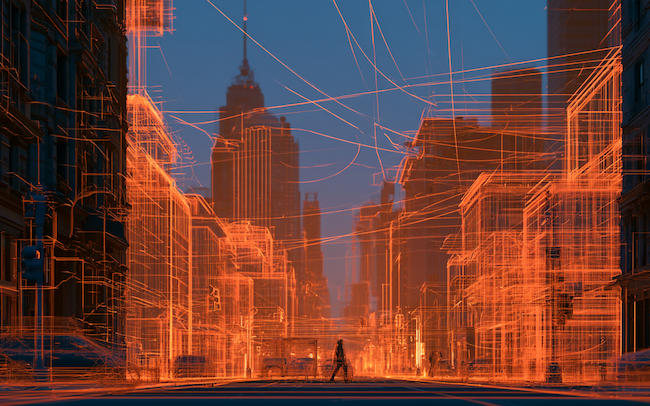
Here is a possible world 50 years in the future, one I think is more likely than the scenario most people expect, which is one huge AI in the sky.
Fifty years from now most AI is invisible. There is nothing to see. It is sort of like air – always there, always on, everywhere. Something you need and use but take for granted. AI is so prevalent we become blind to it.
You don’t need to log onto it, or even to summon it. Rather you inhale it. Instead of a central AI brain, AI is like a gas, composed of zillions of tiny interacting AIs that create an atmosphere. These zillions of minds are like eukaryotic cells in your body, or hundreds of varieties of bacteria in your gut. They form a presence. They are woven together into a vast network of intelligences that create an AI background. This society of AI minds is not so much seen by humans, as it is felt.
Unlike the AI of today, it will be deeply embodied – into robots, vehicles, buildings, and devices. But its embodiment will be so wide, so deep, so pervasive, that it will become the background.
AI might be thought of as a superorganism that is so vast that, like an ocean, it becomes the environment. This environmental AI, like many environments, can become imperceptible to those immersed in it. We’ll only notice it when there is a gap, a disconnection, or it goes down.
Like a coral reef, an AI superorganism will be composed of thousands of species of minds.
Some of these AI minds might be very narrow and dim, just a notch above being stupid, maybe as smart as an insect. Others might be math geniuses. Most sub-AIs will be engineered in the middle to do specific boring and niche tasks.
The chief characteristic of any superorganism is that its power transcends the power of its parts. So the superorganism of AI, this AI environment, will transcend the power of its parts – which will include all the frontier models of the time, and the most powerful specialized AIs for math, or biology, or world building, and the general purpose everyday AIs running the back offices of corporations. Interacting together, these AIs will form a system of co-dependency, with different AIs relying on each other for inputs, guidance, maintenance, support, direction, amplification, resolution, upgrading, verification and trust. This ecosystem of AIs will be the environment, and just as in organic life, each AI will co-evolve with this environment, this society of minds.
Here are some notes on what we could expect for this kind of swarm intelligence.
- Maintaining a sustainable swarm intelligence is tricky. The science of complex adaptive systems indicates that there are sweet spots in the connectivity between swarm parts. Parts that are too heavily interconnected seize up in rigid paralysis; parts too thinly connected fly apart in chaos. Tweaking systems so that they don’t collapse but thrive and flourish is almost more art than science. A sudden collapse of a swarm intelligence will become a prime danger while using them.
- AI protocols will appear. More than APIs, these standards will enable unlike minds – dumb ones and super smart ones – to negotiate, hand off, trust, earn a reputation, and store memory between themselves. These all operate in the background; no ordinary human thinks of them.
- No single institution, corporation, or government will be able to control the swarm environment. When a networked mind makes a mistake, there probably won’t be a single author, owner, or operator to blame. While some institutions may control pressure points, or critical protocols, or bottleneck infrastructure, no institution will be responsible for what happens when people use AI. It will be similar to an internet for AI, which will have multiple stakeholders that keep it going. This diffuse liability is both a blessing and a curse.
- A distributed liability will likely birth new kinds of distributed and decentralized insurance and adjacent law. In addition, the need for ways to verify and trust trillions of agents, all claiming good intentions and competency, will require a whole new technological trust system that can verify, authenticate, evaluate, and rate unlimited alien agents and sub-minds. A significant cost of transactions between parts of the swarm intelligence will be dedicated to the trust network.
- We currently don’t have practical ways to assign accountability when harm emerges from interactions between AIs rather than from a single bad actor. We will need metrics to trace influence across networks, to estimate counterfactuals (“what would have happened without this component?”), in order to govern the swarm.
- A society of minds will produce parasites, scams, slop, spam, and adversarial hacker agents. Most of the agents in the swarm will be actual bots. We’ll grow some equivalent of an immune system with white blood cells to detect, isolate, and diminish the harm. Creating the immune system will be an economic opportunity for many.
- As a superorganism, AI will keep producing emergent phenomena and behaviors. It will generate varieties of thinking that are not present in any of the component AIs. This will be worrisome and exhilarating.
- Because of the planetary scale of this superorganism at its largest, much of its behavior and intelligence will feel alien. Some may call it inhuman, but it will certainly be unhuman.
- There will be multiple levels of swarm intelligence. One level will be planetary. Just like a body with tissue, there will also be sub-levels of swarms operating at the level of nations, and certainly corporations. In fact, as corporations become more and more cognified, permeated with AI, they will more and more resemble outright AI swarm intelligences. Another way of saying this is that more and more swarm intelligences will begin to do the work of, and act like, corporations.
- Rather than engineering, the best way of managing swarm AI may be more like gardening. We’ll use containment, many layers of fences, permissions, borders, and isolation in order to nurture the results we want. We will plant many species of minds, shape the environment, and cultivate the ones that behave well. Instead of controlling the system by understanding every internal mechanism with one clever algorithm, we’ll steer the way we govern markets, cities, or any system: indirectly, imperfectly, with observation and constant intervention.
So an average day 50 years from now in this swarm AI world, we will not be talking about AI. We will hardly see it. It will be everywhere, embedded into everything. We will have one or two personal agents we depend on and like; these exoselves might be like our twins or partners, but beyond them, we won’t be encountering AI. We’ll just encounter the world – cars, tools, kitchens, planes, offices, doors, screens – and that world has AI embedded into every bit of it. Behind our view, an ecosystem of AIs interact and are co-dependent on each other, animate the world with pervasive cognition, such that it is hard to determine where one mind starts and another ends. The environment is smarter. We will still carry our magic stones and wear smart glasses, but most of the intelligence will be embedded into the background. Getting this swarm intelligence to work will be the job of the next generation of inventors.
Weekly Links, 10/02/2026
- Not a normal debate. The debate about whether AI is a “normal technology” has been spun into overdrive with AI-generated musicals defending each side. (AI-musical is becoming a thing.) A Normal Debate?
Robot Basketball
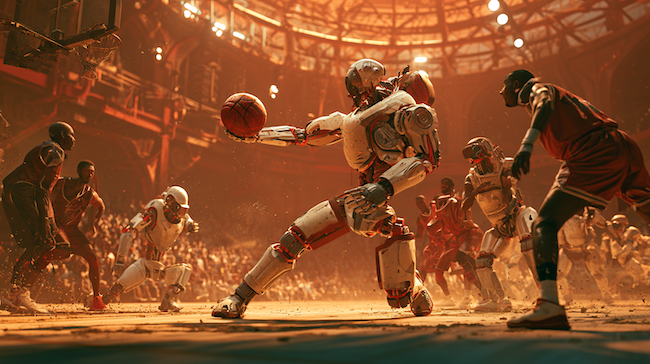
Earlier this year I made a bet with Craig Mod. He felt sure that robots would soon be able to play basketball better than humans. It’s a reasonable prediction based on the fast advancements in robots running sprints, kicking balls, and shooting baskets. If they can beat the fastest human in the 100 meter dash, why not trounce the Warriors? I think it is inevitable that at some point, we could make a specialty machine that would play basketball better than any human could, but I am skeptical it will happen soon. Craig claimed that by 2040, robots could beat the best human basketball players in a full regulation game. I bet against this timeline and say they will not. The winner has to buy a round of gelato.
I am incredibly optimistic about AIs. They will not only do a lot of knowledge work, and change our jobs, they will also accelerate most scientific and technical fields – including robotics. Faster AI models will inhabit the minds of robots and will also enable our minds to figure out all the technical problems humanoid robots present. There are many.
The major challenge is cramming all the necessary power and compute into a mobile unit able to perform for several hours. It turns out that our form factor is incredibly efficient. Compared to what we do with machines, we are insanely efficient. Our supercomputer brains need only 25 watts, which is orders smaller than LLMs. At their max our human bodies generate less than 100 watts while walking, maybe 400 watts playing basketball, while machines need about 500 watts to walk, and 2,000 to exert strenuously. Gaining five fold efficiency in motors is not impossible in 15 years, but we have been actively optimising motors for over 100 years, so this is not a new incentive. It will be difficult.
In addition to our incredible energy efficiency, humans have two other advantages at the moment. Our resilience and recovery. Robots are stiff, and hard, which means when they fall, they break. Basketball is a contact sport. If a 7 foot human pushes over a robot, it may never get up again. Of course the inverse is true too. Getting hit by a machine will seriously hurt. However humans have a remarkable ability to recover, to get around an injury, in a way machines currently do not. Very small injuries can incapacitate a machine. We don’t have a good way to overcome that yet.
The most important hurdle basketball-robot designers face is the flexibility of humans. It is not that difficult to create a machine that is excellent in shooting baskets, or excellent in sprinting, or excellent in jumping, or excellent in dribbling. The challenge is to combine all these abilities without too many tradeoffs. Humans obviously are an existence proof that all these capabilities can be tuned, but at the same time basketball is a sport that is optimized for human skills that come from water-based meat tissue. Trying to optimize silicon and titanium on the same set of meat skills is a serious hurdle.
The terms of the bet require a full team of robots no bigger than professional basketball players, playing with standard rules of substitutions and duration, competing against the very best pro human players. I might concede that a basketball robot could beat an average human by 2040, or even a decent high school team, but the level of athleticism in professional basketball players is superhuman. They too are alien beings. And very quick learners. Getting the best of them in a sport they live and die in is a near-impossibility by 2040.
Any success in a basketball robot will come from a robot that is designed specifically to play basketball. It will not be able to win at volleyball, let alone football or baseball. The greater lesson I think we will learn is that a general humanoid robot is not going to be that useful. Rather we’ll construct a lot of specialized robots to get things done. Retail store restocking robots, cleaning bots, cooking bots, hospice robots. And in sports, the best performers will specialize in a way that humans kind of do.
To be very clear, I fully expect to watch robot olympics. I will be one of many willing to pay to see robots dance, compete in sports, and amaze us with their kinetic abilities. Basketball robots are likely to invent new basketball moves that humans didn’t think of doing, or couldn’t do easily. In the long-term, robots could change how humans play basketball professionally.
I have no doubt this roboty world will happen, I just seriously doubt it will happen in 14 years. I can taste the gelato.
Arguments in Favor of AI Fair Use

I made some notes on the nature of the training of LLMs, and about whether we as a society should consider the material used to train them as a fair use of that material. I believe it would be best for us to consider them fair use, and I made some points in its favor. The context of these points is US copyright law, which I did not spell out here. There are other commonly used arguments pro, and many arguments against, which I have also not listed. I wrote these points as a way for me to think aloud along my own lines, and they are not arranged in any order to make a tight case. I welcome constructive comments, or points I may have missed.
- Text, images, or music, etc, are all expressions made by humans, which are copyrightable. During training LLM transforms these expressions into an abstraction called “latent space.” It takes one kind of thing – expressed content – and transforms into another kind of thing – an almost mathematical abstraction that contains no expression. This is why LLMs are called transformers. The latent spaces of an LLM are closer to something like a syntax which is not copyrightable.
- This latent space transformation is a fundamental transformation, because it goes one-way. It is an asymmetrical process: Content can be moved into latent space, but the latent space cannot be reversed to go back into the original content. It has truly been transformed.
- The usage patterns of how the general public uses the transformed material is new. When an LLM is asked to troubleshoot a broken electronic device, this service does not resemble reading a book or a newspaper article. When an LLM is used to develop a marketing strategy, it is a profoundly different action than reading text. When an LLM is assigned the task of proving a math problem, it is not substituting for a book about math. The transformations accomplished by LLMs are both in their form and in their use. Not only are they transformed, but they are transformed into a whole new category we have not made before.
- The key benefit of LLMs is their smartness, which emerges from the latent space and is not present in the source material itself. Their ability to pass a history exam is not present in any history book, and is not even present in ALL history books. These new benefits emerge from the process of creating an LLM trained on history books, and then transformed into a latent space, which produces this smartness. Much, if not most, of the value of LLMs derives from their ability to generate new benefits beyond what the source material alone can yield.
- The information inside an LLM is not stored in the form of copies of things. Even though an LLM may know the full content of millions of books, it does not contain within it any copies of the books. It may be able to recognize any object in a picture, even though it stores no pictures. Instead of containing a copy of the image, it contains the information contained in the image. The weights of an LLM can be copied, but the latent space itself does not resemble a copy. The latent space is a non-copy entity.
- Intermediate, transitional copies are the norm in the digital world. When your phone pulls up a web page it is technically making a copy of that page for a brief moment. When you send an email, it is copied in transit by telecom companies many times, but we don’t count them as invoking copyright. Since these intermediate copies are not stored, we don’t constrain them. Courts have already permitted literal copying that never surfaces publicly, The copies that LLM’s read once during training, are not stored, are not surfaced, and are therefore normal transitional copies that are fair use.
- The genius of the LLMs comes in part from the astounding fact that all bits of information from millions of different kinds of sources and subjects are mapped onto a single “map”. There is a single conceptual space (the latent space) where every fictional story, and every bit of medical information, is combined with all geological knowledge, and all news events. And so on. As a result the value of any particular contribution to the overall value of the LLM is almost incalculably small.
- Any individual item used in training the LLM has a very low value because 99% of almost every source is redundant. There is very little unique information in any item, even for seemingly original material. When an additional piece of content is inserted into the conceptual space of all human knowledge, most of it is redundant with other material. That means, removing an average bit of source content would make virtually no difference to the output of the LLM. As LLMs continue to scale up, the value of any particular source continues to diminish.
- Modern LLMs have trillions of parameters – that is they have trillions of attributes they are describing. The consequence of mapping all human knowledge into one latent space with trillions of attributes is that every bit of information intersects, or influences, every other bit of information. Calculating this enormously complex relationship between trillions of influences is the grand task of a massive data center. This calculation is the most complex computing task we have ever done. But it is so complex that we cannot practically unravel the ripple of influences of any particular source. The degree of influence for each source content is therefore not calculable at this scale. It is not dissimilar to our considerable inability to calculate in a quantifiable way the influences in our own thinking and knowledge. Therefore the import of a particular source cannot be practically measured.
- In creating its knowledge, an LLM does not distinguish between sources of influence in its training. There are more hours of Star Wars reviews than Star Wars movies. You will have a lot of knowledge about Star Wars even if you have never watched a copy of a single one. What an LLM knows about Star Wars may come primarily from sources other than the movies themselves, from authors who have watched Star Wars. These diverse secondary and tertiary influences are doing a lot (most?) of the work that LLM delivers. Verbatim quotes can even come from secondary sources, which themselves are using the primary material in a fair use way. In fact the high value of LLMs derives in large part because indirect sources of material give a necessary and “intelligent” context to its knowledge. In this way, the LLMs improve the primary source material, to make it truly useful. This is another way LLMs transform material.
- When a human student is studying, they might learn from a book they purchased or from a book they borrowed from a library, which we consider fair use. We don’t judge their learning based on whether they paid for the source, or whether the sources were borrowed or rented. Likewise if an LLM is trained on borrowed copies from a library (fair use) that should not impact our judgement of its knowledge.
- The constitutional rationale for US copyright is incentivizing creation for public benefit, not necessarily securing revenue streams. I’ve personally seen anecdotal evidence that LLMs have been encouraging massive degrees of co-creation. Nearly every day someone sends me something that they have recently created with the aid of an LLM. You might dismiss this as slop. Most of it is. But most of what humans traditionally made everyday could also be called slop. And the best of the slop will get better. What is clear, is that the public benefit of transforming expressions into latent space is huge, and should be encouraged.
- At the moment the smartest AIs humans have invented are LLMs, but that might not be true in the future. There are lots of alternative models to LLMs being experimented with, and they could become the default models next. Today the most advanced LLM models are intensely commercial (and rich). But they might not always be. We already have various types of open weights, open source LLMs. We tend to think of LLMs as chiefly commercial entities, trying to maximize revenue. But LLMs don’t need to be profit-making. Many of the open source models are matching the capabilities of for-profit models today. LLMs can be non-profit. They can also be considered a true common wealth, like a public domain, or like the internet. I call one version of this kind of AI, Public Intelligence. There could be more than one public intelligence. These LLMs would have multiple stakeholders, be publicly funded and publicly accountable. They could be trained on all texts in all languages from all times. In part they would be like a super library with a super librarian, able to do most knowledge work. This public intelligence would be available to anyone, at cost. The latent spaces of the LLMs (whether profit or non-profit) are our new public domain. The purpose of copyright is to maximize the public domain by encouraging abundance of creations with temporary monopolies and then moving the protected into the commons as soon as possible to assist in further creation. The new LLMs are a new kind of commons that provide society with new powers of understanding (getting fantastic answers to questions), new ways of self-improvement, new ways to collaborate, new ways to be creative. It would be best for society and everyone born and yet unborn, if public LLM commonwealths were encouraged. We should maintain the fair use option for training LLMs to ensure we have at least some public intelligence commons.
Weekly Links, 09/04/2026
- Whoa! The best human Go player beat the best AI Go program (with a 2 stone lead). Go grandmaster Shin defeats AI KataGo in historic human victory
- Real-time AI video generation has arrived. Right now it is infinite slop, but it can be used to make a video game / world that is generated on demand instead of pre-built. H3 Max Director | Infinite AI Live Streaming Has Arrived!
A Billion Dollars
What would you do with a billion dollars?
I am occasionally asked by young people for my life advice. Could I counsel them as they decide what to do? They are thinking of going into something new. Or thinking about quitting their job. Should they work for a non-profit? There is usually a financial undercurrent to their concerns. I have a pretty standard response; I ask them to explore this scenario:
Imagine I am a wizard with a magic wand. I wave it over you and now you have a billion dollars. What would you do with your life? The price of things is no longer material. What do you use the money for?
The answers are wild and vary. They first buy a house, and maybe one for family members. Maybe even a second home at the lakeside. They get a car they always wanted. Travel some. Support an artist friend.
I tell them, that is all good, but after all that you will still have a billion dollars. You’ve only spent millions and you’ll make that back in a day or two. And you still have the problem of what you are going to do with your precious time.
Here the answers get interesting. Some would start their own business, or open a bakery. Work with doctors serving the poor. Go pro with their band. Become a YouTube creator. None of this requires anything close to a billion dollars.
I am reminded of a scene in the movie Wall Street where Bud, the protagonist, is working in a high-paying finance job he hates so that he can make a million dollars, retire and ride a motorcycle across China. The inside joke is that you don’t need to work on Wall Street, or to make a million dollars, to buy a motorcycle to cross China. You could easily do that whole trip for $2,000 dollars, saved from a short summer stint working at Costco.
The point of my exercise is that most people’s dreams are not gated by money. Sure you need some money, but you probably don’t need as much as you might imagine. You most likely don’t need multi-million dollars to start your dream.
The bottleneck for most dreams is not financial. It’s a lack of confidence, willingness to take a risk, and face failure, or a lack of imagination of what is possible with current resources. If you want to write a novel you don’t need capital — you need discipline and 1,000
words a day. If you want to start a consultancy you need expertise and a first client, not a war chest. A lack of money is a convenient thing to blame because it feels concrete, but it’s rarely the actual blocker for achievements.
I am not suggesting money is not necessary, or that you should go into debt to pursue your desires. This exercise assumes you’re not choosing between your dream and your next meal. If you are, I would use my wizard’s wand to first grant you a safety net — everything after that is what this essay is about. Money is the fuel you need for a trip – but it is not the goal of the trip. You most likely don’t need more money to accomplish your dream. You need time, skill, relationships, courage, and perseverance.
I’ve managed to do a lot of things without having much money at the start. Here are some tips that I have used:
Start Small, Scale Later – Whatever the cost of a dream, you usually don’t need it all up front. You can begin with a little and if the path is a good one for you, you can gain the additional resources as you proceed.
Constraints Breed Ingenuity — Forward motion and ingenuity often open up new possibilities that can route around costs. This is why most breakthroughs happen in startups. If you could ensure a breakthrough by spending money, all the new inventions would only happen in big corporations. They don’t, because you can’t buy breakthroughs. Startups have no money to buy a solution, so they are forced to be ingenious, clever, thrifty and bold to invent one. They have no choice but to spend their imagination and creativity. That outside thinking generates the new ideas. It is often the financial constraints that make dreams come true.
Small Tweaks, Big Difference – If you are an average worker, you’ll channel more money in your lifetime than you think. The typical median American will see several million dollars of income flow through their accounts over their life. Small tweaks in handling those quantities can make a big difference in achieving your dreams.
Prototype Your Life – Try a scaled-down version of your dream first. Start with a pop-up instead of a storefront; or a self-published ebook instead of a commercial press deal; some hand-made versions instead of a factory run; volunteer to intern with a lawyer before heading to law school; do a self-contained weekend camping trip before tackling the Appalachian Trail. The prototype will reveal what your actual monetary costs might be, and what the real bottlenecks are. Prototyping will often adjust your dream and save you a fortune.
Relationships Beat Capital – Friends and relationships are more important than money. If you want to go sailing, a friend with a boat is better than you owning a boat. Investing into relationships is a better deal than investing into crypto. The most valuable things in life – the things your dreams should include – are actually things that no amount of money — especially a billion dollars – can buy.
1,000 True Fans – My theory of a 1,000 True Fans is aligned with this perspective. It says you do not need a billion fans, or a best seller, or a billion dollars, to succeed in your creative endeavors. To make a living you only need thousands of super fans, if you have direct relationships with them. The key is the direct relationships with your fans.
Lower Barriers – The “minimum viable capital” for most creative or entrepreneurial dreams has collapsed over the last decade. Because of new technologies, the barriers to making stuff have lowered. It is cheap and easy to print a book, to 3D print an ingenious device, to generate a film. You simply need a whole lot less money to make something compared to previous generations.
Other People’s Money – There may be dreams where a lot of money is required at some point: maybe you want to do a hardware chip startup. This is where relationships are important again, because you want to use other people’s money. And the big secret in raising other people’s money is that it is ALL about relationships and character.
Take a small amount of money, and leverage it with great ambition, imagination, and creativity. Try something that no one has tried before, where the solutions are not for sale. Make something that no one is selling. Become the world’s expert in something – anything – and use that expertise as a platform to do more things you like to do. Cultivate friends and make their relationships your capital. Focus on being valuable, helpful, interesting, weird, rather than on being rich. I love what Brian Eno said, “If all I’d ever wanted to do was make money, I’d probably be really poor by now.”
I’ve had the privilege of hanging around a dozen actual billionaires. Despite the myth, they are not unhappy. But here’s the thing: they are still trying to figure out what they want to do next, and who they want to become. And their billions of dollars don’t help them in that. In fact, their billions of dollars are almost a prison. Their previous success hemmed them in, set unhealthy expectations, and will never go away (it is hard to get rid of a billion dollars). The hurdles they have in achieving their new dreams are exactly the same as yours: the need for will power, perseverance, ingenuity and imagination. None of these cost a billion dollars; all of them are available to anyone anywhere.
The goal is not to acquire, but to become. At your funeral people will remember what kind of person you were, not what kind of stuff you had. Your everyday life will need money, and no matter what you do, a fair measure of it will flow through your days. But beyond some minimal amount (way less than a billion) money is not important to who you become. Other assets like your character, your ethics, your work, your relationships, your word, your spirit, your drive – these are your real treasures. Use them to achieve your dreams.
The wizard’s wand is a magic trick. You already have everything the wand would have given you — everything except the billion dollars — which, it turns out, you didn’t need. Nor do you need a magic wand to materialize these powerful assets. They are in your hand right now.
Without a theory of intelligence
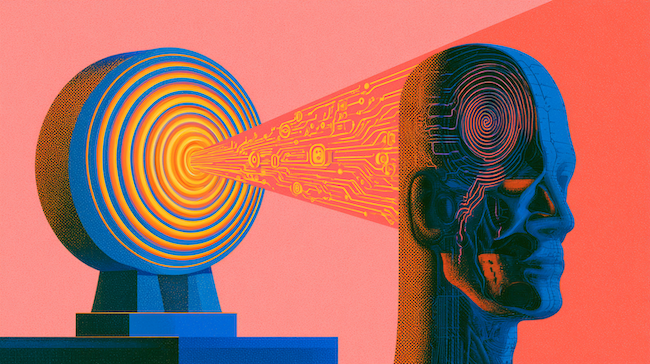
The history of science — and of progress — is a series of benefits that are direct results of new tools. A large part of our current longevity is due to the invention of the microscope. This new way of seeing opened up the microscopic world, a teeming universe we had no idea about, and from that view quickly came germ theory, and soon after, new ways to avoid many common fatal diseases. Hundreds of other advances were also birthed by the microscope, including our understanding of DNA. Similarly, the telescope not only opened the heavens to our inspection, it had a direct role in helping us devise the laws of physics, which in turn permitted harnessing the atom, developing GPS, and making cheap computers. Oscilloscopes, volt meters, barometers, cyclotrons — these are more than measuring tools; they are portals that open up new territories to be explored.
We are on the cusp of inventing a new cyclotron: artificial intelligence. Of course AI will usher in new ways to do stuff. We can offload chores we don’t want to do, but the greatest power will be in accomplishing things we had never imagined doing before. That new superpower will gradually revamp our society as we learn how best to employ it.
But a secondary revolution will come from using AI as a microscope: we will use it to see our own minds. AI will be a cyclotron that lets us inspect the mysterious particles of cognition swirling in human brains — bits that are completely invisible to us now. With this cyclotron we will be able to dissect thinking, take intelligence apart to see its components. We will be able to run endless experiments on whole and partial minds, experiments we can’t and won’t run on ourselves.
The space of possible minds in the universe is vast. Using AI as our scope, we will begin to populate that space, constructing artificial minds for specific purposes — ones that do math proofs, others for everyday robots, others to write stories, another to manage the planet’s climate. With the ability to look into minds, we can begin to build a theory of mind. Centuries ago the microscope gave us germ theory and cell theory. The telescope gave us gravity and relativity. The new scope of AI will give us a theory of intelligence.
Despite the great strides scientists have made in producing AI, we have no theory of intelligence. We don’t know how intelligence works, in humans or in machines. We don’t know what it is, or why it produces smartness. What is the smallest possible thing that will produce intelligence? We don’t know. Is there a universal ingredient shared between humans and machines? We don’t know. What is the metric for intelligence — how would we even quantify it? We don’t know. If we want more of it, what’s the formula? We don’t know. Is intelligence one thing or several — one dimension or many? We don’t know that either. Until we can predict what AI will do, we have no theory, and if we have no theory, we can never predict what AI will do. This is a problem.
Our ignorance about intelligence is vast. Take energy: does intelligence require a lot of it, or just a little? The supercomputer inside our own skull runs on about 25 watts, which hints that the minimum energy needed for intelligence might be small — and that the giant, controversial AI compute centers we’re building now may turn out to be a temporary blip rather than a permanent feature.
In the 1800s, the field of artificial power — steam engines — was hobbled for decades by the lack of a theory of heat. Tinkering engineers spent years on inefficient machines, costly detours, before arriving at the insight that power comes from temperature differential, not temperature alone. There were still engineering problems to solve after that — inventing high-pressure equipment, for one — but the theory told them which hardware problems were worth solving.
Like the theory of heat, a theory of intelligence will require engineers and theorists working side by side. It will be a nerd endeavor that requires building things in order to understand them. It will need a diverse team — neurobiologists, physicists, mathematicians, computer scientists, philosophers, hardware experts — and I expect a lot of foolish ideas will be pursued in order to discover general principles of intelligence.. This is basic science at its purest. It will take patience.
The payoff is a much better sense of where to focus attention and resources. We would know in advance, not after a $100 million training run, whether a given approach is near-optimal, or where the cognitive waste is happening. A theory tells you where the limits are. For instance, it could answer this: are today’s LLMs 1 percent of the way to what’s physically possible with a GPU, or 90 percent? That would be extremely useful to know. And since we’re about to invent thousands of new kinds of minds, a good theory would let us reliably engineer the right configuration for a given task — the way thermodynamics informs the design of an engine.
There’s a good chance a theory of intelligence will turn out to be necessary for real alignment. We may need to understand what the internal representation of thinking should look like before we can engineer core values — not just rules — into an AI mind. Right now we’re doing this by unscientific trial and error. We are trying anything we think of to get AIs aligned with our tricky goals: be creative, but don’t do anything stupid or bad. An explicit formula of intelligence, with a sense of its tradeoffs and limits, would give us something to steer by.
But a theory of intelligence isn’t just for AI. We are thinking machines too, and our intelligence sometimes needs fixing. Modern medicine still classifies psychiatric and neurodegenerative conditions largely by symptom cluster (the DSM approach) rather than by which specific computational function has failed. Unlike brains, artificial systems can be opened, probed, disturbed, and modified to isolate function directly, at a level of access neuroscience has never had. I’d bet we learn more about our own brains from building a thousand AIs under a real theory of intelligence than we’ve learned from a century of neuroscience.
A theory of intelligence might also finally decouple intelligence from consciousness. Intelligence is likely a computational quantity; consciousness is a phenomenal one. Of course, there is a chance that we might discover there is no general theory of intelligence at all; that like life, intelligence is a squishy, messy, almost illusionary phenomenon that cannot be encapsulated into a mathematical formula. That would be unfortunate, but good to know sooner rather than later.
Right now a small group of scientists are trying to find a new field: the science of intelligence. Jacob Yates, a neuroscientist at UC Berkeley and one of the effort’s conveners, says there are already glimmers of where a theory might emerge — pointing to work connecting stochastic thermodynamics with variational inference, and to geometric tools for characterizing the promises of what can be learned from data. A theory might suggest that every unit of learning would need X amount of energy, and Y bits of data. It might propose diminishing returns on scale, or the theoretical limits on how smart anything can get.
Information theory transformed electronics, guiding and accelerating everything that followed. A theory of intelligence would do the same for work, research and science itself. However with or without a theory of intelligence, artificial intelligence is becoming our new cyclotron. It is a telescope that is opening up a new territory: the continent of minds. Once the most mysterious force in our lives – our minds, all minds – will then be revealed. Indeed, the most complex things in the known universe are now available for exploration and study. The entire realm of learning, smartness, and thinking will be near, accessible in the most practical way. In the long term the instrument of AI will probably exceed the importance of the microscope, telescope and cyclotron combined. We find it hard to see the real world without views of the ultra tiny and ultra large made possible by our tools. Future generations will find it hard to see the real world without views of all the possible minds operating upon it, each seeing the world in a slightly different way. A world without the tools of AIs will be unthinkable.
