
The Technium

The Expansion of Ignorance

[Translations: Traditional Chinese, Dutch]

The fastest growing entity today is information. Information is expanding ten times faster than the growth of any other manufactured or natural product on this planet. According to a calculation Hal Varian, an economist at Google, and I made, world-wide information has been increasing at the rate of 66% per year for many decades. Compare that explosion to the rate of increase in even the most prolific manufactured stuff – like concrete, or paper -- which averages only 7% annually over decades.
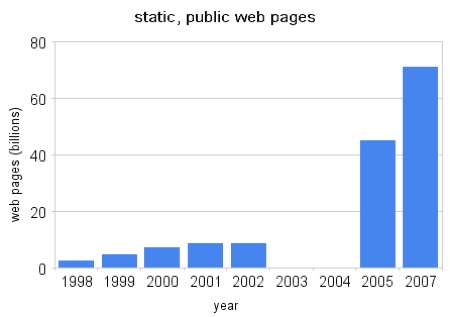
Webpages

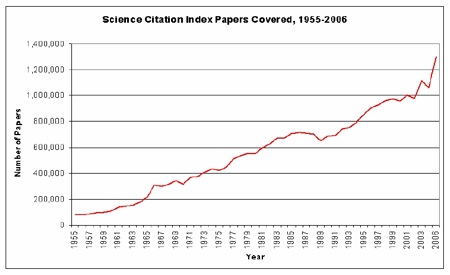
We see the expansion of information everywhere. Less visible, harder to track, but exploding the same is the expanision of knowledge. The number of scientific articles published each year has been increasing in a steady rise for more than 50 years. Over the last 150 years the number of patent applications has increased. By this rough metric, knowledge is growing exponentially.
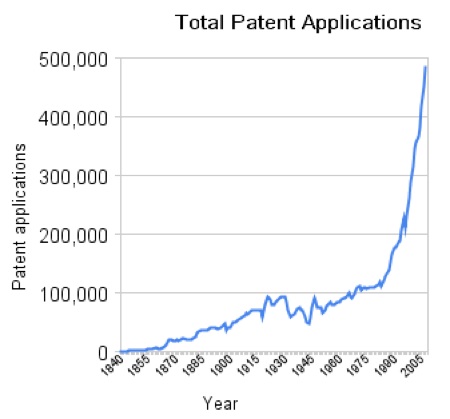
Patents

Science Journals

If knowlegde is growing exponentially we should be quickly running out of puzzles. Because of our accelerating rate of learning, a few writers declared we must be in the age of “the end of science.” This stance is hard to maintain for more than nano-second in view the current state-of-belief in physics: that 96% of all matter and energy in our universe is some unknown variety we call dark. It is clear that “dark” is a euphemism for ignorance.  We really have no idea what the bulk of the universe is made of.  We find a similar state of ignorance if we probe deeply into the cell, the brain, or even the earth.  We don’t know nothin’.

Yet it is also clear that we know vastly more about the universe than we did a century ago. This new knowledge has been put to practical use in such consumer goods as GPS and iPods, and a steady increase in our own lifespans. Our beneficial progress in knowledge comes from tools and technology. Telescopes, microscopes, fluoroscopes, oscilloscopes for instance, allow us to see in new ways, and when we looked with new tools, we suddenly win many new answers.

Yet the paradox of science is that every answer breeds at least two new questions. More answers, more questions. Telescopes and microscopes expanded not only what we knew, but what we didn’t know. They allowed us to spy into our ignorance. New and better tools permit us new and better questions. All our knowledge about subatomic particles derived from the new questions generated after we invented an atom smasher.
Picture 106

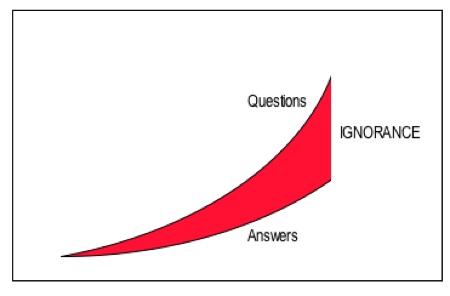
Thus even though our knowledge is expanding exponentially, our questions are expanding exponentially faster. And as mathematicians will tell you, the widening gap between two exponential curves is itself an exponential curve. That gap between questions and answers is our ignorance, and it is growing exponentialy.  In other words, science is a method that chiefly expands our ignorance rather than our knowledge.

We have no reason to expect this to reverse in the future. The more disruptive a technology and tool is, the more disruptive the questions it will breed. We can expect future technologies such as artificial intelligence, controlled fusion, and quantum computing (to name a few on the near horizon) to unleash a barrage of thousands of new huge questions – questions we could have never even thought to ask before. In fact, it’s a safe bet that we have not asked our biggest questions yet.

Or, to put it another way, we have not yet reached our maximum ignorance.

Posted on October 2, 2008 at 5:54 PM

Comments

this is not some external reality coming out of an aggregation, it is a metaphor for our increasing ability to comprehend the nature of our own mind as consciousness .. it is what consciousness is and can already do, already a super-organism .. it seems to becoming externalized, but there turns out to be no difference between inner and outer. it is us as we are, becoming actualized

Posted by gregorylent on October 26, 2008 at 7:47 AM

I like the IGKNOWN — the known unknown.

Posted by Kevin Kelly on October 13, 2008 at 11:47 AM

Further to ‘Barry, no relation’ earlier - I lay claim to neologizing the ‘igknown’, the area of knowledge we know exists but we can’t understand… like how the female mind works 8v)

Posted by nickb on October 10, 2008 at 2:05 AM

Thanks, Enzo. We’ll add.

Posted by Kevin Kelly on October 9, 2008 at 3:23 PM

How much of this expanded “knowledge” is actually important? The number of bytes may be expanding, but I find it hard to believe that all of this is actually new, important knowledge.

We’re actually regressing: Heavy-handed copyright has essentially made all knowledge since the 1930s disappear from bookstores, as Barnes and Noble and others publish public-domain works from the 19th and early 20th century instead of high-priced copyrighted versions from the late 20th and 21st century. We’ll look back at the 20th century as the century of lost scholarship. How much “knowledge” is actually read by anyone? The late 20th century was a renaissance of the 19th century as copyrighted works were thrown off the shelves and out-of-copyright reprints took their place.

Posted by pink panther on October 8, 2008 at 5:33 AM

Great post, Kevin.

I have translated it to Spanish: http://abbagliati.blogspot.com/2008/10/la-expansin-de-la-ignorancia.html

Thanks for sharing your thoughts about our future.

Posted by Enzo Abbagliati on October 7, 2008 at 8:35 PM

Just a quick correction:

Ignorance is not expanding, just our known ignorance.

Posted by Luis Gutierrez on October 6, 2008 at 2:13 AM

Hello Kevin thanks for your great post. I have translated this article into Traditional Chinese, please inform me if there is anything offended by this translation, thanks.

the link is as below:

http://tech-sjh.blogspot.com/2008/10/blog-post_7748.html

Posted by sjh on October 5, 2008 at 10:04 AM

Great post,

Came to this through the Kurzweil post which was talked about on the Guardian today, and I saw this point follows on quite neatly from that one. People used to laugh at the ol’ Rumsfeldian “known/unknown knowns dichotomy”, but of course it was one only things he ever said that made any sense to me.

Posted by Ben on October 5, 2008 at 5:07 AM

I think we constantly traverse the ignorance/knowledge spiral.

These are the stages of knowledge: 1. unaware of our ignorance. (“ignorance is bliss”) 2. aware that we do not know (Questions) 3. Aware of our knowledge (Expertise)

Once we reach stage 3, we unknowingly slip into the next level…and thus we traverse the never-ending knowledge spiral.

-Vasu Srinivasan http://blog.amusecorp.com

Posted by Vasu Srinivasan on October 4, 2008 at 1:24 PM

Kevin, great stuff, as always. thanks.

Brendan @ #1 Sorry, I tried hard and I can’t. Why would you ever not want knowledge? Ignorance is bliss, but only because it doesn’t know any better. Knowledge is often uncomfortable, to be sure, but it is power.

I’ll take as much knowledge as I can get.

“From the discomfort of truth there is only one refuge, and that is ignorance. I do not need to be comfortable, and I will not take refuge. I demand to know.”

Posted by Adam on October 4, 2008 at 8:32 AM

Why do we assume “ignorance” is bad and “knowledge” good? There is an old saw, “Ignorance is Bliss” and I am sure we can all think of situations where ignorance is preferably to knowledge (go on, try!). We need to be careful about framing such binary and academic choices that obscure the real human issue here - the inequality of access to existing knowledge, often with life-threatening consequences.

Posted by Brendan Dunphy on October 4, 2008 at 1:40 AM

@Robert: Curves such as x^2 are polynomial curves. Exponential curves are like e^x. The gap between functions like e^x and 2e^x is rising at a rate of

This post was really neat. Someone put it on StumbleUpon.

Posted by Anon'y on October 3, 2008 at 6:40 PM

I apologize if someone else covered this in an earlier comment, and also for being pedantic.

“And as mathematicians will tell you, the widening gap between two exponential curves is itself an exponential curve.”

It depends on the factors. The difference between y=x^2 and y=(x - 1)^2 is 2x - 1. That’s a widening gap, but it’s widening at a linear rate of 2 dy/dx.

Posted by Robert de Forest on October 3, 2008 at 3:14 PM

@ Simon - I’d say knowledge is a network property or process, and that info is a related system property or process. They work in tandem and as info is input (selectively) into a large complex network (life system, or brain), knowledge results through a combo of hierarchical sorting processes. But learning has to occur gradually as the system intelligence and capacity increases, so more info is good, but too much is indigestible.

Posted by Alvis Brigis on October 3, 2008 at 2:42 PM

How about problem sets vs. solution sets? Or perceived problems, perceived problem sets, collective problem perception, solution demand. Problematics and solvables…

Posted by Alvis Brigis on October 3, 2008 at 2:30 PM

@ Barry Kelly (no relation): Yes, I think I do gloss over this distinction, lumping both types as “ignorance” when I should make a distinction between known unknowns and unknown unkowns. We are moving from less of the latter and more of the former, but we call them the same: ignorance. We need a new better word for “known unknowns.” Any suggestions?

Posted by Kevin Kelly on October 3, 2008 at 2:04 PM

So knowledge is networked? The more pieces of information available, the more nodes and the more possible connectors?

Posted by Simon on October 3, 2008 at 1:15 PM

“…our knowledge is expanding exponentially, our questions are expanding exponentially faster. And as mathematicians will tell you, the widening gap between two exponential curves is itself an exponential curve. That gap between questions and answers is our ignorance, and it is growing exponentialy. In other words, science is a method that chiefly expands our ignorance rather than our knowledge.”

I get what you’re saying but think you’re leaving a few important pieces out of the equation.

First, while I agree that our questions (aka sense that’s there’s infinitely more out there that we don’t know) are expanding, weren’t we more ignorant before even acknowledging these? The term ignorance chasm you refer too is really more a solution chasm, technically. Our maximum ignorance is far behind us. Our maximum question set is far in the future (perhaps it will shrink as we try to “close” off our definition of our system.)

Second, as we co-evolve with information and develop our technology and intelligence we constantly strive to shrink the gap. Yes, there are more questions, but we also mine answers at an increasing rate. There’s probably a fundamental systems power law here for # of questions:solutions.

If you have a moment, take a peek at this crude diagram I pieced together about the relationship between humans tunneling to inner space and expanding outward. Implicit is the idea that as we mine information from our environment and simultaneously develop new capabilities we generate knowledge. It’s rough, but I think it applies here.

http://memebox.com/futureblogger/show/915-nova-spivack-s-web-as-world-observation-leads-us-further-down-the-rabbit-hole

Posted by Alvis Brigis on October 3, 2008 at 1:08 PM

Agreed. The thing that troubles me is the lack of moral humility in the face of one’s own ignorance, no matter how ‘expert’ one is in any particular field.

Posted by Avi Solomon on October 3, 2008 at 11:22 AM

It isn’t the answers. It’s the questions. Are we ignorant about the kinds of questions we are asking rather than the answers we get?

There is also a cult of ignorance that seems to be growing, at least in the USA. Just look at the Republican party which seems to be running on the idea that the mediocre rule and what they call “elites” must always be bad.

Posted by gmoke on October 3, 2008 at 11:08 AM

Questions/Answers are mutually interpendant Arisings that at least are pired. All questions have at least one answer.. some have more. Apparent distance of perception ‘between’ interactional ‘completion’ is illusory unless at least one Answer facilitates Achievement.. After this, the Question/Answer dance is a self-sustainable synergistic medium for Potential permutationals to be correlatively produced and interplayed… furthering Experiencial Extropy of Self.

Posted by OrgoneSight on October 3, 2008 at 10:42 AM

which is why mystics emphasize the importance of “knowing that by which all else is known” and why, as interesting as it is, relative knowledge will always be incomplete.

kevin kelly is a mystic. too. :-)

enjoy, gregory lent

Posted by gregorylent on October 3, 2008 at 4:27 AM

I’d heard the John Wheeler quote slightly differently - “The larger the circle of the known, the greater the circumference of the unkown” - but I think I prefer the geographical metaphor.

Posted by Thomas Winter on October 3, 2008 at 2:13 AM

Perfect point and I like to think about it this way. We seem to growing in ignorance as we learn more because we are growing conscious of our ignorance.

The duality of that situation is very appealing actually! Almost like a Yin & Yang balance of what constitutes knowledge and ignorance.

And of course, agree that we have not asked our biggest questions… :-) We have left those for the poor philosophers and religious folks..who might be the least qualified to handle that topic!

Posted by Mahesh CR on October 3, 2008 at 1:36 AM

That’s not quite right. People who are unaware of their ignorance are no less ignorant, and similarly, progress simply makes us aware of problems we were previously ignorant of.

We’re just discovering more ‘known unknowns’, but since they’re pulled from the pool of ‘unknown unknowns’, I wouldn’t be so sensationalistic as to talk about the “expansion of ignorance”. The ignorance is indeed being reduced, by the movement of ‘known unknowns’ into ‘known knowns’.

Posted by Barry Kelly on October 2, 2008 at 9:05 PM

Excellent analogy. But few things that are running across my mind are:

  1. Aren’t we talking of captive audience within whom KNOWLEDGE is getting dissipated whereas others (majority) are still grappling to acquire that?

  2. The gap between Answers & Questions is Ignorance according to you. But can we really assume that rate of ignorance also increases exponentially?

  3. My point of contention is that more information = more knowledge = few informed people = CHANGE in the world. Isn’t that what are we looking with all these information leading to knowledge?

—Sampad

Posted by Sampad Swain on October 2, 2008 at 8:32 PM

John Wheeler put it nicely: “As our island of knowledge grows, so does the shore of our ignorance.” (Scientific American (1992), Vol. 267)

(I’ve always found this quote combines well with Mandelbrot’s 1967 paper “How Long is the Coast of Britain?”. Answer: depends how you measure, but essentially infinite!)

Posted by Stan James on October 2, 2008 at 7:26 PM


Post a Comment


Type the characters you see in the picture above.