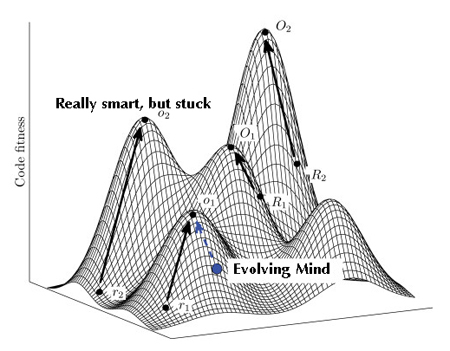
The “no free lunch theorem” in optimization theory states that no method for climbing to the optimum values can be a-priori better than any other, if no a-priori information about the landscape is given.
We also know that in terms of evolutionary fitness, the landscape keep being changed by the actors. This is both good and bad. It’s bad because you won’t get to know the landscape well so you can’t single out a strategy that’s better than blind luck (aka. evolution) but it’s good because what was yesterday a local peak may tomorrow be part of a slope towards a higher peak. You don’t necessarily get stuck in local optima and the “biggest peak” may even grow smaller or larger over time!
But a changing landscape can’t be set up by one species. You’d somehow need an ecosystem of different intelligences, with cooperation, predation and parasitism.
Posted by RobertJ on October 13, 2008 at 7:10 AMWow, that was some good reading. It elaborates more clearly and deeply the thoughts I’ve had about the subject and attempted to put more humorously:
http://mafafu.blogspot.com/2007/11/another-incarnation.html
also @gwern, although it could seem that type 3 and type 4 are identical, there is a subtle distinction. One might suspect that if a lesser mind created a greater mind then that mind would then by default be able to create yet a greater mind, else how could it be considered greater than the lesser that created it. However, there may be some discontinuity on the scale of intelligences where you run into a wall you cannot surpass in your iterations of intelligence generation. For instance, you may be able to create an intelligence linearly greater than yourself, but it cannot reach into an even greater threshold beyond itself, say a geometric or exponential improvement. Although you could might make intelligences linearly better ad infinitum, it would still be the same kind of intelligence. It could not supersede the type by orders of magnitude.
In the world of computers, think, you can add more cores and up the clock speed, but not fundamentally alter the architecture. That’s what I think the answer is anyway.
Posted by matt on September 17, 2008 at 10:53 AM@ steven weinberg: We don’t know what intelligence is. But we can see a distinction between consciousness and intelligence. An animal can have one without the other. Your dog may not be conscious but it is more intelligent than your lizard. I am talking about that latter continuum.
Posted by Kevin Kelly on September 15, 2008 at 9:38 AMNot wanting to sound stupid, I have to say, nevertheless, that it is not at all clear to me what is meant by an “intelligence”, let alone “a variety of intelligences”. In fact, this lack of understanding is severely hampering my ability to enjoy not only what Kevin writes here, but also such other current works as Ray Kurzweil’s “The Singularity is Near”. Is there a common definition of intelligence? I believe Ray K that computers are going to be (by some definition that I don’t yet understand) smarter than people within the next 30 years, or so, and that this fact has unparalleled significance for the character and quality of the lives of my children and grandchildren and beyond. On a gut level I believe it. I just don’t really comprehend it. HELP!
Posted by Steven Weinberg on September 12, 2008 at 9:37 PMThis article, and some of the comments, brush up against my own thoughts on the matter.
For me, the “logic” behind AI speculation never ceases to astound. Why - simply because humans might imagine it or design it or create conditions for its evolution, etc. - is it implied that this greater mind will be something that humans can recognize or identify as related to, or springing from, their own?
The premise is simply not valid; we cannot assume that a truly greater-than-human cognitive being - even one that we ourselves create - will act in any way, shape, or form that we will be able to recognize or understand. If it is greater-than-human… then isn’t it implied that humans - being “less” - might be completely ignorant of even the existence of that greater cognitive being?
If we’re indeed delving into the realm of the Technological Singularity - rather than a synthetic enhancement or genetic augmentation of the biological human brain - then the argument becomes even more absurd. Since machines are not made of human stuff (ie., DNA, living interdependent biological systems, autonomous anatomical function), attempting to define their kind of intelligence (or “thought” or “consciousness”) in the same terms - and assembling a similar list of expectations for it - that we use to define and evaluate our own is simply another insidious form of anthropomorphic prejudice.
In so many ways computers have already exceeded a boatload of different categories of human intelligence (computation, simulation, prediction, memory, procedural accuracy, mechanical control/precision, and so on)… yet here we are still hanging on to the notion that there’s some ultimate holy grail in the field of artificial intelligence, some peak that we’ll be able to recognize once it’s been reached.
Well, I’ve got news for everybody: we won’t be able to recognize it, folks, when it happens; we won’t be the ones up there at the top, and we certainly won’t be able to see the top from our soft little spot at the bottom.
Posted by Paul B Ervine on September 12, 2008 at 8:51 PM@ Jeremy: Yes, I would agree that DNA is a type of “mind” (the lowest possible level) that can allow a mind to emerge.
@Malcom: Indeed, the body or substrate in which a mind operates DOES matter as you say. I don’t think we can have human type intelligence outside human type brain. We can have other types of intelligence in other media.
Posted by Kevin Kelly on September 12, 2008 at 8:58 AMI bet, and I am all in, on #5.
And I base this on something George Dyson once said: http://breadcrumbs4us.wordpress.com/2008/05/26/11/
We can, and one day will, create the Platform. And it will encompass the entire world economy.
Posted by Publius on September 11, 2008 at 7:19 PMThe ant is a good analogy here and I agree with George Dyson on 5:
Simply put - the ant does not understand the ant-hill but requires it. Humans are very similar in nature to ants. We do not understand intelligence, but require it, it is our own ant-hill. We can make it bigger, more complex, but all it becomes ultimately is a bigger ant hill. (bit like your diagram :) )
When you use the term “greater”, I would argue that this adversely affects what you say about development of the mind. Lets separate the ant from the ant-hill a second. In this world, size does not matter, quantum or otherwise. The mind is not a matter of boundaries, it is a matter of effect. Your imagination has no boundaries, other than the effect that imagination has on your surroundings or activities. If you are talking of the ‘greater effect’ of the mind collectively or otherwise, then I agree.
Thought stems from our fundamentals, from our own natural connection that has existed since the big bang, not only via a hybrid ether that we chose to create in the 80’s, this is simply an extension of communication. Even the LHC’s ambitious experiments and ‘Globus’ network are only there to prove what the mind already knows or to facilitate the minds imagination though science.
Google is a mechanical recording and processing device. With human input to tweak its cyclical recording function. Mechanical recording devices as an extension of the biological function do not decree a ‘greater’ mind or even intelligence. I would rather use the concept of infinite mind where there is no scale. If i were to make a graph explaining development of the mind - it would be a mass that had no shape, with no x and y. Pretty useless, but more honest, I feel.
Where you could measure this, is in the effect. I would argue that while individually some of us have more effective minds, we are becoming bigger as a species and collectively less intelligent (e.g. destruction of environment, war etc… our effects, not our books!) which make this greatness of a single mind, collective or otherwise pretty redundant, and because the effects of the mind are not strictly measurable in any other way.
To put this to you, I would personally measure the growth, evolution and the optimal condition of a mind using effect;
1) A mind capable of imagining, or identifying a greater effect. 2) A mind capable of imaging but incapable of designing a greater effect. 3) A mind capable of designing a greater effect. 4) A mind capable of generating a greater effect which in turn itself creates a greater effect, and so on.
and my favourite :)
5) A mind incapable of designing a greater effect, but capable of creating a platform upon which greater effect emerges.
Posted by Paul Harwood on September 11, 2008 at 5:56 PMI’m guessing that you regard Evolution to be a “greater” mind creating “lesser” minds.
Otherwise we could claim that the mind of Australapithecus created the mind of Homo Erectus which created the mind of Homo Sapiens.
I concur with Dyson’s conjecture that a digital mind may yet evolve out of the “primordial soup” we have created with the internet.
I also have a sneaking suspicion that the “arms race” between self-mutating computer viruses and self-adapting antivirus software will play a part in achieving the “critical mass”.
My mind feels like it’s done some evolving today. Thank you!
Posted by John Johnson on September 11, 2008 at 3:30 PMgodel says no
Posted by grantmr on September 11, 2008 at 4:41 AMI’m irresistibly drawn to comment here Kevin. You’re sparking the edges of something I’ve been mulling for quite a while. I’ll try real hard to stay on topic :)
With regard to Google and the Web becoming a springboard to the emergence of artificial minds: At this writing, Google has passed her 10th birthday. From Google Web to Maps to a newly invented browser about to rule the Web, to a Google phone, to a completely new computer operating system. I think the next really big Google sized opportunity will be the shift from organizing the world’s information to organizing the world’s Intelligence.
But on the shape of this emerging Intelligence, it seems to me that Intelligence and communication networks are inseparable in that one can’t exist without the other. And in some cases (as in the Web), they symbiotically reinforce each other in a self accelerating feedback loop.
The network acts as a scaffold for Intelligent systems. Meanwhile, the network compounds the power of the sum Intelligence within the network following Metcalfe’s Law. This combined networked Intelligence repays the favor in further diversifying, increasing the efficiency of, and enhancing the network.
I think that’s why we started calling the Web “Web 2.0”. We recognized it had transitioned into something different. It started behaving meaningfully smarter.
Lastly, as increasingly intelligent singular systems inevitably exchange the sum of their individual Intelligences at near the speed of light, a truly new global Intelligence is bound to emerge with the power to focus on a single global project as one mind and switch to trillions of projects individually. Again in a self reinforcing loop.
Thanks for being such a great source of insight Kevin.
Ted
Posted by Ted Holmes on September 10, 2008 at 8:27 PMMaybe I am missing something, but how is mind-type 3 different from mind-type 4?
A mind-type 3 is designing a mind greater than itself; a mind greater than it logically would have to be able to do everything the original mind could and more, which includes designing a mind-greater-than-the-original-could, which includes… etc.
Type 3 is recursively improvable just like type 4 is.
Posted by gwern on September 10, 2008 at 6:13 PMYour ladder of intelligences reminds me a little of the bootstrapping process in a computer (as you suggest). But all operate on the same hardware, higher levels just use it more effectively.
I would argue that our minds (intelligences) are not as separable from our bodies as we might imagine. That the hardware makes more of a difference that we might easily see now.
It makes interesting science fiction to move our minds into computers and vice-versa, but in practical reality our minds and our brains are highly integrated with our bodies through evolution and years of living together.
We’re just beginning to understand the level of intelligence that cetaceans and octopi have and how it can be very different from ours.
So, the first step in thinking of types of levels of intelligence might be considering how to understand or even classify existing intelligences. And also to understand how they differ from other types. In short, we might not yet know enough about intelligence to intelligently talk about it.
Posted by Malcolm on September 10, 2008 at 5:06 PMKevin (or Mr Kelly I really don’t know which one I should use) you landed a great article and developed it in a magnificent way! Congratulations!
I think we should distinguish mind from thought. A lot of philosophers distinguish the mind from the thought (thought is the words in our heads, the mind is something deeper) and we can take it from there.
There is no doubt that there is “something” with a mind (but no thought, at least none that we are aware of) out there with a high level of intelligence (again, the intelligence is separated from the though).
If we do this we enter a new realm where intelligence can be found everywhere.
I know that we are talking about different things, but before creating a new mind, I think that humans first have to clearly identify “what” is a mind, and then start discovering all the thoughtless minds (but far more intelligent than our minds) and learn from them.
Well, that’s just a personal opinion.
Regards
Posted by Dimitri on September 10, 2008 at 3:21 PMI would argue that DNA is a “mind” of the 5th sort - it is smart of enough to create/be a platform for creating intelligence much more advanced than itself.
Posted by Jeremy on September 10, 2008 at 2:05 PMThe mind able to create platform for greated mind - the ultra-mind, and if that utra-mind is able to create a similar platform of its own - and even greater mind emerges: the mega-mind - there is a chance the first mind would not recognize or sence mega-mind’s presence or existance.
Posted by kanji on September 10, 2008 at 12:05 PMType the characters you see in the picture above.


Considering the evolution of technology based intelligence aside, how would one similarly analyze the state of the possible intelligence of our Planetary Nature? It would, I surmise, satisfy most of the definitions of a superorganism, containing as it does, everything on this planet.
We possibly consider Nature to be non-computational, a force dedicated to ensuring the development of the greatest number of viable living species. Describing the actions, reactions and methodologies used as observed in this evolution could keep many great minds occupied a long time. What tools as employed could be recognized, and possibly developed and refined in such a study.
Stepping away from what we might consider the doings of our Planetary Nature, how does it fit in and work with what we might call Universal Nature?
We could, in viewing these two observable aspects come to greater insights. What is the central motivating drive of our Universe? To simply keep expanding? To help with the life/death cycles of systems all the way from the smallest particle to the largest observable structures?
A rather fractal entity. What role does Intelligence play in all this? Is Intelligence, at the end of the day simply the final and evolving result of the survival imperative?
Posted by stefan on October 26, 2008 at 4:59 PM