
The Technium

13 Generations

A wise society would take the long view. When accessing its environment, for instance, a smart culture might ask itself what consequences would alterations in genetic sequences of wild or domesticated organisms, or introduced species, have in one thousand years? What happens to spent nuclear fuel over 1,000 years?

But 1,000 years is too distant and remote to even contemplate, particularly for busy contemporary folk like us who have trouble making next summer’s vacation plans. Ten centuries so exceeds our own lifetime and the horizon of our imagination that we want to dismiss it as extraneous and unapproachable, and simply not worth thinking about. The Singularity concept is a direct consequence of this difficulty. Believers in the Singularity pronounce, in quasi-scientific terms, that imagining one thousand years from now is literally impossible. But even without the faith in a Singularity, when reckoned in years, a millennial seems forever.

But reckoned in human life times, it is nearer than it first looks.

For most of history a human generation, and not years, was the cultural unit of time. Traits, “blood,” sins, promises, and obligations were passed along in terms of generations. When people looked back (there was no future then) they did so in terms of generations. They could recite the generation jumps by memory. A typical generational roster like the following sequence in the Bible book of 1 Chronicles lists 13 familial generations of father to sons:

Eleazar begat Phinehas, Phinehas begat Abishua,  And Abishua begat Bukki, and Bukki begat Uzzi,  And Uzzi begat Zerahiah, and Zerahiah begat Meraioth,  Meraioth begat Amariah, and Amariah begat Ahitub, And Ahitub begat Zadok, and Zadok begat Ahimaaz,  And Ahimaaz begat Azariah, and Azariah begat Johanan,  And Johanan begat Azariah.

If the average age of fatherhood was 25 years, then this span of 13 generations spans more than 300 years.

But there is another definition of generation besides father/son begatting that might be useful. We might count a full lifespan as a generation. A generation would go from birth to death, birth to death, and so on for 72 years on average. Imagine if we were trying to pass on a treasure and all that was necessary was that one person be alive – if even for a day-- during the life of another to transmit it. That treasure might be an artifact – say a pocket-size library, or some knowledge, or perhaps some wisdom – which can be passed from one holder to the next in a chain. As long as a person is born before the previous holder dies the generation chain remains unbroken.

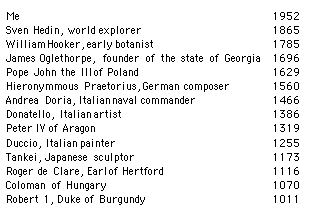
We are evolved to hold generations in our head. How many generations fit in a thousand years? I recently constructed a virtual personal generational chain by searching Wikipedia for a notable person who died shortly after I was born. A few minutes searching turned up the explorer Sven Hedin. I then found a Wikified person who was born shortly before Hedin died. And then someone born before he died, and so on. With little effort I soon arranged a chain of only 13 people that reaches back 1,000 years.
Picture 97

In this virtual chain, the Duke of Burgundy, who was born in 1011, could have personally passed on his formula for success to Coloman of Hungary, who could have passed it on to Roger de Clare, and so on, all the way to Sven Hedin, who could have passed it on to me before he died.

None of the notable luminaries in this chain ever met, so this unbroken circuit is purely conceptual. I was forced to use notable people who were unlikely to cross paths with each other because we have so few historical birth records for ordinary folk. The further back you go, the fewer personal records of any sort, and the more difficult it becomes to make an optimal generation chain. We occasionally find a record of someone’s death; the only people with recorded birth dates are the famous.

However unnamed people in ordinary families could easily form a relational chain with the same span, with a great grandson arriving before the great grandfather dies. We could imagine the grandfather picking up the infant, and perhaps in some indirect way transmitting the wisdom of his grandfather to this next generation.

Generations

We might further imagine a 70-year-old person standing with her arms outstretched in each direction – from the past of her birth to the future of her death – fingertips touching the previous generation and the following generation. With a chain of outstretched hands, each representing 70 years, we need only line up 13 people, fingertip to fingertip, to have them stretch their lives over 1,000 years.

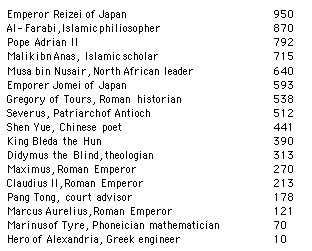
If I hopscotch thirteen generations into the past, I can land in the year 1000 AD. But why stop there? I can continue for another 13 generations of born-before-the-other-is-dead generations and reach the year 10 AD, during the lifetime of Jesus.
Picture 99

This means that there are only 26 human touch-generations between me and Jesus of Nazereth. I could form a human bridge between me and Jesus, or Caesar, or Hero of Alexandria with only 26 people reaching out finger tip to finger tip across time.  Those 26 people could fit into one room.

Calculated this way 1,000, or even 2,000 years doesn’t seem so distant. To span 1,000 years we need only 13 lifespans. We can hold a list of 13 names connecting us to the year 1000 AD in our head, and many people in the past have done so.

Going in the opposite direction we can imagine only 13 lives (and perhaps fewer if longevity increases), linking us and the year 3000 AD. Between you and the year 3000 AD stand only 13 lifetimes. In terms of lifetimes — which are steadily increasing due to medical progress — 10 centuries is just next door.

But in technological change terms, 10 centuries is a distant as another galaxy. Consider all the revolutions that have happened in the last century: automobile, the pill, digital communications, jets. Now times it by 10 or 100 more. Landing in the next millennial will be like landing on an alien planet.

But we can land on this alien plant in less than 13 human lifespans. And that we can imagine.

Posted on September 24, 2008 at 12:16 PM | Comments (13)


Comments

But to pass on information, the receiver needs to be able to accept and understand it. This means an age of 12 (or so) or higher. Similarly, the sender has to be physically and mentally able to transmit the information, which cuts down the upper age somewhat.

Of course, the information could be written down:)

Posted by mjc on September 24, 2008 at 5:25 PM

I have often thought that this why blood feuds can persist long after any of the original actors have died.

I only need to relay a grievance to my grandson, and he to his; and before long hatreds too can be passed on for hundreds of years.

Posted by Gene on September 24, 2008 at 9:11 PM

I have often thought of this concept with regard to religion. Belief in or knowledge of a faith is usually transmitted through a personal contact. (Some people may come to a faith via less personal interaction, like through reading or other media, but I think these cases are the minority.)

It’s interesting to think that a Christian today may have received the knowledge of that religion through a chain of intermediaries stretching back 26 generations to Christ himself. This idea may be applied to any religion you choose, which has an attributable “founder” — Buddhism, Mormonism, etc.

It’s also interesting to wonder how the original tenets of a faith have changed in the transmission and how they will change in the future. It’s a cosmic version of the children’s game “telephone.”

Posted by ml on September 25, 2008 at 8:38 AM

You’ve created an interesting AU here. I wonder, how do these 13 or 26 generations of men reproduce? Since stretching back to the time of Jesus only males - great grandfathers bequeathing the knowledge of centuries to great grandsons - existed, at least according to you. I suppose in your unique universe, males propagate all culture, innovation, wisdom and offspring.

Posted by td on September 25, 2008 at 9:46 PM

The whole Dogon tribe in Mali holds a ‘Sigui’ ceremony every 60 years that reenacts their founding myth, ensuring a living transmision going back into the mists of time. See Jean Rouch on the Dogon Sigui ceremony in his book ‘Cine-Ethnography’

Posted by Avi Solomon on September 26, 2008 at 1:06 PM

This particular train of thought has become more and more important to me as my age approachs the seventy years from finger tip to finger tip. I am now 58, and the U.S. civil war happened about 2.5 of my lifetimes ago. When I was 10, the civil war happened almost 10 of my lifetimes ago.

Posted by Kent Schnake on September 27, 2008 at 8:00 PM

I’ve done something similar — though not so complete — on a personal level. My father, who just turned 90, sang “Dixie” at a Confederate Veterans’ Reunion when he was 6. That is, as a small child, he met people who had fought in the U.S. Civil War. That gives me — and more importantly, my 22-year-old nephew (his grandson) — a connection back to the Civil War. This is a little different from the simple connection from genealogy. While I also have ancestors who fought in the Civil War (and also ones who suffered on the Home Front), there is something compelling about talking to someone who talked to someone who was there. Another example: My grandmother considered herself Irish, though she was born in Texas and never traveled to Ireland. That was due to her grandfather, who immigrated to the U.S. from Ireland in the 1850s. He taught her about Irish history, which she then conveyed to me — not in historical terms, but in tales and images. Yes, my knowledge is spotty, but I feel a connection back to things that happened more than 150 years ago, which gives me a broader perspective on the challenges facing the world — and a real feeling for the amazing amount of change that has happened in the past 150 years. At a time when my father and others of his generation are pointing out the connection between the current economic crash and the Great Depression, a connection through generational understanding could help us make rational decisions.

Posted by Nancy Jane Moore on September 28, 2008 at 6:10 AM

@td rasies a very good point. Why not a single mention of mothers, daughters, or for that matter any females at all? Women (those who don’t die in childbirth, that is) live longer — so maybe your thought experiment could have been accomplished in 12 generations instead of 13.

Historically it would have been hard to make your case with specific famous women, of course, as we have few if any records of any real women’s lives before modernity. But they were clearly there, fully capable of supporting your interesting case.

Posted by Christopher Fahey on September 28, 2008 at 3:22 PM

@td and @Christopher: Of course I would mention women in the generations if there were any historical records to use. But I could not find any with birth and death dates from those centuries, so I used men.

Posted by Kevin Kelly on September 29, 2008 at 11:14 AM

Maybe you can use “72 years on average” for do the same thing with the future, but a man with 72 year living on 1010 doesn’t make sense. Ok, you have used the average… but i don’t see any sense on that number :(

Posted by Dirceu Jr. on October 5, 2008 at 3:27 PM

a lifetime seems so long and short at the same time

Posted by opensourcemd on October 18, 2008 at 12:00 AM

Now, you just need to blog your wisdom, to pass it forward. Chances are your blogs will still exist in 1000 years.

Posted by Bill Burris on October 28, 2008 at 8:22 AM

thank you for this LOVELY piece. A gift back:

“I am the sum total of my ancestors.

I carry their DNA.

We are representatives of a long line of people.

And, we cart them around everywhere.

This long line of people that goes back to the beginning of time.

And when we meet, they meet other lines of people

and we say:

bring together the lines of man”

via “My Culture”, 1 Giant Leap” soundtrack

I think ‘where we come from’ is an important question…and I love the idea of different people’s meeting / connecting / touching and “bringing together the lines of man”

Natalie

PS on the technology front, I can’t help but wonder what technology wants from us, too..

Posted by natalie shell on February 7, 2009 at 6:18 AM


Post a Comment

Your Name:


Thanks for your comment. The words in the CAPTCHA box come from old book texts that are being scanned and stored by the Internet Archive. By entering the words in the box, you prove you are not a bot and also you help proofread the books. If the sample you see is too hard to read, simply click the recycle button to get another two. Don't forget to put a space between the words.