


Literature-Space Vs. Cyberspace


[Translations: Japanese]
This post is yet another response in the debate over reading on the web. In addition to the forum bubbling on the Edge and Encyclopedia Britannica, the New York Times chimed in with a long piece on what it means to read online. I find this question to be a good canary for the many other questions about new technology: is this stuff really new, and if it is, in what way is it different?
In that light the following is my response to Sven Birkerts, who was responding to me responding to him, and so on. This post may not make sense by itself. Following my reply below is a message from a young reader who emailed his response to the discussion. Clearly a chord has been struck.
Sven Birkerts, the critic of web culture, is so eloquent that I want to believe whatever he says simply because I want to be in alignment with such exquisite literary grace. When reading him I crave that sense of wholeness he claims he gets from books. Who would not? But when I examine my own response to reading, I can’t find Sven’s zen.
On my first reading his post, I thought Birkerts was arguing for the exceptionalism of reading, that sacred act wherein all goodness resides, and against the internet. But he then breaks down that distinction by correctly reminding us that we do indeed read on the internet. Well then, maybe greatness lies not in reading per se but in books, Birkerts says. Books as we know them. Here again, the problem is that reading books online is not that uncommon. I read many books in PDF form now. And I read many parts of non-fiction books on my computer without noticing I have gone from a web page to a book page. Books are part of the web.
What about the Kindle, Sven? When you are reading a book on the Kindle, how is that any different than reading it on the web? Or from reading a paperback?
Well, says Sven, than what we are talking about is the web versus novels. Umm, make that good novels. Strong, timeless stories. So in fact the argument of web vs book is really, when all is said, about web vs great story. I think this distinction greatly clarifies the argument.
Do great stories have the ability to transport us to a different place than the web? Maybe. Is this place which Sven incorrectly calls the “reading space” not the same as cyberspace? It may not be. Can you get there if you listen to a great book? I believe so. Do you get there if you watch a great movie? Probably.
I see now that part of the disconnect Birkerts and I have had is that Sven has been talking about books and reading when he was really talking about literature — which is probably not bound to books and reading. Since most of the books and reading I do is not literature, I could not figure out what he was talking about.
Birkerts says: “My core premise is that cyberspace and reading-space are opposed conditions of sentience.” I now understand this statement to be “cyberspace and literature-space are opposed conditions of sentience.” I find this an easier notion to find evidence for (or against).
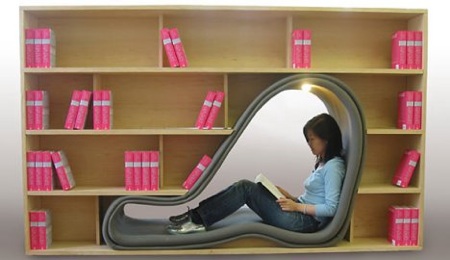
Stories are so hardwired into our subconscious that it would not surprise me if we did indeed inhabit a story-space that is different from our web-based reading-space. This is a testable proposition. Do our brains work differently when we are in the middle of a story versus when we are in the middle of web surfing? I would be astounded if they were the same. But if that was all the happened — different strokes for stories than for links, then the solution to exiting the web and entering stories is easy — just read, listen, or watch more stories.
But to return to Nick Carr’s proposition. His claim — as far as I understand it — is that surfing the web outside of this literature-space not only alters our brain during that time but somehow unwires the hard wiring we have for stories, so that later on we are unable to re-enter that literature-space as easily.
While I understand the worry, and I hear the anecdotes, I believe now is the time to trot out the evidence. So far I have not seen a shred of scientific evidence that such a change has happened. Or even could happen. It may be in science labs; if so pointers please.
My challenge to Carr and Birkerts is to propose a definition of what you are talking about sufficiently precise that it could be falsiably tested.
In the New York Times recent article Online: RU Really Reading? the author serves up a few hints of actual studies, but no actual findings, of how reading may or may not differ on the web and whether it affects the wiring of our brains:
Literacy specialists are just beginning to investigate how reading on the Internet affects reading skills. A recent study of more than 700 low-income, mostly Hispanic and black sixth through 10th graders in Detroit found that those students read more on the Web than in any other medium, though they also read books.
Neurological studies show that learning to read changes the brain’s circuitry. Scientists speculate that reading on the Internet may also affect the brain’s hard wiring in a way that is different from book reading.
Some literacy experts say that reading itself should be redefined. Interpreting videos or pictures, they say, may be as important a skill as analyzing a novel or a poem.
The article makes clear that we need a much better understanding of what reading is.
***
Reader Jeremy Hatch wrote me about his thoughts on reading, and I found his remarks about his own habits illuminated the question of what is reading on the web:
I’m a young guy who grew up in the Silicon Valley itself, I grew up with the web and barely remember a world without it, and I’ve used gadgets and the web my entire life as an integral part of my professional, social, and intellectual development. Needless to say, I think all this has enriched my life immeasurably, and I wouldn’t want to be without it.
One of the things that surprised me most in reading this whole debate is this: nobody has yet acknowledged that it is entirely possible to read, be absorbed in, and thoroughly enjoy a book-length work of literature (or a book-length argument) on a screen. And not just contemporary works, but classics too. Not simply in spite of the availability of the web and recently-developed technologies, but because of it.
Four years ago I bought my second PDA, to replace an old, creaky green-screen model I’d had for years. With this new power, I bought and devoured Haruki Murakami’s masterpiece Kafka on the Shore — not a short book. My list of classics from Project Gutenberg was just as packed. I remember reading Tolstoy’s trilogy of memoirs (the Hogarth translation), DeQuincey’s Confessions, and a great deal of Robert Louis Stevenson’s travel writings. I read some Montaigne, and Seneca.
Your ability to concentrate on a long text is not a function of the medium of delivery, but a function of your personal discipline and your aims in reading. If you sit down to read War and Peace with the aim of enjoying yourself, whether you have paper in your hands or plastic, you expect to be focused on it — joyfully focused, one hopes — for hours on end, perhaps the entire day. Whereas if you sit down to catch up on your RSS feeds — and might I point out how similar that activity is to catching up on your magazine and newspaper reading, in the “paper economy”? — you expect to spend your attention in short bursts, five minutes here, twenty there, perhaps an hour on a long article that especially interests you.
In my experience, the distractions the web offers are entirely ignorable when you want to ignore them, and the web also enables deep research and contemplation to a degree that stretches far beyond the invention of the open-stack public library. There are drawbacks to every age, but I don’t think that the drawbacks of ours will include the total obliteration of prolonged thought and meditation, deep research, and the joy of getting lost in a really good work of literature. People will continue to require all of those things, both for work and for personal development, and they will not go neglected for long.
Jeremy’s experience is much closer to mine. I think literature-space is orthogonal to cyberspace and to reading-space. You can get deep into a book online as well as in paper, and you can skip across ideas on paper as well as online. It is true the medium is a message itself, but what we are now inhabiting is an Intermedia, the media of medias, where one medium flows into another making it hard to define boundaries. The book can be found in cyberspace and in literature space. The book may be bigger than we think. Or smaller than we think. For sure we are in the process of redefining it.
