
The Technium

Simultaneous Invention

In a New Yorker article about Nathan Myhrvold's idea factory, Malcolm Gladwell surfaces the scholarly work of researchers into the history of science who contend that simulatenous discover of inventions is the norm. In any period, ideas are discovered at the same time. Even big ideas. This is true for the past, present, and in different culturess. As Gladwell writes: 

They found a hundred and forty-eight major scientific discoveries that fit the multiple pattern. Newton and Leibniz both discovered calculus. Charles Darwin and Alfred Russel Wallace both discovered evolution. Three mathematicians “invented” decimal fractions. Oxygen was discovered by Joseph Priestley, in Wiltshire, in 1774, and by Carl Wilhelm Scheele, in Uppsala, a year earlier. Color photography was invented at the same time by Charles Cros and by Louis Ducos du Hauron, in France. Logarithms were invented by John Napier and Henry Briggs in Britain, and by Joost Bürgi in Switzerland.  “There were four independent discoveries of sunspots, all in 1611; namely, by Galileo in Italy, Scheiner in Germany, Fabricius in Holland and Harriott in England,” Ogburn and Thomas note, and they continue: 

The law of the conservation of energy, so significant in science and philosophy, was formulated four times independently in 1847, by Joule, Thomson, Colding and Helmholz. They had been anticipated by Robert Mayer in 1842. There seem to have been at least six different inventors of the thermometer and no less than nine claimants of the invention of the telescope. Typewriting machines were invented simultaneously in England and in America by several individuals in these countries. The steamboat is claimed as the “exclusive” discovery of Fulton, Jouffroy, Rumsey, Stevens and Symmington. 
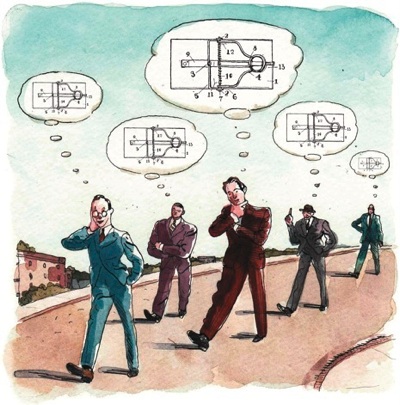

080512 R17386 P465

Nathan Myhrvold runs Intellectual Ventures, which is essentially a patent machine. The chief employees are patent lawyers and clerks who win about 500 patents per year. These patents are generated by a loose group of innovative thinkers whose job it is to sit around and come up with novel ideas. Nathan hires these smart folks to brainstorm with specialty experts. So he may land his group at a small meeting of surgeons, and watch what happens when physicists and doctors blue-sky new medical instruments. They don't do the hard work of trying to make their inventions work; instead they describe them sufficiently to get a patent for them -- if there isn't already one filed.

The point is that there often already is a patent. It's not hard to come up with new big ideas. In fact it is so easy, that most big good ideas come to more than one person at once. That is why we have a patent office -- to assign priority since good ideas are 'in the air."

Gladwell's article is terrific, as usual, but there is a very odd absence. It lacks any reference to others doing exactly the same thing as Myhrvold's Intellectual Ventures. For instance it does not mention Jay Walker, of Priceline fame. Walker runs Walker Digital Labs, which does exactly what IV does. At the labs a bunch of interesting folks sit around with patent lawyers coming up with one idea after the next, which they patent at a furious rate. And then licence to others to develop. Thats' the entire business model of the outfit, just like IV.

But there is not even a hint in the piece that other outfits are mass-producing patented ideas as their chief product.  And the reason this absence is so odd is that if Myhrvold's idea is so great, you would expect, as Gladwell correctly concludes, that other folks would simultaneously have the same great idea. According to the logic of the article there would HAVE to be others. And there are!

Recognition of other people who, like Myhrvold, got the idea to manufacture patents without physical research would have been a great way to conclude this wonderful introduction to simultaneous invention. It's a rare miss for Gladwell.

Posted on May 9, 2008 at 9:38 AM

Comments

@harryh, Yes, the lack of a larger discussion of the value of patents was indeed missing, but I found that more understandable since it is a larger, bigger, longer, more complicated issue in itself — a book really. But a vital and not-yet-exhausted discussion.

Posted by Kevin Kelly on May 13, 2008 at 10:43 AM

Interesting piece on a super interesting human condition. Makes me think about telepathic communication of Mammals. Humans started out with telepathic “muscles” but were not heavily used due to advances in spoken and body languages. This innate ability had become atrophied as a result. Much like how the little toe shrank away with the invention of the shoe. Much like what the modern toilet invented by Crapper is doing to our hamstrings and digestive ability.

We have very little use for telepathy in the immediate sense, still the muscles exist both individually and as a whole, resulting in ideas floating through the air.

An example of this telepathic ability on a mundane level would include the experience of someone saying something you were about to say or visa versa. Or a child speaking in response to its mother’s thoughts. Like I have witnessed twice now with our own daughter.

With that said, I would say that 99.9% of modern day mysticism is not telepathic at all. Just an expert who can get personal info through careful skill, then repackage it as psychic phenomena.

Begs the question, what is intuition? There seems to be a connection somehow.

With respect and kindness, Mike

Posted by Mike on May 13, 2008 at 9:47 AM

I often tell people, “If you have a great idea, act on it right now, because some guy in China thought of it this morning.” I assume the reason is that at any given time, the mass of humans have access to basically the same information and concepts. Much innovation consists of combining these pre-existing concepts, and the cutting edge is that line between “it’s been done” and “what the heck is that?”

Here’s an idea I have, but I don’t know if it’s good or not… some companies are working on compressed-air-powered cars. See for example: http://auto.howstuffworks.com/air-car.htm

I wonder: would it really be that difficult to retrofit existing fossil-fuel cars with compressed-air engines, or to run existing engines by pumping compressed air into the intake manifolds to drive the pistons?

Also, the linked article says electricity is need to compress the air, but I don’t see why. One might have, say, a windmill to run a compressor by direct mechanical linkage, or even to run the car’s motor in reverse to refill the compressed air tank. Seems to me that the running gear could be almost Mennonite in its simplicity.

Posted by Tom Buckner on May 12, 2008 at 3:37 PM

The one of the goals of my company, EasterIsland, is to ultimately make the process and knowledge of manufacturing anything so widely available, that you could subvert patents by simply making it yourself.

Posted by DieLaughing on May 12, 2008 at 1:33 PM

I also though the lack of discussion on the value of patents in general was quite odd. If ideas are so easy to come up with, and if they are just “in the air” and many people are likely to come up with them simultaneously, then why should we allow an idea to be patented (perhaps for significant financial reward)? Just because his got in hours earlier than Grey, Bell should make millions? This question is clearly worth discussion in the context of Gladwell’s essay.

Posted by harryh on May 12, 2008 at 9:20 AM

It’s true: ideas are in the air. But much like the genius behind a successful company is making the right product, the secret sauce behind Myrvold’s endeavor is investing in the right invention. I’d compare it to idea hedging.

Posted by Nicole on May 12, 2008 at 9:01 AM

It seems like these patent factories don’t really license people to develop their ideas. They lie in wait for someone to develop a real product that uses a similar idea they they sue them for a few billion. Recall RIM, the inventors of the Blackberry email device getting sued recently? This isn’t about innovation. It’s about making profit off of other people’s real innovations.

Patent factories like this are one of the many sicknesses that plague the patent system today.

Posted by Ukemike on May 12, 2008 at 6:30 AM

i’ve been saying the same thing for some time now. it’s called “zeitgeist” — spirit of the times…

and companies sitting around thinking up patents? bill g. started doing that at microsoft years ago. why do you think vista can’t fly?

-bowerbird

Posted by bowerbird on May 12, 2008 at 12:15 AM

This could really be seen as an indictment of the concept of patentable ideas. If the idea creation is not as unique as we like to think, then why do we assign exclusive rights to a concept that the arc of science has made almost a foregone conclusion?

Posted by Derek Tumolo on May 9, 2008 at 7:37 PM

U.G. Krishnamurti said: “Thought is not yours or mine; it is our common inheritance. There is no such thing as your mind and my mind. There is only mind - the totality of all that has been known, felt, and experienced by man, handed from generation to generation. We are all thinking and functioning in that “thought sphere”, just as we all share the same atmosphere for breathing. The thoughts are there to function and communicate in this world sanely and intelligently. […] Where are the thoughts located? They are not in the brain. Thoughts are not manufactured by the brain. It is, rather, that the brain is like an antenna, picking up thoughts on a common wavelenght, a common thought-sphere. All your action, whether thinking of God or beating a child, spring from the same source – thinking.

Posted by Ivo Quartiroli on May 9, 2008 at 11:38 AM

It really sounds, despite Gladwell’s adulation, and your effort to be fair, as if these people are just upper-class patent trolls.

Posted by Giles Bowkett on May 9, 2008 at 10:23 AM


Post a Comment


Remember personal info?


Type the characters you see in the picture above.