Kevin, thanks for this post !
It reminded me strongly of the fascinating book by Richard Layard called Happiness - Lessons from a New Science http://www.amazon.co.uk/Happiness-Lessons-Science-Richard-Layard/dp/0141016906
In this book Layard is elaborating on quite a few determinants of happiness around the world using political, financial, social and psychological points of view.
He claims that peer comparison or the relative income level is an important determinant for happiness in a given society.
Hope this book helps your journey ;-)
Posted by Yuri van Geest on May 4, 2008 at 11:57 AMYes, the move from goods to services is part of greater consumptivity.
Posted by Kevin Kelly on April 22, 2008 at 11:08 AMthe dallas fed’s fisher echoed some of your thoughts yday…
“Data from nearly all parts of the world show us that consumers tend to spend relatively less on goods and more on services as their incomes rise… Once people have met their basic needs, they tend to want medical care, transportation and communication, information, recreation, entertainment, financial and legal advice, and the like.” http://www.dallasfed.org/news/speeches/fisher/2008/fs080417.cfm
and here’s what hart had to say re: what money brings…
“The idea of money as a source of social memory was also crucial for John Locke, who figures prominently in our story as the philosopher who inaugurated the modern age of democratic revolutions. Locke was obsessed with money’s role both in establishing a progressive social order and in subverting it as its criminal antithesis. Indeed, he believed that money launched humanity from the state of nature onto the road to civil government. As long as men’s possessions were limited to perishable products, the scope for property was restricted. Money, by offering a durable store of value convertible against all useful things, unleashed the potential for property accumulation and for the intergenerational transmission of inequality. For Locke, then, money was indispensable to that development of cultural memory on which civilization depends.” http://www.thememorybank.co.uk/book/
Posted by glory on April 18, 2008 at 10:58 AMNic says: There is an argument that could be extracted from this data that wealthy society is changing it’s longstanding attitude that money doesn’t bring happiness. I sincerely hope this isn’t so.
That might be true.
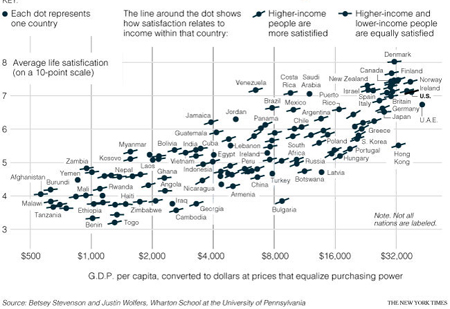
Posted by Kevin Kelly on April 18, 2008 at 8:53 AMInteresting figure. But could it be that it’s the average life satisfaction that leads to higher income, rather than the other way around?
Posted by Tomas Ullberg on April 18, 2008 at 3:18 AMThis is an astounding graph. Thank you for sharing it. I think it was Pearl Bailey who said “I’ve been rich and I’ve been poor and I like rich better”. My oldest daughter grew up in the U.S., went to college in Canada, and married a Norwegian and lived in Norway for several years: average score around 7. She and he now live in Tanzania and probably will live there full time for the next 20 plus years (they are bible translators for Wycliffe). The contrast seems so incredible to me that I can hardly imagine it. And an amazing thing is that it is the U.S. and Norwegian affluence that made the choice to live in Tanzania possible for them.
Posted by kent schnake on April 17, 2008 at 5:33 PMIt seems to show that greater income correlates with greater inequality of satisfaction…
Posted by Kerry on April 17, 2008 at 5:26 PMThe graph raises an interesting question: “why is there so much variation in life satisfaction at any specific level of per capita GDP?” For example, at the $8000 level why is the life satisfaction in Venezuela so much higher than the satisfaction in Bulgaria? Something pretty significant must differ in those two countries related to the fabric of life. Maybe instead of moving up the GDP scale (ie, pursue economic growth), countries might consider instead moving up the satisfaction scale (eg, maybe it’s institutional constraints). Just a thought.
Posted by Gary Lewis on April 17, 2008 at 5:50 AMOliver James’ ‘Affluenza’ is a great book that explores this theory - the reason that Denmark is sio high up on the happiness scale is the choices they make with their money - free education, free helathcare and a focus on improvingsocial services rather than private enterprise.
Thanks for the heads up to the article!
Posted by Ben Matthews on April 17, 2008 at 4:00 AMWe do find happiness in having some control of our time and work, a chance for real leisure, in the escape from the uncertainties of war, poverty, and corruption, and in a chance to pursue individual freedoms — all of which come with increased affluence.
Well put.
Posted by Miguel Marcos on April 16, 2008 at 11:18 PMWhen I first read the article I instinctively believed that there is far more to this data than simply the idea that money breeds happiness, so thank you for bringing it up for discussion.
I agree that satisfaction may well be more about increased choices than ‘happiness’. But I would argue that an even greater influence on people’s satisfaction is how other people view them. In the last decade of economic boom it’s fair to assume that people in affluent countries are satisfied with how their neighbours view them, and as a result they are satisfied with themselves.
But this doesn’t necessarily make people happy.
There is an argument that could be extracted from this data that wealthy society is changing it’s longstanding attitude that money doesn’t bring happiness.
I sincerely hope this isn’t so.
Posted by Nic Hodges on April 16, 2008 at 5:36 PM“…the more affluence for everyone the better.”
Well said and true, as long as the cost appropriate,
Posted by Gary S. Hart on April 16, 2008 at 3:37 PMWould it be too much trouble to post the illustrations as objects that can be expanded to view.
Here, as in the Turninged entry, it is impossible to make the details out.
Thanks
Posted by vanderleun on April 16, 2008 at 2:38 PMI have long thought of possessions mostly in terms of “What does this let me do?” I am most acquisitive in the area of musical instruments; though my collection is a small one compared to many serious musicians, it does include three guitars, a coconut ukulele, guitar synth, amp, and an aging computer rig with Reason and other software. I hope to get a new machine running Logic, perhaps, or maybe Ubuntu Studio. You can do nearly everything on a laptop now that would have required a million dollar studio a generation ago; a roomful of equipment, rendered digital and as portable as a picnic.
Affluence means different things. My grandparents, as I noted somewhere else, did not seem at all wealthy to me. But they had about a hundred acres, with a few cows and pigs and chickens, potatoes and beans, and a very good spring not far from the roof of Appalachia. People unwisely pay a lot of money for bottled water not as good. I could not afford to replicate their little farm!
My point here is that it’s harder to be affluent in a crowded world. Consider the relative affluence of surfers in the 1960’s who had the best beaches almost to themselves, even though they could barely afford to eat. Or consider H.L. Mencken, who, a co-worker tells me, would sneak off to the poor African-American part of town to indulge his yen for oysters. Oysters were considered poor-folks’ food: such was the abundance of Chesapeake seafood, to that smaller population of more than a century ago.
Then there is the matter of equality/inequality: as Mel Brooks said, “It’s good to be the King!” Even in an impoverished society the relatively affluent get the best of whatever is available: the best mates, especially. And we know that unequal societies tend to be more violent. In ancient Rome, I’ve heard, the patriarch was ruler over a household for as long as he lived; even married sons were not masters of their own lives, so that fathers and sons often murdered each other. Living in a more egalitarian society means giving up the opportunity to rise very far above others, in exchange for not having to expend energy competing for position.
Also, there is such a thing as conscious affluence. Think of Steve Jobs living in an almost bare space, in zen ascetic affluence. Compare him to the many poor people who live in trailers crammed with junky, bad-quality crap that they can’t really use because half the time they can’t even find it! (I know some of these people, so this is not some stereotype or prejudice of mine: really nice folks, but they do have an unhealthy relationship to their own chattel, and would probably be happier if they ever tried bulldozing it all and living in a treehouse or a yurt).
Posted by Tom Buckner on April 16, 2008 at 1:54 PMType the characters you see in the picture above.


Yuri, I haven’t seen that book. Will have to check it out. Thanks.
Posted by Kevin Kelly on May 5, 2008 at 5:04 PM