


Why Leapfrogging is Rare


[Translations: Japanese]
Two years ago I posted my skepticism of technological leapfrogging. I really wanted to believe the hope that new lite green digital technology could leap over old dirty technology. But I could find no evidence this was happening. So I wrote up The Myth of Leapfrogging. My main point was that in the case of cell phones — which is the iconic leapfrog example — the evidence shows that while cell phones are increasing faster than land lines, land lines themselves are still increasing. Land lines follow cell phones. Cell phones create traffic that land lines “burn in” to copper. So in the sense that cell phones lead land lines, you can say that cell phones have leaped over land lines. But the ordinary meaning of leapfrogging which most people take to mean “skip over,” as in never do them at all — this has not happened. Land lines are not disappearing.
Despite this lack of evidence for “skipping over” I still wanted to believe in it, so I publicly solicited any evidence of leapfrogging (other the proverbial cell phone) that was taking place at a significant scale. Most examples of solar and internet leapfrogging were small pilot experiments. There were more promise than fact.
I concluded my original essay by stating that “there is no hi-tech without low tech, and no leapfrogging over low tech.” Again to restate: Most high tech requires a matrix of low tech to support it, so it is very difficult to install high-tech without intermediate layers of old tech. The essay got a few nods, a few scowls, but did not change the status of leapfrogging in the public mind, in part because I offered no data for my observations. Last week the Economist reported the results of a World Bank study that suggested similar doubts about technological leapfrogging. In The Limits of Leapfrogging they say:
…It is the presence of a solid foundation of intermediate technology that determines whether the latest technologies become widely diffused. It is all too easy to forget that in the developed world, the 21st century’s gizmos are underpinned by infrastructure that often dates back to the 20th or even the 19th. Computers and broadband links are not much use without a reliable electrical supply, for example, and the latest medical gear is not terribly helpful in a country that lacks basic sanitation and health-care facilities. A project to provide every hospital in Ethiopia with an internet connection was abandoned a couple of years ago when it became apparent that the lack of internet access was the least of the hospitals’ worries.
According to a study by the World Bank cited by the Economist, high technology is often introduced to developing nations where it starts to disseminates but then stalls. A fancy technology may reach 5% penetration, but too often doesn’t succeed beyond that. The Economist states:
In the World Bank’s (admittedly incomplete) database, there are 28 examples of a new technology reaching 5% of the market in a rich country; of those, 23 went on to achieve over 50%. In other words, if something gets a foothold in a rich country, it usually spreads widely.
In emerging markets this is not necessarily so. The bank has 67 examples of a technology reaching 5% of the market in developing countries—but only six went on to capture half the national market. Where it did catch on, it usually spread as quickly as in the West. But the more striking finding is that the spread was so rare. Developing countries have been good at getting access to technology—and much less good at putting it to widespread use.
The evidence from successful emerging markets is that if they absorb a new technology they usually do so fairly quickly. The corollary is that if a technology is not diffused promptly, it may at best be diffused only slowly and incompletely.
I interpret this resistance to mean that there is a development pathway in the technium. Technologies are not only like ecologies in requiring complex guilds of technological species to support each other, they may also be like organisms that require a sequence of developments to reach a particular point. It is hard to imagine why audio mp3 files would need to be preceded by vinyl records or cassettes in a developing country, but easy to see why it would need electricity. Infrastructure may be developmental (requiring a sequence of prior states to support it), while gadgetry may be ecological (not requiring prior states).
The Economist again:
Broadly, two sets of obstacles stand in the way of technological progress in emerging economies. The first is their technological inheritance. Most advances are based on the labours of previous generations: you need electricity to run computers and reliable communications for modern health care, for instance. So countries that failed to adopt old technologies are at a disadvantage when it comes to new ones. Mobile phones, which require no wires, are a prominent exception.
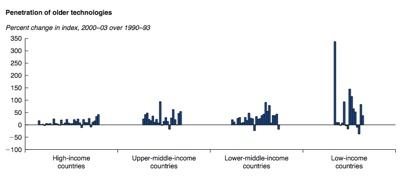
From the World Bank report this graph shows that low income countries are still rapidly inhaling industrial technologies. Big-budget infrastructure –roads, waterworks, airports, machine factories, electrical systems, power plants — are still badly needed and being acquired. The report states:
The diffusion of many of the older technologies depended upon the creation and maintenance of expensive government infrastructure at a time when many governments were grappling with severe budget constraints and weak technical and governance capacity.
How governments deal with the challenge of implementing Technology 1.0 determines how well they can install Technology 2.0. The Economist reports:
This partly explains the patchiness in countries’ technological achievements overall. Call centres in Kenya, for example, pay more than ten times as much per unit of bandwidth as do rivals in India, because India’s fibre-optic cable system is far better and cheaper. So sometimes you cannot leapfrog. As countries get richer, older technology constraints do not always fall away. It depends in part on how governments organise basic infrastructure like transport and communications.
Just because there is not much evidence for successful leapfrogging now does not mean some of the current trials with solar, hydrogen power, and nano-technology won’t leap in the future. It may be there is a minimum set of necessary technologies, and once those are attained leapfrogging is possible. Think of this as a minimum set of literacies that once attained allow you to learn (and leapfrog to) all kinds of state-of-the-art ideas.
