
The Technium

1,000 True Fans

[Translations: French, German, Hebrew, Italian, Japanese, Portuguese, Spanish]

The long tail is famously good news for two classes of people; a few lucky aggregators, such as Amazon and Netflix, and 6 billion consumers. Of those two, I think consumers earn the greater reward from the wealth hidden in infinite niches.

But the long tail is a decidedly mixed blessing for creators. Individual artists, producers, inventors and makers are overlooked in the equation. The long tail does not raise the sales of creators much, but it does add massive competition and endless downward pressure on prices. Unless artists become a large aggregator of other artist's works, the long tail offers no path out of the quiet doldrums of minuscule sales.

Other than aim for a blockbuster hit, what can an artist do to escape the long tail?

One solution is to find 1,000 True Fans. While some artists have discovered this path without calling it that, I think it is worth trying to formalize. The gist of 1,000 True Fans can be stated simply:

A creator, such as an artist, musician, photographer, craftsperson, performer, animator, designer, videomaker, or author - in other words, anyone producing works of art - needs to acquire only 1,000 True Fans to make a living.

A True Fan is defined as someone who will purchase anything and everything you produce. They will drive 200 miles to see you sing. They will buy the super deluxe re-issued hi-res box set of your stuff even though they have the low-res version. They have a Google Alert set for your name. They bookmark the eBay page where your out-of-print editions show up. They come to your openings. They have you sign their copies. They buy the t-shirt, and the mug, and the hat. They can't wait till you issue your next work. They are true fans.
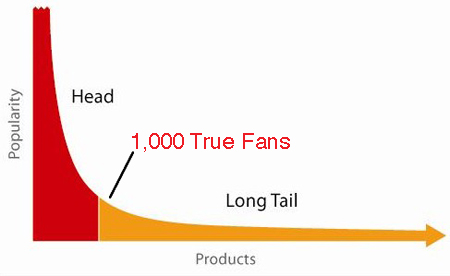
Truefans-1

To raise your sales out of the flatline of the long tail you need to connect with your True Fans directly.  Another way to state this is, you need to convert a thousand Lesser Fans into a thousand True Fans.

Assume conservatively that your True Fans will each spend one day's wages per year in support of what you do. That "one-day-wage" is an average, because of course your truest fans will spend a lot more than that.  Let's peg that per diem each True Fan spends at $100 per year. If you have 1,000 fans that sums up to $100,000 per year, which minus some modest expenses, is a living for most folks.

One thousand is a feasible number. You could count to 1,000. If you added one fan a day, it would take only three years. True Fanship is doable. Pleasing a True Fan is pleasurable, and invigorating. It rewards the artist to remain true, to focus on the unique aspects of their work, the qualities that True Fans appreciate.

The key challenge is that you have to maintain direct contact with your 1,000 True Fans. They are giving you their support directly. Maybe they come to your house concerts, or they are buying your DVDs from your website, or they order your prints from Pictopia. As much as possible you retain the full amount of their support. You also benefit from the direct feedback and love.

The technologies of connection and small-time manufacturing make this circle possible. Blogs and RSS feeds trickle out news, and upcoming appearances or new works. Web sites host galleries of your past work, archives of biographical information, and catalogs of paraphernalia. Diskmakers, Blurb, rapid prototyping shops, Myspace, Facebook, and the entire digital domain all conspire to make duplication and dissemination in small quantities fast, cheap and easy. You don't need a million fans to justify producing something new. A mere one thousand is sufficient.

This small circle of diehard fans, which can provide you with a living, is surrounded by concentric circles of Lesser Fans. These folks will not purchase everything you do, and may not seek out direct contact, but they will buy much of what you produce. The processes you develop to feed your True Fans will also nurture Lesser Fans. As you acquire new True Fans, you can also add many more Lesser Fans. If you keep going, you may indeed end up with millions of fans and reach a hit. I don't know of any creator who is not interested in having a million fans.

But the point of this strategy is to say that you don't need a hit to survive.  You don't need to aim for the short head of best-sellerdom to escape the long tail. There is a place in the middle, that is not very far away from the tail, where you can at least make a living. That mid-way haven is called 1,000 True Fans. It is an alternate destination for an artist to aim for.

Young artists starting out in this digitally mediated world have another path other than stardom, a path made possible by the very technology that creates the long tail. Instead of trying to reach the narrow and unlikely peaks of platinum hits, bestseller blockbusters, and celebrity status, they can aim for direct connection with 1,000 True Fans. It's a much saner destination to hope for. You make a living instead of a fortune. You are surrounded not by fad and fashionable infatuation, but by True Fans. And you are much more likely to actually arrive there.

A few caveats. This formula - one thousand direct True Fans --  is crafted for one person, the solo artist. What happens in a duet, or quartet, or movie crew? Obviously, you'll need more fans. But the additional fans you'll need are in direct geometric proportion to the increase of your creative group. In other words, if you increase your group size by 33%, you need add only 33% more fans. This linear growth is in contrast to the exponential growth by which many things in the digital domain inflate. I would not be surprise to find that the value of your True Fans network follows the standard network effects rule, and increases as the square of the number of Fans. As your True Fans connect with each other, they will more readily increase their average spending on your works. So while increasing the numbers of artists involved in creation increases the number of True Fans needed, the increase does not explode, but rises gently and in proportion.

A more important caution: Not every artist is cut out, or willing, to be a nurturer of fans. Many musicians just want to play music, or photographers just want to shoot, or painters paint, and they temperamentally don't want to deal with fans, especially True Fans. For these creatives, they need a mediator, a manager, a handler, an agent, a galleryist -- someone to manage their fans.  Nonetheless, they can still aim for the same middle destination of 1,000 True Fans. They are just working in a duet.

Third distinction. Direct fans are best. The number of True Fans needed to make a living indirectly inflates fast, but not infinitely. Take blogging as an example. Because fan support for a blogger routes through advertising clicks (except in the occasional tip-jar), more fans are needed for a blogger to make a living. But while this moves the destination towards the left on the long tail curve, it is still far short of blockbuster territory. Same is true in book publishing. When you have corporations involved in taking the majority of the revenue for your work, then it takes many times more True Fans to support you. To the degree an author cultivates direct contact with his/her fans, the smaller the number needed.

Lastly, the actual number may vary depending on the media. Maybe it is 500 True Fans for a painter and 5,000 True Fans for a videomaker. The numbers must surely vary around the world. But in fact the actual number is not critical, because it cannot be determined except by attempting it. Once you are in that mode, the actual number will become evident. That will be the True Fan number that works for you. My formula may be off by an order of magnitude, but even so, its far less than a million.

I've been scouring the literature for any references to the True Fan number. Suck.com co-founder Carl Steadman had theory about microcelebrities. By his count, a microcelebrity was someone famous to 1,500 people. So those fifteen hundred would rave about you. As quoted by Danny O'Brien, "One person in every town in Britain likes your dumb online comic. That's enough to keep you in beers (or T-shirt sales) all year."

Others call this microcelebrity support micro-patronage, or distributed patronage.

In 1999 John Kelsey and Bruce Schneier published a model for this in First Monday, an online journal. They called it the Street Performer Protocol.

Using the logic of a street performer, the author goes directly to the readers before the book is published; perhaps even before the book is written. The author bypasses the publisher and makes a public statement on the order of: "When I get $100,000 in donations, I will release the next novel in this series."

Readers can go to the author's Web site, see how much money has already been donated, and donate money to the cause of getting his novel out. Note that the author doesn't care who pays to get the next chapter out; nor does he care how many people read the book that didn't pay for it. He just cares that his $100,000 pot gets filled. When it does, he publishes the next book. In this case "publish" simply means "make available," not "bind and distribute through bookstores." The book is made available, free of charge, to everyone: those who paid for it and those who did not.

In 2004 author Lawrence Watt-Evans used this model to publish his newest novel. He asked his True Fans to collectively pay $100 per month. When he got $100 he posted the next chapter of the novel. The entire book was published online for his True Fans, and then later in paper for all his fans. He is now writing a second novel this way. He gets by on an estimated 200 True Fans because he also publishes in the traditional manner -- with advances from a publisher supported by thousands of Lesser Fans.  Other authors who use fans to directly support their work are Diane Duane, Sharon Lee and Steve Miller, and Don Sakers. Game designer Greg Stolze employed a similar True Fan model to launch two pre-financed games. Fifty of his True Fans contributed seed money for his development costs.

The genius of the True Fan model is that the fans are able to move an artist away from the edges of the long tail to a degree larger than their numbers indicate. They can do this in three ways: by purchasing more per person, by spending directly so the creator keeps more per sale, and by enabling new models of support.

New models of support include micro-patronage. Another model is pre-financing the startup costs. Digital technology enables this fan support to take many shapes. Fundable is a web-based enterprise which allows anyone to raise a fixed amount of money for a project, while reassuring the backers the project will happen. Fundable withholds the money until the full amount is collected. They return the money if the minimum is not reached.
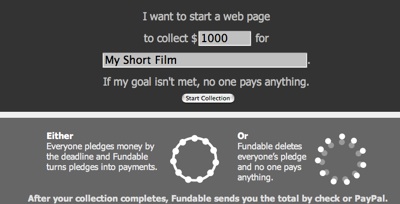
Fundable

Here's an example from Fundable's site;

Amelia, a twenty-year-old classical soprano singer, pre-sold her first CD before entering a recording studio. "If I get $400 in pre-orders, I will be able to afford the rest [of the studio costs]," she told potential contributors. Fundable's all-or-nothing model ensured that none of her customers would lose money if she fell short of her goal. Amelia sold over $940 in albums.

A thousand dollars won't keep even a starving artist alive long, but with serious attention, a dedicated artist can do better with their True Fans. Jill Sobule, a musician who has nurtured a sizable following over many years of touring and recording, is doing well relying on her True Fans. Recently she decided to go to her fans to finance the $75,000 professional recording fees she needed for her next album. She has raised close to $50,000 so far. By directly supporting her via their patronage, the fans gain intimacy with their artist. According to the Associated Press:

Contributors can choose a level of pledges ranging from the $10 "unpolished rock," which earns them a free digital download of her disc when it's made, to the $10,000 "weapons-grade plutonium level," where she promises "you get to come and sing on my CD. Don't worry if you can't sing - we can fix that on our end." For a $5,000 contribution, Sobule said she'll perform a concert in the donor's house. The lower levels are more popular, where donors can earn things like an advanced copy of the CD, a mention in the liner notes and a T-shirt identifying them as a "junior executive producer" of the CD.

The usual alternative to making a living based on True Fans is poverty.  A study as recently as 1995 showed that the accepted price of being an artist was large. Sociologist Ruth Towse surveyed artists in Britian and determined that on average they earned below poverty subsistence levels.

I am suggesting there is a home for creatives in between poverty and stardom. Somewhere lower than stratospheric bestsellerdom, but higher than the obscurity of the long tail. I don't know the actual true number, but I think a dedicated artist could cultivate 1,000 True Fans, and by their direct support using new technology, make an honest living.  I'd love to hear from anyone who might have settled on such a path.

Updates:

One artist who partially relies on True Fans responds with a disclosure of his finances: The Reality of Depending on True Fans

I report the results of my survey of artists supported by True Fans: The Case Against 1000 True Fans

Posted on March 4, 2008 at 1:51 PM | Comments (226)


Comments

Kevin,

I don’t know where to begin. Amazing insight.

As an artist, the dream is to “hit it big” or sell out. As you mentioned, “poverty” is the alternative to creating relationships with 1000 True Fans. Either financial poverty or worse: the poverty of a talent unfulfilled.

It is so clear to me now that “creating” (online or not) should be about relationship generating. I’ve long said that all comedy is niche — it’s all an inside joke. You’re either on the inside (and get it) or are on the outside (are put off, don’t like it, don’t connect, etc.).

Moving towards developing financial relationships with 1000 is certainly not a difficult task, but a observable goal; thanks for the clarity.

I’m looking forward to reading this again, and to sharing it with everyone I know.

apm

Posted by Alec McNayr on March 4, 2008 at 3:22 PM

Kevin- was referred to your post from Seth Godin’s blog. Your observations are insightful and, it seems to me, mostly accurate. I think your comments also tie in nicely with what Seth observes about branding, and also with some behavioral economics as noted in the fascinating new book: “Predictably Irrational” by Daniel Ariely. Ariely might say that “True Fans” derive add’l value from the knowledge that they are unique and “in the know” regarding (insert name of artist here) I am a photographer about 90 miles north of NYC in a lovely area of NY State that receives a fair amount of tourist traffic and I have been able to operate a gallery in the black, including a FT employee, due to: 1) exploiting an unfilled niche 2) providing a quality product at a reasonable price 3) making the gallery presentation museum-quality (see Ariely where he notes that a high priced menu item generates sales for the lower priced offering) 4) branding my name with advertising. Not everyone will be able, or want to do all these things, and the variables, e.g., proximity to a metro area will not always be possible, but the principles are the same and technology, esp the web, is the new railroad — a paradigm-buster. My weak link remains the web but we’re re-designing the site and looking to utilize this venue more efficiently and in keeping with our customer expectations. It’s a wonderful time to be an artist because of this technology! Though I am not a designer, every year I design on my computer and have printed in China (!) 2000 calendars for $2.50@ and sell them here for $14.95 - thank you technology! And every year the True Fans come out of the woodwork to purchase them. At this point, like Jimmy Buffet (perfect example of a True Fan artist) says about his hit song “Margaritaville,” “It’s not really mine anymore - it’s theirs.” Thanks for the insights!

Posted by G. Steve Jordan on March 4, 2008 at 3:42 PM

Kevin, first off I saw this because Seth Godin sent out a tweet, and I believe it’s one of the best articles I’ve read in a long, long time. I am a woodturner. I turn exotic bowls, wine stoppers, and make small items for wedding favors. I think you are right in that 1,000 true fans is something to shoot for and should make an artist sustainable. I also believe that 1,000 true fans will obviously lead to more than 1,000 true fans due to just sheer mass. I would say, online I have between 50 and 100 fans. I am not sure exactly how I would define “true fans” I have not been in it long enough to generate a lot of second and third purchases. However, I did do a social media experiment where as by I needed to make a last ring payment for my girlfriends ring to ask her to Marry me the night before Podcamp Toronto. I sold more than I needed in bowls and it was the busiest 4 days of my life. This being said, I hope to have generated some “True” fans through this method. I also plan to do some partial charity work where inspired pieces will go to “The Frozen Pea Fund” I think following your heart, being upfront and honest, and helping where you can will go a long way to building a very loyal following of “Super Fans”
I am an artist, and I know many artists…I think their one stumbling block is not staying in contact. I went to an art show and wrote my name on every mailing list sheet I could get a hold of. I was never contacted once by any of them. So in my estimation, it will not be hard to stand out, it is not hard to be different, and it is not hard to be “Excellent” as Seth Godin would say. Seth was interviewed by Mitch Joel at Tedd, and I listened to the podcast. One thing he said really resonated with me and please don’t quote me. The gist was that the barrier to entry has been dropped. You could have an obscure craft that was in demand by 5000 people 50 years ago, but these people were located all over the world. That artist would probably have starved. These days with the barriers broken, those 5,000 (Fans) people, purchasers of your product can keep an artist thriving! I guess, I see my self as that obscure artist who does beautiful work, but not always in the mainstream eye. If you ever wanted to work one on one with anyone and test this theory, I would be 1000% game. I am very committed, and I work smart. If nothing else I am a true “Fan” of your blog now. Thank you for the post Keith Burtis

Posted by Keith Burtis on March 4, 2008 at 3:45 PM

Wow…quite thought provoking. Definitely going to be on my mind for a bit while I try to figure out how to work it into my business.

Posted by Mike Piper on March 4, 2008 at 4:53 PM

I think this is te most compelling factor on the long tail… we don;t have to reside in the infinite to benefit. we can simply find a cluster who care. Steve.

Posted by Steve Sammartino on March 4, 2008 at 5:12 PM

This is absolutely brilliant - bang on. As an artist myself, I always wondered exactly how I would fit into the Long Tail. Turns out I’m already on the path to 1000 True Fans (well, just part of the way there), without having defined it that way. Thanks so much for sharing this.

Posted by Marc Johns on March 4, 2008 at 5:45 PM

My goal is to get 1,000 true fans.

My website is about overcoming addiction. I currently have 40 true fans (RSS subscribers….these are the people who have elected to read every thing that I publish on the site).

In some niches, 1,000 RSS subscribers isn’t worth a hoot. In fact, 10,000 isn’t worth all that much in some niches. But because my particular niche is so young in the online world, it is prime real estate.

I don’t think the monetization is so important just yet. Having a 1,000 true fans represents a turning point with a blog such as mine. It starts building on itself, and creates leverage for other projects and monetization options.

I definitely think 1,000 true fans could put me into “make-a-living” territory, if I play my cards right. Awesome ideas here, thanks for the excellent post!

Posted by Patrick on March 4, 2008 at 6:00 PM

Well-developed theory and, as you point out, already in practice by some creative people who don’t have delusions of blockbuster success, yet would prefer not to be completely starving artists. However, I wonder if more thought could be paid to this note of caution:

“Not every artist is cut out, or willing, to be a nurturer of fans. Many musicians just want to play music, or photographers just want to shoot, or painters paint, and they temperamentally don’t want to deal with fans, especially True Fans.”

Even if they have a manager to help be the front person for their fan-cultivation needs, there are still more marketing responsibilities required of artists (even indie ones) than in the past. And this weirds out many introverted, yet ingenious, creators.

Therefore, I wonder, is the popular reclusive artist a notion of the past? Will nearly every artist of the future have to be a little bit more marketing-minded, a little more in touch with their fans? And, if so, what will that do to art? Will the world simply miss out more often on the next Salingers, Jandeks and Pynchons?

Posted by Jeff on March 4, 2008 at 6:15 PM

I think this is just about right on.

I’ve estimated I have about 300 of what Kevin Kelly calls “true fans”, and I am earning about 1/3 of my living with my self-publishing (in print and eBooks). Over the past three years it has been my objective to shift my position left-ward on the “long-tail”, increasing access to my “fans”, and increasing my income, largely using interactive video over the internet to connect more closely with those who can pay me for my helping them care for their historic buildings.

This past year it really seems to be working and Kevin’s essay “1000 True Fans” crystalizes my thinking on this and gives me new criteria for measuring my success, and two new ways to push in that direction.

Kevin, thanks for posting this.

John by hammer and hand great works do stand by pen and thought best words are wrought by cam and light he shoots it right

www.HistoricHomeWorks.com

Posted by John Leeke on March 4, 2008 at 6:36 PM

You mention fundable.org as a good resource… my absolutely favorite site for raising funds and creating useful campaigns is www.thepoint.com. Their site is really well put together, community-driven, and is effortlessly integrated with a lot of social networking stuff to make it easier to spread the word.

Before you ask, no I don’t work for them, but my friend does, and the company really is a super useful tool for artists to raise funds via a tipping-point model.

-Mark

Posted by Mark on March 4, 2008 at 6:44 PM

Great post, Kevin! I totally agree with what you’re saying here, and so does Malcolm Gladwell. He once wrote that becoming the “famous superstar” is like a tournament - many people start, but only one comes out on top. And as you mentioned, too, the chances of getting there are slim to none. Furthermore, according to Duncan Watts (http://www.fastcompany.com/magazine/122/is-the-tipping-point-toast.html) the chance of reaching super-stardom status are quite random!

Posted by Shawn@MoneyBrick on March 4, 2008 at 7:08 PM

Kevin, Thanks for the great post. It gave me a new approach on how I really should be tailoring my marketing campaigns as an independent filmmaker.

Kevin Tostado Director of indie award-winner Yellow Lights DVD Now available at http://www.yellowlightsmovie.com

Posted by Kevin Tostado on March 4, 2008 at 8:40 PM

Selling out at its apex. Needs to be done? yes no… maybe. interesting post to say the least.

Posted by Steven Jacobs on March 4, 2008 at 9:43 PM

Great article. This is an approach that often gets overlooked, but it is probably the most rewarding for creators who value their work and its results over their own personal fame. That being said, 1,000 true fans will last you a lot longer than the standard 15 minutes from 10,000 bandwagon jumpers…

Good writing, good examples, good point. You may have earned yourself a new fan.

Posted by Keeyai on March 4, 2008 at 10:04 PM

This is excellent, thank you. I have been meaning to do some more research on understanding the long tail and this is an informative place to begin.

This clearly makes sense to the creator/artist, but I am more curious how well this parlays into the niche service industry.

Posted by Conor Neu on March 4, 2008 at 11:53 PM

Thank you Kevin for this enlightening write-up - for those who like me and my readers who strive to become independent of the existing work system, your ability to have articulated this out is absolutely fantastic.

Not only.

I believe that the greatest outcome of this may go actually well beyond the economic benefit that such people could gain.

It is in fact in our newly conquered ability to do what we really want and what we are inspired to that in my humble opinion will create the biggest impact and the most positive consequences.

Identifying and articulating so clearly how those who have something to share can indeed not only survive but also create more wealth and opportunity for themselves and for others is certainly the greatest news you could ever bring here for me.

Thanks from the heart.

Posted by Robin Good on March 4, 2008 at 11:55 PM

Excellent article but I think there is another thing worth mentioning. Most creative artists I know would rather create things than market them, but I think this is because of two main reasons. Firstly you need to learn marketing the same as you need to learn to compose music, paint, perform etc. Secondly most creative people cannot distinguish between the mendacious hype of wall to wall, bad advertising and true marketing, i.e. reaching the people who are interested in what you do. I am certain that no matter how shy your are there is a marketing style that will be concomitant with your personality. We all know about the private lives of many singers and seen provocative photographs of them. Yet there are also people like Enya who has kept her private life almost entirely to herself. This shows that many different ways work within the same business.

Posted by Ian Stewart on March 5, 2008 at 12:21 AM

You linked Tipjoy as as tip-jar that is an exception to the most common blogger route to monetization: Ads. Links themselves are a form of currency exchanged in a blogger support network with link, commenters’ URLs, trackbacks, blog-rolls etc.

Links are an interesting micro currency because they are really all about building notoriety to increase the fan base. A good example is Instapundit, a lone power blogger. I’ve seen it countless times where a linked smaller blog posts an addendum saying “Thanks for the link, Instapundit. Readers, check out the rest of the site and stay a while”

To use your parlance, the blogger network is a recommendation system to bring new lesser fans and hopefully True Fans to a blog.

Services that nurture and grow a fan base, connecting fans to content creators in new ways, will grow. MySpace exploded because the connection between musicians and fans scaled perfectly from high school punk bands to major musicians. The former use it as a forum for friends with the latter as a news and information dispersion system.

I’ve seen a number of new startups going after the patronage model. A well designed mechanism to allow connections between creators and patrons online needs to scale well across fans categories. A very small number of True Fans can give significant support, some will use tools like Tipjoy to give micro-support, and a great many will simply discover the artist with their work available, distributed, and promoted through the system.

Posted by Ivan Kirigin on March 5, 2008 at 12:35 AM

Really great post. I doubt that most artists would take the time to gather and manage 1,000 true fans. Most of them do not have time/patience/know-how to do such thing. So there’s a great opportunity for “a mediator, a manager, a handler, an agent, a galleryist” to promote long-tail artists and manage their tribes/fans. But that’s a real full time job, and it also requires the artist and the manager to collaborate well together.

Posted by Gael Ovide-Etienne on March 5, 2008 at 1:21 AM

Hey, just a correction to the info above regarding Jill Sobule. Jill is an American (not Canadian) artist, born in Denver and currently residing in Los Angeles. She was interviewed recently by the Associated Press about her fan-financed CD project (www.jillsnextrecord.com), and the resulting article was picked up by a number of media outlets, including the Canadian Press. Just thought I’d set the record straight on that.

Posted by BoTo on March 5, 2008 at 2:22 AM

That is true. But everybody dreams big. That is why nobody will go for a 1000 true fan policy.

Posted by Niyaz PK on March 5, 2008 at 2:34 AM

Fantastic. I love how it quantifies and places a finite (although slightly arbitary) on the concept. So many times wonderful ideas fall short in their ability to convert to practical application without work by the user. Not saying this should not be done, but it’s refreshing when an “author” takes that further initiative. Will let you know when I have successfully used this model!

Posted by Dini Dangerfield on March 5, 2008 at 2:45 AM

Nice theory, but only really applicable to the ‘performing’ arts or the ‘fine’ arts – in other words, those which are directly purchased by the consumer. ‘Commercial’ art such as photography, feature writing or design is more often based on a model of selling to an outlet - a publication, website, agency, gallery etc - either on a bespoke, commissioned basis or as a one-off sale. In which case, the ‘1,000 true fans’ are more like ‘100 (or 10, or whatever number works) reliable clients’, which has been the ideal for most freelance commercial artists for a long time. A mix of the two is an interesting concept, though.

Posted by bylinegoeshere on March 5, 2008 at 3:34 AM

Simply a great post! Here my post to spread your theory also in Italy:) http://internet.blogosfere.it/2008/03/1000-veri-fan-questa-teoria-e-gia-nella-storia.html

Monty

Posted by Marco Montemagno on March 5, 2008 at 3:39 AM

Wonderful post, I don’t have 1,000 True Fans yet, but now that I have read this, I want 1,000 True Fans. I have never been shooting for stardom, but living above the poverty level is my main goal. I have accomplished this [living above the poverty line from my work] but it has taken 10 years to get there. With this model, I know it could work a lot faster. Lots to think about, thanks for that. :)

Posted by Heather on March 5, 2008 at 3:51 AM

That’s a very insightful post.

I fall in the category of someone making a comfortable living through my blogs - do you have any suggestions to make to people like me about how to gain “true fans”?

At the moment bloggers tend to use the number of RSS readers as a measuring stick of “fans” they have but I’m not sure if it’s an appropriate measure

FYI I found this article via http://www.seobook.com/can-you-build-1-000-true-fans

Posted by Neerav Bhatt on March 5, 2008 at 4:26 AM

Getting fans to fund artists has been something I’ve been thinking about for a long time, and after a couple years of talking about it, my friends and I are working on the idea at paycreate.com.

Drop me an email, let me know what you think.

Posted by Jesse Arost on March 5, 2008 at 5:05 AM

Kevin- Great post! I’m a longtime marketing guy who has been teaching young musicians a CRM approach to building their fan base. We usually divide fans into three or four levels…at one end are the “super fans” who will book a berth on your music cruise…at the other are “casual fans” who get dragged by friends to your show and buy a CD. Setting goals for numbers of fans at each level and then customizing a set of money-making offerings for each level can help the artists build a sustainable following without selling their souls to the record companies. The direct connection tools of the Web 2.0 world help facilitate this approach as they make the traditional record-company model obsolete.

Posted by Fred Hundt on March 5, 2008 at 5:13 AM

VERY interesting thought. My wife and I are looking at starting a landscape photography business and I see a lot of wisdom in the 1000 True Fans. Used to work near a Thomas Kincaid gallery and you are most right about how much True Fans are willing to spend. Their devotion is aweinspiring.

Posted by Erebus on March 5, 2008 at 5:29 AM

Brilliance! Seth pointed me in your direction. I’m a budding author (first book to be published spring 2009)generating a growing base of “true” fans. I love the idea that 1000 seems like a doable number. The obscurity associated with the publishing industry coupled with my recent arrival in my fan niche left me feeling doubtful about potential success. Thanks for moving me forward. Regards, Joe

Posted by joe bruzzese on March 5, 2008 at 5:34 AM

I love this idea.

I help out a nonprofit that doesn’t have a marketing department and I run fund raising events for them. The 1000 fans idea would be a great model for us to get money from donations.

Posted by Brett Evans on March 5, 2008 at 5:44 AM

I think you have hit the nail on the head here. This is a really fascinating report. I am an artist and journalist and have for three years been out on my own as a sole proprietor running an indie music label company, a consultancy that takes me around the world and the founder of a non-profit charity. Maybe I have 1,000 true fans but not in any single one of these jobs I perform.

So it is interesting to also consider running multiple solo ventures as a business model. That’s what has worked for me. I started the non-profit to give back to students and pays me nothing.

Yet, through it - I have become networked to many hundreds of others “True fans.” People who support me indirectly through my other businesses. That wasn’t the original plan but it has worked out that way and benefits everyone in a really nice way.

The one thing you need to have is a lot of patience and remain nimble if this is your calling. Things change fast.

Posted by Robb Montgomery on March 5, 2008 at 5:51 AM

The proverbial nail has been hit on the head. A small group of artists here in Chicago have been talking around this belief for some time.

The trick is: how can part-time artists find enough avenues to reach the 1000 true fans. If you consider standard “conversion rates”, somewhere between 1000-10,000 people need to be exposed to your recorded works to capture that one true fan. Maybe it’s less, but that’s a popular ratio.

For a songwriter, live shows provides the greatest potential to capture true fans. In my experience, live shows yield about a 200:1 ratio. So, if you believe this formula, after playing to about 200k people will you find 1000 true fans.

Posted by Mike on March 5, 2008 at 5:57 AM

Great post again Kevin. I’ve tried to elaborate on your thoughts and give some tips on how to actually go about doing this on my own blog.

Fundable is a good tip. One of the problems I see people having is that they have mailing lists but still aren’t engaging properly with their fans. Fundable is still ‘asking for the sale’ and artists are still scared of doing that.

Posted by Julian Moore on March 5, 2008 at 6:03 AM

Great article.

I’m so glad that you explained the concept so clearly.

I’ve had a similar model in my head as I started my own business, publishing illustrated books/products about friendly monsters.

It wasn’t named “1000 true fans” or anything like that, but it just seemed like creating and selling directly to the fan-group is the way to go for people like me.

I hadn’t really equated it to how many fans it might take; I just know I need to bless as many as possible.

Here were my thoughts: (echoing yours)

  1. Don’t rely on a big break; I don’t want my chances of success to ride on the back of an endorsement by Oprah.

I’d rather build my base myself, by hand, because this doesn’t require a rare, crazy-lucky break. I also don’t buy lottery tickets for the only chance to live my dream.

  1. Create relationships directly with the fans. Talk to them, listen to them, and offer them products, directly.

  2. Produce quality stuff that I can be proud of. I’m tired of seeing great ideas watered-down by committees.

  3. Think long term. I try to make things that I can hopefully be proud of 10-15-20 years from now. If I can still be selling my first book when I’m 77, then I’m probably doing something right. (And have probably made a good return on that effort)

The Big Challenge for someone like me is creating enough products that can engage the super-fans for your $100 per fan example.

$100 per person a lot of product, since I can only afford to produce one book per year.

However, you’ve spelled out some other ideas (virtual product, print on demand, donations) that might fill that void.

Okay, back to building.

Thanks again.

Posted by Daniel on March 5, 2008 at 6:12 AM

Thanks for this. It supports my notion that what former CEO of Technorati, David Sifry, called the “magic middle,” is the place to strive to be. While having a hit would be great or being an A-lister something to envy, I think reaching the plateau you’ve described is very realistic. The other is not. And, as your argument so expertly outlines, is unnecessary as well.

Posted by Paul Chaney on March 5, 2008 at 6:14 AM

This is EXACTLY what pharmaceutical marketers do when we work to connect with patients who will tell other patients about our products. We call them Advocates, and they’re people with long-term conditions such as lupus or diabetes who have successfully managed them using pharmaceuticals, lifestyle changes and education. I wrote a lengthy post about Advocates on my blog.

Posted by Alfred O'Neill on March 5, 2008 at 6:33 AM

On this one, I seem to agree with you. I have my own thoughts on this, which I am writing online. See http://paragraphr.com/pages/show/11. What you described as 1000 true fans seems related to what I call success 2.0. We are entering the longtail world, where we will have so much variety in everything. But we still want the fame and fortune of mass production age - the billionaire, the world star. In the world of longtail, especially in the mass niche kind of longtail, we will have more of smaller successes. Rather than a company of 10,000 generating 100M dollars of profits, we will have a one-person business earning 100K a year.

Posted by hyokon on March 5, 2008 at 6:36 AM

This is a brilliant piece of work. I just printed it out for my teenage daughter who wants to be an artist.

BTW, your post made Boing Boing. You should increase your own number of “true fans” today.

Alex

Posted by Alex on March 5, 2008 at 6:37 AM

I am a True Fan of at least two people who seem to recognize the phenomenon, musician Robert Pollard late of Guided By Voices, and presidential candidate Ron Paul. Both of them seem to be following, among other strategies exactly what you have laid out here, the beauty of the approach is that dead-weight overhead is minimized, and the ability to diffuse the message by multiple paths is unhindered by the lack of conventional “blockbuster” success. Superb article.

Posted by Vince Daliessio on March 5, 2008 at 6:38 AM

Personal coaches, who are creative entrepreneurs, use this approach. Actually the number of True Fans needed for a coach to prosper is probably much less than 1000, because coaching clients pay a pretty high fee to work one-on-one with their coach. Perhaps we could call these Ultra True Fans.

Fortunately for coaches, most of us love nurturing our fans. As a former choreographer, I must say that for me, co-creating with my clients is much more fun than being an artist!

Posted by Julia Stewart on March 5, 2008 at 6:41 AM

This is so great - thanks very much.

I’ll add another strategy based on the same idea - maybe you need 10 Superfriends.

These Superfriends are probably companies. If you’re a musician, maybe in addition to your 1000 True Fans you need 10 contacts who place music in TV shows and films. Any one of these superfriends could be worth $10,000 or $50,000, all at once and all of a sudden. They buy a song, they hire you to score something…you get the idea.

Posted by Lee Stranahan on March 5, 2008 at 7:08 AM

great essay…it’s the way I’ve built my magazine…

1 rider at a time 1 reader at a time 1 subscriber at a time

I boil this philosophy down to one basic idea:

either you are a beach ball or a ball bearing.

Beach balls are bright, seen everywhere and require a tremendous amount of air to keep them afloat. One major prick, and they run into trouble…

Ball bearings are small, continually polished and while they are hard to find but leave a huge impression.

Posted by michael on March 5, 2008 at 7:09 AM

IMO the film “Be Kind Rewind” illustrates the points laid out in this blog perfectly.

Posted by Geoffrey Longman on March 5, 2008 at 7:09 AM

Trent Reznor (Nine Inch Nails) gets it:

http://www.psfk.com/2008/03/nin-markets-new-album-from-free-to-300.html

Posted by Rick Liebling on March 5, 2008 at 7:12 AM

I should think that a company would do best by trying to convert their customers into “True Fans” as well. The catch, though, is to have a remarkable product that people will get excited about.

Or make your existing, boring product the best it can be.

Posted by Xander Becket on March 5, 2008 at 7:29 AM

I really really enjoyed this. As someone who is trying to think outside of the box when it comes to making my creative mark in my world it was insightful and fresh.

Posted by J Johnston on March 5, 2008 at 7:54 AM

If nothing else, having a goal of 1,000 true fans gives a person a realistic, attainable goal. Even if an individual doesn’t get there in the first months or the first year, you have a number to tell you that you’re on your way.

Thank you for such an insightful and logical post, it is truly appreciated. Plus, I’ve seen it on at least four different Twitter streams.

Posted by jennydecki on March 5, 2008 at 8:08 AM

I like the way you’ve quantified this. It nicely describes how I’ve been making a living for the last four years. I sell an average of 4,000 books (collections of my online comic, Schlock Mercenary) per year to pretty much the same two- to three-thousand people. I pre-sell the book, and with each release I pay the bills for about six months at a go.

So… from where I’m sitting, you’ve nailed it. You’ve described what I do, and more importantly (for me, anyway) you’ve described why it works, and what I need to do to keep it working.

Thanks!

—Howard Tayler

Posted by Howard Tayler on March 5, 2008 at 9:00 AM

Great post! I’ve heard reference to this from a music perspective but you really captured how this thinking can work in other arenas too.

I’m a baker and am working on building my “true fan” base, contacting them directly (with permission of course) and baking based on their wants and needs. In a few short months I can already see the concentric circles forming. Until now I hadn’t really thought about what my magic number is, but I suspect it’s less than 1000.

Wow, you know, I’ve been struggling with how to expand my operations to bake more and get more customers. This might be the secret to knowing how small I can stay and still make a living. Thanks!

Posted by Mark on March 5, 2008 at 9:21 AM

Hi Kevin - You might check out Jane Siberry (now Issa) who has been operating under many of the 1KTF model for quite awhile:

http://www.issalight.com/

Also, Robert Fripp runs his label/online distribution site Discipline Globabl Mobile Live much like a 1KTF business:

http://www.dgmlive.com/index.php

Of course, there are many others.

One idea: it may be that there are more ‘formerly successful’ artists moving away from the head toward the long tail who could benefit from a 1KTF model. These artists have already proven they have ‘something to offer’ for True Fans, and converting a subset of 100K passive fans to True Fans may be easier than developing 1K True Fans from scratch?

Keep up the great work and best wishes, -Steve

Posted by Steve Ball on March 5, 2008 at 9:34 AM

This makes really good sense to me as it gives artists a tangible goal to work towards and lessens the fear of the unknown.

For musicians, what do you think of applying the model of “100 True Fans” in major cities, for ticket/touring purposes?

Thanks for this, the wheels are spinning…

Posted by dot on March 5, 2008 at 9:38 AM

More artists artits making a living from the 1000 True Fans model:

Like Jonathan Coulton “More than 3,000 people, on average, were visiting his site every day, and his most popular songs were being downloaded as many as 500,000 times; he was making what he described as “a reasonable middle-class living” — between $3,000 and $5,000 a month — by selling CDs and digital downloads of his work on iTunes and on his own site.” http://tinyurl.com/yrwsdw

Or the “Einstürzende Neubauten” In brief, for a financial contribution of 35 € (CD only) or 65 € (CD+DVD), the supporters will receive: - an exclusive CD (and DVD, for the CD+DVD option) in deluxe packaging - regular live webcasts and chat for watching the working process of the band at rehearsals and recording; - at least one exclusive live concert (via webcast) from the band, band member(s), or related parties; - etc. http://supporter.neubauten.org/

And of course, Nine Inch Nails Label official: “Ah, well, you’re right, it doesn’t. Basically it’s because we know you’ve got a core audience that’s gonna buy whatever we put out, so we can charge more for that […] True fans will pay whatever”.

His 300$ special edition (limited to 2500) of the latest CD was sold during only a few days! http://swen.antville.org/stories/1637132/

But not everybody has luck with the Street Performer Protocol

In 2000, King published a serialised novel “The Plant” over the internet, bypassing print publication. Sales were unsuccessful, and he abandoned the project

http://en.wikipedia.org/wiki/The_Plant

Posted by Swen on March 5, 2008 at 10:05 AM

Congratulations and THANK YOU for an amazing post. I’m sending it around the world.

Ryan Michael Galloway

Posted by Ryan Michael Galloway on March 5, 2008 at 10:29 AM

Independently of the SPP, I came up with the Digital Art Auction (http://www.digitalartauction.com). This let’s all fans keen enough to overcome the decision cost of pledging anything for their favourite artist’s next work, express the maximum price they’d be willing to pay for a copy. Bearing in mind the shape of the long tail, the Digital Art Auction reveals the revenue available at all price points and the artist can pick the price they want, e.g. that maximises revenue. Each fan whose max price covers this, pays just the artist’s chosen price. and gets a copy of the work. Everyone else pays nothing, gets nothing - but this doesn’t stop them buying a copy from anyone else (or getting one from a file sharing network).

QuidMusic is a simpler variation, e.g. the ‘True Fans’ pledge a quid for the musician’s next single - no matter its quality.

I’m now working on 1p2U.com - A blogger’s ‘True Fans’ pledge a penny for their next article.

You can tell I’m continually lowering my sights can’t you? ;-)

Posted by Crosbie Fitch on March 5, 2008 at 10:51 AM

I’m a painter who’s made a living selling my own work for 7 years. I’ve never thought of it in these terms, but this is essnetially the idea that has allowed that to happen. I may only have 200 true fans. But I would guess I have several hundred average fans. With the prices of original art this has allowed me to do quite well the last few years. Ever year I gain some new fans, and every year I can expect certain customers to want to buy a painting again. Alot of my sales are to repeat customers (who I would consider True Fans.) My goal is always winning over peole who are just learning about me. Once they’ve bought one painting, I feel like I’m halfway to a second sale. And the best part is that I am able to continue painting the pictures I want to.

Great Article. Thanks. And by the way I found it through a link from www.linesandcolors.com, which wrote a review.

Posted by Colin Page on March 5, 2008 at 11:12 AM

This is very interesting.

What’s been keeping me a going as a recording artist for the last several years has been the “commission-only” music that I make available. For a fee, I will create an album (more like an EP, actually) of music for someone, and then transfer all of the rights to the composition and recording to them. They can do whatever they want with it, including put their own name on it and sell it (although I warn that doing so will lower the value). I charge on a sliding scale based upon income (and yes, I request proof of income) and political orientation. I started this experiment in 2002 and in that period, these commissions have been my best source of income as an artist.

It’s allowed me to connect with a small group of people who have an interest in my music (I’m not comfortable calling them “fans”) and then to create a relationship with them that spills over to the people in their lives, with whom they share the unique work that I made for them.

Posted by Waxwing Slain on March 5, 2008 at 11:34 AM

Kevin, thanks for putting your concept into words, and doing it brilliantly. Your 1000 True Fans idea is sort of what I’ve been trying to do on my site. It’s nice to know I’m not the only one thinking this way. Looks like I’m not crazy after all. (Oh, wait—-this might not actually prove that.)

Two years ago I decided to go directly to readers online, figuring that if enough people enjoyed my writing I would eventually earn a living from it—-and probably make more money than I would have through the traditional publishing route.

I write and post mystery novels on my website at a rate of two to three chapters per week. I’m now on my fourth book. It’s taking a while to earn enough True Fans, but it’s happening for me.

Thanks again. This is encouraging.

Robert Burton Robinson

Posted by Robert Burton Robinson on March 5, 2008 at 11:38 AM

amazing post - thank you. this is one more piece of the puzzle in figuring out how to be a profitable ‘content creator’ in this economy. I’m a professional photographer, and am curious about your thoughts on adapting this model to B2B. I can see how fine art print sales dovetails nicely with the True Fan model, but I’m looking for a new model for selling commercial illustration. The most successful (currently) model for commercial photography appears to be microstock sales. Under scrutiny, however, it’s a great model for the companies that sell/license/own the images and a terrible model for photographers (minus the few rock starts making a pile of money - but that’s true in any business model) -

thanks

andy

Posted by andy batt on March 5, 2008 at 12:01 PM

Coincidently the Center for an Urban Future held an event yesterday on Brooklyn’s creative freelance economy. According to the Center Brooklyn has 22,000 creative self-employed workers -independent artists, writers, photogrpahers, jewewly makers, designers etc.

I also think your point is broader than artists. There are roughly 21 million personal businesses (self-employed and/or solo practioners) in the US and their numbers have been growing much faster than the overall economy. The majority of these folks are not artists, but they all need “true fans” to survive and thrive.

The center is at www.nycfuture.org and a post on the event is at www.smallbizlabs.com.

Posted by steve on March 5, 2008 at 12:04 PM

Nancy Baym has an entry in her Online Fandom blog about musician Jill Sobule raising almost $74,000 from fans to record a new album.

Posted by MattFriedrichs on March 5, 2008 at 12:08 PM

I’ve been doing a lot of thinking, lately, about how I might move from the world of “corporate jester” to providing something creative that a smaller audience might find more useful. Right now I engage with a very few corporate types (about four) who value me very highly to get to that 100K — actually more than that, as expenses to find and satisfy them are pretty high.

I’m going to do some thinking about what it would look like to make 1000 people a little bit happy instead — would it be writing, or helping them improve their skills, or offer them a way to lessen their pain? I could do all or some of those, I’m sure.

Nice post.

Posted by Dick Carlson on March 5, 2008 at 12:19 PM

“Not every artist is cut out, or willing, to be a nurturer of fans.”

That is true, but that doesn’t mean that a major record label is required. If a solo artist can nurture enough fans all by themselves to make a living, then can’t the artist who isn’t interested in doing it themselves hire one person to do it for them? Perhaps someone who does it for several artists.

Posted by Winston on March 5, 2008 at 12:26 PM

Good old boingboing, they’ve just turned me on to this site, and I’m soaking this up like a sponge.

I’m a digital artist, and over the last 3 years, am pushing to make a go of my artwork. I’ve been getting fine art prints into local gift shops and stores, and have my first real gallery opening coming up in May.

This article is just perfect, it adds a piece to the puzzle on how to get things rolling. But I’m still struggling to find an avenue for my work, to find my audience. Once people go through my online galleries and see my artwork, I receive quite a few emails from visitors, saying they’ve never seen anything like the work I create, and they love it.

So my biggest obstacle right now is a very fundamental, basic problem- exposure. I have set up online galleries at the usual artist promoting websites, but my work is lost amongst thousands of other artists. I’m residing near Knoxville, Tennessee, which isn’t a hotbed of artistic growth, although things have been improving the last few years. I don’t know if my work is too modern or cutting edge or what, but I can’t get things rolling.

My work is pretty unique, so I’m either doing something really cool that people just haven’t seen before, or I’m so far off into the weeds I’ll never be discovered.

I’ve about run out of options on what to try next. I’ve emailed the link to this article to numerous struggling artists I know, and I know that help in trying to figure out how to find your audience would be most welcome by a lot of people.

Thanks for this article, it gives me hope that I might actually make this art thing work.

Steve

Posted by Steven Lareau on March 5, 2008 at 12:31 PM

An interesting article but I think unrealistic for most starting and even established solo artists.

I’m a freelance artist and have been trying to make a living selling my personal art since around 2005. Even though I have had a website since mid 90s and know the web tech well (I enjoy programming almost as much as art making) the process of promoting my work has been enormously difficult for me.

I find the recommended no/low cost methods of online promotion mentally exhausting to the extreme. Networking on social networks, social bookmarking, participating in blogs, forums, link building, SEO, adwords, etc.

If it wasn’t for my persistence and good knowledge of the web technologies I would have given up the whole idea of making a living online doing what I love long time ago.

You wrote that “Not every artist is cut out, or willing, to be a nurturer of fans.”, I think this is generally true for most artists. Artists, the majority of them, are introverts. They thrive living in their worlds (writing, painting, composing, etc) and get quickly overwhelmed by too much external input. And hiring a manger is not an option for most artists either. Yet, promotion through social interaction is essential for success.

You end by writing about the study in which “Sociologist Ruth Towse surveyed artists in Britian and determined that on average they earned below poverty subsistence levels.”

My guess is that the primary reason for that is the nature of most artists. They are not made for things like promoting their work, selling it, or maintaining and increasing their fan base through constant social interaction. Artists are made to create art - first and foremost.

Posted by Dawid Michalczyk on March 5, 2008 at 12:59 PM

The awesome animator Nina Paley of

http://www.ninapaley.com

used her true fans to get a 35mm print of her cool animation feature Sita Sings The blues out in time for a showing in Europe. Each person who contributed gets a credit at the end of the film, which is funny as it’s a whole on-woman film show.

But she got what she needed in time from her true fans donations.

Posted by cainmark on March 5, 2008 at 1:23 PM

Feh, superstardom has never been for me. My goal as an artist has always been simple: make a living from my creativity. The 1KTF method makes sense, and puts in words some of the ideas I’ve been batting around.

My challenge is that my current True Fans by one of my products for one event - their wedding. My job has been trying to figure out how to convert these specialized Fans, into fans for all of my work.

Posted by Daniel Sroka on March 5, 2008 at 1:33 PM

The value of a network is not n^2 where n is the number of nodes. It is n*log(n).

Posted by Matthew Stoltenberg on March 5, 2008 at 1:57 PM

It all sounds so easy. Until it meets real life.

When One Thousand Means Over Fifty Thousand

Posted by Mike Cane on March 5, 2008 at 2:30 PM

I’ve written a book for a very niche target audience (classic longtail stuff), and while Oprah still hasn’t returned my calls, the ride on the longtail has been a rush. Many of my readers who have written me have become friends (what the “F” could stand for in 1KTF), and I’ve paid a few bills with my book sales. It’s been hard work, but that’s the new barrier of entry into the longtail market, isn’t it?

Posted by Jason Comely on March 5, 2008 at 2:47 PM

Hey Kevin,

Really enjoyed this article. I play in a Canadian based band just starting our career in music and the article has given me lots of new ideas about ways we could potentially generate income to keep our creative dreams alive.

On a similar note: I’m sure you must have seen how Nine Inch Nails recently used their “true fans” to almost instantly sell out 2500 copies of their Ultra Deluxe Limited Edition packages of their new record for $300 a piece. Obviously they are an established act who sit a lot higher up the long tail, but still, they used their “true fans” to cut themselves a $750000 paycheck in an era where many formerly successful bands are fumbling to find a way to convert their popularity back into cash.

Anyways, looking forward to reading more of your articles.

Cheers, Tyson ACRES OF LIONS http://www.acresoflions.com

Posted by Tyson Yerex on March 5, 2008 at 3:05 PM

Check out Jambase www.jambase.com Dan Heimbrock told me exactly this number back in 2001 and they have built a fantastic business helping musicians do exactly this.

Beyond Art and Music this theory has a lot of application to business as well. The Long Tail is alive and well in the mundane world of Dry Cleaners and gift shops too.

A lot of people think that the long tail only is applicable to dispirsed geography. The reality is that it’s about being able to find small niche audiences. Home Depot is on the far left, Joe’s Hardware in Greenfield Indiana is towards the far right. But thanks to the Web Old Joe can compete fair and square with the big box through blogging, email etc….

Joe acually has an advantage….he lives in Greenfield.

Posted by Chris Baggott on March 5, 2008 at 3:08 PM

For visual artists out there looking for more ways to get the word out about themselves: I once found an artist because someone had made a LiveJournal icon of their work and put the artist’s name in the icon info. I thought it was a neat bit of art and wanted to see the rest, and searched for the artist, and found that she only showed her work at a physical gallery in Tennessee. Might have bought something otherwise. Anyway, the thought is, perhaps if you make icons/avatars of some of the neatest bits of your pictures and release them under a free attribution license, you’ll get totally random fans.

Posted by Madeline F on March 5, 2008 at 4:34 PM

I am an Australian Singer who has just launched an interesting concept to fund and promote my new EP. I have a mosaic image divided into lots of little pieces, each one can be purchased for AUD$10 each. Each purchase gets to include a hover over message with their piece and they get a limited edition copy of the EP when it comes out!

I am interested to hear any feedback on the concept!

Thanks

Posted by Courtney Act on March 5, 2008 at 6:01 PM

This is an excellent post. You have inspired me to beleive once again that success is possible.

Posted by BrentD on March 5, 2008 at 7:27 PM

It strikes me that some writers and publishers already pursue a similar idea through cultivating “true fan” booksellers through review copy mailings, author’s personal email lists and things like that. I know a couple of smart publishers who keep individual booksellers in the loop about writers we’ve reviewed or blurbed before, and some go above and beyond by occasionally getting new writers to us whose work they think we might enjoy (based on those earlier reviews) and hence sell to many, many “casual fans.” But most just take the review and run, pursuing the holy grail of high-profile TV show appearances, and discounting the importance of frontline booksellers who can handsell 50 to 100 copies of writer X’s new book (and keep handselling past the first 15 minutes of TV fame).

You find 50 true fan booksellers and they’ll find you 5000 sales. You build on that and pretty soon those 50 booksellers are accounting for solid, dependable backlist sales and an ever-growing frontlist success.

I love this idea. It’s a great way to reframe the way we think of our businesses. Thanks, Kevin.

Posted by RichR on March 5, 2008 at 8:50 PM

I’m pretty overwhelmed really. In a good way. I’m a designer and entrepreneur. I have several projects in the oven and I’m constantly thinking about how to improve, make more authentic, reach out on an emotional level, with every venture. Thank you for inspiring a new level of thought and promise.

Posted by Mike Dunford on March 5, 2008 at 8:57 PM

This is a great post and I shared it on my blog. I’ve been thinking about it since it first posted and here’s one thing that comes to mind: I’m a massage therapist and I’ve worked freelance for almost two decades. The third year was the year I was in the black, and that was the year that my client base reached about 1,000. That was the year I quit the day job.

Now, 1,000 folks didn’t see me all at once and I certainly didn’t work every day but I always made my rent without a problem. Each client had a different rhythm. Some only saw me in crisis-mode. Some saw me weekly. Some only worked with me during birthdays or holidays. The exact number of clients was a bit fluid and many came and went.

It’s worth noting that I launched my practice pre-Internet, but I still think you’re on the money. Although, I wouldn’t say my clients are fans although they must think I’m pretty cool or they wouldn’t return.

I guess the point is that in reference to your topic, the same concepts hold true for small service oriented business and freelancers like myself.

Posted by T. Barnes on March 5, 2008 at 10:01 PM

john sinclair, the detroit poet, has espoused this identical idea for a while now (10 years?), based on actual experience from the ground up (which means it triangulates your perspective), but he pegs the number at 2000

so artists, don’t give up if “it’s not working” when you hit 1000! because the first thousand makes it that much easier to get the second…

-bowerbird

Posted by bowerbird on March 5, 2008 at 11:47 PM

Good article. I’ve been thinking along the same path for a while, but I haven’t even dared think the thought of giving up my full-time job to actually try it. I run a blog, and I create music, but so far it hasn’t paid off. I’m running a few small Google Adsense text-ads, but the traffic on my site is really low so I make next to no money ($30 in half a year). Google Adsense is obviously not intended for strange little blogs about moustache wax and fixed gear bicycles. A tip-jar would probably work better. Out of the 100 or so people who actually visit the blog every day maybe one can become a True Fan?

Posted by Martin Olsson on March 6, 2008 at 1:07 AM

Fantastic post Kevin, you’ve clearly hit a chord with lots of people, and explained the idea in a really clean way - you make it sound so simple! As a lifelong music fan and founder of We7 which is all about countering piracy, championing and paying new artists I really enjoyed reading this and the enthusiastic response you’ve had. The True Fans have always been out there acting as motivated evangelists, I hope that changing models in the arts and the online world means these die-hard enthusiasts get the thanks they deserve. For all the upheaval in the music industry, this is the sort of positive outcome I’m delighted to hear being discussed. Steve Purdham, CEO, www.we7.com

Posted by Steve Purdham on March 6, 2008 at 3:23 AM

It’s interesting (at least to me) that I arrived at my current ‘fiscal plan’ nt by having a vision and setting a goal, but by backing into it. Why release ‘Meatbot Massacre’ over the internet? Because the hobby game magazines that might have considered it were dead. Why free? Because I didn’t want the hassle of building an online store. Why ransom it? I knew about how much I’d get paid, one time, if I’d placed it in one of those defunct magazines. I put a greed premium on that and asked for it. It was all a process of making sausage out of scraps.

Turns out, sausage is delicious.

Something I keep coming back to, when contemplating the changing landscape of publishing and creativity, is a William Gibson riff in ‘Spook Country.’ One character is an ex-pop star turned spy* and in one conversation, someone points out that the time when there could BE pop stars was less than a hundred years. The technology had to be at a certain, very unstable point: Advanced enough to make recorded music, but still so clumsy and fussy and primitive that professionals were required to operate it. That expertise allowed the record companies to exist, because releasing a record was too expensive or time-consuming to do on a lark. Now, that’s no longer so. To get a really good, professional-quality recording mass produced on a CD released into Wal-Mart… okay, sure, that’s still a job of work. But so many listen to mp3s that can’t even capture a professional degree of clarity, and they don’t care. Why should the artist?

Posted by Greg Stolze on March 6, 2008 at 5:16 AM

Thank you for the words of inspiration.

It is difficult to succeed as an artist, or in my case, a fan making the case of becoming an artist. I feel that most of my peers (DJs and musicians) have this belief that the only way to make an artist living is to ‘sell out’ to what the majority is demanding.

That ideology has produced the likes of MTV or anything on YouTube with over a million hits. So much talent has fallen into groupthink when there were so many that could have done the 1,000 True Fan model and managed to live comfortably.

Since selling out to make a blockbuster is beyond my integrity (or skills perhaps?), making 1000 true fans will definitely be a plausible goal as I dream of getting to do what I love to do for people that find it lovely!

I once heard someone say (I think it was Dan Dennet at a TED conference) that the secret to happiness is to give your life to a cause greater than your self…something along those lines… -A.J.

Posted by A.J. on March 6, 2008 at 6:54 AM

Great article, i have been doing this style of thing for the last 4 years (of the 13 years i have been running a label). Totally abandoning the distribution deal i had and going it completely alone.

My own magic figure is lower than 1000 but i break even on a yearly basis and am free to create what the hell i want when i want it. A lot is given away for free, for example the whole of 2006 i worked on a project where each day i made and gave away audio for free online giving away over 600 tracks in this time. That is an unprecidented project even now.

Other releases are pre-sold directly to the people i know are interested totally bypassing traditional forms of distribution completely.

I also achieve this with no press anymore because i send no promos out and people just find what i do via online search and links which build up from those who support what i do.

Ultimate freedom is the way forward with no link to the dying industry and other social networking waste of times like myspace, facebook, iTunes and last fm. Although these can spread the word they also eat into your creative time it’s a balancing act. Also charging for MP3s is laughable certainly in the way iTunes run their business in a per track model.

The main thing is the work and being able to work, do the work and don’t worry about distribution. Ultimately it’s all about what you create.

Support total independence.

Posted by V/Vm on March 6, 2008 at 7:38 AM

We never put it quite this way, but the “1000 True Fans” was on our minds when we founded TuneCore. We wanted to give artists a way to monetize that relationship, and the best way was to break down barriers to the digital shelves. With iTunes now the 2nd largest music seller in the world, of any kind, it’s a place to send those 1000 folks.

Because we don’t take any %, we don’t exploit the long tail, we let the artist exploit it. Isn’t that the only fair way?

—Peter peter@tunecore.com

Posted by Peter Wells on March 6, 2008 at 8:09 AM

Excellent post. In the last year and a half I started seriously pursuing a career as a visual artist and have already acquired several true fans. This post is a great encouragement to keep going personally and helpful for anyone else whose just starting out.

Posted by Anima on March 6, 2008 at 8:47 AM

Kevin: This is a great post. Thanks for writing it. I love the idea of 1,000 true fans.
Your post has changed my thinking about how to build my career and life success on line coaching business. All the best, Bud Bilanich The Common Sense Guy www.SuccessCommonSense.com

Posted by Bud Bilanich on March 6, 2008 at 8:56 AM

I love this concept. It give me hope that I will be able to make even a modest amount of income with the art I am going to begin selling. Thanks for expressing this so articulately and providing real examples of how this can work.

Posted by Denise Mares on March 6, 2008 at 9:47 AM

Kevin, found this post through Wil Wheaton’s blog, and I have to say it’s brilliant.

The 1,000 True Fans model is the perfect compromise between endless (and near-impossible… and do you really want that anyway?) striving for (cough) Britney-level crazed stardom, or toiling for years in Ramen-noodle-fueled obscurity.

I think you inspired a lot of people with this one. Thank you.

Posted by Kristi on March 6, 2008 at 10:00 AM

True fans look for the thing that lights their tree. I am a true fan of Joni Mitchell, Terry Pratchett, Saffire, and other artists, who have no relationship to anyone else—no kind of demographic or other statistic.

only a 1000 of the millions of folks out there…what a concept!

Posted by Charlotte Babb on March 6, 2008 at 10:25 AM

Kevin,

Outstanding and infinitely inspiring post. Based on your ideas, I’ve started a fan-based initiative to publish a biography of 90s alt-rock giants The Smashing Pumpkins.

Details here: http://www.fundable.com/groupactions/groupaction.2008-03-05.4170411700/view?searchterm=

Posted by Trace Thornton on March 6, 2008 at 10:52 AM

Personally I’m a bit sick of hearing about the long tail but this article got me thinking. 1000 seems like a good number yet to find 1000 you typically need to be seen by 100,000 or more don’t you? Any thoughts on how to get 1000 more quickly than building an audience of lessor fans in the range of 100 K?

Posted by Adam on March 6, 2008 at 11:28 AM

Funny you should mention it. This is a large part of the business model we work on…

SITE: http://toughcustomer.org/

SOUNDS: http://toughcustomer.org/wire

Posted by Tough Customer on March 6, 2008 at 12:07 PM

Kevin,

Fantastic insight here… and it certainly has hit quite a few heads [which i’m glad to see!]. 1,000 seems like a solid, reasonable number to me. In my chosen field (music and performance) it is definitely viable but perhaps still difficult to maintain on my own.

I’m thankful for the ‘patrons’ i’ve had so far, have a donation button on my official page and myspace page that hints at special gifts for those that donate a bit more than postage would allow, and even have a few things hidden online that i send them as a way of showing gratitude for their support. Though i’m far from a comfortable living at the moment, the inroads i’m making are in line with your thoughts here.

The one stumbling block i see in this model [even as evidenced by this page] is that there are simply SO MANY people with creative aspirations these days, and the number continues to grow. I can foresee a point where everybody with access to a computer believes they should be nurturing some outlet, and thus expect their desire to result in financial gains too.

If everybody is fostering product-involved-genius, how do you justify your want for income? Where does the money ultimately come from if it’s just exchanging hands in support of one another?

As much as i enjoy the idea of being completely independent, i’ve enjoyed the ‘old-model’ way of label-side patronage for musicians more and feel it may still be the best way to kickstart one’s work towards artistic feasibility. My output as Phylum Sinter has involved about 12 independent labels so far [including compilation releases] and i’m still grateful for the offers to release with those that believe in my work enough to let me realize what i want to release without oppressive creativity shaping tactics on their part.

The one-to-one contact involved in keeping my fanbase alive has been an inspiration on it’s own, but maintaining it has a few implications for me — perhaps i’m not strong enough to take that much input directly and not have it influence what i had in mind?

Thanks for this one, i’m bookmarking it and will be re-reading it as i conspire in the near future.

Best regards, c.todd phylum_sinter

Posted by c.todd [phylum sinter] on March 6, 2008 at 1:36 PM

Hm, this is something I wrestle with in my professional artistic life a lot and this is the first time I’ve seen it boiled down to achievable-seeming numbers like this; thanks, I needed that!

Posted by samantha Lynn on March 6, 2008 at 1:59 PM

Fantastic article - as an artist I’ve been trying to tackle the problem of making a living as an artist in a long tail economy on my blog, and your article has really helped.

Posted by Paul Watson on March 6, 2008 at 2:24 PM

Kevin, you omit mentioning one obvious point —- don’t get involved with large corporations who are positively hostile to true fans.

(1) We all know the sad on-going story of fan-fic.

(2) Just because you have true fans, doesn’t mean they’re actually in a position to send you any money. I happen to like a number of (on-American) artists from my youth in the early 70s. Has the long tail helped me? Not yet. In spite of the fact that it would cost EMI nothing to make this material available for purchase via Amazon or iTMS, it’s not there. So these artists I like are making nothing, as is EMI —- a lose-lose situation which EMI appears to have zero interest in rectifying. I’ve no idea why they imagine that a middle-aged man with fixed music tastes is going to spend money on this week’s manufactured rap band rather than the tastes of his youth, but that seems to be their strategy for getting rich.

Posted by Maynard Handley on March 6, 2008 at 2:24 PM

Working on our version. http://www.artemiseternal.com It’s a hard, hard, hard journey that is also long as all hell.

I hope everyone who loves the “1000” idea here can and will find an artist and/or project to get involved with. Talk is cheap. ;-) Do something. Move and be moved.

Posted by jess on March 6, 2008 at 3:45 PM

Trace, good luck on your fan-funded biography of the Smashing Pumpkins. Let me know how it goes.

Posted by Kevin Kelly on March 6, 2008 at 4:09 PM

A.J., Whether it was Dan Dennet or not, it’s good advice:

“The secret to happiness is to give your life to a cause greater than your self.”

Posted by Kevin Kelly on March 6, 2008 at 4:54 PM

Bowerbird, thanks for the tip on John Sinclair, whom I had not encountered yet.

Posted by Kevin Kelly on March 6, 2008 at 4:56 PM

T. Barnes, that’s a fantastic piece of data. Seems to work even in the service field as well.

Posted by Kevin Kelly on March 6, 2008 at 5:01 PM

Chris Baggott,

I’ll have to check out Dan Heimbrock. Thanks for the pointer.

Posted by Kevin Kelly on March 6, 2008 at 5:58 PM

Cainmark, I appreciate the pointer to Nina Paley.

Posted by Kevin Kelly on March 6, 2008 at 6:07 PM

David Michalczyk,

The purest, most introverted, most maniacally focused artist has to reach his audience somehow. Great artists will have patrons, or managers, who let them work and deal with the messy stuff. If fact many world-class artists have a True Fan base of LESS than 1,000.

Posted by Kevin Kelly on March 6, 2008 at 6:12 PM

Thanks to Swen for the data on Coulton. I am very eager to get more examples of those who are doing this.

Posted by Kevin Kelly on March 6, 2008 at 6:17 PM

In Walden, Thoreau writes: “I too had woven a kind of basket of a delicate texture, but I had not made it worth any one’s while to buy them. Yet not the less, in my case, did I think it worth my while to weave them, and instead of studying how to make it worth men’s while to buy my baskets, I studied rather how to avoid the necessity of selling them.”

For an artist, art is that thing which simply must be done. I have experimented with a number of lifestyles and have schemed various schemes to make my art connect with money, but the result has always wasted my time and demeaned my art.

After 20 years of making art, what works best for me is doing the work without thought of consequence (neither money nor celebrity) and keeping the livelihood entirely separate.

It’s possible to find deep satisfaction in a “day job.”

I’m afraid there’s a prevalent attitude that a job must be a chore to be escaped at earliest opp, which is why so many artists and wannabes dream of instant wealth—a mindset which results in much conformist art.

They dream of the golden key which will unlock the door to a life of everlasting leisure.

In the meantime they dabble in get-rich-quick schemes and whittle down their art to the lowest common denominator.

Not everyone, of course.

And not me. (OK, maybe once.)

Least of all you.

But I suspect those people are out there—they might even be reading this article!—with dollar signs in their eyes and a hankering for making YOU their next True Fan….

Posted by robert on March 6, 2008 at 8:09 PM

Kevin —

Great summation of something I’ve got some data on, that I addressed in a scholarly article, called The Deep Niche (Journal of Electronic Publishing), regarding our experiences at the National Academies Press.

A large proportion of the publications of the Press are exceedingly small-market publications — things that could not be affordably “marketed” in traditional terms. But many of our publications are sustainable because we’ve found the “1,000 true fans” of some abstruse topic.

While you’re mostly talking about artists — writers, artists, musicians — the same can also be true about ideas, or memes, or scientific conclusions.

In a world of a billion Web users worldwide, there’s a remarkably resilient market of interest in specific, pertinent content that is of use, and of interest to, a thousand (or ten thousand) readers who care enough to want the final publication. Making the material openly available means they find us, and can browse, and can make use of the content.

Thanks for your smart distillation of the functional application of the phenomenon. It may lead to some new economies, and new opportunities for creative expression, of small-market (and large-market) ideas.

Posted by Michael Jensen on March 6, 2008 at 9:17 PM

This is inspiring. I used to be a magazine editor penning editorials to 100,000 readers, and I used to joke that I already knew what it felt like to be famous since 100,000 readers (or at least those who read the editorials and noticed the top of the masthead) knew my name. Just the other day it occurred to me how successful I would be if I had 100,000 fans of my music. The irony is, even with 100,000 fans, I would be far from famous. Frankly, it would be perfect — no paparazzi, no plastic surgery! Now you’ve made me see that perhaps I can set my sights on 1000 (and in truth I have about 500 True Fans right now) and be closer to my goal than I imagined.

Thanks for this!

—Alexa

Posted by Alexa Weber Morales on March 6, 2008 at 11:40 PM

Hey Kevin,