I have been trying to prove that gravity is a direct result of mass slowing time. little creatures have smaller masses therefore experience a faster time zone. A perfect example is ants with a life span of 45 to 65 days. As you observe a trail of ants, its like observing a string of cars moving along a highway from a mountain top. These heavy armoured vehicles are cruising, not to mention they are blind and have head ons with on comming traffic. How do they cope with these constant crashes, my answer would be they are not as dramatic as we see them that they are moving quite slow in there time zone.It brings me to another anomony of why most small insects have antennas is because there world time is so speed up that sound is speed up to very high frequencies like a doppler effect. Going up the sizes of the animal kingdom they hear lower fequencies the larger their mass. This also to me explains a expanding universe by observing redshift of stars. The universe isn’t expanding, its just that light is passing through a slower time zone because of the mass of the central galaxies. If I Increased my mass to the size of the universe I would observe the cycles of the heavens speed up. An observer here on Earth would notice I would almost not move for years even if I was thrashing around. The opposite true if my mass was as small as an insect my human hosts would notice that my life span would be very short. What frustrates me is the speed of light is constant but in relation to time and times gravity causing effect. Therefore they should of done experiments of measuring the speed of light in different extremes of gravity enviroments to see real things start to change. As far as I know they haven’t done this- Galileo,Ole Roemer, Heinrich Hertz, Hippolyte Fizeau,Albert Michelson and Edward Morely.I personly have come to the conclusion that matter has an effect on time, because time can’t penetrate matter and therefore causing it to bend around it even stretching it. I think spacetime is a wrong term. Because empty space is a zero quantity- 10x0=0 10+0=10 10/0=0 10-0=10 where as measurements are relative more to real objects.
Posted by dave p on April 15, 2008 at 10:10 PMGood question. I hope someone does the research.
Posted by Kevin Kelly on February 5, 2008 at 9:10 AMSo…I wonder if this invariance holds true across “species”… I wonder if the MTBF of a human thing is basically the same as the MTBF of a, dunno, disk drive, when the scales are normalized…
?
dwoz
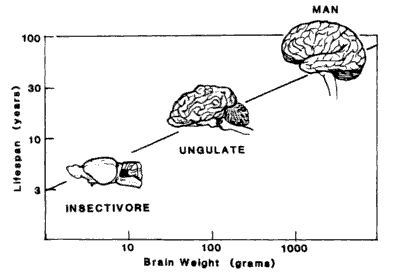
Posted by dwoz on February 4, 2008 at 7:39 PMCool post. As you mention, the relationship between metabolic rate and body size is a fairly strong one across species. This is thought to drive the relationship between lifespan and body size: in effect, smaller organisms live shorter lives because their bodies ‘run’ at a faster rate, and therefore age at a faster rate. Why should this be so? There is no strong consensus at this point, but one of the more promising ideas has to do with the internal transport networks that move around water, blood, or air within an organism (e.g. our circulatory system). Regardless of how large an organism gets, it still has to transport its internal materials to each individual cell, and large size effectively slows down the total rate of transport across the network. If this hypothesis is correct, then larger organisms live slower and longer because their cells are supplied with metabolic supplies at a lower rate. (See http://www.esa.org/history/papers/BrownJHMA.pdf for an overview of this exciting but controversial perspective).
The idea that this could apply to vivisystems in general is thought-provoking. For this to be so, I think you would have to posit that electronically-based vivisystems all share similar ‘aging’ properties, i.e. that the component parts of the vivisystems tend to wear out at the same rate with the same amount of usage. It’s also important to consider how tightly coupled the entire vivisystem is. The cells that comprise an organism are extremely tightly coupled in terms of the whole-system organization. Therefore the rate at which individual cells operate is highly dependent on the functioning of all the other cells in the organism. As a contrast we can consider an ant colony. Each ant has a metabolic rate proportional to its own mass, not the mass of the colony. This helps explain the great success of the social insects; by existing as a coordinated system of independent metabolic entities, an insect colony can operate at a much higher speed than an organism of a comparable mass. Does this mean that vivisystem size is unimportant? Not at all, but the effect of size in technological vivisystems may manifest itself in new and idiosyncratic ways when compared with the effect in individual organisms.
Posted by Kyle on February 3, 2008 at 9:52 AMre: Recently researchers have found a similar and surprising invariance in the ration of lifespan vs mass in plants.
This is not prevailingly true for plants. A Christmas cactus can live for hundreds of years. It need not be very big. I have one that is 40 years old and I got it from a cutting, so…
Also, a cutting of my 40-year old quickly yields a new and youthfully vigorous plant, with no symptoms of aging.
Even grass - the stuff we walk on - is virtually immortal, even to the extent of the individual plant being incredibly long-lived.
Nobody on the planet except seems interested.
Laugh at the grass if you want to. But I believe the grass is laughing at us.
Posted by REG H on October 14, 2007 at 10:06 AMInteresting… but why would a complex system only get ~ 1 billion energetic cycles? Why is 1 billion the magic number, and why is there any limit at all? What mechanisms cause the system to fall apart after that point?
What would the equivalent of a heartbeat be for something like the internet?
Posted by anon on September 21, 2007 at 7:36 PMType the characters you see in the picture above.


Scaling laws should be taken with a grain of salt. For instance, early research had found a strong correlation between body mass and time spent sleeping. But when one corrected for phylogeny, (that closely related species would be more alike) this relationship vanished. (New Scientist 15th of march) It was an effect of some lines of animals being bigger than others.
Posted by Robert on April 28, 2008 at 6:20 AM