


Being Is All Maintenance


There used to be rule of thumb that said: for every dollar you’ll spend on gasoline for your car, you will also spend a dollar on repairs and maintenance. For instance if you drive 10,000 miles a year, and you average say 25 miles per gallon, that’s 400 gallons of fuel per year. At say $2.50 per gallon, you can figure on spending $1, 000 in gas annually. According to this rule of thumb, you should expect to average the same amount on tires, repairs, oil changes, and so on over the life of your car. I haven’t counted my own receipts recently but I’m guessing that rule of thumb is still valid. Edmunds, the automobile buyers guide, calculates just the first five-year “true cost of ownership” of a car (which includes insurance, taxes as well as maintenance and repair) at about 150% of the purchase cost of the car.
The equivalent for high tech equipment seems to be that for every dollar you spend purchasing it, you spend a dollar’s worth of your time maintaining them. For instance, if you spend $100 on a software package, you’ll easily spend 4-6 hours installing, upgrading, and troubleshooting the code before you are done with it. (Figuring the $14-23 hourly rate of an average Maintenance Technician.) The more disembodied and software-governed the device, the more this is true. While I use a Mac, more reliable and user-friendly than other computers, I send several full days a year in dealing with its ailments.
I have found that for me the new constraint in purchasing stuff is not its price (which in general continues to drop), but its maintenance time. Every device I bring into my home demands hours of support time – not counting the time required to learn how to use it. The hours are spent on the phone with tech support, researching manuals online, cruising user forums, or simply tinkering with the tool. All things will need help at some point in their lives. I’ve been surprised at how much time I spend on keeping seemingly solid things – like a showerhead – going. Why would a showerhead stop working after years of working well, and no injury or disturbance on our part? Well, matter decays, and the once new inevitably falters. And when one trips, the other stuff around start to stumble. The more our household becomes an ecology of devices, all somewhat dependent on each other, the more time they require for keeping them healthy. I feel as if I am a vet for gear.
The poor techno patient is somewhat like an animal, and somewhat like a garden, and a lot like a boat. I was reminded of these metaphors recently as I devoted an inordinate amount of time keeping three websites going. If you don’t baby a website, it goes to seed, gets mangy, and sinks. You can’t just erect a web site, get it to work perfectly, and hope it will keep going as the traffic streams in as long as you don’t mess with it and keep the electricity on. That is a foolish as expecting your new boat to remain seaworthy as long as you don’t mess with it. But while it sits there “doing nothing,” the weather, the sea, the elements are steadily eroding it away. Even if you change nothing about your boat, or on your website, everything around it is changing. Operating systems and browsers get upgraded. Monitors evolve. Code gets corrupted. Bugs accumulate. Spammers and viruses attack. Rather than just purring along self-sufficiently, a popular website requires something to be repaired or tended to nearly everyday.
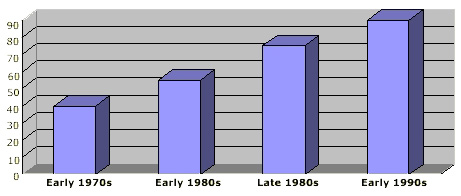
At a personal level this is bad enough, but at the enterprise or institutional level, maintenance is much closer to the auto/gas rule of thumb. In other words, for every dollar you spend in buying or developing software, you’ll spend almost as much maintaining it. Graphed over time, the trend continues to rise, so someday we may spend more on maintenance than on purchase. This chart is taken from data compiled by Jussi Koskinen at the University of Jyvaskyla in Finland, and from Tata Consultancyin India. It charts the percentage of software life-cycle costs devoted to maintenance.
This degree of high maintenance has been a surprise. It is not part of the official future. In the future we all hoped for, smart things without moving parts were suppose to last longer, and need less handholding. In the official future we never imagining replacing our cool communicators every year with better models, or making sure they were welcomed and played nice with all the other stuff in your lives. I don’t remember Tom Swift, or the guys in Star Trek, or Star Wars, or any other citizens of a science fiction century carrying as much stuff as we do. Their rooms were not filled with gadgets. But if current trends are extrapolated, in 100 years, a person like me will have 60 items around them while they work, 45 appliances in their kitchen, and 375 objects in their garage.
And they will send 1/3 of their working time keeping it all going. We will be like herders again, engaged in technological husbandry. Or we can see ourselves as techo gardeners, pulling bugs and viruses from our rainforest of gear. It’s not unpleasant work; just more than we thought.
