Vehicles
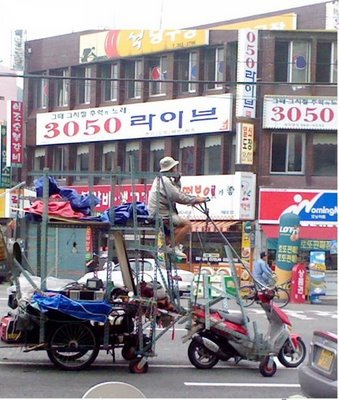
Scooter Contraption
I can't tell what this is for. Might be a portable night market stall (for food?). There's a generator on the tail and a light bulb hanging in the middle. Seems to be in Korea. That's all I know. (Thanks Dave Gray)
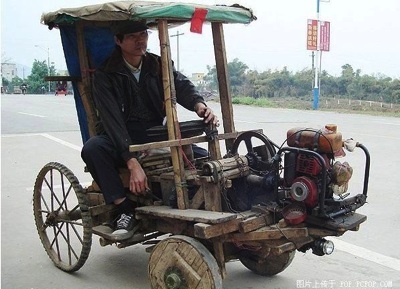
Generator Motor Car
Some kind of home-made vehicle from China. I appreciate the wooden wheels and bamboo combined with what looks like a cheap honda generator motor. (Via here.)
Last-minute Chimneys
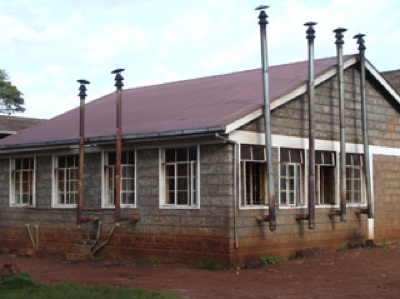
I've lost track of where I found this, but these chimneys look like a last-minute idea. No clue on why they need so many. Perhaps it is a community kitchen?
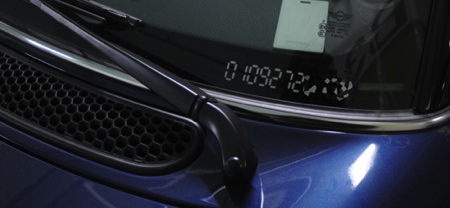
Public Mobile Phone Numbers Stickers
Apparently the norm in South Korea is to post your cell number in the window of your parked car, since in all probability, your car is blocking someone else’s. They will need to call you to move your car. Used to be the numbers were scribbled notes. But Younghee Jung has noticed recently that the practice is becoming formal, and now the numbers get fancy print stickers. The numbers in his photos below are scrambled (by him) at the end.
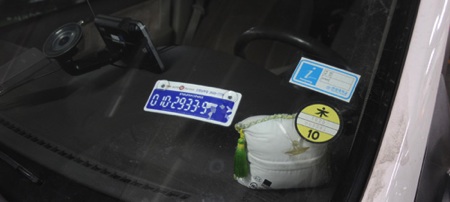
He writes:
...putting owner’s mobile number printed on the front window seems to be on its way to become a norm for car owners in korea. and often its not a scribbled note anymore. the parking convention in korean cities does require leaving the contact information on the car, as people may have no alternative in resting your car without blocking other cars’ exit route, for instance.(Via Jan Chipchase)
More Homemade Trucks
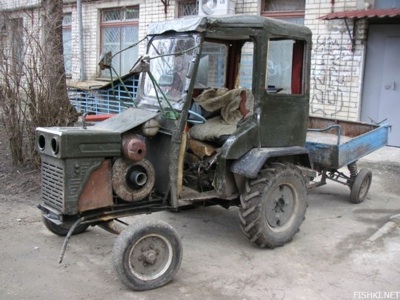
From China, I think.
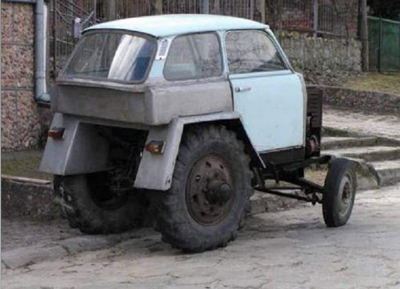
Russian, I think.
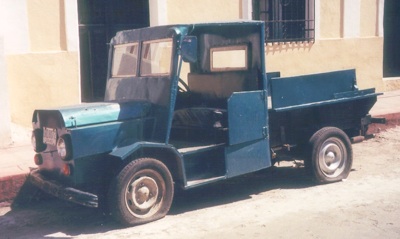
Cuban, I believe.
Polish Home-made Tractors
In the '60s Poland it was almost impossible to acquire a tractor in Poland. Agricultural machines produced by the country were available mainly for state-owned enterprises. For private farmers these tractors were too expensive and they weren't even robust or efficient enough for the mountain region. Out of necessity they constructed their own machines using spare parts and bits and pieces from whatever machines they could find. Including decommissioned army vehicles and pre-WWI German machines.
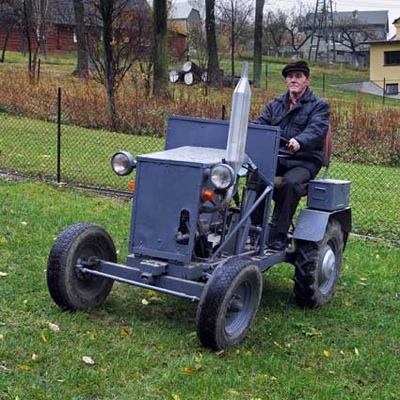
Lukasz Skąpski, "The Machines", 2005-2007, Courtesy Żak Gallery.
Handle Bar Adaption in Lagos
In Lagos Nigeria the traffic so bad and thick that the handle bars on the ubiquitous motorcycles are pinned back to make it easier for the bikes to navigate fast between rows of stuck cars.
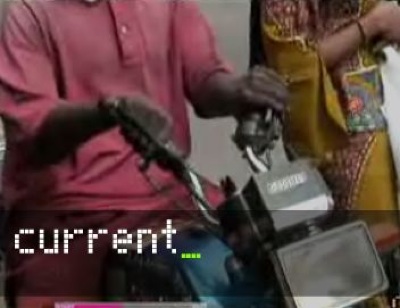
It was hard to extract a decent picture from the Current video, but you can see it fine at about 6:30 on the clip here.
Cuban Motor Bike
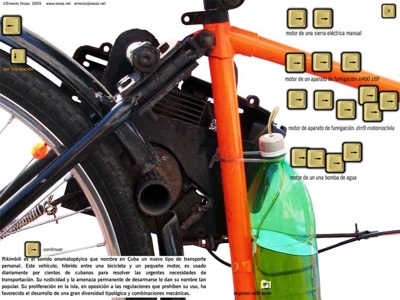
What an elegant design. A wonderfully sleek bicycle is given a motor and gas tank in Cuba to make a motor bike.
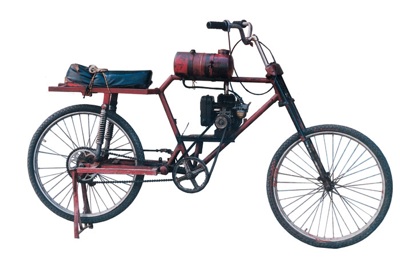
A close up view with annotations shows a different home-made motor bike in Cuba, collected by Ernesto Oroza. The detail of the soda bottle gas tank is wonderful. This design uses the motor's rotor to directly power the tire.
Go Cart Haulers
From Zeraga’s Flickr pool.
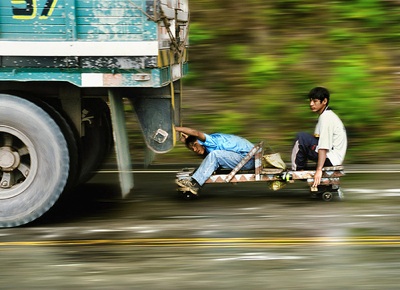
In Perú from Huánuco to Tingo Maria, where the road from the Pacific coast across the Andes finds its way towards the Amazon lowlands. This is near the top of the last mountain pass. From there, soapbox rider can enjoy a vertical 1000 meters of gravity assisted ride. As these kids help stranded truck drivers along the road, they're called bomberos (firemen). They transport drinks, food and spare parts to broken trucks.
Homemade Sled
Good sleds are hard to find these days. Might be liability issues, since a fast sled can be dangerous for little kids. You can make a dangerous fast sled using an old pair of skis and a plastic tub "sled." Jeff Potter, chief blogger at on Out Your Backdoor wrote to me with instructions:
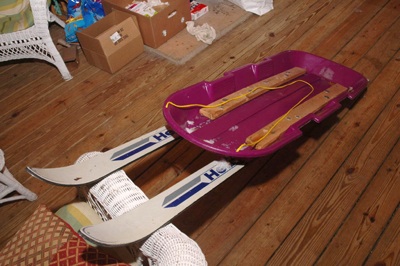
My brother Tim created a neat homebrew sled design. I made a couple of them for our kids for Xmas. What you do is take a plastic tub sled ($10 hardware store) and screw a pair of XC skis to the bottom of it. You can also use downhill skis---better for rough use. You can add a spacer of 1x3 firring between sled and ski to get some height for floating better over fresh snow. Use short, stout screws, Gorilla Glue (expands) and big washers to avoid pull-thru. Then glue foam-padding into the inside. This sled runs straight, smooth and far. Definitely the fastest on the hill. You'll be a big hit!
It's dangerous because you can't steer. But it's fast. Pictures and inspiration were found on Out Your Backdoor.
Cuban Truck-Raft
It doesn't say exactly what's going on in this photograph but it accompanied an article in Foreign Policy on the continued exodus of immigrants fleeing Cuba to the US. The home-made vehicle appears to be a truck-powered raft. The barrels provide floatation and the engine drives the propeller. Cool hack if it works.
ATM cage
It makes sense you'd protect an ATM like it was a bank. In fact why don't all ATMs look like this one, found on Flickr?
Portable Large Sound System
Pico are hand built sound systems erected in chiva, or local bus/truch transport, in Cartegena, Colombia. The large speakers and boom boxes are tricked out like juke boxes, and the entire brightly painted chiva becomes a music hall. I could only find a few photos (email me if you find more). Here is an abstract of a scholarly examination of the tech culture.


Sound Systems, World Beat and Diasporan Identity in Cartagena, Colombia
Deborah Pacini Hernandez in Diaspora: Volume 5, Number 3, Winter 1996
Afro-Caribbean music plays a large role iin Cartagena, Colombia, a city with a large population of African origin. Hernandez details the ways in which the Colombian recording and broadcast industries resisted the dissemination of such music, and discusses the material practices centered around picos, locally constructed sound-systems, through which African-Colombians acquired, reproduced, disseminated, and transformed recorded diasporan musics. She notes that the black Cartageneros' production of such music systems preceded the appearance of world beat in northern contexts by almost a decade, and traces their acknowledgment of and participation in a diasporic Afro-Caribbean identity based on musica africana.
Pop-Up Market in Bangkok
Street Use's Ambassador-at-Large, Todd Lapin, filed this report about street use in Thailand. The contents of this short video clip entitled Train Runs Through Bangkok Market is very hard to describe, but I can assure you it is worth watching. What is most surprising is the speed of recovery. Mr. Lappin writes:
Watch this one through to the end... it's a pop-up market on a train track in Thailand. Amazing.
Pakistan's Decorated Vehicles
I've ridden in some Pakistan buses decorated like this truck, and I do believe the extreme color makes the dusty, long trip more fun. I took a few photos, but nothing like the wonderful portfolio of art that Peter Grant has accumulated. He's followed the trucks back to their painterly sources. And it is not just trucks (or lorries as they are called there) that succumb to these paint jobs, and that Grant captures. Pakistanis paint bikes, carts, jeeps, scooters, buses and boats in a similar riot of color.
Some may wonder, why? These large, ornate decorations remind me of the massive antlers of moose. According to some evolutionary biologists, the fantastical, and impractical horns are the result of a runaway arms-race, as males try to outdo other males in their maleness. I think the same is happening with the lorry decorations in Pakistan. When I was there 30 years ago, the art was simpler (although still eye-popping). It has gone over the top as artists and owners try to outdo each other in detail, scope, and intensity. This art is cool and useless, and hugely impractical.
For a related exaggerated decoration of trucks, see the Japanese Dekorata in Street Use.
Power Cart

This prototype of a prototypical street cart is artist Mouna Andraos' idea. From the artist's proposal: "An old idea from yesterday's streets adapted to serve the needs of today's urban dwellers, the Power Cart is a mobile unit that delivers alternative power to people in the streets. Street vendors have traditionally played an important role in defining the urban environment and often speak to the current social and cultural context of a city. In most parts of the world (and if the weather permits it), the street is a place where social interactions abound and where commerce rules, and street vendors around the globe bring to local populations the things they need right at their door steps. Knife sharpening in India, refills of gas in Africa, fake Gucci bags in Paris and chair massages in New York, the Power Cart looks and feels like another service for the city of today. Need a charge on your cell phone? Your laptop is about to die and you really need to check that email? Or maybe there is no power around you at all? Where ever you might be in the world, hail the Power Cart for a quick fix. Let the Power Cart owner turn the crank for you and get the electricity you need, one minute of cranking at a time."

Korean Marketplace CargoCycles
Street Use reader Michael Carnassus, who has lived in Korea for 5 years, sent these snapshots and report:

These motor bikes (motorcycles in US English) and bicycles are used to transport stuff around Dong Dae Mun Market in Seoul. I love the way that the people in the market have this fiercely independent spirit of free enterprise but also have these complicated symbiotic relationships with one other. These bikes are the grease that make the market smooth, you see them ferrying ridiculously big loads for 500 metres or so to where the products are needed.

Note the carefully street modded/welded carrying beds with 90 degree load supports. I've seen fridges, washing machines and dish washers carried on these things without trouble, even the bicycles. Note the extended rear swing arms with twin suspension coils/springs.

Only the rear suspension is modded usually, however. Look closely at the bike that has a pale blue fuel tank and is stretched out. I actually offered to buy it. That thing is so heavily modded it's ridiculous, it's about 100 cc but the engine is obviously not original. NOTHING is original!! The reason I wanted it was for the McGuyver cool of it all. I was gonna ship it home and just love it. The old dude who owns it got me drunk on cloudy rice wine this afternoon (it was a crappy rainy day) and it's his life. He loves the thing and so do I. I have an appointment to ride it happily enough!

I'm a keen cyclist and motorcyclist and I have to give respect to the guys who ride the rickety contraptions in that market, it can't be easy moving all that crap on your back!

Three Wheeled Cabs in China
Reader Bryan Lauas sent me a couple of links for 3-wheeled utility cycles. He pointed me to Vincent Budnick's nifty site where I found some pictures of three wheelers in China. Here's what Vince had to say:


A lot of small transportation and service needs are cheaply met by rear wheel drive motorcycle based three wheelers. These are mostly the familiar 150cc motorcycles outfitted with a two-wheel rear axle, and some kind of frame or enclosure.This yellow beauty is a taxi in Chingqing, which is a high altitude northwestern city, so it gets cold. I doubt if it has heat, but I'm sure that the hard shell makes for a much more comfortable ride than the more open configurations below.Both vehicles below were photographed (at night) in Dali. Dali is in a southern region, and is pretty temperate even in January when we were there. I'm not sure of the gearing, but the area there is quite hilly, and these bikes have very small engines.

Tump Line/Human Delivery of Heavy Goods
For thousands of years humans have transported heavy goods on their backs using a head held tump line. The loads a fit porter can carry are astonishing. Some can manage 100 kilos (220 pounds), which considering their own body size is incredible. These guys in Nepal can manage both heavy and awkward loads with ingenuity. Keep in mind that the coke bottles below are heavy glass (made to be washed and re-used many times), and are filled. Just one wooden tray would be a load for most of us. I've seen these porters pack in refridgerators, heavy lumber, furniture, and mother-in-laws. These photos are by Jeff Greenwald.

Bling Trucks, or Dekotora, in Japan
Reader Alexander Rose passed on a website featuring these really cool truck decorations found in Japan. The blogger who posted the images say this about them:

"If you meet such an embellished apparition on a highway at midnight, it may either scare you off the road, or cause you to start to believe in alien encounters. The amount of chrome on these babies is probably equal to a monthly chrome production of a small African republic. I have to admit I'm still scratching my head after seeing this."
These chrome beauties are known as "dekorota' in Japanese. According to Wikipedia, "Dekotora (デコトラ) commonly have neon or ultraviolet lights, extravagant paints, and shiny stainless or golden exterior parts. These decorations can be found on both the cab and the trailer, and not only on the exterior but also in the interior. Dekotora may be created by workers out of their work trucks for fun, or they may be designed by hobbyists for special events. They are sometimes also referred to as Art Trucks.

In 1975, Toei released a movie Trucker (トラック野郎 torakku yarō) that featured as the protagonist a costumed trucker who drove his garishly decorated truck all over Japan. [YouTube clip from movie here.] This movie was a big hit with both old and young, and caused a wave of Dekotora popularity to sweep over the country. While Dekotoras were present throughout the 1970s, before the movie they were restricted to the north-eastern fishing transport trucks. It is possible that the movie was an attempt to popularise this kind of trucks. In those days, ready-made parts for trucks were not easily available, so these trucks freely utilised parts from sightseeing buses or US military vehicles.

Since the late 1990s, Dekotora have been heavily influenced by the art of Gundam [think lumbering Japanese manga robot]. In addition to the Gundam-influenced designs, it is common to see decorations that are more akin to modern art, or even retro designs that closely resemble those found in the movie Trucker.
Beach Roller Skates
It's pretty crazy. Hold onto a large kite and then haul yourself around a flat beach on these fat-tired homebuilt skates. They are made from old ski boots and surplus rubber wheels. The inventor is Tim Anderson who gives instructions on his website.

The skates have to be pretty sturdy.

Homemade Landsailer
I don't know much about this contraption, other than what the label at this windsailing website says: Homemade Landsailer. Looks cool though. Tell me if you know more.

Backyard Pulse Jets
If there ever was a technology that calls out for street use, it is a jet engine. There is a small subculture of jet hackers. Among them is New Zealander Bruce Simpson who runs a cool website of his experiments. He tells how he got started:
When I first started tinkering with pulsejet engine technology in 1999, I realized that there was huge potential for improving these devices. Although deceptively simple in construction, their design had changed little in the 55 years since the end of WW2, when they were rapidly replaced by the now common turbojet. The opportunity to apply 21st century materials and knowledge to the task of improving a design still mired in the 1950's was too great to resist -- so I set about developing a range of engines, each incremental better than the last.
In true enthusiast street use spirit Simpson tells you how to make one yourself. He sells a book on DVD with instructions.
"A step-by step video shows you how to build this pulsejet for around $20 using just regular hand-
tools. That's right, no welder or lathe is required."
Mad Max in Vietnam War
Yeah, I'm on a vehicle mash-up jag these days. Here's another road-warrior-worthy vehicle. Remember those pictures of Mad Max war trucks taken in Iraq by Defensfor Fortis? They were not the first to hack an armored vehichle. Here's a snapshot of a jury-rigged tank made by GIs in Vietnam. This picture by Ralph Marchese was taken sometime in 1967, of the HHC 3rd/47th Infantry.

Like a Peking Duck in the Water
More farmer-built vehicles. This one featured on the Chinese website, SHM, is an amphibious vehicle. Goes on dirt roads and rivers. According to a translation provided by the great China-watching website Virtual China, the inventor has applied for a patent for the thing.
"On Sept. 25 [2006], 75-year old boatsman Hu Zeshen piloted the dual-use amphibious vehicle that he invented. Mr. Hu lives in Loudi city, Hunan Province, in southern China, and has spent his life working on ships plying China's rivers and canals. He calls his invention "the Happy Boat." The vehicle has a 5 horsepower diesel engine and a 1 horsepower electric engine. He and his wife plan to take the vehicle on holiday during China's National Day vacation, to explore scenic waterways in other parts of his province. Mr. Hu will apply for a patent for his vehicle, too."
Recycling Vehicles for Recycling
An independent documentary called "Pretty Dyana" captures the story of how Roma (gypsies) in Belgrade find old Citroen Dyana cars and modify them into mini-trucks that haul recycled cardboard.

They do this primarily by stripping the cars of everything except their motors, chaise, and steering wheel. Everything else goes. The Dyana is particularly suited for this, the Roma say, because the frame remains intact after you take everything else away. So they can easily add a bin on top of the back. And presto, now they have a cardboard hauling cart.

And because it doesn't look like a car anymore, it fits into some grey zone with the police. Not that they don't get fined for driving it around. All this and more about how the Roma survive in Belgrade is presented in this nice short documentary.

Note the plastic bottle gas tank.
Farmer-Built Submarine
The original source is in Chinese, so I don't know too much about this homebuilt submarine, other than it was built by a Chinese farmer. On inspection, I doubt it will even submerge; it is probably simply a boat with submarine decoration. I hope I am wrong.

It appears on a site with a collection of other homemade vehicles, including a UFO.
Bikes of Burden
Designed to move people, bicycles and motorbikes are actually used to move almost anything that can be moved. In my travels in Asia I've seen bikes piled impossibly high with all manner of cargo, from livestock to cardboard. It's really astounding what a bike can balance and transport. Dutch photographer Hans Kemp has focused his lens on the motorbike cargo culture of Vietnam. He's gathered his collection of 148 examples of the unintended cargo of motorbikes into a very finely printed photobook, called naturally enough, Bikes of Burden. Here are a few examples from his book, which is also available on Amazon.

It's a remarkable living zoo of chickens and ducks on the way to the market.

When the ducks are tiny they are taken to farms in smaller cages. Then farmers will raise the ducklets.

This guys sells music cassett tapes and offers a tiny hi-fi set to test them out and also serve as an advertisement. Of course the tapes are all pirated.
Shopping Cart Cart
Reader Steve Portigal pointed us to his friend Victor Lombardi, who captured this cool hack. A guy riding his bike down Canal Street in NYC while towing a shopping cart. It apparentlhy serves as a found and free hauling trailer. I would love to see the hitching details.

House-truck and Truck-houses
Roger Beck makes and collects housetrucks. "Many people have the dream of being a gypsy--a dream of travel & freedom. For every housetruck or housebus, there is an artist who has built it to meet their individual needs. I have hundreds of housetruck and housebus photos including many unique, one-of-a-kind vehicles." Indeed if you visit his site, Housetrucks, you'll find a few of his 350 images. The rest are available from his self-published book.

This cute housetruck was found in New Zealand.

This is a side view of a long housebus with porch!
Meals on Wheels
Lloyd Kahn sent over a cool picture he took in Thailand. It shows a VW van converted into upscale street bar in Bangkok. It's part of his collection of the diverse ways people around the world create shelter.

Chrysler Motel
Friend and Street Use reader Todd Lapin sent this nice catch along. It's an old Chrysler converted to residential mobile housing. He says it's been an inhabitant of the SF waterfront near Islais Creek for years. If you are going to live in your car parked on a public street, why not alter it so it gives the maximum comfort and privacy? He writes in his Telstar Logistics blog:
"This 1960s-era Chrysler station wagon has been given a remarkable DIY residential conversion. It isn't used for weekend trips; the owner lives in it full time. That explains why there are so few windows, and why there's a big skylight on the roof -- fewer street-level windows means far more shelter from prying eyes. We've seen this car a lot over the years, and we've noticed that it moves frequently, but never far, within the waterfront district."

Instant Car Camouflage
Here's a really odd homebrew solution. The car is a new model not yet released. The problem is spies. Like paparazzi, they stalk the test race courses and suburbs around car design centers, hoping to score a photo of a brand new never-before-seen car to post on the car-fanatic web sites or magazines, like Winding Road, where this one was posted. To thwart the spies from capturing anything useful while they test the vehicle, the designers will cover it with... well... stuff. In this case, cardboard, duct tape, foam, plastic -- anything that was around the garage. I nominate it as a great case of rapid prototyping. No one yet knows what this vehicle is. Speculation runs toward it being either a Toyota or Subaru.

Naked Lorry
Reader Jason McCandless says he snapped this picture of a stripped cab-less lorry in Ayyuthuya, Thailand, from the back of a tuk-tuk. "It was the second one I'd seen when I was there, and it looks even more strange in real life."

Utility Vehicle
Bob Travis posted this picture on his Flickr site. He says it is a presumably still running utility vehicle used by an organic farmer to haul stuff on his one-man farm.


Beach Ferry
We're on a homemade truck roll. Here is another one from Thailand. Used on the beach to ferry tourists. Note the really cool bench over the front wheel. Thanks to Hobotraveler.

Improvised Truck Armor
It would be hard to find a better example of "street use" than these hardened street trucks outfitted for desert war. A guy named Defensor Fortis, who was stationed in Iraq, posted some photos on Flickr of truck modifications performed by contractors. These are desperate attempt to protect a factory-issue truck from roadside bombs or enemy fire. They also boast their own artillery posts to return fire. When asked about the effectiveness of the jerry-rigged armor Defensor said, "I have seen no proof, but I imagine they're fairly safe from small arms fire and more than like fitted with "run flat" tires."
This one is a Ford Super Duty gun truck in Southern Iraq (Mar 06).

In southern Iraq a modified GMC truck used by a British company, April 06.

In June 06, a gun truck in southern Iraq.

From the rear gun ports you can notice the armor plate behind the glass.

.
Dashboard Oven
MSNBC carried this story on August 3, 2006 datelined in Bedford New Hampshire about a women who uses the dashboard in her SUV as an oven to bake cookies.
Blistering heat was just what Sandi Fontaine needed to bake cookies for her co-workers — on the dash of her Toyota RAV4. With temperatures soaring Wednesday, Fontaine placed two trays of cookie dough on the dashboard, shut the doors and retreated inside to her air-conditioned office.Fontaine first tested her dashboard oven three years ago. She said anyone can do it; the only requirement is for the outside temperature to be at least 95 degrees, so it will rise to about 200 degrees in the car. "When you open the door to that car," she said, "it's like, oh, my God. It's a wonderful smell."
Redneck Technology
It's sort of a joke site, but some of the pictures captured by the website Redneck are legitimate attempts by folks to make do with what's at hand. And what is at hand is often old vehicles.
This one is a houseboat employing an old tow cabin.

And here is a root cellar (for storing vegetables over winter) that ingeniously uses a old school bus.