

Rapid Prototyping
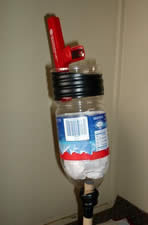
Quick Fruit Picker
Reader by Kris Bordessa pointed me to this blog post, which describes a neat quick friut picker devised by his/her kids.
"A fruit tree – heavy with fruit – was taunting them with ripe morsels high in the branches and out of their reach. Fifteen minutes later, they were successfully nabbing fruit with a homemade fruit picker made of a dowel, a water bottle and a chip-clip."
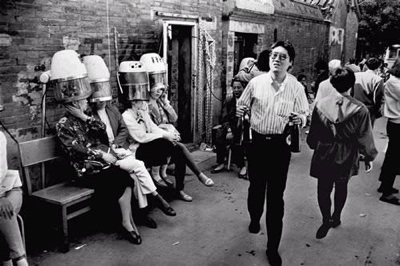
Street Retail in China
A hair salon and a massage store have set up on the street in China. Who really needs walls? You get a much better view outside than watching a TV. And when it rains, no one goes out shopping anyway.

Begging Extensions
I thought these very long pole nets, invented by these kids in China, are an ingenious solution to a problem of many kids in the developing world: need some money. Their particular problem was that scores of tourists float by in boats going down a scenic river, but they don’t get quite close enough to beg money from. Some tourists would be willing to donate if they could get some money to the boys. The solution is to lash a fishing net to a long bamboo pole which can reach the boats are certain turns. The boys reach their poles out and the tourist deposit the bills. The one in the picture is dropping a red 100 renbi note which is worth about US$8. That’s a big tip for these guys. But the solution is so clever I’d almost be willing to give them something for their effort. The photographer and source for this picture is unknown; I found it at this site of China photos.

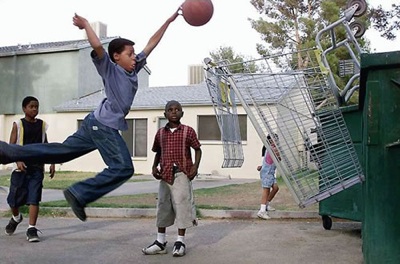
Shopping Cart Basketball Hoop
I tried to track down the provence of this image, but was unsuccessful. It shows some kids using a grocery shopping cart as a make-shift basketball hoop. Very clever!
>
Camel Bookmobile
There’s few streets in this part of Kenya, so the bookmobile comes via a camel. This ingenious library is boxed and strapped to a camel. Author Masha Hamilton has accompanied the camels on library trips through Kenya’s isolated Northeastern Province. She writes on her web site:
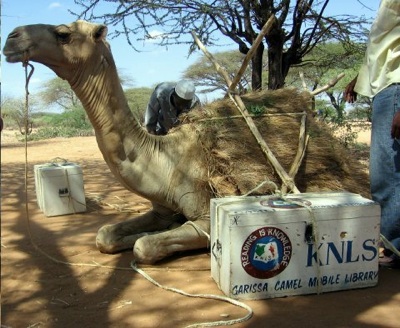
The actual Camel Bookmobile brings books to semi-nomadic people in Northeastern Kenya who live with the most minimal of possessions, suffering from chronic poverty and periodic drought. I visited the region during a period of drought and made several hours-long walks through the African bush with the bookmobile. I cannot describe how moving it was to see the people, particularly children, crowding around as the traveling librarians set up straw mats under an acacia tree and spread out the books. The excitement is palpable.
The Camel Bookmobile books are primarily in English. The children are taught the language in outdoor “classrooms” under acacia trees for the younger students, indoor classrooms for the older students. They particularly like children’s storybooks, though all fiction is also sought-after, as well as books about math and astronomy, biology and other sciences. As you can imagine, the camel library always needs more books — the trip is hard on books and, as these are a semi-nomadic people known as pastoralists, not all volumes are returned.
This area, Northeast Kenya near the unstable border with Somalia, is definitely a region in transition. Due to years of drought and famine, the elders (many of whom still feel romantically attached to their nomadic lifestyles) are recognizing that their children must be educated, so the demand on the camel library is growing. Illiteracy rates in this region are put at 85 percent. Among adults outside the towns, my guess is that it is higher than that. We in the West have so many books; just mailing a single one to the camel library, if done five-hundred times, would have enormous impact.
The Camel Bookmobile librarians told me their patrons also really appreciate the sense of connection they get when a book is signed from a particular place and person. It widens their understanding of the world. So send a favorite book or two, sign your donations with your name and city, and add a note if you wish.
Instructions for contributing to the camel bookmobile are on Marsha’s site.
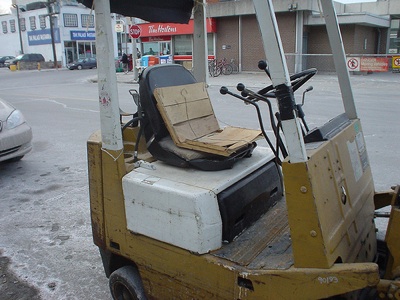
Improvised Seat in Several Layers
Thanks to Rob Cruickshank for the pointer and this photo. He says, “As soon as I saw this, I thought “Street Use”! Looks like the worn-out seat was replaced first with a pillow, then with a wooden fruit-crate. It’s possible that the wood is warmer than a cushion — it’s been cold here.”
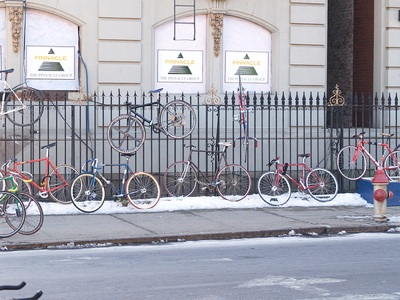
Improvised Second Tier Bike Rack
When you run out of space on an improvised bike rack you can go for the second level. This picture of “a few of the 200 brakeless fixed gear bikes at monstertrack 2006 in NYC” was posted on John Rogers’ Flickr set.
Hands and Feet Quad Bike and Bent Trike
Bikes are pretty easy and very rewarding to modify on the street. Here’s two very invention street modifications from Australia. They were found by Wade Hatler. He writes on his travelog: “I took off for a six-month bicycle tour two years ago and never quite managed to go back home.” Along his travels on the backroads of Australia he spied these two remarkable bikes.
“Why would someone build a homemade trike you ask? Well, because trikes have some compelling advantages, but commercially built trikes are pretty expensive. Someone with some skill in the machine shop can take a couple of old bicycles and make a nice stable, comfortable commuting vehicle with practically zero expense. The one [below] here has an actual office chair as the seat. You can see he hauls his daughter around on the trike, and life is good. Front wheels are simply the front steering assembly and part of the frame from a diamond frame bicycle. A crossbar hooks them together, and to the frame that holds the foot cranks and pedals. A small tie-rod connects the front two tires together, and steering is just a chunk of the original handlebars. You don’t get a blisteringly fast performing trike with Ackerman steering in this fashion, but you can get a good, solid, dependable, environmentally friendly vehicle for just about free.”
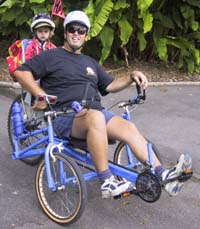
“This invention [below] is called the BiQuadly. It’s a four wheel, fully independent suspension, two wheel drive, multi-speed rig that’s powered by both the arms and the feet. I’ve never seen anything quite like it. It’s all a handmade prototype: Basically, you power the bike by cranking the pedals, which go through a conventional bike’s derailer to a jackshaft, which then goes back to each of the rear wheels. The two hand levers you see move in both the back to front and the left to right planes. In the back to front direction, they hook to a crankshaft. Once you get going, you can crank back and forth on the hand levers, and it applies power from your arms onto the pedals to assist your legs. In the left to right direction, the handles are hooked to the steering, and they make the front tires turn to steer.”
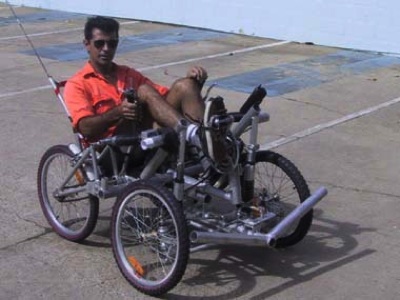
.
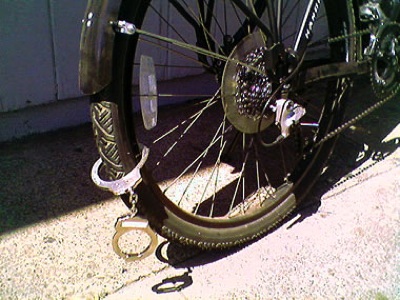
Handcuff Bike Lock
Jonathan Schreiber writes: Thought you might enjoy this bike-related street use that Justin found as we were walking from our offices to lunch in Sausalito (CA). A CHP Bike cop was getting a sandwich inside Golden Gate market. This what he used as his bike lock.
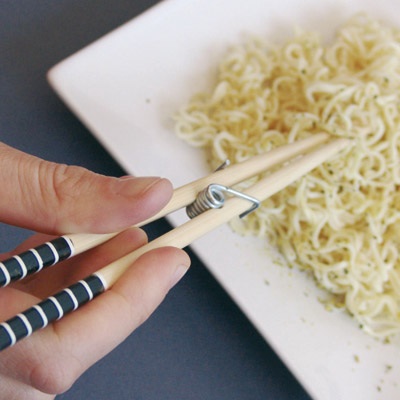
Spring-loaded Chop Sticks
I’m not sure who much these are actually used. They may be simply a design project. But they look plausible. In fact, I think I’ll make some for guests.
You remove the spring from a wooden or plastic spring clothespin, and insert it between two chop sticks — perhaps with a little grove shaved on the chop stick shank. The result is a pair that is easy to use and requires no life-long skill to pick up grains of rice.