Improvised Technology
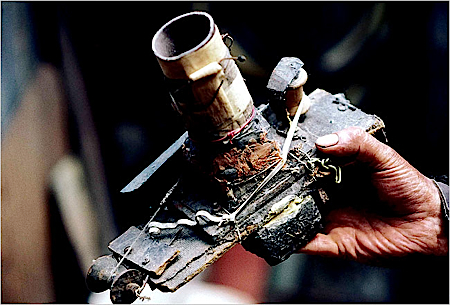
Home-made Camera for Ogling
Jailhouse Tech
There's an emerging category of street technology which might be called Jailhouse Tech. The material constraint of a prison inspire fantastic innovation and re-use of made parts. A lot of the devices made in this manner are crude weapons, but others include eating implements, tattoo instruments, music, and other tools. Here are some examples from a prison in Mexico City by Gabriella Gomez-Mont.
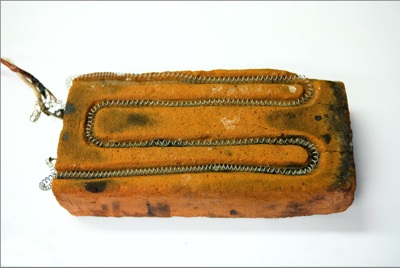
Electric cooking stove made with wire and brick.
From the fantastic interview with the artist who works in this prison and who facilitated the photographer who shot these images:
Now that it is over and done with I can tell you this. For the eight prisoners that helped us it would have easily meant another extra seven years in jail, and for us instant lock-up until they set bail. Especially because of having in our possession—or even presence–those knives made from the metallic edges of the windows! In there, they menace and kill people with those, we would all gotten into so much trouble if we had been caught with them. I don’t even know if those particular knives that we photographed that day had already been used for some sort of bloody business or not, I preferred not to ask; but it would have been even worse.
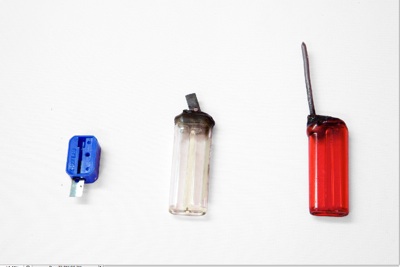
Weapons.
Street Food Contraptions
Dornbracht, a German manufacturer of bath and kitchen fixtures is presenting a exhibit called "Global Street Food" which has removed street food carts from the streets and spotlighted them in a gallery on Dornbracht's campus.
I wish I had thought to photograph the many wonderful carts I had seen in my travels, but it never occurred to me then.
Here is grill from Kampala, Uganda.
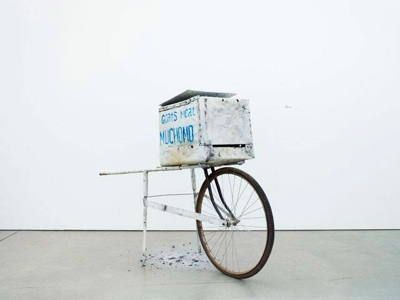
And a cheese and sausage cart from Buenos Aires.
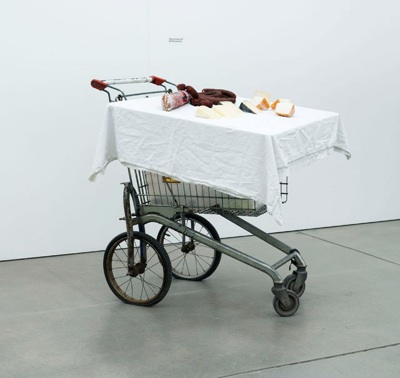
If you have photographs of interesting street food carts send (or point) them to me, and I'll post.
Improvised Polish Hot Water Setup
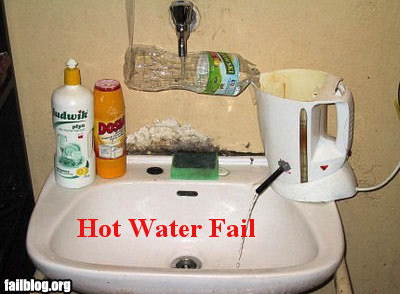
This picture of a jury-rigged hot water delivery system from Poland is pretty cool. I bet it works. (Ignore the label, it is meaningless, added by the website Fail Blog, where I found the picture. Thanks, Ross Beane. )
Improvisation in Thailand
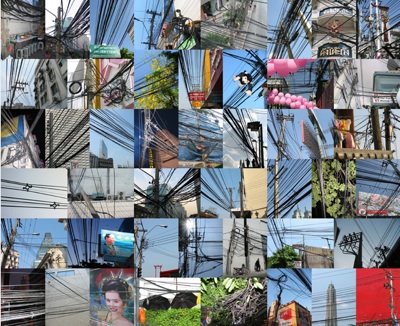
Thomas Kalak is a photographer from Munich, Germany who specializes in the offbeat. His subject is the curious art of found technology. He's accumulated a magnificent gallery of old American cars in Cuba called "Havana Oldtimers". In Thailand he focuses on the often-seen but rarely-noticed jumble of wires that weave their way overhead every street. Adhoc in design, these almost organic nests have their own charm if you let them seduce you. Kalak has collected an entire portfolio of Bangkok Wires.
These and more are included in a new book about Thailand called "Thailand -- Same Same, But Different. No cliches here. No lovely maids, palm beaches or grand temples. Instead Kalak captures odd moments of street use. Plastic chairs in alleys; traffic cone patterns. Even the locals are blind to their off-center beauty. Kalak has a keen eye for the way folks improvise. I think of this work as improv zen.
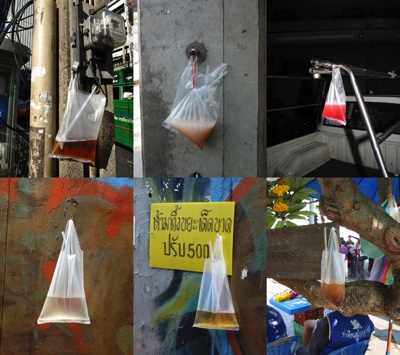
The ubiquitous plastic bag becomes an instant cheap bottle if you add a straw. And you can hang it anywhere.
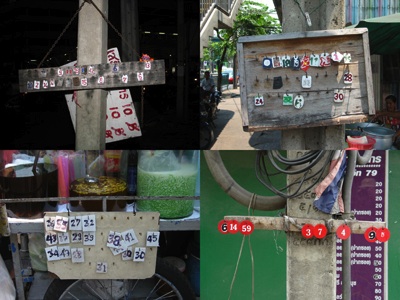
Owner-built key ring boards.
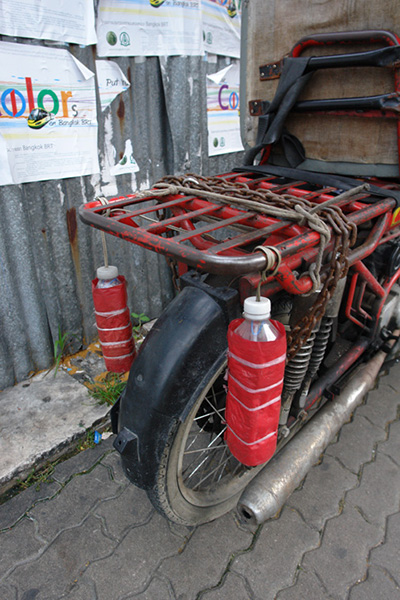
I think these are home-made brake lights. Suspended by a wire, a bulb inside a bottle covered with read plastic will light up at night.
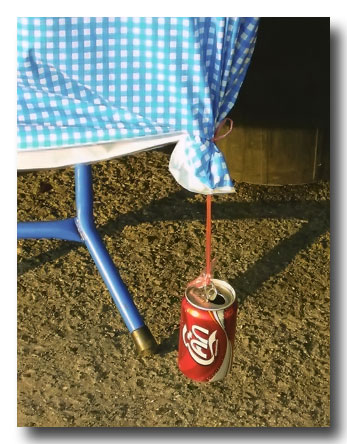
Filled with water this can keeps the table cloth from blowing away.
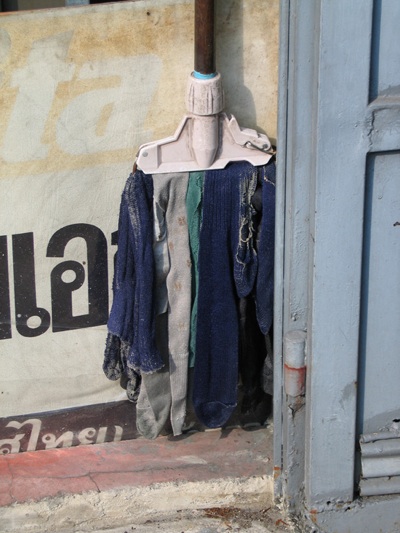
A mop made from old socks!!
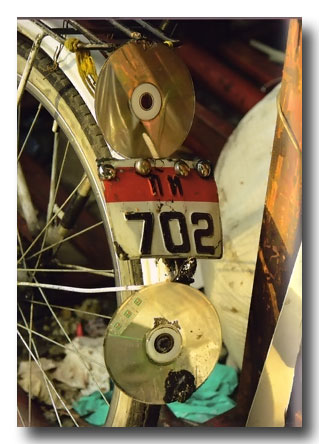
Reflectors made from CDs.
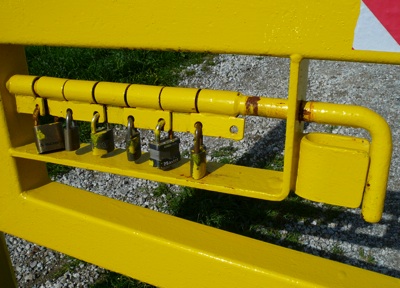
One Gate, Multiple Locks
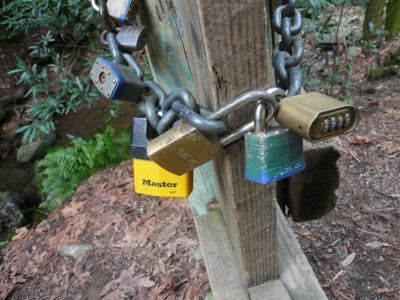
What do you do if you have a locked gate but more than one person is permitted to open it? You don’t want multiple keys, in case one is lost/stolen. Then all the keys may need replacing. Instead you can have multiple locks, chained into one long lock. Open any lock to open the gate. This way each person needs to manage their key (and lock). I’ve seen various installations on this solution in different parks in the Bay Area.
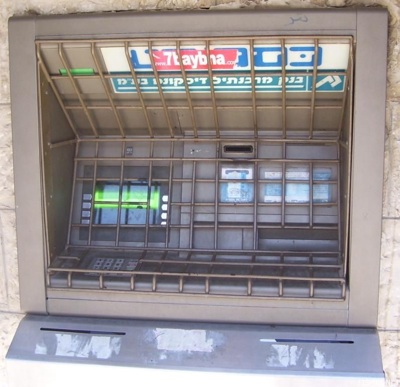
ATM cage
It makes sense you'd protect an ATM like it was a bank. In fact why don't all ATMs look like this one, found on Flickr?
Portable Large Sound System
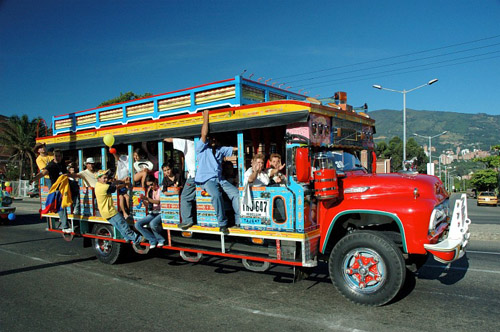
Pico are hand built sound systems erected in chiva, or local bus/truch transport, in Cartegena, Colombia. The large speakers and boom boxes are tricked out like juke boxes, and the entire brightly painted chiva becomes a music hall. I could only find a few photos (email me if you find more). Here is an abstract of a scholarly examination of the tech culture.
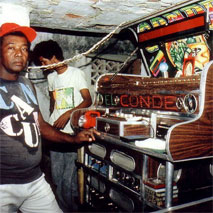
Sound Systems, World Beat and Diasporan Identity in Cartagena, Colombia
Deborah Pacini Hernandez in Diaspora: Volume 5, Number 3, Winter 1996
Afro-Caribbean music plays a large role iin Cartagena, Colombia, a city with a large population of African origin. Hernandez details the ways in which the Colombian recording and broadcast industries resisted the dissemination of such music, and discusses the material practices centered around picos, locally constructed sound-systems, through which African-Colombians acquired, reproduced, disseminated, and transformed recorded diasporan musics. She notes that the black Cartageneros' production of such music systems preceded the appearance of world beat in northern contexts by almost a decade, and traces their acknowledgment of and participation in a diasporic Afro-Caribbean identity based on musica africana.
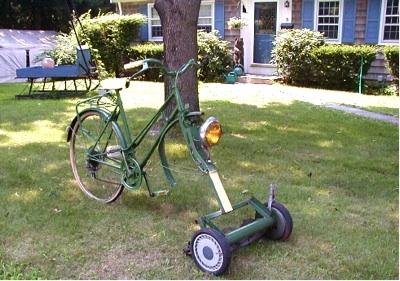
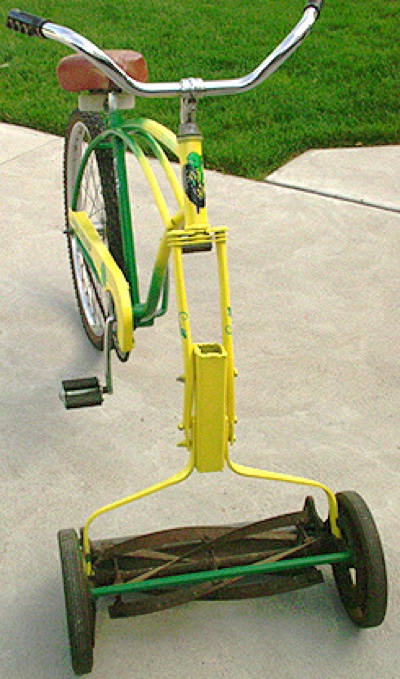
Great Minds Think Alike: the Bicycle Lawnmower!
Over at Treehugger, Warren McLaren has rounded up all the examples of this ingenious, indigenous, "labor-saving" invention that he could find.
It is apparent that thousands of people who have to mow the lawn decided there must be an easier way and had exactly the same idea: Why not hook the mower to a bike? And so the bikemower is born in a thousand of garages around the country. Judging from the pictures, they are still in the garages. Most of the pics rounded up by McLaren look as if they were taken at garage sales. I have my doubts that the bike mower is very useful, or easier to use than pushing on your feet.
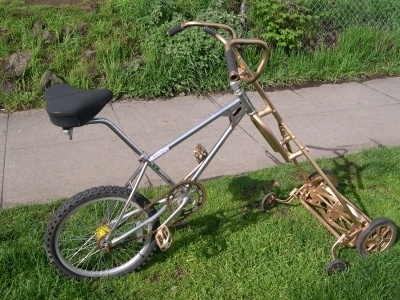
For the full set see the Treehuger post above.
Power Cart
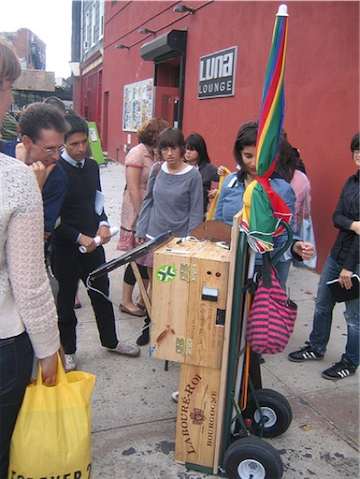
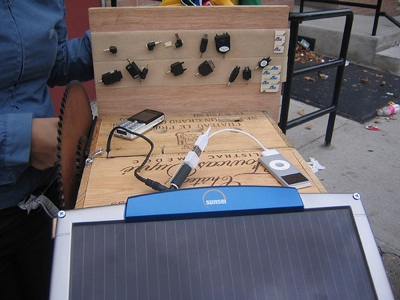
This prototype of a prototypical street cart is artist Mouna Andraos' idea. From the artist's proposal: "An old idea from yesterday's streets adapted to serve the needs of today's urban dwellers, the Power Cart is a mobile unit that delivers alternative power to people in the streets. Street vendors have traditionally played an important role in defining the urban environment and often speak to the current social and cultural context of a city. In most parts of the world (and if the weather permits it), the street is a place where social interactions abound and where commerce rules, and street vendors around the globe bring to local populations the things they need right at their door steps. Knife sharpening in India, refills of gas in Africa, fake Gucci bags in Paris and chair massages in New York, the Power Cart looks and feels like another service for the city of today. Need a charge on your cell phone? Your laptop is about to die and you really need to check that email? Or maybe there is no power around you at all? Where ever you might be in the world, hail the Power Cart for a quick fix. Let the Power Cart owner turn the crank for you and get the electricity you need, one minute of cranking at a time."

Public Cartoon Blackboard
According to a BBC news item datelined Nairobi, a one Humphrey Barasa has "has been drawing cartoons on the [Kenyan] bus stop shelter for the last six years."
The cartoons, which Mr Barasa draws on the face of the shelter, highlight various issues - from politics and politicians, to health and social issues - and act as a pictorial analysis of current affairs..... He has won many fans, who visit the shelter every day to view his latest masterpiece. "It's very, very excellent work. It always gives me inspiration and that's why I pass here every day," said one of his fans.

Foam Hard Hat
This foam cushion tied to the worker's head in India is reputedly a hard hat substitute. The picture is from this humor blog so I don't know its veracity. It is much more likely a piece of padding to hauling iron pipes since the common way to transport heavy things in india is using the head/spine for support.

Beer Bottle Solar Hot Water Heater

According to the Internets, this Chinese farmer is getting hot shower water from this roof of beer bottles and plastic tubing. This version of the story was seen on Ananova (sent in by reader Arnaud Betremieux). The account says "I invented this for my mother. I wanted her to shower comfortably," says Ma Yanjun, of Qiqiao village, Shaanxi province.Ma's invention features 66 beer bottles attached to a board. The bottles are connected to each other [with plastic tubing] so that water flows through them.Sunlight heats the water as is passes slowly through the bottles before flowing into the bathroom as hot water, reports China Economy Network. Ma says it provides enough hot water for all three members of his family to have a shower every day.And more than 10 families in the village have already followed suit and installed their own versions of Ma's invention."
Homemade Charcoal Tongs
Cute set made from wire. Found in a farm house in Zhongdian, Yunnan, China.

Russian Lamp
This is one of a series of images floating around the internet, forwarded to me by Bruce Sterling. It's labeled as somewhere in Russia, but that might be only a tasteless joke. But in any case it's a handy lamp.

Flashlight Broom Handle
A discarded flashlight becomes an ideal broom handle. Photographed by Jeff Greenwald."The little girl with the flashlight broom worked in her mother's lodge in the village of Chomro, in the Annapurna mountains of Nepal."

Improvised Scrap Metal Detector in Vietnam
The title of this set of photos from the Flickr photo stream of Clear Path International is "Hobby De-Miner". Clear Path International is a non-profit devoted to serving the survivors of landmines. As the unnamed photographer explains, "We ran into this boy collecting scrap metal from the Vietnam War alongside the road near Da Nang. Often, while searching for scrap, people that do this will find a bomb and attempt to dismantle it and sell the metal. Many are killed or injured."


The equipment apparently works. Here is a piece of iron found and recovered.

Lamp from Lightbulb
World traveler and author Jeff Greenwald sent me this photo of a improvised kersone lamp. He writes: "The light bulb/kiwi tin lamp was photographed some years ago in an inn along the southwest coast of Sri Lanka, probably in Hikkaduwa."

Handcuff Bicycle Lock
In addition to this photo of a bike where the police rider used their handcuffs as bicycle lock -- previously posted on Street Use -- here is another one with the same idea (found on this guy's blog).

Russian Match Box Camera
Don't know much about this other than the tiny hint posted on a English/Russian blog says:
"One Russian blogger made a camera from the two matchboxes and a tin beer can. Somebody submitted us his camera and photos he made in St. Petersburg."
Two shots of the camera itself, and one photograph made by the camera.


Toilet-Paper Napkin Roll
I like this thrifty way curbside restaurants in China served up napkins: in a toilet paper roll, from the inside out. Cheap, and handier than cut napkins.

Anti-Sitting Methods
This lovely web site is collecting all the ways in which landlords prevent people from sitting, or sleeping, on their property. We are talking here about city life, and the way the commons have been diminished by ... what? Liability issues? Homelessness? Law and order? I have no idea why sitting is so verboten. But there's no end to the ways in which bottoms can be kept away without calling too much attention to the intimidation.


Bamboo Rebar
The majority of farm houses and barns in China are built with home-made sun-dried mud-and-straw bricks. They are stacked up using wet mud for the mortar (thus the origin of the contemporary contractor's term "mud" for mortar). By employing string levels a remarkably rigid, straight, and durable building can be made from earth. But in Yunnan I saw how the locals use small bamboo twigs as a type of rebar. They lay these very strong sticks (bamboo has a tensile strength similar to steel) along one course of bricks every tenth row or so, just as we might add rebar in wet cement. The bamboo serves the same purpose and its use probably predates rebar and concrete.

Unabomber's Handmade Pistol
I am not at all sure why Ted Kaczynski made this gun, unless it was to avoid the detection of having to buy one. It's remarkable in its craftsmanship. Don't know if it worked, but given how meticulous he was, it probably did. This photo is part of the government evidence against him, found at this CBS site, without much explanation. If you know more, write.

In the comments, Cory H. supplied the answer to why the Unabomber made this gun, and whether it works:
Reprinted from his diary in the Government's Sentencing Memorandum, which explains that agents discovered a completely homemade, operable handgun, as well as a corresponding written description of its creation and purpose:
[A] few days ago I finished making a twenty two caliber pistol. This took me a long time, for a year and a half, thereby preventing me from working on some other projects I would have liked to carry out. Gun works well and I get as much accuracy out of it as I'd expect for an inexperienced pistol shot like me. It is equipped with improvised silencer which does not work as well as I hoped. At a guess it cuts noise down to maybe one third. It is said that it is easy for machinist to make a gun, but of course I did not have machine tools, but only a few files, hacksaw blades, small vice, a rickety hand drill, etc. I took the barrel from an old pneumatic pistol. I made the other parts out of several metal pieces. Most of them come from the old abandoned cars near here. I needed to make the parts with enough precision but I made them well and I'm very satisfied. I want to use the gun as a homicide weapon.
From Ex. 91
Marching Water Drums of Brazil
I caught this glimpse of street use in a documentary about the AfroReggae movement taking place in the favelas of Rio, Brazil. In an effort to raiser pride and social awareness, the kids are given percussion workshops. Desperately poor, they make their own marching drums from empty water jugs and small oil cans, much in the manner of the Caribbean steel drum makers, but much more crudely. The film is called Favela Rising and it's not half bad.

Coffee Pot Mini Meth Lab
According this the local news station in Huntsville Alabama, the ubiquitous cheap Mr. Coffee pot in hotel rooms is often used as a just-in-time makeshift mini-laboratory to make the drug meth. It :
Ask just about anyone in law enforcement, and they'll tell you to be careful if you ever brew coffee in a hotel room.
"I know enough now that whenever I go to a hotel, regardless of how nice it is, I'll never use a coffee pot," said Marshall County District Attorney Steve Marshall.

Instead of brewing coffee, coffee pots are sometimes used to brew methamphetamine. And since meth labs in hotels aren't anything new, Rick Phillips of the Marshall County Drug Enforcement Unit says there's definitely a risk. "The coffee makers that you find in every motel room is an ideal heat source. They mix it up in the coffee pot, put it on a heat source and let it sit there and cook," said Phillips. It's common knowledge to those who fight meth, but a shock to your average citizen. Phillips says it's pretty easy to tell if a coffee pot has been used to cook meth. It will have a dark reddish-orange stain.
Phone Charging Booths in Uganda
The ever-amazing vagabond researcher Jan Chipcase has a wonderful report on the phone charging booths in Uganda. Jan says:
Uganda is a country coping with a severe energy crisis resulting in frequent power cuts. In addition, access to mains electricity in rural locations is limited. Given that mobile phones require power, and access to power can be unpredictable - how do people keep their mobile phones and other electrical devices charged? Last July a Nokia research team travelled to Uganda and explored this issue as part of a more in-depth study into shared phone use.

There are two forms of mobile phone battery charging services in Kampala - either offered as an additional service by phone kiosk operators or as a stand alone service. It costs 500 Ugandan Shillings (0.2 Euro) to have a battery recharged similar to the price of 2 or 3 phone calls. Whist both services appear to thrive there are a number of barriers to use: customers cannot use their phone whilst the battery is being charged; the customer risks, or perceives the risk that their battery being swapped for an inferior one; a perceived risk of phone theft - signs that suggest service providers are not responsible for loss or theft are evident.
![]()
For many Ugandan rural communities with no access to mains power car batteries are the primary means of providing electricity to the home. Businesses such as bars also run off car batteries but they are more likely to have their own power generator. A used car battery costs 30 to 40 dollars and can keep a household powered for a month, though in a bar the same battery might last a week. The homes we visited ran electrical items included radios, CD players, television and domestic lighting.
Rat-proof Trash Baskets
On the island of Cozumel, the scuba divers haven near Cancun, Mexico, local residents have devised a trash basket that hovers above ground. I think this design does two things> 1) It raises the garbage above rat height, although they may still be able to get up the slippery pole (rats are amazing). But it must decrease the ease, and keep some of it out of reach. 2) It makes it easy to spot recycleables, like cans and bottles, or even other junk someone else might want.


Mexican Speed Bump
Throughout Mexico "topes," or speed bumps, are ubiquitous. These can be metal pods arrayed across the road, or asphalt humps, or even significant concrete wedges. You really do have to slow down, and almost stop to crawl over them. There is usually a sign warning they are ahead, because if you hit one going fast you can total your car. In other words, the topes are effective. Small towns will have one coming and going, because they are more effective than speed limit signs, which everyone would ignore. But even highways have them, near intersections or bus stops.
Along the southern coast of the Yucatan, beyond the last electricity and asphalt, at the end of the road, the Mexicans still want the benefit of a tope, but what to do on an unpaved mud/sand road? Well along the coast, where old ship ropes can be found, the solution is to lay a big fat rope across the road. It works, at least for a while, but it is easily replaced.
This one is strung across the road in the small pirate town of Xcalak, Yucatan.

Street Polaroid in a Box
I took these pictures of a portable street photo studio in New Delhi, India (I think) around 1975. I saw similar set ups in many parts of the Indian subcontinent (like Pakistan, Afghanistan, Nepal) in those years. They all operated the same way. It's a low cost, low tech way of doing instant photograpy. Here's how the system works.

The box is both camera and darkroom. The photographer aims the lens of the large box at you while you are standing in front of a cheesy painted background on a hanging cloth. The fllm he uses is a piece of plain photo paper about 3 inches square, rather than transparent negatives.The tolerances for moving paper around are less than small bits of film, so the camera can be made of cardboard or wood. He then develops the photo paper in the same camera/box using small dishes of photo chemicals stored inside the box. He does this by inserting his hands through cloth baffles. He looks at what is happening via a red-filter window in the top of the box. When the "negative" is developed, he takes it out of the camera/darkroom box. He then places this negative image in front of his lens (you can see one of these negatives at the end of the rail extending from the camera in the snapshot below). This image is enlarged slightly on a second larger piece of photo paper, and this time when it is developed inside the camera/darkroom, it turns into a positive image -- a finished photographic portrait of you! So in fact, no film is used, only photo paper. The whole things happens in 5 or 10 minutes while you wait.

Photographers can also do touch-up work on the inter-negative image with a very fine brush - taking out blemishes or adding highlights to eyes, etc. The final results were quite acceptable, and of course very inexpensive. Very few people outside of tourists had or could afford a film camera then, so this was a very affordable way for most people to get their picture taken when they visited the city.
I have no idea if such camera/darkrooms are still used today.
Soviet Improvised Household Articles
This stunning gallery of improvised household objects from the Soviet Union. Many are utilitarian, but many others are decorative, toys, or personal artistic expressions.
These were all collected by a young Russian, Vladimir Archipov. His found objects were produced in the last twenty years and were made in Russia at a time when manufactured items were very hard to get, yet the aspirations for them were growing. The collection began when Archipov found a coat-rack made by his grandfather out of heated and bent toothbrushes. He then saw for the first time the true nature of handmade objects and their lovely beauty. He started collecting stuff from his relatives and friends and then friends of friends. He writes: "There are over a thousand items in my collection today, and they all have three characteristics in common; functionality, a visual uniqueness and the testimony of the author, who is both the creator and the user. They represent an astonishing part of modern folk material culture, but unfortunately, are under the constant threat of ruin, because I do not have the means at my disposal for their proper storage. I have never once, in the eleven years I've been collecting them, received any help, support, or even interest from the state."

The website is entirely in Russian, with broken links and a strange navigation scheme, and very little text. However there is an absolutely fabulous book based on Archipov's collection called Home-Made: Contemporary Russian Folk Artifacts. It is a gorgeous book, a catalog of sorts, with several hundred marvealous objects showcased. Paired with each artifact is the story of how it was made as told by the maker. It is these stories that give a soul to each thing. I highly recommend the book for all street-users. Thanks to reader Michael Krakovskiy for bringing this incredible resource to my attention.

We prepared this aerial according to the dimensions published in Radio magazine. But, you know, resonators are everything. THey were made form forks so that the reception would be better. In my opinion it all worked out very well. The effect was noticeable from the very start. Everyone particularly wanted to watch the programmes from Petersburg. My mother had the forks in her cupboard. She bought them when everything was collapsing around us. There wasn't anything else but forks to buy in the shops then. They weren't even very good forks, in the practical sense. But they went well with that aerial.

Water boiler. Made from Razor blades, matches, cable, plug - Oleg Baichurin, Saransk, 1989 I used this when I was studying. I lived in halls of residence with a lot of people. Because of this we had to boil water for tea very quickly, but we had an electric cooker which boiled water very slowly. So we kind of thought up this home-made water boiler. We found a cable with a plug from a kettle, or took it from a small heater and then took two completely ordinary razor blades. We joined them together with matches so that there was a gap between the razor blades. We fastened them together with matches and joined the two ends of the wires. And so you lower this thing, this water boiler, into the water, into a three litre jar and plug it in and the water boils very quickly. A three litre jar boils in about two to three minutes. It's like the simplest way to boil water. How did we come up with it? Well, in physics there's a law relating to the properties of conductors. Water is a conductor and using a current between plastic is a common method of boiling water. Standard kettles that you can buy in shops are based on this, and everyone uses them because they are convenient. But in 1987 or 1988 it was difficult to buy a kettle, so for us, that water boiler was a real luxury. There were lots of people, all wanting tea. It was quite a powerful conductor and the cable didn't heat up. The first time we left just a small gap, but the water started to bubble, the wires started to buzz and the cable started to burn so we then decided to leave a two or three centimetre gap.

Metal brush. Made from wire - Vasilii Arkhipov, Kolomna, 1992
I had to clean the back of a vehicle which was starting to rust. I had to clean it with a metal brush, but you can't get everywhere with the type of brush I had. It wasn't convenient,it really wasn't and l had to get in everywhere. So I had to make a kind of shaving brush. I took a brush from the guys at the foundry which was going to waste. I got some binding so I could tie-up the bristles like a shaving brush. It turned out to be an excellent metal brush.It's narrow and it's very convenient to use it to get in there where the rust has appeared... and in other places where a big brush can't fit and you need a small metal brush. With this brush you can get in there, once, twice, give it a good scrub and that's your lot. Finally I used some 'anti-corrosion' and then I was able to paint it.

Television aerial Aleksandr Tarasov, Ramenskoye, Moscow region, 1980. Made from table lamp base, textolite, a conductor, screws.
This is a television aerial, for the 33rd channel, which in the period between 1978 and 1980 was transmitted in Leningrad. There weren't any antennas for sale and the magazine Radio published some different plans for making them. Basically this antenna was made using a sketch from this magazine. Instead of cutting it out of a sheet of metal I took a piece of fibreglass laminate, which is plastic with foil on one side. And the tracks were cut out from foil according to the sizes published in Radio. As for the base, I used a base from a table lamp - it was necessary to fix it on with something. There's nothing miraculous about this construction, I was more amazed that Arkhipov saw something in it. I consider it to be a very simple thing, made for a purpose between other jobs. The signal from the antenna is received through this cable and then sent to the TV. The cable has to correspond with the elements of the antenna in order to effectively transmit the signal coming from the antenna. Apart from that, this cable has to go around the antenna in a certain way so that the wave resistance in the current of the cable connecting the antenna matches the 'line'. Well, here you need to use your wits. How can you lay this cable around the antenna? Around the edges some openings were drilled and thread was put into them and then with the method they use in radio electronic equipment it was tied on. They bind sausages up like that. And because of this it reminds some people of plaits, or a sausage.

Petrol can. Made from steel, wood - Vyacheslav Suranav, Kolomna, Moscow region, c.1970
As recounted by Vyacheslav's brother Sergei: There weren't any petrol cans back then, but we still had to drive around the place. The same goes for petrol stations, not like now - one on every corner. You had to have a can for petrol and there weren't any, so we made them for ourselves. My brother made his own too, he had a few. Fill up two or three and you could drive anywhere. They took fifteen or twenty litres. There were all kinds and one turned out shaped like a briefcase. He used to drive the boss - maybe that's why it turned out like this.

Bucket. Made from rubber inner tube - Nikolai Serov, Tver, 1998
It's a really handy item and really easy to make. You take an old inner tube from any wheel and cut off the part with the hole In it. Then you cut out handles and you have your bucket! It's light, doesn't take up any space, throw it in the boot and away you go! The only thing that's awkward about it is you can't stand it on the ground, but it's OK for scooping up water and washing the car, and all sorts of other things. All the cars round here have them. Why buy it when you can make it yourself.

Badminton Shuttlecock. Made from Plastic bottle, cloth, elastic band-- Gennadii Konychev, Ryazan region, 2000
I took a plastic bottle and cut out something looking more or less like a shuttlecock. These stabilisers are supposed to be the feathers. And to soften the impact I covered the end with soft pieces of material and an elastic band.
Brazilian Stove
I can't tell what this stove in Brazil was made from. Was it an oven with new clay top? Was it a trash can? Was it an old dishwasher? Something found was modified to serve as a stove feed with litter or scrap. Found on Comingtobrazil.

Jazz on Bones: X-Ray Sound Recordings
In the USSR and Eastern Europe in the 1950s underground night spots would play music pirated from the west. The only media they had were recorders etched into discarded X-ray film. I've long sought some images. Researcher Camille Cloutier pointed me to these, collected and posted by József Hajdú. Here's what he says about them:
During the late 1930s and early 1940s the prevalent sound recording apparatus was the wax disk cutter. As a consequence of the lack of materials in the war-time economy, some inventive sound hunters made their own experiments with new materials within their reach.
I do not know the name of the inventor who first utilized discarded medical X-ray film as the base material for new record discs; however, the method became so widespread in Hungary that not only amateurs, but the Hungarian Radio made sound recordings on such recycled X-ray films.
I felt that those X-ray record albums relate to our contemporary lives in many ways, especially when considering such terms as 'multimedia' or 'recycling'. I copied the X-ray films with their engraved sound-grooves on photosensitive paper and made enlargements of certain details.
I was quite lucky to find a considerable amount of similar sound records in private collections. These are also interesting from the visual aspect. By utilizing different photographic processes, I created from them pictures meant to be exhibited in galleries.
In an online paper called The Historical Political Development of Soviet Rock Music, Trey Drake, at the University of California, Santa Cruz, offers further historical perspective on this street use of technology:
Owing to the lack of recordings of Western music available in the USSR, people had to rely on records coming through Eastern Europe, where controls on records were less strict, or on the tiny influx of records from beyond the iron curtain. Such restrictions meant the number of recordings would remain small and precious. But enterprising young people with technical skills learned to duplicate records with a converted phonograph that would "press" a record using a very unusual material for the purpose; discarded x-ray plates. This material was both plentiful and cheap, and millions of duplications of Western and Soviet groups were made and distributed by an underground roentgenizdat, or x-ray press, which is akin to the samizdat that was the notorious tradition of self-publication among banned writers in the USSR. According to rock historian Troitsky, the one-sided x-ray disks costed about one to one and a half rubles each on the black market, and lasted only a few months, as opposed to around five rubles for a two-sided vinyl disk. By the late 50's, the officials knew about the roentgenizdat, and made it illegal in 1958. Officials took action to break up the largest ring in 1959, sending the leaders to prison, beginning an orginization by the Komsomol of "music patrols" that later undertook to curtail illegal music activity all over the country.
From Artemy Troitsky's Back in the USSR: The True Story of Rock in Russia (1987, Omnibus Press):
The demand for pop and jazz recordings at the end of the fifties and beginning of the sixties was already enormous, while records and tape recorders were in catastrophically short supply. This led to the birth of a legendary phenomenon -- the memorable records 'on ribs.' I myself saw several archive specimens.
These were actual X-ray plates -- chest cavities, spinal cords, broken bones -- rounded at the edges with scissors, with a small hole in the centre and grooves that were barely visible on the surface. Such an extravagant choice of raw material for these 'flexidiscs' is easily explained: X-ray plates were the cheapest and most readily available source of necessary plastic. People bought them by the hundreds from hospitals and clinics for kopeks, after which grooves were cut with the help of special machines (made, they say, from old phonographs by skilled conspiratorial hands).
The 'ribs' were marketed, naturally, under the table. The quality was awful, but the price was low -- a rouble or rouble and a half. Often these records held surprises for the buyer. Let's say, a few seconds of American rock'n'roll, then a mocking voice in Russian asking: "So, thought you'd take a listen to the latest sounds, eh?", followed by a few choice epithets addressed to fans of stylish rhythms, then silence.
Both the shtatniki and beatnicki were few in number and their heyday was brief. The imitative, decorative style and American mannerisms they cultivated were way out of place in the early sixties, when Soviet youth was full of euphoric enthusiasm over the fliht of Yuri Gagarin, the Cuban revolution, and the programme proclaimed by Khruschev at the 22nd Party Congress wherein Communism would be achieved within the next two decades. Decadence and disaffection were completely out of style.
I'd love to find out more about this street use. Pointers welcomed.
Blackboard Headlines
As the New York Times reported August 4, 2006, a clever man in Monrovia, Liberia found a way to serve the latest news to those who not only don't have a RSS reader, nor a TV, they can't even afford newspapers. He carefully writes headlines on a large community blackboard. This "newspaper" has the largest readership in the city.
In a country where wheelbarrows fill in for pickup trucks, water is carried on little girls’ heads instead of in pipes and gallon-size jars replace gas pumps, it is perhaps no wonder that a battered blackboard serves as newspaper and newsreel all in one.
Mr. Sirleaf prepares his news summaries and editorials in the newsroom of his shed and often uses visual aids for those who cannot read. The man behind what is surely the most widely read report here in the capital is a self-taught newshound with little more than a high school education and a nose for a good scoop.
He is Alfred Sirleaf, the 33-year-old managing editor of The Daily Talk, a white plywood shed trumpeting the latest headlines along Tubman Boulevard, one of the capital’s main thoroughfares.
For those who can read, Mr. Sirleaf writes up his succinct reports on the panels of his blackboard in a meticulous hand. “I try to write it really clear and simple so people can read it far away, even if they are driving by,” he explained.
For those who cannot read, Mr. Sirleaf has devised an ingenious system of symbols that transmit and sometimes subtly editorialize on the news. With the electricity story, hanging from the eaves of the newsstand on one corner was a kerosene lamp, next to an unlighted fluorescent bulb; on the other corner, there was a bag of drinking water, the kind young children sell to passers-by on the streets.
Every morning Mr. Sirleaf buys half a dozen newspapers and scours them for the most important developments. If they involve the United Nations peacekeeping force, for example, Mr. Sirleaf hangs up a blue helmet, the ubiquitous headgear for those forces everywhere. A chrome hubcap is the symbol for the president, who is called the “iron lady” of Liberian politics.
Inside his tiny newsroom he composes the day’s headlines on his blackboard, a meticulous process that can take a couple of hours. He carefully draws lines on the board with light-colored chalk to ensure that the words are written in a straight line. He uses a musty, tattered dictionary to check his spelling. In place of photographs he uses old campaign posters and other free handouts.
When a big story breaks, he has a painted “Breaking News” sign that he hangs like a shingle in front of his blackboard. The last time he used it was when Charles Taylor, a former president and warlord who started Liberia’s civil war, was arrested and turned over to a special court in Sierra Leone to be tried on war crimes charges.
He keeps on top of developments through a network of correspondents — friends who volunteer to be his eyes and ears — who send him reports via text messages to his cellphone. The shoestring operation brings him no income.
“I just manage along with whatever money I can find,” he said. Occasional gifts of cash and pre-paid cellphone cards keep him in business.
Home-made Car Repair Tools in Nairobi
The true craftsman makes his own tools. That's especially true where you have no choice. Eric writes in Afrigadget, a blog about appropriate technology in Africa, of the home made tools he found in the Jua Kali lawnmower repair shop in Nairobi, Kenya.
Tools for specific needs can be expensive or hard to come by in some places in Africa. It could be something as simple as a certain sized wrench that is needed to remove a particular bolt.
I decided to take a short walk in Nairobi and just see what caught my eye. Bernard runs a small engine repair shop on the outskirts of Nairobi, Kenya. Mostly, he fixes lawn mower engines for the wealthy people living nearby, however he also fixes about any other small engine that you can think of.
The tools shown below are just what he works with. Many times he has to fabricate pieces that would be impossible to buy, or to expensive for him to make a profit on. It is really amazing to see him work, and to watch the problem-solving take place.
The tool below is a socket welded to some rebar.
Dumb Dumbbells
If you don't have heavy metal weights for your gym, you can use concrete and big rocks chipped to the correct form. Here is are some make-shift weight lifting dumbbells found in the Garrido Boxing Gym in Sao Paulo Brazil. Notice the tidy wooden pallet to keep the weights off the floor. The gym occupies a left-over space under a concrete highway flyover. The picture was taken by Jan Chipchase from his blog Future Perfect.
Homemade Bike Light
Homemade versions of cheap stuff are made for two reasons: you have more time than money, or out of curiosity and nerdiness. This bike light was done for the second. Instructions for making one.
Prisoner Tech
Inmates in prison are rightfully restricted from materials, technology, and resources of most any kind. But their desire for stuff is the same as anyone else's. With this mother of invention -- desperation -- they have taken their copious amounts of time and creatively developed some amazing counterparts to commercially available gadgets. This collection comes from a collaboration with a gallery, Temporary Services, and an incarcerated artist called Angelo. They put on an exhibit of items made by Angelo and others in prison.
A tattoo gun made from a discarded motor and copper wire.
Paper mache dice.
Real Fishermen Make Their Own Gear
On the local fishing pier in Pacifica, California, where I live, the fishermen have been busy modifying grocery carts to serve as movable tool boxes and gear haulers. There are many ethnic migrants here who are not afraid of making or altering something themselves. A common device is to affix sections of large diameter PVC water pipe to hold fishing poles.
Another guy uses a defunct carry-on travel bag for his tool chest.
I like the use of plastic bottles for floating bobs.