
Street Use

Homebuilt generator

In theory if you spin an electric motor, it should "run backwards" and generate electricity. So this guy, Dan Meyer, in Minnesota built a small generator using an old gas engine and an old DC motor.
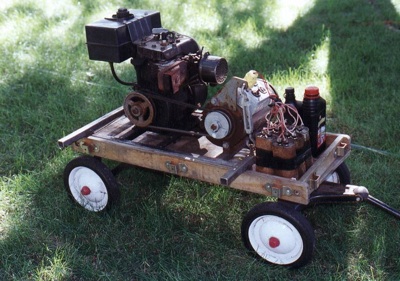
Homegenerator

Dan says: "It is made from a 6 horsepower Tecumseh engine and a 1 horsepower 3450 rpm induction motor. I had the gas engine and frame that had been given to me from a friend. My brother had an old water pump motor he was willing to donate to the cause, and my brother in law knew where to find several motor run capacitors and picked them up for me. I got an outlet box, outlets and a pulley from my favorite hardware store and I was all set to experiment.  I worked (well...I played around with it...I can't call this work) with this alternator for the last few years, powering Christmas lights on the house, heating my Scamp travel trailer, running an electric weed wacker around the yard (the world's only gas-electric weed wacker) and other miscellaneous duties. Voltage regulation with this machine is not too bad for an unregulated mechanical device. At no load, it will produce about 130 volts. With a 1500 watt (125 volt) heater running, I see about 100 volts (or about 830 watts). To my disappointment, it would not start my furnace fan. This is because the surge current required to start my furnace fan is well over 8 amps. If you overload an induction generator, it simply stops generating.  All this experimenting has little practical value for me. To show how futile this interest in emergency generators actually is, there has been exactly one day during the last 5-6 years I had a chance to truly use this as an emergency generator when the power failed for a couple hours. I used it to power my computers so that I could surf the web. That's why this is a hobby, and nothing more."

Posted on October 3, 2006 at 9:17 PM | Comments (5)


Comments

How about some details on the "motor"/generator wiring. The Make link said you were using a DC motor, which would of course be simple. (Like a treadmill motor) How do you excite an AC, capacitor-run induction motor as a generator?

Posted by Dave on October 4, 2006 at 12:18 AM

an ac motor would have been much more efficient

Posted by c6jones720 on October 4, 2006 at 1:28 PM

You left a lot of important information out. Like the link to the web site where I learned how to hook this all up - http://www.qsl.net/ns8o/Induction_Generator.html

... and a link to my web site: http://www.n0kfb.org/

-- Dan Meyer

Posted by Dan Meyer on June 3, 2009 at 8:30 AM

You said, an induction generator will stop generating if overloaded. What is the cause, and what is the cure? Mine stopped generating.

Thanks

Posted by Craig on July 25, 2009 at 11:52 PM

For Craig:

I've never played around with these types of generators (beyond hand spinning an induction motor and measuring a voltage with a meter), but from what I understand, all you have to do is hook up the motor as a motor (ie, drive it with its rated AC voltage), and let it run for a few minutes.

What is going on is that there is residual magnetism in the rotor, which is what you are exploiting using it as a generator. Everything is find until you "overload" it; the residual magnetism is lost. Under normal operation, it stays around; I imagine that overloading the motor when generating causes excess heat in the rotor, which causes the residual magnetism to fade and/or dissipate entirely (just like exposing any permanent magnet to heat).

Posted by Andrew on November 16, 2009 at 9:02 AM


Post a Comment

Your Name:


Thanks for your comment. The words in the CAPTCHA box come from old book texts that are being scanned and stored by the Internet Archive. By entering the words in the box, you prove you are not a bot and also you help proofread the books. If the sample you see is too hard to read, simply click the recycle button to get another two. Don't forget to put a space between the words.