Street Use

October 2006 Archive

Instant Tourist Snapshots

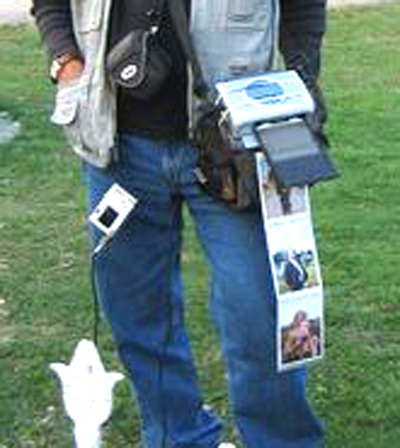
In contrast to the almost medieval instant photo process I featured from India, here is a modern update from Turkey. Reader Erik Fitzpatrick writes:

My wife and I were in Turkey recently and while we were in the plaza in front of the Aya Sofya (Hagia Sofia) in Istanbul, I noticed this photo vendor. But instead of the old-fashioned kid-with-a-polaroid, this guy had a digital camera and a battery-powered photo printer!
Turkeycamera

Posted on October 31, 2006 at 5:22 PM | Comments (1)


Handcuff Bike Lock

Jonathan Schreiber writes: Thought you might enjoy this bike-related street use that Justin found as we were walking from our offices to lunch in Sausalito (CA). A CHP Bike cop was getting a sandwich inside Golden Gate market. This what he used as his bike lock.
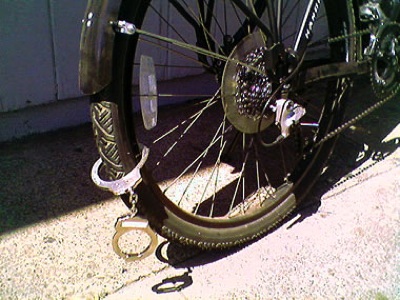
Handcuffs-As-Bike-Lock

Posted on October 26, 2006 at 12:50 AM | Comments (3)


Spring-loaded Chop Sticks

I'm not sure who much these are actually used. They may be simply a design project. But they look plausible. In fact, I think I'll make some for guests.

You remove the spring from a wooden or plastic spring clothespin, and insert it between two chop sticks -- perhaps with a little grove shaved on the chop stick shank. The result is a pair that is easy to use and requires no life-long skill to pick up grains of rice.

Springchop

Posted on October 26, 2006 at 12:35 AM | Comments (3)


Under Desk Duck Tape Slip Holders

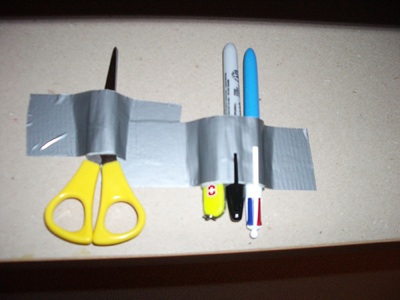
Quick! A nifty way to store desk utensils without cluttering up the desktop. Make customizable holders with duck tape stuck to the bottom of your desktop. The idea and photos come from benrodian. His instructions:
1. make little duct tape slots for everything you need at your table or desk. (yes, that is a glow-in-the-dark Swiss Army knife)
2. stick everything to the underside of the desk.
3. now everything is right there but the top of your desk/table isn't cluttered.

Desk Pocket

Posted on October 25, 2006 at 7:33 AM | Comments (0)


Rubber Band Hands Free Cell Phone

As far as I can tell this is not a put-on, or hoax, but a legitimate innovation born of desperation. And I believe others have discovered the same solution. (I'm always surprised more people don't use some kind of hands-free contraption.) If you know more about this particular picture (forwarded to me by Alexander Rose) please email me.
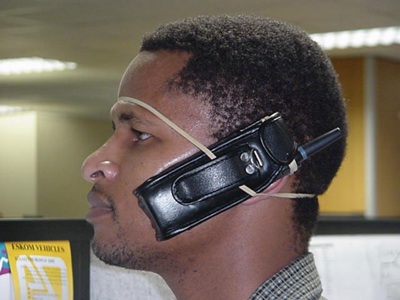
Handsfree

Posted on October 18, 2006 at 12:16 AM | Comments (4)


Mad Max in Vietnam War

Yeah, I'm on a vehicle mash-up jag these days. Here's another road-warrior-worthy vehicle. Remember those pictures of Mad Max war trucks taken in Iraq by Defensfor Fortis? They were not the first to hack an armored vehichle. Here's a snapshot of a jury-rigged tank made by GIs in Vietnam. This picture by Ralph Marchese was taken sometime in 1967, of the HHC 3rd/47th Infantry.
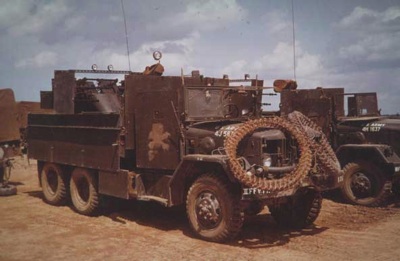
Homemade Tanks  9Th Inf

Posted on October 13, 2006 at 8:56 PM | Comments (0)


Homebrew FM Radio Station in India

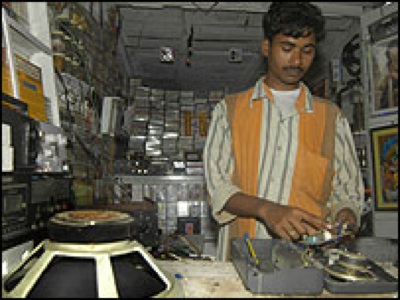
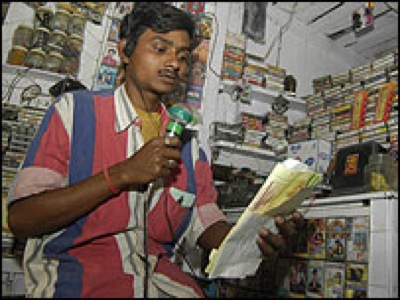
In February, 2006 the BBC.com had a good article on an DIY low-powered FM radio station operated out of a electronics repair shop. I'd be surprised if this was the only one in India (or Asia) like this. The owner-builder claims not to know that broadcasting required a license. The station, he says, just sort of grew from his junk and his interests.

"On a balmy morning in India's northern state of Bihar, young Raghav Mahato gets ready to fire up his home-grown FM radio station. It may well be the only village FM radio station on the Asian sub-continent. It is certainly illegal. The transmission equipment, costing just over $1, may be the cheapest in the world.

Raghavstation203


The transmission kit is fitted on to an antenna attached to a bamboo pole on a neighbouring three-storey hospital. A long wire connects the contraption to a creaky, old homemade stereo cassette player in Raghav's radio shack. Three other rusty, locally made battery-powered tape recorders are connected to it with colourful wires and a cordless microphone. The radio station is a repair shop and studio rolled into on. The shack has some 200 tapes of local Bhojpuri, Bollywood and devotional songs which Raghav plays for his listeners. Raghav's station is truly a labour of love - he does not earn anything from it. His electronic repair shop work brings him some two thousand rupees ($45) a month."

Raghavworking203

Raghav makes his living from repairing electronic goods.

Posted on October 13, 2006 at 8:51 PM | Comments (0)


Uganda Wire-Truck Toy

I really like this toy truck made by a kid in Uganda. It's a wonderful design. Note the steering wheel that also serves as a push stick. I like the airy wire cage -- a cool way to make a big truck with little material. Less is more, as Buckminster Fuller would say. This picture was taken by Bob Jones, a high school teacher in England who was on a learning trip to Uganda. The trip was, he says, "an investigatory project exploring the ideas of Citizenship and development in Uganda."

Uganda Toy

Posted on October 11, 2006 at 1:50 AM | Comments (2)


Hand Held Ink Jet Printer

Your arm moves the printer head in this home-made hand-held ink jet printer. Devised by a Dutch hacker, he calls it an electronic stamp. It can print on paper, white board, a balloon - anything you can move your arm over.

Tmb-Hpim3728


He writes on his blog, Sprites Mods, "In a normal inkjet printer the print head is moved back and forth with a motor and a guiding system. If however, we want to make a manageable device then it is not convenient to integrate this entire system into an electronic stamp. That is why we use only the cartridge together with some electronics that drives the head. Moving the head itself is a job for the user. When moving it is important to hold the whole assembly straight and move with a uniform motion across the surface. After a little practice this is quite easy to do.

Posted on October 10, 2006 at 11:38 PM | Comments (1)


Like a Peking Duck in the Water

More farmer-built vehicles. This one featured on the Chinese website, SHM, is an amphibious vehicle. Goes on dirt roads and rivers. According to a translation provided by the great China-watching website Virtual China, the inventor has applied for a patent for the thing.

Car

"On Sept. 25 [2006], 75-year old boatsman Hu Zeshen piloted the dual-use amphibious vehicle that he invented. Mr. Hu lives in Loudi city, Hunan Province, in southern China, and has spent his life working on ships plying China's rivers and canals. He calls his invention "the Happy Boat." The vehicle has a 5 horsepower diesel engine and a 1 horsepower electric engine.  He and his wife plan to take the vehicle on holiday during China's National Day vacation, to explore scenic waterways in other parts of his province.  Mr. Hu will apply for a patent for his vehicle, too."

Boat

Posted on October 10, 2006 at 5:30 PM | Comments (1)


Recycling Vehicles for Recycling

An independent documentary called "Pretty Dyana" captures the story of how Roma (gypsies) in Belgrade find old Citroen Dyana cars and modify them into mini-trucks that haul recycled cardboard.

Dyana2

They do this primarily by stripping the cars of everything except their motors, chaise, and steering wheel. Everything else goes. The Dyana is particularly suited for this, the Roma say, because the frame remains intact after you take everything else away. So they can easily add a bin on top of the back. And presto, now they have a cardboard hauling cart.

Dyana1

And because it doesn't look like a car anymore, it fits into some grey zone with the police. Not that they don't get fined for driving it around. All this and more about how the Roma survive in Belgrade is presented in this nice short documentary.

Dyana3

Note the plastic bottle gas tank.

Posted on October 7, 2006 at 4:20 AM | Comments (3)


Farmer-Built Submarine

The original source is in Chinese, so I don't know too much about this homebuilt submarine, other than it was built by a Chinese farmer. On inspection, I doubt it will even submerge; it is probably simply a boat with submarine decoration. I hope I am wrong.

Chinesesub

It appears on a site with a collection of other homemade vehicles, including a UFO.

Posted on October 6, 2006 at 8:43 PM | Comments (0)


Street Polaroid in a Box

I took these pictures of a portable street photo studio in New Delhi, India (I think) around 1975. I saw similar set ups in many parts of the Indian subcontinent (like Pakistan, Afghanistan, Nepal) in those years. They all operated the same way. It's a low cost, low tech way of doing instant photograpy. Here's how the system works.

Photostudio1 Sm

The box is both camera and darkroom. The photographer aims the lens of the large box at you while you are standing in front of a cheesy painted background on a hanging cloth. The fllm he uses is a piece of plain photo paper about 3 inches square, rather than transparent negatives.The tolerances for moving paper around are less than small bits of film, so the camera can be made of cardboard or wood. He then develops the photo paper in the same camera/box using small dishes of photo chemicals stored inside the box. He does this by inserting his hands through cloth baffles. He looks at what is happening via a red-filter window in the top of the box. When the "negative" is developed, he takes it out of the camera/darkroom box. He then places this negative image in front of his lens (you can see one of these negatives at the end of the rail extending from the camera in the snapshot below). This image is enlarged slightly on a second larger piece of photo paper, and this time when it is developed inside the camera/darkroom, it turns into a positive image -- a finished photographic portrait of you! So in fact, no film is used, only photo paper. The whole things happens in 5 or 10 minutes while you wait.

Photostudio2 Sm

Photographers can also do touch-up work on the inter-negative image with a very fine brush - taking out blemishes or adding highlights to eyes, etc. The final results were quite acceptable, and of course very inexpensive. Very few people outside of tourists had or could afford a film camera then, so this was a very affordable way for most people to get their picture taken when they visited the city.

I have no idea if such camera/darkrooms are still used today.

Posted on October 6, 2006 at 1:02 AM | Comments (6)


The Bottomless Ink Cartridge

From the extensive archive of repair culture at Jan Chipcase's blog Future Perfect comes these two glimpses of street vendors filling a need. The need is for cheap ink jet cartridges. Why not refill them while U wait?

051224-Hochiminh-067-Thumb
Here an ink refiller works in Ho Chi Minh City, Vietnam.


Fashionshoots-004-1-Thumb
This shop operates in New Delhi, India.

Posted on October 4, 2006 at 5:07 AM | Comments (3)


Homebuilt generator

In theory if you spin an electric motor, it should "run backwards" and generate electricity. So this guy, Dan Meyer, in Minnesota built a small generator using an old gas engine and an old DC motor.

Homegenerator

Dan says: "It is made from a 6 horsepower Tecumseh engine and a 1 horsepower 3450 rpm induction motor. I had the gas engine and frame that had been given to me from a friend. My brother had an old water pump motor he was willing to donate to the cause, and my brother in law knew where to find several motor run capacitors and picked them up for me. I got an outlet box, outlets and a pulley from my favorite hardware store and I was all set to experiment.  I worked (well...I played around with it...I can't call this work) with this alternator for the last few years, powering Christmas lights on the house, heating my Scamp travel trailer, running an electric weed wacker around the yard (the world's only gas-electric weed wacker) and other miscellaneous duties. Voltage regulation with this machine is not too bad for an unregulated mechanical device. At no load, it will produce about 130 volts. With a 1500 watt (125 volt) heater running, I see about 100 volts (or about 830 watts). To my disappointment, it would not start my furnace fan. This is because the surge current required to start my furnace fan is well over 8 amps. If you overload an induction generator, it simply stops generating.  All this experimenting has little practical value for me. To show how futile this interest in emergency generators actually is, there has been exactly one day during the last 5-6 years I had a chance to truly use this as an emergency generator when the power failed for a couple hours. I used it to power my computers so that I could surf the web. That's why this is a hobby, and nothing more."

Posted on October 3, 2006 at 9:17 PM | Comments (5)