Street Use

August 2006 Archive

Community Payphones of the World

The Payphone Project collects stories, pictures and phone numbers of pay phones from around the world.

Among their collection are these three representative payphones.
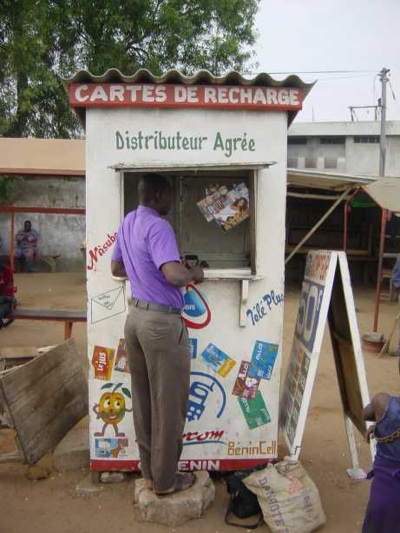

Benin Payphone
Community phone booth in Cotonou, Benin.
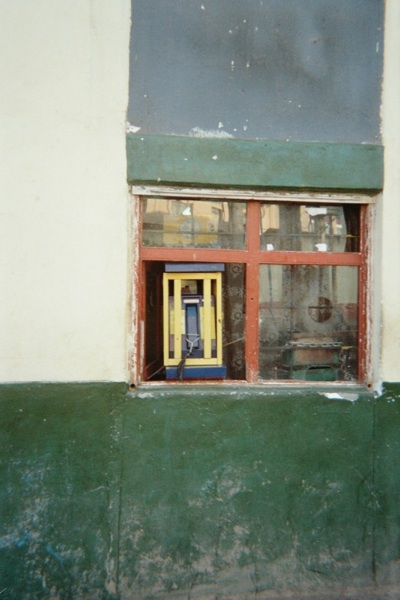
Cuzco Phone.Sized
Pay phone chained to the window of a store in Cuzco, Peru.
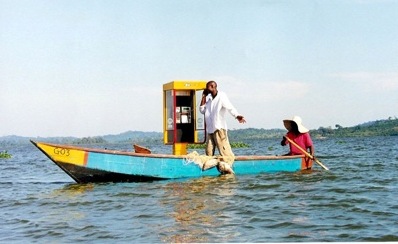
Lake Victoria Solar Payphone 01-1
Payphone on Lake Victoria in Uganda using GSM Technology and Solar Power. Photo sent in by Craig Wheeler, Remkor Technologies South Africa.

Posted on August 31, 2006 at 1:57 AM | Comments (5)


Matching Cardboard Luggage

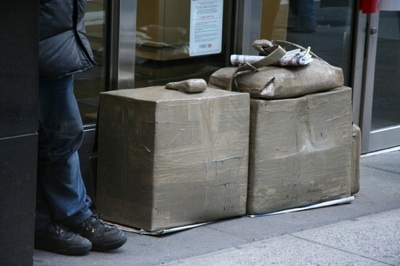
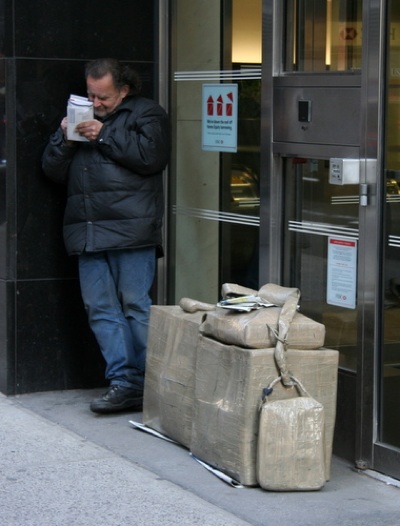
This guy has discovered several important facts. 1) If you wrap anything in cheap packaging tape, it is almost indestructible. And 2) Matching luggage makes you look very chic. This fellow, photographed in Manhattan by Street Use reader Michael Krakovskiy, accomplishes both goals at once. He's made his own extremely useful matching luggage from cardboard and tape.
Custom-Luggage-2

Custom-Luggage-1

Posted on August 30, 2006 at 2:06 AM | Comments (0)


Jazz on Bones: X-Ray Sound Recordings

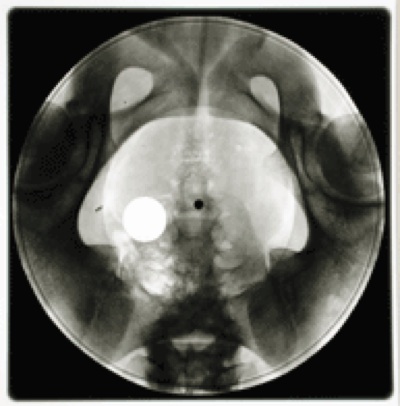
In the USSR and Eastern Europe in the 1950s underground night spots would play music pirated from the west. The only media they had were recorders etched into discarded X-ray film. I've long sought some images. Researcher Camille Cloutier pointed me to these, collected and posted by József Hajdú. Here's what he says about them:

During the late 1930s and early 1940s the prevalent sound recording apparatus was the wax disk cutter. As a consequence of the lack of materials in the war-time economy, some inventive sound hunters made their own experiments with new materials within their reach.
X-Ray1

I do not know the name of the inventor who first utilized discarded medical X-ray film as the base material for new record discs; however, the method became so widespread in Hungary that not only amateurs, but the Hungarian Radio made sound recordings on such recycled X-ray films.
X-Ray2

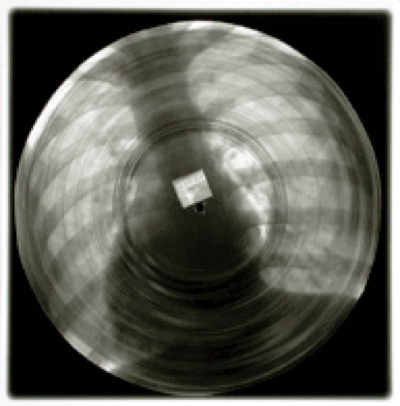
I felt that those X-ray record albums relate to our contemporary lives in many ways, especially when considering such terms as 'multimedia' or 'recycling'. I copied the X-ray films with their engraved sound-grooves on photosensitive paper and made enlargements of certain details.
X-Ray3

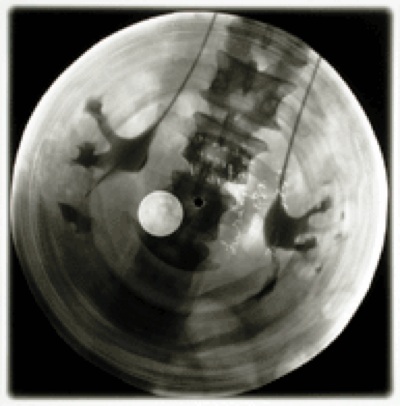
I was quite lucky to find a considerable amount of similar sound records in private collections. These are also interesting from the visual aspect. By utilizing different photographic processes, I created from them pictures meant to be exhibited in galleries.

In an online paper called The Historical Political Development of Soviet Rock Music, Trey Drake, at the University of California, Santa Cruz, offers further historical perspective on this street use of technology:

Owing to the lack of recordings of Western music available in the USSR, people had to rely on records coming through Eastern Europe, where controls on records were less strict, or on the tiny influx of records from beyond the iron curtain. Such restrictions meant the number of recordings would remain small and precious. But enterprising young people with technical skills learned to duplicate records with a converted phonograph that would "press" a record using a very unusual material for the purpose; discarded x-ray plates. This material was both plentiful and cheap, and millions of duplications of Western and Soviet groups were made and distributed by an underground roentgenizdat, or x-ray press, which is akin to the samizdat that was the notorious tradition of self-publication among banned writers in the USSR. According to rock historian Troitsky, the one-sided x-ray disks costed about one to one and a half rubles each on the black market, and lasted only a few months, as opposed to around five rubles for a two-sided vinyl disk. By the late 50's, the officials knew about the roentgenizdat, and made it illegal in 1958. Officials took action to break up the largest ring in 1959, sending the leaders to prison, beginning an orginization by the Komsomol of "music patrols" that later undertook to curtail illegal music activity all over the country.

From Artemy Troitsky's Back in the USSR: The True Story of Rock in Russia (1987, Omnibus Press):

The demand for pop and jazz recordings at the end of the fifties and beginning of the sixties was already enormous, while records and tape recorders were in catastrophically short supply. This led to the birth of a legendary phenomenon -- the memorable records 'on ribs.' I myself saw several archive specimens.

These were actual X-ray plates -- chest cavities, spinal cords, broken bones -- rounded at the edges with scissors, with a small hole in the centre and grooves that were barely visible on the surface. Such an extravagant choice of raw material for these 'flexidiscs' is easily explained: X-ray plates were the cheapest and most readily available source of necessary plastic. People bought them by the hundreds from hospitals and clinics for kopeks, after which grooves were cut with the help of special machines (made, they say, from old phonographs by skilled conspiratorial hands).

The 'ribs' were marketed, naturally, under the table. The quality was awful, but the price was low -- a rouble or rouble and a half. Often these records held surprises for the buyer. Let's say, a few seconds of American rock'n'roll, then a mocking voice in Russian asking: "So, thought you'd take a listen to the latest sounds, eh?", followed by a few choice epithets addressed to fans of stylish rhythms, then silence.

Both the shtatniki and beatnicki were few in number and their heyday was brief. The imitative, decorative style and American mannerisms they cultivated were way out of place in the early sixties, when Soviet youth was full of euphoric enthusiasm over the fliht of Yuri Gagarin, the Cuban revolution, and the programme proclaimed by Khruschev at the 22nd Party Congress wherein Communism would be achieved within the next two decades. Decadence and disaffection were completely out of style.

I'd love to find out more about this street use. Pointers welcomed.

Posted on August 28, 2006 at 7:29 PM | Comments (18)


Chrysler Motel

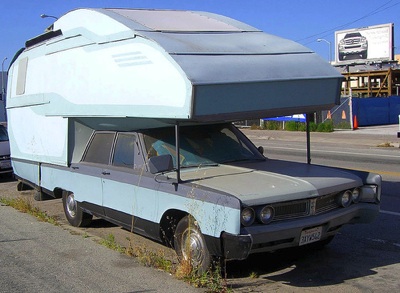
Friend and Street Use reader Todd Lapin sent this nice catch along. It's an old Chrysler converted to residential mobile housing. He says it's been an inhabitant of the SF waterfront near Islais Creek for years. If you are going to live in your car parked on a public street, why not alter it so it gives the maximum comfort and privacy? He writes in his Telstar Logistics blog:

"This 1960s-era Chrysler station wagon has been given a remarkable DIY residential conversion. It isn't used for weekend trips; the owner lives in it full time. That explains why there are so few windows, and why there's a big skylight on the roof -- fewer street-level windows means far more shelter from prying eyes. We've seen this car a lot over the years, and we've noticed that it moves frequently, but never far, within the waterfront district."

Chryslermotel

Posted on August 28, 2006 at 6:56 PM | Comments (0)


Rooftop and Building Sides Theaters

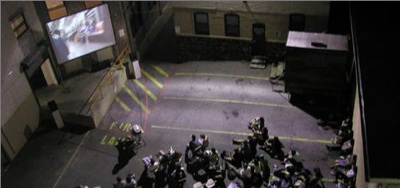
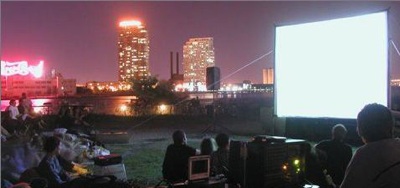
This is literally street use of technology. Projecting films for the neighborhood at night is not a new idea, but hi-tech digital projectors make it possible on a much smaller scale. In New York City a group called Rooftop Films will rent equipment or help communities set up movie projections during warm summer nights. But anyone with a cheap digital projector can do their own show in their own neighborhoods. You need a large white wall or screen, a projector, DVD player, sound, lots of chairs and a warm night.
Rooftopfilms1


Rooftopfilms2

Posted on August 25, 2006 at 11:58 PM | Comments (5)


Beach Sandal Curtain

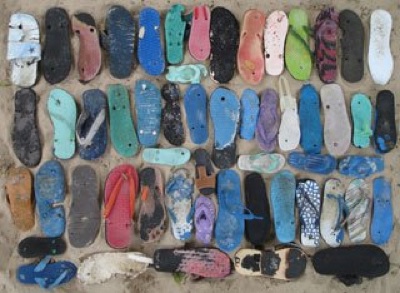
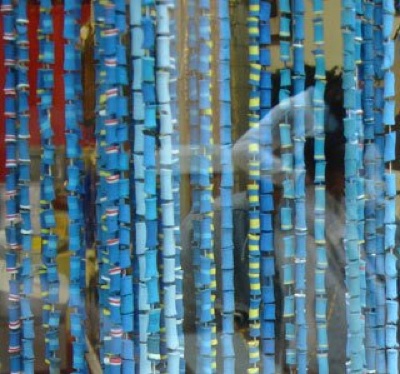
A large part of street use is recycling one product into another product. Often the new product is lightyears away from the notion of the designers of the original product. In Nairobi, Paul Merrill found this bead curtain made up of plugs from the soft foam in the soles of flip-flops. Flip-flop sandals are the standard issue shoe in much of Africa. Since they are so lightweight and wear out fast, they are constantly being lost or discarded. They wash up on the beach in large numbers. Here's Paul's collection from one morning's walk:

Sandals

But someone figured out they could be harvested to make a colorful bead curtain for only the cost of string.
Sandal-Beads

Posted on August 25, 2006 at 7:21 PM | Comments (0)


Quick Public Showers

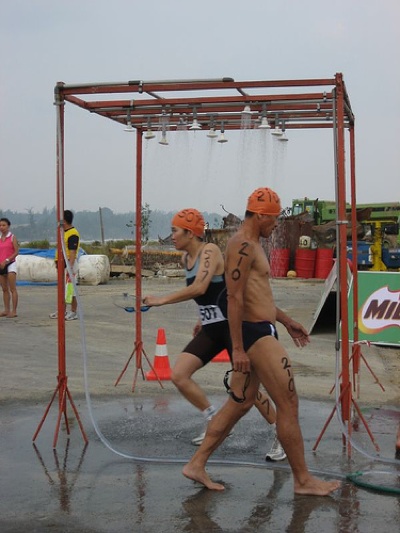
These makeshift showers were seen at the International Triathlon 2006, Marina Bay, Miri, Sarawak, Malaysia. Photo by Sharon.

Rapid Showers

Posted on August 24, 2006 at 9:56 PM | Comments (0)


Rice Sack Sails

Sails sewn from used rice sacks found on a boat sailing up the Niger in Mail between Mopti and Timbuktu. Photo by Crazyrabbit.

Ricesacksails

Posted on August 24, 2006 at 9:41 PM | Comments (0)


Makeshift Latch

Problem: wind blows door open in old hut. Solution: improvise a latch using metal grills and extension cord. This apparent hack was found in a hut apparently used by vagrants. Post on Flickr by Tak.

From the inside it looks like this.
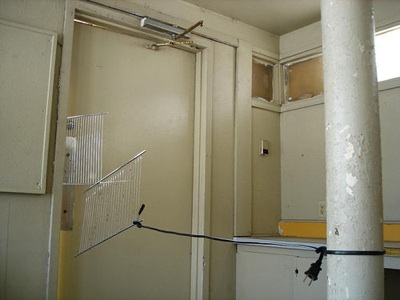
Latchout

From the outside, we can see how the latch holds.
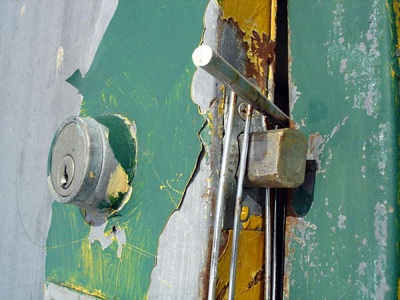
Latchin

Posted on August 24, 2006 at 9:24 PM | Comments (0)


Makeshift Bomb Trigger

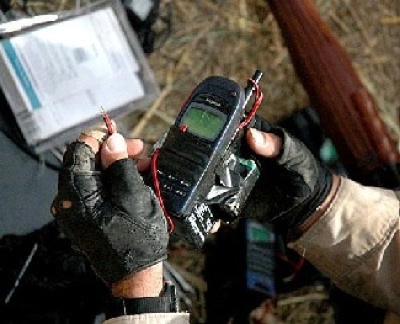
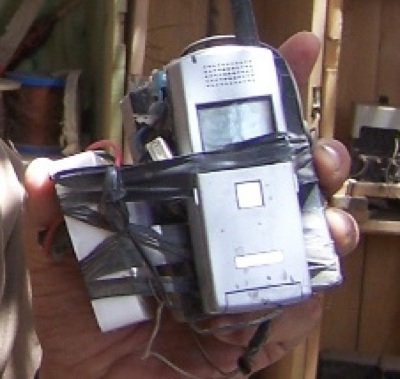
I found a few more examples of makeshift bomb triggers from Iraq. A soldier named Chris Heathscott posted this picture on the Black Five site. As they state: "Soldiers from the 39th Brigade Combat Team recently hit the jackpot in Taji, Iraq. After some intense fighting, they nabbed a terrorist leader and cache of weapons and items used for IEDs (Improvised Explosive Device). One type of trigger device found was a cell phone rigged up to a motorcycle battery which allows the trigger to remain operational for an extended period."

Ied Trigger

I don't know much about the second image:

Trigger

Posted on August 24, 2006 at 7:19 PM | Comments (0)


Improvised Explosive Device

An Improvised Explosive Device, also called an IED, is a street-made weapon. These are the uglies blowing up civilians and soldiers in Iraq.

This photo of one IED found in Iraq was submitted to Shock and Awe section of the US soldier bulletin board Military.com by Shain Chmura. He adds: Make special note of the "01 Call Missed" displayed on the phone.

Iedcellphone

I don't know anything about this device. The image is courtesy of the US Department of Defense.

Ied

Posted on August 19, 2006 at 5:27 AM | Comments (7)


More African Truck Toys

Paul Merrill, who is stationed in Nairobi, Kenya sent in another fine example of a homemade toy truck. This one uses sticks. He notes that he didn't have time to inspect the wheels to see what they are made from.

I find these trucks to be more than just toys. They are models as well. Or perhaps miniatures. They represent that mirror world that toy trains, dolls, video games, and board games represent. A parallel word, but a smaller one that a child can control. I think too, they also represent aspirations. They hope someday to have a truck, drive a train, have a baby, or command an army. Having one now, like a bit of "cargo" may help the real thing appear later.

Toycar1

Toycar2

Posted on August 19, 2006 at 4:47 AM | Comments (0)


Instant Car Camouflage

Here's a really odd homebrew solution. The car is a new model not yet released. The problem is spies. Like paparazzi, they stalk the test race courses and suburbs around car design centers, hoping to score a photo of a brand new never-before-seen car to post on the car-fanatic web sites or magazines, like Winding Road, where this one was posted. To thwart the spies from capturing anything useful while they test the vehicle, the designers will cover it with... well... stuff. In this case, cardboard, duct tape, foam, plastic -- anything that was around the garage. I nominate it as a great case of rapid prototyping. No one yet knows what this vehicle is. Speculation runs toward it being either a Toyota or Subaru.

Toyota-Hatchback-Rear

Posted on August 18, 2006 at 9:03 PM | Comments (2)


Fryer Basket Antenna

Lots of low-tech household items have been used to boost wi-fi signals, starting with Pringle cans and upward. But none have been able to match the decibel gains offered by a Chinese fry basket. This off-the-shelf item seems ready-made to accompany a laptop as it seeks a good signal in the park. Or near a den window. It has a nearly perfect parabola shape, and a handy bamboo handle. A guy in New Zealand named Stan Swan has devoted a web site to perfecting the fry basket antenna, where this image comes from.

Chinesefry

Posted on August 17, 2006 at 2:05 AM | Comments (1)


Bullhorn on Trike

From the ever-amazing Jan Chipchase collection of street use documents comes this cool instance of a bull horn mounted on a tricycle. Used to lead a funeral in New Delhi, India.

Bullhornbike

Posted on August 17, 2006 at 1:59 AM | Comments (0)


Naked Lorry

Reader Jason McCandless says he snapped this picture of a stripped cab-less lorry in Ayyuthuya, Thailand, from the back of a tuk-tuk. "It was the second one I'd seen when I was there, and it looks even more strange in real life."

Thai Truck Chasis

Posted on August 16, 2006 at 5:46 PM | Comments (1)


Homebrew High-speed Drill

There's a certain brilliance in making your own tools, either out of desperation, or because you can. You take one thing and transform it into something else that transform yet another thing. Here's a high speed drill (10,000 rpm) made from auto blower motor. The maker Aaron Gustafson says it works better than any of his other drills.

Homemadedrill

Posted on August 16, 2006 at 5:34 PM | Comments (0)


Oaxaca Mobile Stores

There is no end to the modifications of bicycles. The most economically important alterations though are the many ways in which mobile resturants and stores are created from bike technology, or to be more exact trike technology. The three wheeler is very stable and easy to maneuver.

Oaxacahotdogs

You can ride your store to the corner of the park and sell fruit and drinks. Note the cool awning.

Oaxacaicecream

You can haul a lot of stuff to your corner, including ice chests, burners, supplies and an umbrella.

Posted on August 16, 2006 at 2:58 AM | Comments (0)


Where Are the Pay Phones?

When everyone has a cell phone, what happens to pay phones? They adapt to compete. Not everyone does have a cell phone, yet, so those without one want an easier way to make calls rather than struggle with broken phones in booths that don't take the coins you may have. In China, an overhead sign indicates this tiny store will sell you a call on their working phone. Win-win for everyone. I grabbed this shot from this Flickr person.

Chinapayphone

Posted on August 15, 2006 at 6:45 PM | Comments (0)


Airconditioner Fan Hack

This is a lovely hack. A guy takes copper tubing wrapped in a spiral around both sides of an electric fan. The tubing is connected (via cable ties) to an aquarium pump which circulates ice water held in a plastic storage bin beneath the fan. The fan then dispenses the cold into the room. A full set of pictures can be seen on the guy's Flickr set.

Airconditionerhack

Posted on August 15, 2006 at 6:27 PM | Comments (4)


Utility Vehicle

Bob Travis posted this picture on his Flickr site. He says it is a presumably still running utility vehicle used by an organic farmer to haul stuff on his one-man farm.

Utility

Utility2

Posted on August 11, 2006 at 3:00 AM | Comments (4)


Boy-built Toy Truck

I really find these homemade toys and trucks to be lovely. Yet, I know every kid with one of these boy-built toys would trade it in a second for a mass-produced plastic truck. This example comes from the Solomon Islands. I found the picture on the UNICEF Childrenssite.


Solomon Truck

Posted on August 11, 2006 at 2:52 AM | Comments (3)


Beach Ferry

We're on a homemade truck roll. Here is another one from Thailand. Used on the beach to ferry tourists. Note the really cool bench over the front wheel. Thanks to Hobotraveler.

Hobo Beach Truck

Posted on August 10, 2006 at 7:08 PM | Comments (1)


Street Tech in Asia

A group of photos capturing the ingenuity of consumers adapting or inventing technology have been circulating on the internet for the last year. Here are three of them. I don't know their origin, but would like to. If you know where these came from, who took them, etc., please write me. In the meantime I'll make my guess at what's going on.

Donkey Truck

I am not sure, but I think these guys are simply moving a truck cab. I can't think of any reason why it would be used as a vehicle.

Streetcleaner

Chinese brooms are used at an angle, rather than the western perpendicular mode. Here they are inserted into a spinning hub to make a street sweeper.

Shovel Pan

No pot or pan? We'll you have an iron shovel, right?

Posted on August 10, 2006 at 6:40 PM | Comments (2)


Improvised Truck Armor

It would be hard to find a better example of "street use" than these hardened street trucks outfitted for desert war. A guy named Defensor Fortis, who was stationed in Iraq, posted some photos on Flickr of truck modifications performed by contractors. These are desperate attempt to protect a factory-issue truck from roadside bombs or enemy fire. They also boast their own artillery posts to return fire. When asked about the effectiveness of the jerry-rigged armor Defensor said, "I have seen no proof, but I imagine they're fairly safe from small arms fire and more than like fitted with "run flat" tires."

This one is a Ford Super Duty gun truck in Southern Iraq (Mar 06).

In southern Iraq a modified GMC truck used by a British company, April 06.
Iraqtruck4

In June 06, a gun truck in southern Iraq.
Iraqtruck3

From the rear gun ports you can notice the armor plate behind the glass.
Iraqtruck2
.

Posted on August 9, 2006 at 9:49 PM | Comments (2)


Dashboard Oven

MSNBC carried this story on August 3, 2006 datelined in Bedford New Hampshire about a women who uses the dashboard in her SUV as an oven to bake cookies.

Cookie oven

Blistering heat was just what Sandi Fontaine needed to bake cookies for her co-workers — on the dash of her Toyota RAV4. With temperatures soaring Wednesday, Fontaine placed two trays of cookie dough on the dashboard, shut the doors and retreated inside to her air-conditioned office.Fontaine first tested her dashboard oven three years ago. She said anyone can do it; the only requirement is for the outside temperature to be at least 95 degrees, so it will rise to about 200 degrees in the car. "When you open the door to that car," she said, "it's like, oh, my God. It's a wonderful smell."
Posted on August 7, 2006 at 10:02 PM | Comments (1)


Blackboard Headlines

As the New York Times reported August 4, 2006, a clever man in Monrovia, Liberia found a way to serve the latest news to those who not only don't have a RSS reader, nor a TV, they can't even afford newspapers. He carefully writes headlines on a large community blackboard. This "newspaper" has the largest readership in the city.

In a country where wheelbarrows fill in for pickup trucks, water is carried on little girls’ heads instead of in pipes and gallon-size jars replace gas pumps, it is perhaps no wonder that a battered blackboard serves as newspaper and newsreel all in one.

Mr. Sirleaf prepares his news summaries and editorials in the newsroom of his shed and often uses visual aids for those who cannot read. The man behind what is surely the most widely read report here in the capital is a self-taught newshound with little more than a high school education and a nose for a good scoop.

Blackboard1

He is Alfred Sirleaf, the 33-year-old managing editor of The Daily Talk, a white plywood shed trumpeting the latest headlines along Tubman Boulevard, one of the capital’s main thoroughfares.

For those who can read, Mr. Sirleaf writes up his succinct reports on the panels of his blackboard in a meticulous hand. “I try to write it really clear and simple so people can read it far away, even if they are driving by,” he explained.

For those who cannot read, Mr. Sirleaf has devised an ingenious system of symbols that transmit and sometimes subtly editorialize on the news. With the electricity story, hanging from the eaves of the newsstand on one corner was a kerosene lamp, next to an unlighted fluorescent bulb; on the other corner, there was a bag of drinking water, the kind young children sell to passers-by on the streets.

04Liberia.Large2

Every morning Mr. Sirleaf buys half a dozen newspapers and scours them for the most important developments. If they involve the United Nations peacekeeping force, for example, Mr. Sirleaf hangs up a blue helmet, the ubiquitous headgear for those forces everywhere. A chrome hubcap is the symbol for the president, who is called the “iron lady” of Liberian politics.

Inside his tiny newsroom he composes the day’s headlines on his blackboard, a meticulous process that can take a couple of hours. He carefully draws lines on the board with light-colored chalk to ensure that the words are written in a straight line. He uses a musty, tattered dictionary to check his spelling. In place of photographs he uses old campaign posters and other free handouts.

When a big story breaks, he has a painted “Breaking News” sign that he hangs like a shingle in front of his blackboard. The last time he used it was when Charles Taylor, a former president and warlord who started Liberia’s civil war, was arrested and turned over to a special court in Sierra Leone to be tried on war crimes charges.

He keeps on top of developments through a network of correspondents — friends who volunteer to be his eyes and ears — who send him reports via text messages to his cellphone. The shoestring operation brings him no income.

“I just manage along with whatever money I can find,” he said. Occasional gifts of cash and pre-paid cellphone cards keep him in business.
Posted on August 4, 2006 at 4:28 PM | Comments (1)


The Dangerous Beauty of the Shiv

William Drentell, writing in the blog Design Observer, reviews an exhibition of shivs -- crude knives made covertly by prisoners. He says:

A shiv is a weapon crafted from the limited resources of a prisoner’s closed world. Crudely constructed from such things as spoons, shoelaces and upholstery tacks, shivs lie somewhere between the graceful and the grotesque. They’re primitive, too — like outsider art, but produced deep on the inside.

The individual parts that make up a shiv tend to be everyday objects, innocent things furtively reconstituted as lethal weapons. Each design choice is essential, but what’s particularly notable is that shivs, at their core, are not so much evocations of minimalism as they are symbols of survivalism. A shiv is all about masked utility: it’s an innocuous object with improbably toxic intent (whether used to attack others or to protect oneself...).

The shivs shown here, from the collection of designers Chris Kasabach and Vanessa Sica, were confiscated more than twenty years ago from New Jersey’s Rahway Prison (now East Jersey State Penitentiary), a maximum-security facility that houses more than 1,500 inmates serving sentences of twenty-five years to life. The designers saw each shiv in their collection as a piece of evidence, and over time, came to identify a kind of unique design pathology. Their observations are fascinating, as are the artifacts that inspired them and the circumstances surrounding each object's unique method of manufacture. You’ll never look at a typewriter the same way again.

The photographs of the shivs were made by Brett Yasko for an exhibit at the gallery By Design called Dangerous Beauty: The Art of the Shiv, and the captions written by Chris Kasabach and Vanessa Sica. Among the collection were these two:

Shiv5

Materials:
Carriage return from typewriter; U-clamp attached to side; handle wrapped with boxing tape, string, upholstery thread and fragments of dried putty.

Backstory:
By law, prisoners must be provided materials to have an opportunity to prepare their own legal defenses. In the 1980s, typewriters were made available for this purpose: the long, notched "spear" here is the carriage return from a prison-issued typewriter. The handle, wrapped with tape, is likely to have been taken from Rahway's boxing facility, where several world-class boxers trained, including Rubin "Hurricane" Carter.

Shiv7

Materials:
Wood strip; five large razor blades glued into one side; six small razor blades glued into other and wrapped with boxing tape, rubylith and clear tape; handle wrapped with boxing tape.

Backstory:
Lifted from the facility's metal sign shop, this shiv is wrapped in "rubylith" — a red, masking tape classically used in signmaking (and, before the digital revolution, commonly employed by graphic designers in the production of "mechanicals"). Eleven disposable razor blades, available for purchase from Rahway's commissary back in the 1980s, are carefully inserted down the sides.
Posted on August 3, 2006 at 5:13 PM | Comments (0)


Home-made Car Repair Tools in Nairobi

The true craftsman makes his own tools. That's especially true where you have no choice. Eric writes in Afrigadget, a blog about appropriate technology in Africa, of the home made tools he found in the Jua Kali lawnmower repair shop in Nairobi, Kenya.

Tools for specific needs can be expensive or hard to come by in some places in Africa. It could be something as simple as a certain sized wrench that is needed to remove a particular bolt.

I decided to take a short walk in Nairobi and just see what caught my eye. Bernard runs a small engine repair shop on the outskirts of Nairobi, Kenya. Mostly, he fixes lawn mower engines for the wealthy people living nearby, however he also fixes about any other small engine that you can think of.

The tools shown below are just what he works with. Many times he has to fabricate pieces that would be impossible to buy, or to expensive for him to make a profit on. It is really amazing to see him work, and to watch the problem-solving take place.

African Tools-1

The tool below is a socket welded to some rebar.

rebar tool

Posted on August 3, 2006 at 10:21 AM | Comments (2)


Dumb Dumbbells

If you don't have heavy metal weights for your gym, you can use concrete and big rocks chipped to the correct form. Here is are some make-shift weight lifting dumbbells found in the Garrido Boxing Gym in Sao Paulo Brazil. Notice the tidy wooden pallet to keep the weights off the floor. The gym occupies a left-over space under a concrete highway flyover. The picture was taken by Jan Chipchase from his blog Future Perfect.
brazil dumbbells

Posted on August 3, 2006 at 9:56 AM | Comments (1)


African Homemade Toy Trucks

Throughout the world kids have always made their own toys. Toy trucks are popular. These you push with a stick to make them go over rough roads. Being a truck driver is what a lot of kids would like to grow up to do. Note the cool cargo.

This picture of boys in Mozambique came from Travel Images.

Mozambique128-1


This one is from Southing, a blog of two Danish travelers, Helle Gammelgaard and Mario Travaini.

Toyb

Posted on August 3, 2006 at 4:49 AM | Comments (1)


Redneck Technology

It's sort of a joke site, but some of the pictures captured by the website Redneck are legitimate attempts by folks to make do with what's at hand. And what is at hand is often old vehicles.

This one is a houseboat employing an old tow cabin.

Redneck Houseboat

And here is a root cellar (for storing vegetables over winter) that ingeniously uses a old school bus.
Redneck Root Cellar

Posted on August 2, 2006 at 9:27 AM | Comments (1)


Tool of One's Own

Lloyd Kahn found this hand-made tool on the workbench of Louie's On the River. It's a Vice-Grip with a 90 degree pipe elbow welded to it to serve as a handle that can rest in your palm and let you work it one handed.

P6302035-Lo-Res

Posted on August 2, 2006 at 8:49 AM | Comments (0)


Homemade Bike Light

Homemade versions of cheap stuff are made for two reasons: you have more time than money, or out of curiosity and nerdiness. This bike light was done for the second. Instructions for making one.
Mk3

Posted on August 2, 2006 at 4:40 AM | Comments (0)


Prisoner Tech

Inmates in prison are rightfully restricted from materials, technology, and resources of most any kind. But their desire for stuff is the same as anyone else's. With this mother of invention -- desperation -- they have taken their copious amounts of time and creatively developed some amazing counterparts to commercially available gadgets. This collection comes from a collaboration with a gallery, Temporary Services, and an incarcerated artist called Angelo. They put on an exhibit of items made by Angelo and others in prison.

A tattoo gun made from a discarded motor and copper wire.
Tack Gun

Paper mache dice.
Paper Mache Dice

Posted on August 2, 2006 at 4:16 AM | Comments (0)


Poles As Billboards

Telephone poles are supposed to hold up electrical wires, except when they serve as ad hoc billboards. I found this one telephone pole in my hometown of Pacifica, California which could be seen dead-on as you drove down a street ending in a "T". The pole has been covered by so many bills, posters, and sheets of papers nailed in over the years that it now has a sign ironically prohibiting its use as a sign post.


P1000314


Nails in pole


This billboard telephone pole glows in Oaxaca town Mexico
oaxaca billboard pole
.

Posted on August 2, 2006 at 4:01 AM | Comments (1)


Garbage In, Water Out

It's simple but elegant. A new garbage can gets a spigot and becomes a handy source of running water to wash one's hands in a cafe in a Oaxaca market.

Garbage can water

Posted on August 2, 2006 at 3:23 AM | Comments (0)


Slack In China's Wiring

It always makes sense to leave a little slack when you are doing wiring. Once you cut a wire, it's hard to "glue" back together again. So why do I find this massive scale slack in wiring on a downtown street in Shanghai so amusing? It's entirely logical. No sooner do you add one hookup, you're going to need to add another. In the developed countries, we hide our anticipation. In China they flaunt it. "Hey, we are growing so fast, there's no need to tidy anything up!"


P1010152


slack wiring 2

Posted on August 1, 2006 at 10:30 PM | Comments (0)


Never Say Die

There is something beautiful about how some old things are improved with repair. In Asia, broken large pots and fine china were usually mended by drilling holes near the edge of the broken pieces and then binding the shards together with flattened brass wire. Here are some ceramic pots in China that were mended this way. The small one I saw on the island near Shanghai, and the large one near a village in Zhuji (near Nimbo, also near Shanghai) used for washing clothes. They are very waterproof, and seem to work as good as new. But to my eye, the repair strands add a wonderful texture.
Mended clay pot


small mended pot

Posted on August 1, 2006 at 7:46 PM | Comments (0)


Real Fishermen Make Their Own Gear

On the local fishing pier in Pacifica, California, where I live, the fishermen have been busy modifying grocery carts to serve as movable tool boxes and gear haulers. There are many ethnic migrants here who are not afraid of making or altering something themselves. A common device is to affix sections of large diameter PVC water pipe to hold fishing poles.

fishing cart

Another guy uses a defunct carry-on travel bag for his tool chest.


tool chest


I like the use of plastic bottles for floating bobs.

bottle bobs

Posted on August 1, 2006 at 1:34 PM | Comments (0)


Ultimate Portable Knife Sharpening Contraption

I noticed this nomadic knife and scissors sharpening guy set up his contraption in a market near Oaxaca Mexico. He could roll it along on its single wheel. When he got a customer, he tipped it slightly so the seat was up. He put the leather strap in the bike rim and then he could sit and pedal the wheel. It would turn the grinding wheel, and he would merrily sharpen away, sparks flying. I've seen a lot of makeshift sharpeners, but this one was the most elegantly designed ever.

sharpener

Posted on August 1, 2006 at 6:16 AM | Comments (1)