Living on the Road
Klean Kanteen

Klean Kanteen offers a range of stainless steel water bottles that are well made, relatively lightweight, and come with a variety of interchangeable tops. They seal tightly (I pack them in my briefcase with my computer), even with the sport top. They're light enough to compare well with a plastic water bottle, but without the ecological waste of disposable bottles or the odor of reusable plastic bottles.
They come in various sizes (12 oz. to 40 oz.) and the 18 oz size fits nicely in a bicycle bottle cage. I take mine through airport security empty and fill it on the other side.
[The new Sport Cap 2.0, a sport cap perched alongside a loop, is a particularly cool and functional design. I prefer them to Sigg bottles (previously reviewed) for the simplicity of the Klean Kanteen's design and many cap options -- each member of my family uses a different one. Also, it turns out some older Sigg bottles contained BPA, though the company initially claimed otherwise. Klean Kanteen’s bottles are 100% 18/8 stainless steel -- they even have a stainless steel cap option now -- and there’s not any doubt about their safety. --es]
Available from Amazon
Eagle Creek

There may be a better product here and there in a particular piece of luggage, but it’s just not worth my time messing around to find out. I’ve replaced all of my duffels, carry-ons and backpacks with Eagle Creek products, and have been using them for the past two years. I’ve standardized on Eagle Creek luggage because I've found their stuff to be uniformly excellent, and it just saves me the frustration of trying stuff out and finding it has deficiencies.
Eagle Creek makes a handful of practical accessories for space-saving and orderly packing. Their Pack-It Folders compress lots of shirts, pants or skirts into a compact, wrinkle-free stack. And their Cubes are ideal for organizing underwear and socks while compressing them and maximizing space. They also offer Compression Sacs, giant Ziploc-like bags with one-way air valves that can compress your dirties into a fraction of their uncompressed size. All of these accessories work quite well with other brands of luggage; they are by no means specific to Eagle Creek.

Another reason I’ve chosen Eagle Creek: the company’s products are extremely rugged and have a lifetime warranty. I took them up on their warranty on a bag that got slashed. I live in San Diego and found that I could just take it by their headquarters rather than mail it in. They gave me a new bag, no questions asked.
Just to qualify as an experienced traveler, I’ve accumulated more than 6 million lifetime miles in the American Airlines AAdvantage program, more than two million on United, and a million on two or three others.
Eagle Creek Universal Traveler Backpack
$120
Available from Amazon
Eagle Creek Travel Gear Pack-It Folder 20 Organizer
$30
Available from Amazon
Manufactured by Eagle Creek
Contigo Autoseal Mug

Far and away the best travel mug I've used is the Contigo Autoseal Stainless Steel Mug. The Autoseal mechanism is the most leak-proof design I've found; it seals automatically when you're not actively drinking from it, so there's no worry about knocking it over with the top open. This is the only mug I'll use around my computers now.
I had a terrible experience with the Oxo mug. It was impossible to clean due to the enclosed design of the lid, and eventually accumulated way too much gunk inside for me to be comfortable using it. The lid on Contigo’s mug is fairly open and easy to clean, and the entire thing is dishwasher safe, though they also sell a model with a colored body that isn't. They sell replacement lids for $7 if you have a problem, but I've been using four of them for over a year in heavy rotation with no issues.
Contigo also makes plastic smaller containers for kids and larger water bottles (both of which are BPA-free) with the same Autoseal design.
Available from Amazon
Manufactured by Contigo
Knirps Umbrella

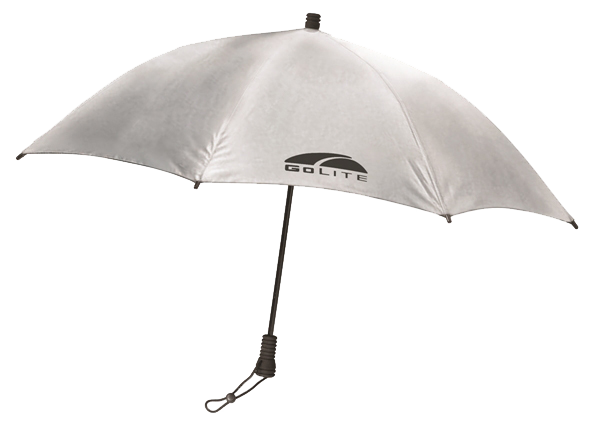
I live in London, which is pretty rainy, and so the Knirps X1 I’ve had for many years has seen plenty of use. It’s both highly durable and extremely compact: it folds down to the size of a two D-cell Maglite (about 6 ½ inches). Folded, it’s much smaller than the GoLite umbrella previously reviewed on Cool Tools, which is 25.5 inches long and doesn’t collapse. The Knirps is just a few grams heavier, and its coverage radius (37 inches) is 16 inches wider than the GoLite’s.
It's an excellent compact umbrella, but the trade-off for its extreme portability is a too-small handle. The minimal size of the X1 leaves little room for a proper handle, and therefore the design incorporates a shallow cup into which the canopy tips slot when the umbrella is folded. The cup is about an inch and a half in diameter — too small and shallow to offer much purchase in windy weather.

This makes using the wrist-loop (which, to its credit, is strong and firmly attached to the cup) a must. I hold the cup low in my hand and grip the tube above it like a golf club — thumb pressed on the tube, with the first two fingers wrapped around it. This isn’t so comfortable for prolonged use, but it’s enough to hold the umbrella steady in gusty weather, although not steady enough to stop it being blown about a bit.
Available from Amazon
Manufactured by Knirps
Thermos Nissan Travel Mug

I’ve had this coffee mug for about five years (coincidentally the length of the warranty), and it’s held up very well. It keeps stuff hot, and is usually on-hand thanks to the included carabiner.
I haven’t tried the OXO Liquiseal Travel Mug for comparison, but my Thermos Nissan mug is very easy to keep clean. It’s dishwasher safe; the OXO mug isn’t. The lid on my mug can be popped apart with a small coin for cleaning, and its silicone O-ring is also easily removed if it needs a wash. The bottom rubber cap can also be pulled off to be cleaned, and the black silicone hand grip around the mug can be removed, too.

I am never worried about leaks in my car, on my camera bag or inside my backpack. I love the handle-ring combination because the handle fits into my pocket while the mug remains outside; though not the most secure way to carry the mug, it is a great option when my hands are full. When I lose or destroy this mug I'm going to get the exact same one because it is the ultimate on-the-go coffee cup.
Available from Amazon
Manufactured by Thermos Nissan
Mountainsmith Day

The MountainSmith Day Pack is a cool tool that I've been using continuously for eight years now, and can't imagine how I lived without it prior to that. It can be carried with the shoulder strap like a messenger or shoulder bag, by the handles like a normal utility bag or using the comfortable lumbar waistbelt.
The size of this pack is ideal for me, with enough room for a 12" PowerBook and a couple of books or a full-size DSLR with spare lenses and room left over. The two water bottle pockets give easy access to water when hiking or walking. The bag’s exterior has multiple points to strap or clip to (extending carrying capacity) and the elastic rigging adds flexibility as well. The main compartment has an additional hanging pocket that is a great place to keep a few pens, a small Moleskine and more.
After seven years using my original Day Pack, I upgraded to the new model last year, which has some design improvements and is made from 100% recycled PET plastics.
--Mark Helberg
You can carry a Mountainsmith over one shoulder, two shoulders, in your hand or clipped onto your hips -- like a fannypack but not a fannypack. The belt cinches the pack into you; properly adjusted, it's as close to you as your own skin. No sway, no shift, no rub.

Buy a Day or Tour pack with Strapettes, to convert it into a daypack, and your grandkids will inherit it and take it to space camp on the moon.
-- Jeff Pulice
MountainSmith Day Pack
$65
Available from Amazon
Mountainsmith Strapettes
$22
Available from Amazon
Manufactured by Mountainsmith
Rick Steves Convertible Carry-On

I lived out of a bag for most of the past year, traveling with my wife. We visited 11 countries and used all manner of transportation. I used Rick Steves’ Convertible Carry-On Bag, and my wife used the less expensive Back Door Bag.
These bags were great. They were tough enough to withstand our daily abuse; and quite light. The Convertible Carry-On had just the right number of pockets: enough to keep some organization going, but not so many that the bag is all zippers. None of the zippers on either of our bags has given us any problems.
Wheeled bags like the Travelpro Rollaboard are great if you're going to be places where you can use the wheels all the time. While traveling through poorer countries there often isn't a good surface for rolling luggage, and the instant you have to carry the bag the extra weight really hurts. The harder shell on those types of bags obviously protects your stuff better, but also makes it harder to stuff under seats.

I only expanded my bag (using the perimeter zipper) a few times, and barely used the waist belt, but it sure was useful when I did turn to these features. The small size (9 x 21 x 14 in.) was great when stuffing the bags under bus seats. Despite the fact that the bags conform to maximum carry-on size, we often checked them because we exceeded carry-on weight limits: Our filled bags are about 28 lb., while we encountered weight limits that were typically around 22 lb.
Of the many things I purchased before our trip, this bag was one that I've never second-guessed. I wouldn’t hesitate to buy another one if this one ever shows enough wear to warrant it.
Available from Amazon
Manufactured by Rick Steves
Chrome Metropolis

Backpacks distribute weight better and more comfortably for longer rides or commutes; messenger bags excel for errand runs that include multiple stops. That’s why, I’m told, messengers use them. Writing and editing reviews for Rodale's MountainBike.com years ago gave me the opportunity to try lots of gear, and I’ve used high-quality messenger bags from Manhattan Portage and Timbuk2, among others. It's a tough field. Most of what's in this category is a solid buy. But Chrome bags stand out. Chrome’s Metropolis is at least as durable as its competitors, but with better attention to details, my favorite of which is a ’70s-era seatbelt buckle connecting the main strap.
It seems gimmicky but it's not. The buckle strap closure means you don’t have to heave a loaded bag all the way over your head -- just unbuckle, pull the strap over your shoulder and rebuckle. It’s as fun as it is utilitarian.

Chrome's Metropolis is expensive, and well worth the price if you live car-light and don't use a rack and panniers or Xtracycle. My Metropolis bag is about a decade old and going strong, if a bit faded. I wash it every couple of years. It's one of the best-designed and -constructed things I own, and there aren't many tools I'd be as comfortable recommending. The company offers a lifetime guarantee, and I know from personal experience (in a non-media capacity) that Chrome’s customer support is outstanding.
This bag took on a second life when my daughter was born. I wasn’t fond of the diaper bags my wife carried, so I used my Chrome bag for lugging the complex infrastructure that accompanies an American baby. The big main compartment and quick access suit the Metropolis well to this purpose, too, though the underside of the belt buckle rubbed my chest more when I was walking around upright than when I was hunched over the top tube of my bike.
Available from and manufactured by Chrome Bags
Travel John

I’ve used these for several years, and they’re great when the need to urinate calls but no facilities are accessible. I've found them useful while flying in small planes that don’t have a toilet, and also when I didn’t want to leave my tent in the middle of a rainy night to relieve myself. Long lines for the Port-A-Potties at the airshow with your kids? Problem solved.
I learned of the piddle pack concept while serving in the USAF. Back in the day it was a plastic bag with a sponge that wasn’t always successful absorbing all the urine. The technology these days, similar to what you'd find in a disposable diaper, is much better. A biodegradable polymer within the bag turns your liquid input into an odorless gel that won’t spill, and a unisex collar makes it ideal for the whole family. Keep some in your glove compartment. You won’t be sorry.

Available from Amazon
Monster Outlets To Go Power Strip

I travel to the developing world a lot and always carry several power adapters, but each only provides a single outlet. Using Monster’s mini-strip in tandem with an adapter, I get four outlets instead of one, useful for plugging in my laptop, Backberry, iPhone and/or iPod and charger for camera batteries. This compact power strip plugs into itself to maintain its minimal profile (6.25 x 2.25 x 1.8 inches, the cord is 12 inches fully extended) when not in use, so it easily fits into a laptop bag and is considerably smaller than a standard power strip. I have not been without it for more than two years, and it’s kept me off my knees hunting for power outlets on several continents.
Available from Radioshack
Digihitch

This a website promoting hitchhiking. You didn't used to need a website to hitchhike, only a thumb and pulse. I've spent a lot of time standing by the side of the road with my thumb out, and it led to some of the best days of my life. Times are different now.
What this site offers is mostly encouragement. Stories of other hitchhikers having a blast, reassurances that hitching is safe and legal, and suggestions about where in the world the natives are friendly to hitchers.
If you'll hitch, I'll pick you up.
-- KK

Isn't hitchhiking illegal in many areas? The short answer is: no.
*
Hitchhiking is not as popular in North America as it was 30 years ago, but it is still legal if one follows the laws of each state. Also, hitchhiking is still a viable mode of transportation in many other areas around the world, including Europe, parts of Asia, Africa, Australia, etc.
The most common law related to hitchhiking in the United States has been established in the Uniform Vehicle Code (UVC). It states:
No person shall stand in a roadway for the purpose of soliciting a ride.
What many people fail to realize is that a roadway is defined (in the same UVC) as:
That portion of a highway improved, designed or ordinarily used for vehicular travel, exclusive of the sidewalk, berm or shoulder even though such sidewalk, berm or shoulder is used by persons riding bicycles or other human powered vehicles.
As you can see, the law only states that hitchhikers cannot stand in a driving lane (good idea, huh?), but they can stand on the shoulder or sidewalk of a road. A further code mentions that US States have the right to restrict pedestrians (i.e. hitchhikers) from entering certain highways (interstate routes, for example), but must post a sign if this is the case.
What it all boils down to is this. Hitchhiking is not only possible in the US, but also legal. Many US States have adapted the above code to their own liking, though keeping a similar wording. You can research more about current hitchhiking-related laws in the digihitch USA section.
*
I held up a sign in Japanese: "Kaze o fuku mama, ki no mukoo mama," loosely translated to mean: "Wherever the wind blows, so too will my feelings take me." A folk singer I met thought it would be funny if I tried hitchhiking displaying this old song lyric.
It was funny. So funny, in fact, people stopped their cars to take pictures of me, and then drove away.
*
I had been stuck at an entrance ramp for hours [in Belgium]. I was joined by a six foot five fellow hitchhiker carrying what looked like a body bag.
A car stopped for us, and the woman inside hit the button to lower the passenger side window. She peered out of the opening at us. "Are you dangerous?" I shrugged my shoulders and said "Not me," turning to my fellow hitchhiker, "Are you?" "No."
She let us into the car. She was a child psychologist, specializing in abnormal psychology, claiming she could tell by our body language during the response that we were, indeed safe.
*

Double your chances of getting picked up by using a cardboard destination sign, like these from a European trip.
*
During the past fifteen years I've hitchhiked through over a dozen countries, spending months at a time begging rides. Everyone from grandmothers to soccer hooligans have stopped for me. Rebels pick me up to bond with a fellow outlier of the system, while law and order types give rides to keep me from harm, or to make sure I cause none. I've been treated to steak dinners, been given free lodging, plenty of free advice and even some cash. I've slept in driver's mansions, in rest stops, and in road side culverts. I've traveled at 150mph with an executive in a new Mercedes across the German autobahn, and I've limped through the hills of central Japan in a sputtering Toyota van with a Japanese rhythm and blues band.
William Gibson Aviator Briefcase

I recently acquired a new bag to tote the laptop computer that is my principal interface with the world in which I exist.
It's a bag designed by William Gibson, more commonly known for novels such as Pattern Recognition, in which a professional cool hunter named Cayce makes the sneaker-spotting consultancy of the real world's Faith Popcorn into the romantic material of digital age noir.
Nowadays Gibson makes stuff like bags, including this one, a beautiful product of ballistic cloth and "genuine horse leather." It includes a custom miniature MAG light attached to the zipper, to help one navigate through Gibsonian mapless territories, and a variety of pockets to stash digital devices, and maybe a Fluo Orange ballpoint pen.
The bag is labeled "Buzz Rickson's Flight Equipment." It's produced by the Japanese faux-WWII military outfitter whose replica aviator jackets were fetishized in Pattern Recognition as one of the only pure and comforting designs in the eyes of the novel's hyper-sensitive heroine. Porter is a highly regarded Japanese maker of custom bags, in this case for the growing "William Gibson Collection," which includes jackets, gloves and shoes.
Buzz Rickson's is a real-life company that should properly exist only in the imagination of Gibson (or perhaps Jean Baudrillard, since it's a Japanese atelier producing simulacra that surpass the original).
I was elated at this opportunity to personally possess tangible proof that the cyberpunk narrative has thoroughly overtaken consensus reality. I also rather needed a new laptop bag, so I placed my order with the exclusive San Francisco boutique which sells Gibson bags from its trendy storefront on Valencia.
There were three colors to choose from: cyberpunk black, bomber pilot khaki, and tank commander green. I went for the khaki, as it seemed more Global War on Terror-ready, with its Paul Bremer Timberland boot aesthetic.
I have had a lot of laptop bags over the years. In college, I had an insane foam-padded monster from Kensington designed to portable-ize my pre-Power Book 512k Mac Classic. My Patagonia cyber-backpack was adventure-ready, comfortable, roomy, Franco-Californian and indestructible, but couldn't hold a 15-inch PowerBook when I upsized. A beautiful chimera from Booq looked cool, but made me feel like I should be wearing a Space 1999 uniform to go with it (not a bad thing, necessarily, depending on your date). And my standard Timbuk2 black ballistic cloth messenger bag was seemingly bottomless. That bag worked especially well when I was getting around by bike on a daily basis, in weather fair and foul.
How does the Gibson bag hold up amid this fierce competition?
Price: At $530, it's at least twice the cost of any of its peers. Call that the simulacrum premium.
Utility: the bag has all the basics, carried out with wabi-sabi devotion to perfection and fine detail: An interior sleeve that can hold a 13-inch laptop. Holsters for three pens and two or three electronic devices and their accompanying cords. A zippered deep interior pocket for precious loose things, like maybe your passport, your checkbook, or your last stash of illegally procured Ativan. Another interior sleeve for letter-sized papers. Two snap-lock exterior pockets, styled like those you'd find on a pair of tactical pants, each about the right size for your laptop cord, a pack of American Spirits, a compulsively accessed Blackberry, or a tattered paperback about the flagellant messiah. An exterior sleeve to hold a folder of declassified documents, a copy of Wallpaper, the day's Financial Times, an Ace Paperback Original, or an old Penguin. A serviceable shoulder strap, and a very beautiful pair of canvas briefcase straps that overlay perfectly, snapped together by a separate leather dongle. Several carabiner-friendly exterior folds, one of which is pre-occupied by a leather strap dangling a key-ring. Perfect for carrying a hand grenade, a Make magazine IED, or a Paul Virilio postmodern information bomb.
This bag is made for traveling light. It is small, and does not expand like an accordion, or open a door into the Negative Zone in the way the big Timbuk2 bags do. You can overfill it with very little effort, for it is the laptop bag equivalent of a perfectly crafted postmodern Tokyo infill flat. My biggest pet peeve is that the exterior paper pouch cannot be closed over an 8 1/2 x 11 sheet of paper. Maybe it prefers Japanese-sized stationery.
The shoulder strap is not really designed for messenger-style carrying. Indeed, the bag works best when carried briefcase style, loaded only with essential electronics and the light mission dossier containing the glossies of your targets.
After several months of use, I have found that the bag achieves a very effective cyberpunk evangelism, for it really promotes going paperless. For a science fiction writer-slash-technology lawyer, prone to lugging lots of paper, its limited physical dimensions combined with its fetish design qualities retrain one's eraser-dust laden twentieth century bad habits as effectively as the constraints of a 140-character Twitter box.
Ruggedization: The bag does not have the extra protections of many other laptop bags: padding, waterproof liners, hermetically sealed pockets within pockets. Laptops are increasingly disposable devices for the accessing of networked data, and no longer need to be transported like Fabergé eggs. But the bag holds up well. Mine survived a trip to Mexico City for a conference on parallel worlds (at which the bag also served as a useful prop for illustrating the infiltration of consensus reality by imagined cyberpunk worlds). The bag also survived any mutant strains of influenza and took no permanent stains from Mark Dery's escamoles. A Saturday morning drenching by an entire plastic pitcher's worth of Texan iced tea left it unscathed, while the dutiful laptop slept cozily inside. The current editor of COOL TOOLS was there at the time and was laughing his ass off.
The verdict? This is the rip-stop fabric bag that tore the fabric of reality. It features a seal of approval from the Gomi-no-Sensei himself -- the William Gibson name carved into the horse-leather, in a perfectly incongruous Japanese designer simulation of your second grade teacher's perfect cursive.
All good karma for this laptop and its contents, meriting a mostly-unqualified thumbs up.
Sometimes available from Self Edge
Additional Food for Thought:
![]()
Books That Changed My Life
![]()
Synthetic Worlds
![]()
Veto Pro Pac Tool Bag
![]()
Tom Bihn Brain Bag
![]()
Dandux Coal Bag
Minty Boost

The Minty Boost is a small, make-it-yourself, battery-powered charger for USB devices, built into an Altoids gum tin. The tin is not absolutely necessary to the device's operations, but it protects the works, makes the charger portable, and looks great. Minty Boost runs on common AA batteries (I use rechargeables), so it's easy to use on the road. I enjoy that I can boost the charge on my iPod without having to surrender a USB port on my laptop. According to inventor, Limor Fried (aka "Lady Ada"), a MintyBoost will run an iPod 2.5 times longer than a 9V USB charger. Minty Boost is well-known in the world of open-source, DIY technology, but obscure in the mainstream, because Fried does not sell them pre-assembled. Instead she offers fairly-priced kits, as well as free parts lists and DIY instructions on her web site ladyada.net. Sometimes you can find assembled Minty Boosts for sale on the site's forums for a slight markup. I was lucky enough to receive mine as a gift from my boyfriend, whose soldering skills far surpass my own.

OnlineClock

Some people are instinctive wakers who can rely on rising whenever, wherever they need to. That's not me. My schedule is always based on Eastern Standard Time, even when I am traveling, so I'm a bit paranoid when it comes to hotel alarm clocks. By far, my favorite travel alarm is OnlineClock: The weight is just right (zero grams, if you're carring a laptop); the price is perfect (free); and it's easy to use. The interface is fantastically simple: a big digital clock. Just select a wake-up time from the drop-down list, and raise the volume on your laptop to whatever level won't cause friction with the neighbors. When the time you've set arrives, your laptop sounds off like a conventional alarm clock. Brilliant! I've tried wrist watches, cell phones alarms, travel clocks and extra-loud vibrating clocks, but OnlineClock's interface is simple enough I can handle it even when jetlagged or dopey from too many hours awake, a standard my wristwatch doesn't always meet. I don't know how the site determines the correct local time, but it's been accurate for me both around the U.S. and in Israel.
Caveat: this works well for me because I typically go to sleep with an open laptop logging work-related messages, or playing an audiobook, etc. If you're unable to keep a laptop or other web-browsing device open, this isn't for you. Of course, there are other online clocks. Kukuklok has a wide range of tones, if you prefer to wake to a bugle. Avnoy has cool, artistic display, but it's Flash-dependent and there's too much information displayed on the screen for the mostly-asleep mode of my brain to handle. In addition, I'm sure there are plenty of resident alarm clocks that run as applications, but that's one more piece of software I don't need to keep current or transfer among machines, or care about cross-platform compatibility (company laptop is OS X, my personal machines usually run Ubuntu or other Linux variant).
The simplicity of OnlineClock keeps me coming back.
BoxWave VersachargerPro

The Versacharger is a combo 110V AC and 12V DC USB converter to charge phones, PDAs, and various other electronics. You just purchase additional USB connectors and "tips" as you go for specific gadgets. Even some GPS units can be charged with appropriate voltage transducers.
I've used this charger over a year, mostly when I travel -- greatly reduces the amount of cables, chargers, wall warts, and misc. I have to tote around. I keep all my devices (GPS, Palm T/X, cell phone) and charger in a small cloth, drawstring bag, along with a Ziploc bag for all the various tips (I use a gold marking pen to write which tip goes with which device).
It's worth noting, I prefer using the cords manufactured by Syncharger (maker of the previously-reviewed kwikSynCh). As opposed to the designated tips from Boxwave, the Syncharger cords have USB at both ends and you only have to change the "Mtips" for your device, which is both less bulky and less expensive (the Mtips are $7 each; the shorter kwikSynCh is $15 and the retractable Syncharger is $27; compared to the BoxWaves which can run $26). If you only need to charge one device, Boxwave's bundle price is great, and their miniSync (pic above) gives more flexibility and packs smaller. However, if you need to charge multiple devices, I think the Syncharger cords are much more convenient.
StashSafe 100 Hip Pack

I've worn fanny packs for over 20 years. The StashSafe hip pack is the best one I've found. Specially-geared to prevent theft, the strap has stainless wire embedded inside so no one can cut the strap and run off with it. The buckle's catch is hidden by a velcro-backed flap that ensures it's neither visible nor reachable.
I used my pack heavily on a recent 6-week trip through Central America. The fanny pack is heavier and bulkier than many others (ed.: 300 grams). But it features several compartments and pockets inside that can carry a lot of stuff. In my case: two cameras, wallet, change, pen, small notebook, magnifying glass, penlight, swiss army knife, passport, watch.
You can also attach a lock between the two zippers and a stainless steel loop so they cannot be unzipped (pic below). I think this is more for locking it up when leaving it in a hotel room (and you can lock the bag around any pole or object that it can't be slipped over). When I'm out and moving around, I go into it so often, it would be a drag to keep unlocking it, so I've never used a padlock.

Another item I bought from PacSafe, but never used it on my trip, was their backpack & bag protector, a stainless steel mesh web that fits over a backpack so you can lock it to some kind of non-movable post. None of my hotel rooms seemed that open to theft, but I'm sure in some parts of the world and in some neighborhoods, you might want added security (esp. with laptops, cameras, etc).

Pelican Weapons Case

Pelican claims their cases are waterproof, crushproof and dustproof. I have no reason to believe otherwise. I’ve dropped my 1750 weapons case countless times, driven in the rain with it in the back of my truck, and generally beaten it up. The inside always stays completely dry and it shows little sign of wear.
I mostly go duck hunting in Louisiana, so my heavy outdoor use is mostly seasonal, but even indoors you want something you can trust. When you spend a lot of money on a gun (like the Browning shotgun I own), you want it to last. In the past I've used soft cases, but I have friends who have always hailed Pelicans as the highest quality gun cases they owned.
After six months, I am completely convinced this polypropylene hard case is the last case I will ever need. Just holding it in your hand you can feel how durable it is, yet still light weight enough to be
manageable (about 26 lbs w/the foam). It also comes with a foam interior liner that is customizable so everything fits snug. In terms of safety, the 1750's padlock holes are protected with stainless steel panels. The case even comes with an unconditional lifetime guarantee, though Pelican's construction and quality seemingly deem it unnecessary.

Since purchasing this case, I’ve picked up a Pelican Micro Case, which works equally as well. Perfect for keeping a cell phone, wallet and keys dry.
-- Steven Domingue
While equipping a cryonics response team that has to carry all kinds of fragile equipment as checked airline baggage, I sampled four or five different brands of containers. We concluded without any doubt that the Pelicans were the best, and they also tend to be the cheapest, so long as you aren't tempted to buy them with the overpriced foam inserts. It's much more economical and more satisfying to buy polyurethane foam separately (e.g. from upholstery stores) and cut it to fit the objects which you want to protect. A bread knife with fine serrations is good for cutting foam; a utility knife is not good; a band saw with a thin blade is the best of all.
I've lugged Pelicans through all kinds of punishing conditions, and have never seen one experience any damage. They are heavier than aluminum equipment cases, but they don't dent, crack, bend, or break.
-- Charles Platt
Kindle

Yes, it is now time to get a Kindle. You all have likely seen the many reviews and hoopla around e-books. I myself had planned to sit on the sidelines and let some of this technology mature before purchasing an e-book reader. But when Neal Stephenson sent me an advance copy of the 960 page Anathem in PDF format, I realized that it was time for me to get one. I had played around with the previously-reviewed Sony version, but decided to purchase the Amazon Kindle (1st generation) which had recently come out. At the time, this was primarily because it had the widest available e-book selection, and it seemed like that would only get better due to Amazon's relationship with publishers (there are now over 240,000 books in Kindle format).
However, after owning a Kindle for several months, and having just upgraded to the Kindle 2, I have discovered the real reason why you want one. It is because you think of books that you want to read while you are reading other books. On the Kindle you have the unique ability to buy the book right then and there, while you are thinking about it, and it appears on the device moments later all via a free cellphone link they call Whispernet. This feature is one of the least discussed, and to me most useful parts of owning a Kindle, especially compared to the other readers out there. It is because of this feature that I am now reading more than ever.
The fact that the books are less expensive, instantaneous, and you can carry a whole library of them everywhere you go is just icing on the cake. The E-ink screen, built in dictionary, and search functionality are all as good as you want them to be. For those of you who like to travel light, e-books really excel; I even put mine in a ziplock and read it in the bathtub. So far I like all the improvements in the Kindle 2, my only wish is they could get an FAA exemption so I could read during take off and landing. Nevertheless, I made a new cover for Kindle 2 with my laser cutter out of a copy of Green Eggs and Ham (pics below). My Kindle is now FAA-approved :)


[Note: Amazon recently released a Kindle iPhone App. If anyone can report positively or negatively, please let us know in the comments below or via the submit page!]
Available from Amazon
SelectWisely Allergy & Emergency Translation Cards

These laminated cards display "strongly-worded" warnings ("I have a life-threatening allergy to XXX") in a range of foreign languages and even pictures where possible. While I have not seen these cards in use (nor have I used them myself), they really make a ton of sense. I had a friend once who was allergic to soy. Even in the States getting people to believe and deal with the allergy was difficult. Made me appreciate the plight of people who suffer from food allergies.
SelectWisely also tailors basic cards in more than two dozen languages for more than three dozen food allergies, plus phrases for vegetarian, vegan, gluen-free, and lactose intolerance. A great and simple idea. Sure you could mimic this easily with a printer and laminator, but the prices are not outrageous.
Dandux Coal Bag

Sometimes you just need to carry a lot of heavy stuff. For me it's usually books, either to/from the library, booksale, or used bookstore. One of the best containers I've found for hauling hefty loads is the classic Dandux Coal Bag. Made by C.R. Daniels -- known for their industrial trucks and carts, conveyor belts, outdoor gear, and even straitjackets -- this canvas tote is rated to hold up to 95 pounds and was originally intended for carrying rock or machine parts. L. L. Bean Boat/Tote bags are equally as classic, and more widely available, but I've found they just don't hold up like the Dandux ones. Some totes have slightly-longer handles, which lets you carry them over the shoulder. For me, being able to really load up the Dandux is worth having to carry it with your hands.
-- James Hom
Dandux Coal Bag
$27
Available from C.R. Daniels
Threat Level Backpack Panel

My son is 14 and while there have been no shootings or violence at his school, there have been incidences of guns. This 12x17 ballistic panel can be inserted into the back of a backpack behind the books or laptop to help protect the wearer from errant gunfire. It is a shame anyone even needs to think like this, but I've found the increased number of school shootings and violence so disturbing that I decided for the minimal cost, it offered better protection that nothing at all. In addition to providing my child with some measure of safety besides crawling under a desk, I wanted to increase my safety during this year's hunting season. I have been hunting for 20 years and during the past few years, I've heard about more and more hunting accidents. Compared to Kevlar body armor or vests, the price of one panel is far cheaper.
I took this purchase seriously so I did my due diligence. The panel is made of an Ultra High Molecular Weight Polyethylene (UHMWPE) Fiber composite textile that is actually more resistant to moisture decomposition than Kevlar has proven to be (the original trade name was Dyneema, but it is now a generic material). It was independently tested by HP White’s Lab in Maryland (the premier testing facility for NIJ testing standards). The panel met or exceeded the Level 3a standard, which protects up to and including 9mm full metal jacket and 44 Magnum handgun rounds (approx. 99% of all handgun calibers). Given the ballistics of those rounds and the velocities of those rounds, it only makes sense that buckshot would not penetrate the material, as well. The NIJ standard does not test for buckshot but the shape of buckshot and the lower velocity of the shot and unrifled properties of the projectile would make it clearly less powerful than a 44 Magnum bullet.
Overall, I am sure it will do a better job of protecting me from buckshot than a wool, fleece, nylon or leather or duck cotton jacket, one of which I would still be wearing for warmth anyhow. The panel tapers at the top, so it can insert easily into nearly every backpack, allowing my son and I to share it easily. Being roughly equivalent to the size of a standard pack, it fits quite nicely. It is not heavy or clunky, so there isn't any shifting around in your pack either.
The test result print outs from White’s Lab are posted on their web site (note: the file seems to only like to display properly in Internet Explorer). They also have some video on the site and on their blog of them test firing over 70 rounds at a panel with no penetration, from all sorts of handguns to 22 rifles and some type of shotgun. It is pretty wild to watch and is basically what impressed me enough to buy it.
Better than relying upon luck or the school to protect my son, if something tragic were to happen. And definitely decreases the chances of my having a hunting accident. Thankfully, I have yet to have to test it (and hopefully never will), but I feel confident it will protect me.
-- Sean B.

Threat Level IIIa Backpack Panel - Large
$155
Available from My Child's Pack
Boondock RVing

Components of an RV electrical system.
With a little bit of gumption you can liberate your RV from the leash of the RV parks. Run it untethered, off the grid. Camp in a wild place, or in a parking lot. Takes some advance planning, maybe some more gear, certainly a change of spirit. This book will help. While its technical specs are out of date by a few years, the general drift of the book's advice is right on. Like in anything else off the grid, there's much talk about batteries, inverters and cables. There is not much here about mail forwarding, etc, which is best covered by hanging out on the forums at Escapees, the watering hole website for full-time RVers.
Escapees is a membership club for full time RVers which offers a popular mail forwarding service. You can get your postal mail and packages forwarded in a hundred different ways and schedules. Since it is based in Texas, your official residence can then be located in a state without income tax. Its 35,000 members are eager to share their knowledge of the RV life with newbies.
Also, Workamper is a good online bookstore full of RV-related titles. Guides to: Finding work on the road, cooking, repairs, shopping guides for new rigs, directories of camp grounds, Rving in Mexico and Alaska, dealing with insurance, etc.. Also a book that lists what stores lie at each exit of the interstates! Most of the published lore focuses on snowbirding, and RV parking, rather than boondocking.
Overall, Boondocking RVing is the best book about the logistics of long-term nomadic RVing.
-- KK
Escapees RV Club and Mail Forwarding

The Complete Book of Boondock RVing
Bill Moeller
2007, 176 pages
$12
Available from Amazon
Sample excerpts:
Additionally, the cost of staying in private campgrounds is increasing, going up by a dollar or more per night each year. We recently read an article in RVBusiness magazine, written by a campground spokesman, that stated the industry envisions campground prices will eventually reach a level of 50% the cost of a midlevel hotel or more. Consequently, if you would normally pay $100 a night for a hotel room, you would pay $50 a night in an RV park.
*
Retail Stores and Restaurants
Retail and chain stores often have large, well-lit parking lots. We have camped at Fred Meyer, Kmart, and Wal-Mart stores (or Camp Wally as they are more commonly called). In fact, Wal-Mart carries an edition of the Rand McNally road atlas with an insert that lists all of the U.S. and Canadian Wal-Marts. other options might include discount warehouses, such as Sam's Club, or restaurants, such as Cracker Barrel and McDonald's.
*
Casinos are excellent places for convenience camping. We don't know of any casinos that prohibit overnight camping, unless they have a commercial campground. Of course, they expect you to patronize the facilities, so at least eat in their restaurants, which often have excellent buffets at reasonable prices. ... With the profusion of casinos being built all over the country, they can make great overnight stops with good food and entertainment. Some casinos have regular RV parks, but still allow boondocking in certain areas of the parking lot.
*

You can use flexible water tanks to transport water to the RV.
*
We have two catalytic heaters -- a small one (1,600 to 2,800 Btu), which is mounted on the wall, and a medium-sized one (3,200 to 6,000 Btu) we can move around as needed. We've kept warm in some below-freezing temperatures with the catalytic heaters as our only heat source.

Our catalytic propane heater with the folding doors that we made to protect the cabinetry near it.
*
There is a bit of controversy over whether 6-volt or 12-volt batteries are better in a battery bank. Two of the arguments for using 6-volt batteries are (1) there are fewer cables involved in series wiring, so there are fewer connection to corrode; and (2) in 12-volt parallel wiring, one of the batteries in a two-battery bank will receive most of the load and most of the charge, and therefore will fail faster than the other.
The first argument has some validity as there are fewer cables in series wiring, so there is less corrosion. The second argument is not necessarily true, if you wire the bank as shown above. if a battery goes bad in a 12-volt bank, you can just disconnect it and use the remaining one. You'll still be getting 12 volts. With a 6-volt bank, however, one bad battery means the loss of the whole two-battery bank.
*
Should you tilt your panels and follow the sun? ... We have seen rigs with their panels mounted on racks that allow them to swing around to track the sun. Frankly, this just seems like too much work to us, plus we don't really think it's necessary. Also, when panels are tilted up, they can be more easily damaged by the high winds that occur during the winter months, particularly in desert areas.

Three 100-watt solar panels installed lengthwise on the roof of a friend's motorhome.
Multi-Use Car Charger

I've been using this multi-use car charger in our older camper van for over a year. With two cigarette lighter ports and two USB ports, it is by far the best auto accessory for us power users and road warriors. It comes configured to plug into an unused cigarette lighter receptacle, but can also be installed with either double sided tape (included) or using removable tabs and screws (included) to permanently mount inside a vehicle. I wired ours directly to the Eurovan's wiring to replace the single cigarette lighter port near the driver's seat. Very heavy duty in construction, it's built like a tank. No heat, no troubles. It's made a great addition to the vehicle, which we use frequently during the summer and winter for multi-day trips. Now we can routinely power up our cell phones, window-mounted TomTom GPS and a laptop (with a 100W max inverter). The USB ports have worked great to power everything we've hooked up to it: iPod, cell phones, Bluetooth kit. While most chargers and inverters I've seen max out at 10 or 15 amps, this one handles 20 amps, which is enough for all four devices to charge at the same time. The total power we pull from this charger when simultaneously charging is maybe 10 amps, but it's great to have the option of using a bigger inverter to pull additional power. This unit also sports a removable 20A fuse on the back panel should anything go awry. The instruction sheet is clear and shows how to wire the unit to your vehicle without too much fuss. At under $20, an awesome deal.
-- Robert Cullinan
Multi-Use Car Charger
$16
Available from Amazon
True Wind Sailcloth Bags

These bags are made with real sailcloth, which has a very unique feel about it. As a sailor, I can tell you that Dacron sailcloth is very lightweight, extremely durable, and very water resistant. It is not damaged by sunlight and can take a lot of wear and tear. That's why it is such a great fabric to have in a duffel bag. I bought a large duffel myself and love it. The colors are vibrant and fun; the design is taken from marine signal flags). I use mine about four times a month, mostly when traveling on the weekends. During the sailing season, I'll use it just about every weekend while on the boat. The size I have (large) fits all my gear and space never seems to be a problem with what I need to pack for a weekend trip. There are other sailcloth bags out there, especially those made from recycled sailcloth, which is appealing in some sense, but you don't always know where the cloth comes from or the quality. All of True Wind's bags are made with new sailcloth that comes from an Irish company called Hood, which has a long history in the industry. The bag also just looks different and the quality is there. True Wind uses solid brass hardware, and personally, I like that they're made in the US. The company also offers monogramming, which wasn't available at the time I ordered mine.
-- Warren B.
True Wind Sailcloth Bags
$175
(various colors)
Available from True Wind
Related items previously reviewed in Cool Tools:
En Route 3-in-1 Travel Purse

You've previously reviewed wallets on Cool Tools, so let's have equal time, guys ;-) .This travel purse is actually the best everyday purse I've ever found. I've used and abused it for four years, and the purse still looks great. Its polyester microfiber sheds dirt and is machine washable. Best of all, the easy-to-open strap clips (satin brushed metal which continue looking good indefinitely) allow me to convert it to a waist pack in seconds. Worn as a waist pack, the front zippered section (with your money & credit cards) is easily accessible without removing the purse. It’s great for shopping and errand running. You can keep your hands free. You don't have to hold onto it or shove it out of the way. You can't put it down and forget it somewhere. Wearing it as a waist pack also helps deter pick-pockets and purse-snatchers, too. And, whenever necessary, you can convert right back to shoulder use in five seconds.
Here's a rundown of the interior: flat pocket under Velcro flap in front (good for receipts). Unzipping the front compartment reveals two flat pockets and one zippered pocket (cash), then two more flat pockets (checks in one), one fronted by 8 card pockets (each can easily hold 5+ cards), and a pen loop. The back zipper reveals a large compartment -- mine holds keys, cell phone, PDA, camera, folding brush, comb, lip gloss, sewing kit, mini first aid kit, tape measure, etc., I enhanced the inside of the back pocket by adding a Velcro strip, so small items don't vanish below.

I originally bought mine to improve my posture -- no matter how big a purse I get, over time I'll overfill it and gradually tilt sideways. Even the "healthy back" bags didn't work. This one's big enough to hold what I need, but small enough so it won't get too heavy. It's astonishing how much it can hold, but it's small enough that if you really must carry a designer purse for a night on the town, you can drop this little beauty inside.
-- Barbara Dace


En Route 3-in-1 Travel Purse
$35
Available from PackingLight
Or $40 from Amazon
Manufactured by En Route Travelware
Related items previously reviewed in Cool Tools:
Topeak Mini 6

This incredibly compact, bike-oriented multi-tool has five different sizes of Allen wrench plus a Phillips screwdriver head, all of which folds up into a little pod about the size of a walnut. Sometimes I'll carry it in my pocket or toss it in shoulder bag; mostly I keep it in the under-seat pouch of my bike. It really comes in handy for quick adjustments: raising the seat height, tightening the rear view mirror, adding and removing accessories, etc. Because it's so small it doesn't give enough leverage for really tight nuts (you can't remove a handlebar stem with it), but by extending the tools on the opposite side of the one you're using you can get a handle that's effectively 2.5 inches long, which is enough for small jobs. It also works well as a keychain fob, though at 58g it's slightly on the heavy side.
-- Dylan Tweney

Topeak Mini 6
$12
Available from Amazon
Manufactured by Topeak
Related items previously reviewed in Cool Tools:
Lights Out Sleep Mask

This mask has indispensable for daytime naps or when sleeping in barracks or tents with other people who like to stay up late. I was stationed for a couple months in Qatar and am currently stationed in Kuwait (that's as much as I am able to tell you without breaking OPSEC). The mask is more effective and comfortable than the other ones I've worn. You can open your eyes no matter the time of day and think it's the darkest time of night. It blocks the light most effectively due to the contour over the nose. With normal masks you get gaps on the sides of your nose, no matter how you try to position it or if it has a nose cut-out. When I got back from basic training five years ago I discovered I liked to take mid-afternoon naps. I found a silly sleep mask, pink with fake daisies on it. I was able to sleep, but I would wake up with my eyes all dried out. I eventually lost it and went through a basic satin sleep mask and also a silk eye mask that had little pillows attached to the bottom edge so it wouldn't smash your eyes. Once again, though, both of them dried my eyes out something fierce. Since this mask does not press against your eyes, it allows for moisture to draw out out along your eyelashes.

I have been using the mask almost non-stop for the last nine months. I don't use it nightly anymore, mainly because lately my roommate goes to sleep before me. I use it during the day when I have to work an overnight shift. I have a tendency to lose things so when it's something affordable I buy two. When I had a different roommate, we worked different shifts. She would borrow one of my masks, and we were able to each leave a light on for the other person so we wouldn't walk into a pitch black room. On one occasion, there was a horrific downpour that flooded our tent. Unfortunately one mask was drenched and when it dried out it the fabric started to come away from the foam. I continued to use it and the second mask I brought with me. The second mask's foam started to separate from the fabric when I had to fold it up to stick in my pocket and take it out and fold it back several times on my journey from Qatar to Kuwait. Even though the fabric is coming away on both masks, they are still comfortable and wonderful to wear.
In a few months I am going home because my deployment will be over. Even though I'll be back to being a "citizen/soldier" in the National Guard, I plan to keep sleeping with this mask. I don't have to adjust it five times to fall asleep or use eye drops after I wake up. And I love the sensory deprivation aspect. I have traveled a lot. On a plane I use the mask in conjunction with my iPod and an inflatable neck pillow. I love thinking that when I open my eyes it might be in a different place than when I closed them. With this mask I can pretend, until I take it off, that I am going to wake up at home in my own bed.
-- PFC Erica H Sandberg
Lights Out Sleep Mask
$10
(blue)
Available from Amazon
Related items previously reviewed in Cool Tools:
BDU Pocket Field Organizer/Wallet

I had seen these small pouches before, but didn't pay close attention until I saw photo of a fully-loaded one on Flickr. When I don't want to carry my whole gear bag, these are great for the bare essentials. Even when I do need my gear bag, the BDU is compact enough I just slide it right in, as is. It really helps keep my stuff organized. I fit five pens, including the previously-reviewed 0.18 mm pen, a Moleskine planner, Sony Clie PDA, ID and credit card, pocket knife and a small flashlight. You open up the wallet and it has slots for pens/pencils with a pouch behind that section that fits a pocket Moleskine perfectly. On the inside right, there's a flap with a clear plastic pocket for ID stashing. It can also fit a small portable music player.

Behind that is another pocket where I store my small LED flashlight and pocket knife (removed easily for air travel, of course). On the back are attachment straps that can be used as a belt mount - if you prefer a larger version of the Handyman Belt Organizer -- or to mount the wallet to another bag or gear. I am in the process of putting together a bug out bag with a small first aid/survival kit. I'll likely buy another BDU wallet just for that. After I started searching, I found there are various manufacturers (BlackHawk and Spec-Ops) and styles to choose from (some don't have the flap that can cost $18 to $30. I ended up getting mine for less from a surplus store on eBay.
-- Ivan Romero
BDU Pocket Field Organizer/Wallet
$8
Available from Arvada Surplus
or $10 from County Comm
[Photos on County Comm show how a medic transformed his pocket organizer into an impressive I.V. starter kit --sl]
Related items previously reviewed in Cool Tools
Eagle Creek All-Terrain Money Belt

Although you can certainly get cash in plenty of places overseas, in a good many others ATMs just do not exist. You gotta plan ahead: this nylon money belt is pretty much exactly what I've always been looking for in a money belt, because it's actually a belt. While traveling in Asia for six months, and on trips to Mexico, I've used a standard money "belt" that's really more of a pouch you tuck into your beltline. You then subsequently appear to have either a distended abdomen or a money belt tucked into your pants, which obviously contradicts the goal: fly under the radar. I can keep my documents and passport safely hidden elsewhere, thanks much. But for carrying cash through pickpockety or banditry-prone places, this belt with a slim, zippered pocket is a real winner. I happened to see it at REI just before I left for a three-week trip to Nicaragua. I did have some trouble getting people to accept my origami-style folded bills (I really loaded up the belt), which is ironic because I didn't find a single dry Cordoba in the entire country! Still, from now on, I will always travel with this belt.
-- Mathew Honan
The Eagle Creek money belt has another great feature -- the buckle is plastic, unlike many others with metal buckles, so it doesn't have to be removed during airport screening. Keeps your cash right where you want it, not on a conveyor belt disappearing into an x-ray machine and not out in the open where someone with a sharp eye might notice it.
-- Evan Marks
Eagle Creek All-Terrain Money Belt
$12
(black or brown)
Available from Campmor
Or $15 from Amazon
(black, palm or brown)
Manufactured by Eagle Creek
Related items previously reviewed on Cool Tools:
Balikbayan Box Cover

The Balikbayan Box Cover is a heavy-duty canvas bag with reinforced seams and side handles that's designed specifically to fit a 20" x 20" x 20" cardboard box. The beauty of the box cover is that after TSA officials inspect and reseal your box, they can zip up the top flap on the bag closed and your box is further protected from re-opening. The bag also helps guard your box (and its contents) from rough airline baggage handling. Gearing up for an extended visit to Moscow, my wife and I struggled to find a way to pack a large box of provisions that would still be well-sealed even after TSA inspection. I'm typically a minimalist when packing for trips, but this was a much different situation than your typical few days on vacation. I was concerned TSA folks might not be especially thorough about re-taping the box seams, which could lead to the box tearing open in transit. A Filipino friend came to the rescue with this simple, but incredibly effective solution (in the Philippines, when someone travels abroad, it's customary to ship his/her relatives a Balikbayan box filled with gifts/goodies). At 60 inches linear total, the box cover conforms to major airline luggage size restrictions, although it may take some creativity to keep the weight within the 50-lb. limit in this large of a box.
-- Rob O'Daniel
Balikbayan Box Cover
$27
Available from Balikbayan Gear
[The covers come in an array of colors, including "bubblegum pink"; helpful if you're looking to make a quick ID at baggage claim. --sl]
Related items previously reviewed in Cool Tools:
Col. Ichabod Conk Shaving Soap

After receiving some nasty shaving lotion in a foil package at a hotel, I went on a quest for a travel shave soap I wouldn't have to declare as liquid or gel at airport security. This soap comes inside a hinged, clear plastic container. Pack it wet or dry the soap off first with a towel or piece of toilet paper/Kleenex -- either way, you shouldn't have any water/dampness issues in your luggage, as it seals well. The soap foams up a little when you get it nice and wet, seemingly a bit more than regular soap. Based on my usage, I'd say it's good for at least 25 shaves (at the rate I seem to travel that should do it for life). Though ease of carry-on was my initial criterion, the quality of the shave, price, expected lifespan of the product, and the functionality of the packaging make this a great option. Bonus: it smells really good (I use the lime version).
-- Joseph Stirt
The soap lasts *hundreds* of shaves from my experience. I've tried all the flavours, but prefer the Amber and Bay Rum. I use these at home, a couple or three times a week. The tubs are all over a year old; the Amber is in its second year and is only now down to the bottom of the container. Of course, if one's making enough lather to shave a ship of sailors, it's not going to last as long.
-- David Priest
Col. Ichabod Conk Shaving Soap
$3.50, shipping excluded*
(lime)
Available from Amazon
Also available from Amazon in almond, bay rum, and amber
Or $3.50, w/cheaper shipping
Available from Best Grooming & Shaving Tools
Manufactured by Col. Ichabod Conk Products, Inc.
[*Before buying, please note the Amazonian shipping price ($8+); the best deal is to stock up on several at once or go in with some friends who also want to try one out -- sl]
Related items previously reviewed in Cool Tools:
Pacsafe Travelsafe

The Travelsafe 100 is a heavily reinforced, lockable nylon bag with steel cable woven through the fabric and an external steel cable which makes it possible to lock the bag to a stationary item (such as the frame of a bed in a hotel). The bag is 8+" x 13" and quite light. It's more of a deterrent to casual thieves, as a well-equipped, professional thief armed with a hacksaw or 5" bolt cutters could probably penetrate it (a knife would not be sufficient to cut the steel mesh). On a recent surf trip to Costa Rica, the hotel safe at the main office was only open 8am-6pm, and was basically unavailable given our daily schedule. I used the bag to store my digital camera, iPod, passport, wallet, traveler's checks and money by locking the bag to the hotel bed frame (my travel buddy also put some of his things in it, too). If you don't want to be burdened with a key, you can buy your own combination lock, though the spindle needs to be thin enough to fit. Pacsafe also sells lockable knapsacks, shoulder bags, computer bags, and even steel mesh covers to extend over large backpacks or suitcases. I chose the model I did because I wanted something relatively inexpensive and small enough to just hold valuables and electronics.
-- Carl Hamann
$45
Available from Amazon
Manufactured by Pacsafe
Related items previously reviewed in Cool Tools:
Art Comber

Efficient equipment, tool or "stuff" management is always an issue with creativity. With the Art Comber, I always have a portable art studio at my beck. I draw everyday, but attend paint-ins/outs a minimum of least once a month. It is one thing to simply draw with a pad and pencil; it is another to be able to get out of my vehicle or attend a workshop with a self-contained studio intact and, almost instantly, sit down and let colors fly and create. The seat is quite comfy, much more than a campstool. The average indoor dining chair seat measures 17"; the Comber measures 14 1/2" and the height is quite close to a regular chair, too. I've taken the Comber through a variety of terrain -- roadside, parks, reserves, beach, arboretum, poolside, barns, and other artists' homes. The relatively light weight is important since you are pulling and lugging around a lot of stuff.
My cart (approx. 21" x 8.5") holds: 1 digital camera (strapped on), 1 14"x18" cushioned lap desk w/metal clip-fastener, 1 sketch pad/book, 1 14"x20" watercolor-paper block pad, 1 ceramic/metal mixing pan (15 1/2"x 11 1/4"), plastic or paper trash bags, 1 12.5" x 9" clipboard, 2 collapsible canvass paint tube caddies, 2 brush caddies, 1 portable easel (use depends on style of painting), 1 tri-leg 23" x 3" camp stool (for an extra flat surfaced mini-table, if necessary), scissors, tape, water spray bottles, 4-6 stackable water containers w/closeable lids, Kleenex, jar or plastic bottle, bottle of water, sandwich, bug spray. I use portable caddies and Ziplocs to handle much of the stuff (erasers, glue tubes, sponges, frisket, rulers, water bottles, etc.). One improvement would be to add side pockets and a few compartments, so unpacking for the colorful spontaneous event would be even simpler. Until then, I am very pleased with the Art Comber and the caddy also serves as tidy storage when I am not painting.
-- Carol Watson
Art Comber
$50
Available from Jerry's Artarama
Related items previously reviewed in Cool Tools:
i-Blue 747 Bluetooth GPS Logger

Once you've got the GPS bug, you'll find there's a lot more than simply knowing where you are and where you're going. There's also knowing where you've been, so you can plot your bike rides in Google Earth, geolocate your trail photos after the fact, or otherwise track your movements. This requires what's known as a GPS "logger," which is either a feature in some of the higher-end handheld GPS navigation gadgets, or a stand-alone device. I’ve used two of the stand-alone variety on robotic aerial photography planes, which is admittedly a little extreme, but the conclusions are useful for anyone just going for a walk in the park.
The first is the i-Blue 747 Bluetooth device from Transystem, and the second is the TrackStick II. One is great, and the other isn't. Both come with software that will output your track data to a Google Earth file that you view and send around to friends. (Note: neither support the Mac, so you'll need to use Parallels, dual-boot or find a different device if you're one of those happy Apple folks.) There are probably other uses for these GPS loggers involving your teenage children, your car and various banned locations (and no doubt even creepier uses that I haven't thought of), but I didn't test those.
The i-Blue 747 can be found for less than $70 at Amazon. It's got 16MB of memory, tracks 32 satellites and has Bluetooth so you can use it for real-time communications with a PDA or smartphone. It comes with rechargeable lithium batteries and is really small (approx 2.9" x 1.75" x 0.75"). It also saves GPS positions once per second, which is important when you're moving fast, either on a car or bike or -- in my case -- in the air. In our testing, the i-Blue 747 acquired a satellite lock in less than minute and was rock-solid in keeping it. [Note: the software communicates with the device via a virtual Com port, handled by a driver. It can be a little tricky to figure out which Com port, however, so I suggest you go to your Windows device manager and see which port was assigned to the device and set the software to use that. On one of my machines it was port 5; on the other it was port 10; it depends on how many other drivers you've already loaded.]
The TrackStick II costs a jaw-dropping $190 at Amazon. It only has 1 MB of memory and only tracks 12 satellites. No Bluetooth, so it's just a logger with no real-time function. It requires AAA batteries, which only last for a day or two of regular use, and is long and rectangular (4.25" x 1.25" x 0.9"), about twice the total size of the i-Blue. It has a built-in USB jack, so you can plug it straight into your PC. Aside from that advantage (the i-Blue requires a standard USB cable), the software does essentially the same thing as the i-Blue's.
In testing, three serious problems cropped up with the TrackStick (aside from it being expensive, big, and badly underfeatured): 1) It only records a GPS record every 15 seconds in low-power mode and every 5 seconds in high-power mode. Even at the highest, battery-draining settings, that's too slow for accurate tracking; 2) It takes forever to get a satellite lock. The first time, it took more than half an hour and subsequently it took more than three minutes; 3) Keeping that satellite lock is a struggle, too. By having a GPS chip that only sees 12 satellites, the TrackStick II suffers from frequent drop-outs and glitchy datapoints. We found it essentially unusable.
Basically, I can't understand why the TrackStick is even sold. The i-Blue 747 does everything at a third the price, and it also does important things like Bluetooth, 1-second GPS sampling, and has a useful amount of memory.
-- Chris Anderson
i-Blue 747 GPS Logger
$66
Available from Amazon
Manufactured by Transystem Inc.
Related items previously reviewed in Cool Tools:
Yeti Sherpa Coolers

I have an ice chest fetish: every time I go into an Academy or a Bass Pro Shop, I always have to check out the coolers. I had yet to find a decent chest to keep drinks cold all weekend in the sun until a friend told me about Yeti Coolers (formally Icey-Tek), the heavy-duty coolers that hard-core fishermen use. They are marine grade and because the lid and the walls are about 2" thick with polyurethane foam insulation, ice can last at least 3 days, all weekend! I was so impressed I bought the 50 qt Sherpa and the Lunchmate, which holds about 18 canned beverages with ice. I have tried many non-powered coolers: Colemans, Igloos, generics, all sizes and shapes. I was most excited about a stainless steel Colemans, but mine fell apart. Unless these get stolen out of my truck, they will be the last coolers I ever own. The only con: expensive. However, you do save money on ice.
-- Jim Plank
Yeti Sherpa Cooler
$180
(50 qt.)
Available from Amazon
Manufactured by Yeti Coolers
Related items previously reviewed in Cool Tools:

PocketDock AV


The PocketDock is the Swiss Army Knife of iPod connectivity. A non-standard, compact cable and small dock with several AV connectivity options, it replaces a bag full of adaptors and cables and makes life easier, especially if you spend a lot of time traveling and staying in hotels. Mine lives in my laptop bag and goes with me on regular business trips to Australia, so I can plug my iPod into hotel stereos and even hotel TVs to watch video podcasts via S-Video. I've yet to come across a situation where I haven't been able to output satisfactorily. The key for me - aside from the fact it's significantly cheaper than Apple's AV Connection kit - is how the audio is line-out, rather than from the degraded headphone jack connection. The sound quality, therefore, is higher: I can barely hear the difference between AIFF tracks playing on my iPod through my Linn hi-fi at home and tracks being played via CD on my CD player.
-- Chris Hunter
PocketDock AV Cable
$30
Available from Amazon
Manufactured by SendStation
A Map for Saturday

Don't watch this documentary unless you are ready to quit your job. It's about the joys and woes of long-term traveling. It's impossible to watch this fun film and not confront the fact that you are here instead of there, out on the road, soaking up the mysteries of the world, with all-you-can-eat $3 dinners and $5 rooms, backpacking around the world for a year, as the filmmaker himself did. This kind of vagabonding is more a state of mind than a state of motion. Something weird happens when you travel longer than 10 days, and that wonderful transformation (which no one can explain to their family when they return) is what this superbly written, fabulously edited, deeply personal and wonderfully likeable documentary is all about.
This film explores the mellow subculture of (mostly) young people who trek along an invisible international traveler's circuit. There's a kind of endless distributed global party going on every day of the year (plainly visible here), and to join it all you need is a ticket to any country and the address of the local hostel. I was part of this mind-set for many years and boy, does this film nail the peculiar delights of perpetual cheap travel. Not just the highs (everyday is Saturday, each new person an instant best friend), but also the lows (always saying goodbye, and loss of connection).
This DVD won't give you the how-to specifics of vagabonding. For that I recommend First-Time Around the World. A Map for Saturday works best as an orientation course, offering inspiration on why to tackle this once-in-a-lifetime adventure. It's the next best thing to having a good friend come back and tell you what really happens when you find yourself at the other end of the road.
-- KK
A Map for Saturday
Brook Silva-Braga
2006, 90 min.
$15 ($20 with shipping), DVD
Available from the filmmakers' website
Sample excerpts:

Filmmaker Brook keeps track of his expenses for one day in Laos. He starts out with his $5 room shared with fellow traveler Kym.

You have to get used to the squatty potties in Asia. The bucket of water on the side is used to flush the toilet.

A game of beach volley ball on the sands in Thailand. Hanging around for weeks sipping cold beers at sunset is part of the plan.
First-Time Around the World

The ultimate trip is a slow transverse of the globe on very little money with lots of time. I've recommended two guides for this way of traveling in the past: The Practical Nomad (for budget travelers) and World Stompers (for those with almost no money). While both of these books still have some good tips in them, they are both a bit out of date and have been superceded by this great new information-packed volume from Rough Guides.
First-Time Around the World is the book I would write if I had to give my advice on how to travel cheaply and globally. It's smart, current, wise, and true. And worth reading even if you are only traveling for a few weeks.
-- KK
First-Time Around the World
Rough Guides
2006, 336 pages
$11
Available from Amazon
Sample excerpts:
Q: I've got $4000 saved up. Will that get me around the world?
A: No problem. You can find round-the-world tickets for half that price, or hitchhike on yachts for even less. The more important question is what kind of trip do you want to take and how long do you want it to last? To figure out a daily budget that fits your comfort level, and to learn which countries offer the best value, turn to the "Cost and savings" chapter, where you'll find some budgeting tips as well.
*
Fake police scam
A kid comes up and asks for change for a small banknote. Not long after (most likely in a city park or on a quiet road), a man approaches, flashes a badge quickly and tells you he's a police officer. He explains that the note you just received from the boy was counterfeit and that he needs to take it back to headquarters and you will be fined for your involvement. At this point, just as you are starting to wonder if it's real, a large muscular "colleague" arrives and pressures you to pay up.
How you beat it: take a good long look at the badge and tell him that, although he is certainly a genuine officer, there are many impersonators and that, according to their own tourist ministry, you're supposed to make all such spot payments at police headquarters, and you'll be happy to follow him there on foot. Under no circumstances should you get into their "unmarked police car".
*
Free transport scam
You're met at the train or bus station by a tout who is offering free transport back to his hostel. You follow him onto a city tram and notice that it's not free - he just didn't pay the fare.
How you beat it: ask how you'll be getting to the hotel. If it's by public transport, make sure the tout is willing to cover your fare.
*

Time and space
One thing travellers often forget to mentally prepare for is the different conception of time and space on the road. With buses that don't leave until they're full, boats that wait at the harbour for the captain to return from his family holiday, and mechanical problems that require spare parts sent by cargo ship from Australia, the hardcore traveller's mantra of "no watches, no calendars, no worries" begins to seem like a healthy response. Your personal space, on the other hand, is likely to shrink, whether you're speaking with someone who insists on standing almost nose-to-nose during the conversation or you're packed into a six-person minivan with seventeen other passengers. Plan for twice as much transport time as you think you need, try to grab a seat near a window so you can control the fresh-air supply - and make sure you've got something to read.
Hostelz

Kitchenette in Itaca Hostel in Barcelona, Spain

Dorm in Glebe Point Hostel, Sydney Australia
Hostels range in price but they are usually the cheapest lodging option in most cities. You can often find a bed in mega-cities for less than $20. A hostel has very little to do with youth, although there is still a network of official youth hostels, which anyone of any age can use. A hostel is simply a hotel where you sleep in a shared bedroom, or a dorm, instead of a private room. Shared facilities mean cheap digs. (The exception is South and Southeast Asia where private rooms are as cheap as hostels). Hostels also often have a shared kitchen which residents can use. This means hostels are very social places with lots of interaction between travelers.
Cool Tools previously reviewed the hostel booking site Hostels.com, but that site has fallen a bit behind the times after a change in ownership. Much better these days, with thousands of more hostels in their database, and a lot more friendly mojo, is Hostelz. It is the most complete and useable portal for global hostelling.
Started by a backpacker, the web site Hostelz list some 22,000 hostels and guest houses around the world. They encourage independent reviews by users and don't censor negative reviews. In addition, they hire backpackers $7 to officially review hostels for the site. Hostelz graciously provides you with the complete contact and location information of each hostel so you can book a room yourself. But Hostelz also provides the option to book a room through them at the same price. Since they do not charge hostels to be listed, this booking option provides their only income, which so far is enough to keep the site going.
Hostels are a great, often overlooked resource, and Hostelz is your best bet for finding one.
-- KK
Sample excerpt:
Kabul Hostel, Barcelona.
17-25 Euros per bed.
Five stars.
This hostel lived up to its name as the party hostel. I stayed in a twenty-person dorm for three nights and there was always at least one group that stayed up well past 6 a.m. One night we had twenty-three people (three people on the floor). If you want to sleep, do not stay in a twenty-person dorm. It did not help that I got the biggest party room in the entire hostel. (I'm not really complaining -- I had a great time.) Earplugs help. The good -- spacious lockers and toilet facilities, hot water. Excellent location if you want to stay where the action is. Lots of French girls. The not so good -- never-ending noise when you want to sleep. Staff were generally rude at the front desk. (No big deal but other hostels had friendlier service.) Five internet computers for two hundred-plus guests meant there was always a line. I would stay here again.
Nelles Maps

Nelles Maps are the best foldable maps for travelers I've seen. I favor them for six reasons: 1) They come at a good practical scale for traveling, fine enough to show most small rural towns. 2) Each map displays shaded physical relief of mountains, highway numbers and even "places of interest" - which are often not listed in guide books. 3) The maps are printed on both sides to maximize coverage. 4) They are printed in a form that folds neatly into a shoulder bag, with cover. 5) They are reasonably priced. 6) Best of all, Nelles seem to keep them very up to date. I haven't found any Nelles maps in print that are more than a few years old.
These qualities may seem expected, but most maps of third world countries are uselessly vague. Nelles maps shine in particular for Asia and Africa, and remote places where good maps are hard to find. I know from personal experience they have the best ones (in English) for China (in 3 maps, a North, Central and South), for India, and for the Himalayas as a whole. And they have the only useable map for Papua Maluku (Papua New Guinea) that I've been able to find. You may be able to find maps that are better for specific countries, but try Nelles (based in Germany) as your first stop.

Available from Amazon
kwikSynCh Dual USB Charger

I travel a lot, including abroad. With the kwikSynCh, I use one cable to charge all my various toys (US cellphone, GSM cellphone, Bluetooth headset, iPod etc.) from my laptop's USB port. Typically each device needs its own power supply, but with the kwikSynCh, I only carry one power supply (for the laptop).
You purchase "mTips" (i.e. connectors) to suit your particular devices. I am particularly impressed by the mTip for my 4-year-old 6310i Nokia GSM phone that includes an in-line small adapter (i.e. "booster") to generate 6V from the 5V the USB port actually puts out.
Yes, only 2 devices can be charged at once with the kwickSynch, but I also have a 120V-to-USB adapter (and the mTips work with any USB source), so I can do three at once. In a pinch, I connect the fastest-charging device (or least drained) as soon as I get to the hotel at night and switch last minute before I go to sleep. Even if I don't end up with all items fully charged, I'm still usually OK until my next meeting -- and I find that the colorful cable hanging off my USB port also makes a great conversation starter.
-- Michael Orr
kwikSynCh
$15
Available from and manufactured by Malleable Devices Inc.
mTips
$7
Also from Malleable Devices Inc.
Sony Portable Reader

The Sony Reader is a portable, unobtrusive paperback-sized handheld device for reading eBooks. I've carried it on several plane trips and car trips and have found it be quite convenient and functional. In fact, I generally have it with me all the time, so I'm never without a book (or 40). Having it has encouraged me to read the types of books I might not consider otherwise due to space constraints around my home or simply not wishing to carry around a physical book that could potentially get damaged during transport. The books I usually read tend to be technical or reference books, but I've particularly enjoyed reading some classics and contemporary fiction on the Reader.
The three things I think distinguish it from a PDA used as reader or a laptop are the battery life, the fact that its E Ink technology works just as well in bright sunlight as it does indoors, and the book-like form factor.
Battery life: Sony advertises that you can get "7500 page turns" off one charge, and "turning a page" is the only operation that consumes battery life. This is a bit misleading in that a "Sony Reader page" is much smaller than a paperback book page (example: Anna Karenina is 860 pages in paperback but 2100 pages on the Reader). However, battery life is one thing I look for in a handheld device and I'm very happy with it on this one. I recently took the Reader on a 9-day vacation and read for multiple hours a day, and the battery wasn't even half drained. When I've used color PDAs (or anything with a color screen) I've generally been much less thrilled with the battery life. The Reader also doesn't need a fancy processor to drain batteries further, since it only does essentially one thing.
Works in sunny environments: This is really important for me if I want to take it on vacation or read outside. It's amazing how well the device works in very bright sunlight -- I'd say it's better than a regular book because not only is it highly readable, it doesn't have the glare of paper. I've used it as a passenger on very sunny road trips where it was pretty much the only thing I was able to look at, and it worked great.
Form factor: It's like a small, thin book and is easy to hold and carry like a book. Again, it's actually more convenient than a regular book, because you don't have to use both hands to turn the page (it's also quieter). The controls are well-designed for reading sequentially and I haven't found any problem with losing my place in a book. The nice-looking cover that comes with it also opens like a book. (I've found no need to purchase the accessory leather cover. The provided cover I got still looks great even after I've had it banging around in my bag for several months, touched it with greasy hands, etc.)
I haven't tried the iLiad (the other E Ink device for the U.S. market), but based on what I've read about it, I still prefer the Reader. The iLiad is twice as expensive and its official specs for battery life (12 hours) seem to be much less than what I've experienced with the Reader. It's also a bit bigger than the Reader (8.5"x6.1"x0.63" vs. 6.9"x4.9"x0.5"). I'm not sure how much that would bother me, but I really do like the size of the Reader.
The one feature the iLiad has which the Reader doesn't is that you can apparently take notes and annotate text on the iLiad. I think this is a pretty cool feature - now if only they'd bring down the price and improve the battery life, I could imagine getting one myself. The Reader is very geared toward reading, and only reading. The only "writable" thing you can do on it is mark pages as bookmarks and clear your history (it automatically records your most-recently-read 100 pages in each book).
I've purchased most of my books from the Sony Connect store ("BBeB" format), but the device also takes PDF, TXT and RTF formats (if you have Word, the Connect software will convert Word documents to RTF). The screen size is quite small, so PDFs work best if sized specially for the Reader. (Some instructions for doing so are published here). Manybooks.net and Feedbooks.com are two sources of free eBooks, and both sites provide custom sizing of PDFs for the Reader. TXT files display very well, in an easy-to-read default font. The displayed text size can be adjusted for all formats. The Reader also will play music files (MP3, AAC) -- which I haven't made much use of as I already have an MP3 player -- and it will display images (JPEG, GIF, PNG), which look pretty good considering they're in black and white. (I've uploaded maps and photos to my Reader.)
The device comes with 92MB of built-in storage, expandable with either an SD card or a Memory Stick. I haven't used any expansion cards since most books are only around 500K to 1.5MB. The cable for connecting the device to the computer is a standard USB cable that works with other devices I have (camera, MP3 player).
A few caveats:
*The Sony Reader eBook format is, of course, proprietary, and the device doesn't support any other proprietary formats (e.g. those from Palm Digital Media). This is mitigated somewhat by the fact that you can use your own PDFs, but it's something to keep in mind if you already have a collection of DRM-protected eBooks from somewhere else.
*The screen "flashes black" every time you turn the page. I have never found this bothersome at all, but it's a weird behavior (apparently an artifact of the E Ink) that you may wish to look at in person before making the purchase.
*It's not particularly good for reference books, as the device currently doesn't have a search function. (However, you can search content you've imported or purchased via the Connect software for the PC.)
*The Connect software is currently not available for the Mac. It is possible to put content directly on an SD card and put it in the Reader, but I've always used the software (which I find quite easy to use), and since I don't have access to a Mac I haven't figured out if there's also some way to get purchased eBooks on the Reader directly.
*The screen does not have a backlight, so if you want to read in the dark you have to use a booklight or some other form of external light. I've used a headlamp in a "reading emergency," which worked great.
One more thing: if you get hooked, people can give you gift certificates for the Sony Connect site via Borders (note: they're not the same as a normal Borders gift cards, and for some reason you have to go into a physical store to order them).
-- Maria Blees
Sony Portable Reader
$225
Available from Amazon
Ampac Tote Bag

This bag is always my carry-on bag when I fly and has been for more than five years. There are 12 very useful pockets which vary in size and can be used to hold snugly almost anything: PDA, cell phone, etc. Two of the pockets have mesh fronts so you can see what's inside, and there's also a key holder that keeps keys or other items handy yet out of sight. The side pockets on each end are sized for a water bottle (many bags offer one pocket, but two is even better). I find the bottle(s) really stay put, but are easy to remove and go back into the pocket without much fuss. Also, the bag has big, rugged zippers that never jam. The openings in the zipper pulls are 5/16" x 3/16" and rectangular in shape, useful for attaching things like bungee cords, what-have-you.
The versatility of the bag is a big plus. My daughter uses hers (actually, she stole mine so I bought another) for her daily transport to and from law school (laptop, books, materials, lunch, water bottle, etc.). Sure IKEA's tote bag is only $0.99, but it only has one pocket versus the Ampac's 12 of assorted sizes. And the IKEA can't be closed, so it's placement under an airline seat or in an overhead bin would be a potential mess/disaster.
I find $30 pretty sweet for something this useful and very tough and well built. After 5+ years of travel, it still looks brand new. Ampac offers the bag in eight colors: Black, Green, Blue, Khaki, Yellow, Red, Purple and Lime Green. I opted for red, which makes it easy to find and keep track of while traveling, but I'd buy another in a heartbeat if mine did get lost.
-- Joseph Stirt
Ampac Tote Bag
$30
Available from Ampac Travelware, Inc.
Silicone Travel Bottles
![]()
Unlike most travel bottles which must be turned upside down to squeeze out their contents, these are designed in a light bulb shape with the opening at the base of the container. No shaking or waiting for contents to be accessible on account of gravity. Better yet, the use of flexible silicone -- instead of hard plastic -- allows you to depress the container easily, getting out every last drop of its contents, like a tube of toothpaste. The extra wide mouth makes filling the bottles much easier and quicker. Best of all, the bottles were designed in accordance with TSA standards: they are transparent enough to be considered clear and hold 2 oz each. I have flown with these several times with great results. I simply put them in a clear plastic zipper bag and drop them in the security bucket with my shoes and am on my way. They're on the pricey side, but are so easy to use I won't be switching back to those hard plastic travel bottles (even if the TSA eases up).
-- Linda Leckart
Silicone Travel Bottles
$20
Available from and manufactured by PKOH NYC
Tool Box Grill

The Tool Box Grill is the best portable, tabletop barbecue grill we've ever owned. This gas-powered grill is a good size and is easy to use anywhere (we are full-time RVer's). The handle on top makes it easy to carry, the grill is very stable, and there are no vents in the bottom, meaning no greasy mess (there's a built-in grease tray, too) and the grill doesn't dirty up the compartment where we store it. The grill heats up quickly (I mostly cook with medium heat, sometimes low), but is completely cool and ready to store by the time the meal is finished, and it closes up quick just like a tool box. We used the less expensive charcoal model several years ago and switched to gas when it became available (no ash to empty out after).
-- Gwen H.
Tool Box Grill
$65
Available from Amazon
Manufactured by Hans Plads, Inc.
APC Universal Notebook Battery

When flying you can never be sure if your aircraft will be equipped with in-seat power, especially in economy. My laptop's battery only lasts a couple hours when playing movies, but most external extended batteries have been bulky and require another external charger - until now. The recently released Universal Notebook Batteries by APC finally solve the problem well.
The UPB70 model I purchased for my last trip to Europe is very light and very thin using lithium polymer batteries and it requires no extra charger. To charge up it just plugs in-line: wall plug --> laptop power supply --> APC battery --> laptop. Both the laptop and battery get charged simultaneously. It works with both of my current laptops, as well as my wife's, so we can share it (also defraying the cost). The battery also has a separate USB-charging port for your phone, iPod or any other USB-charging accessory, like my GPS, which is handy. Most importantly, it kept my laptop playing movies all the way from London to San Francisco!
They are a bit expensive at around $150, but considering those "air power" adapters are often $120 and you can almost never use it, I think this is a deal. The batteries also come with tips for several hundred specific laptop models so you can figure out how to allow the battery to be charged in-line with your laptop cord. The one thing the APC battery doesn't have is the Apple MagSafe connector yet (although they do have the G4 connector), but there are seemingly options for making an adapter for yourself.
One note: I learned quickly is that if you are taking it through airline security, it's best to take it out of your bag along with your laptop, as they will always want to see it once it goes through the X-ray.
-- Alexander Rose
APC Universal Notebook Battery
$145
Available from Amazon
Manufactured by APC
GPS & Google Earth Solution

I have been doing a lot of exploring and surveying in the desert recently, and have been trying to find the right GPS mapping solution. The solution I found incorporated stuff I already had (laptop and GPS) with the help of some excellent, nearly free software. The best part is that it works even better than the $900 in-car GPS solutions as it uses always up-to-date satellite data, and is easily sharable.
Basically you run Google Earth and use some great donation-ware to link it in real time to a GPS. This means that your mapping software and maps worldwide are not only free, but you also get hi-res satellite views and in some cases 3D buildings (in downtown areas). Only a year or so ago this would have cost tens of thousands of dollars in proprietary GPS mapping gear; it would be difficult to share it once done; each map and satellite shot would cost extra; and it would have been an ordeal to get it all loaded up and working properly for each area you wanted to go.
What you need... (my set up is listed below). To get started you need a computer that can run Google Earth and you need a GPS. If you want this setup to be mobile, it's of course best to use a laptop, and if you plan on using it as a primary navigation solution, I would suggest a tablet PC or UMPC with a daylight-readable screen. I use a hand-me-down Fujitsu Stylistic 5000 tablet PC that I keep in a "ruggedized," water-resistant case with drop protection by Otterbox. Tablet PCs and UMPCs are great for in car use as they have daylight readable screens, and their touch screen interface and form factor are easier to use in a vehicle. The Fujitsu ST 4000 and 5000 also happen to fit the Otterbox case for a very rugged combo.
To connect the GPS to Google Earth on a PC I recommend Goops (there are a couple other options out there like Earth Bridge, but I have not tested them yet). For Mac you will need GPS2geX).
The GPS I use is the tiny Globalsat BT 359, which has a very long battery life and works wirelessly by Bluetooth to my Mac, PC and even my Treo (there are also some GPS's that have data logging memory built in like the DG-100 and TrackStick, though I have not used these yet). This style of GPS is only meant to be used in conjunction with another device as it has no screen or memory.
So once you have a GPS and your laptop has the right software, you will need to pair your GPS to the laptop via Bluetooth and make sure it's recognized by Goops (or whichever linking software you are using). You are now able to track your real time position and history in Google Earth. Goops can even color code your track history based on your speed (red for fast; blue for slow), and give you speed and altitude data on the fly. You can also track multiple networked units as well. Below, the red, levitated track is a plane.

The trick here is that Google Earth DOES work even when disconnected from the Internet. You just need to be sure the cache is updated in the area you are going to (you can set your cache to 2 gigabytes in the preferences to maximize this). So before I go somewhere I just zoom in pretty close and "fly" over the area or route, and this loads all the hi-res satellite imagery into the cache for off-line viewing. This solution is WAY easier than buying map CD's and downloading them into a GPS, and satellite imagery is way more useful for navigation.
My favorite part of this is that you can save your track and share it with others via Google Earth. They can replay your track and even download it to their GPS (with the $20 Google Earth Pro upgrade) and follow your footsteps. The following is my set up, but as I mentioned above, you can mix and match based on what gear you may already have or prefer.
-- Alexander Rose
Goops
Free!
Available here
(note: for Mac you will need GPS2geX -- also free)
Google Earth
Free!
Available here
Here is the hardware:

Globalsat BT 359 Bluetooth GPS
$75
Available from Amazon
Or $160 from Semsons & Co., Inc.
Manufactured by Globalsat

OtterBox Tablet Case
$225
Available from PC Mall
Manufactured by OtterBox

Fujitsu Stylistic 5000 Tablet PC
$1600+ (depending on model/specs)
Manufactured by and available from Fujitsu
Sigg Aluminum Water Bottles

These bottles are a great solution for anyone looking to get away from plastic. In the last few years, studies have suggested that using plastic bottles may be harmful to your health. For instance, plastic bottles made of polycarbonate (#7 recycle code) contain a substance called bisphenol-A (BPA), which acts as an endocrine disrupter that mimics estrogen and has been linked to aneuploidy, adipogenesis, and other scary problems with funny names. Found in plastics with recycle codes 1-5, phthalates (the chemical that softens plastic) can be carcinogenic and act as endocrine disrupters, too. Even water standing at room temperature in a plastic bottle can leach phthalates from a bottle, not to mention a bottle that goes through temperature changes throughout a day.
Granted there's been great debate over all these studies and whether the levels of leached phthalates in the average plastic bottle are really high enough to merit health concerns. Either way, just think about the toxic byproducts of plastic production: dioxin (a carcinogen) and plastic waste. Enormous amounts of plastic waste from all those bottles that aren't recycled create equally enormous vortexes of plastic garbage in various oceans, where they wreak havoc on marine life. Moving away from plastic is healthier for the planet.
The Sigg bottles are just a tad heavier than their plastic counterparts. The water-based, polymer coating is taste-neutral and acid-resistant (think fruit juices), and guaranteed for the life of the bottle (5 years according to the manufacturer). They come in a variety of eye-catching designs and sizes. You can also purchase a variety of caps (i.e. the sport top) that increase the utility of the bottle for your specific needs.
-- Ari Cohn
Sigg Aluminum Water Bottles
$20+
(1.0 liter)
Available from Amazon
Manufactured by Sigg
Hostels.com

I've been living in Asia for 2 years now and travelling fairly regularly. With the exception of Shanghai (a guy on the street helped me find a nice hotel) Hostels.com has been my main booking device for lodging. Hostels.com and other services like Hostelworld and Hosteling International provide electronic booking for guest houses, hostels, and barracks like shared rooms in apartments almost everywhere. So far it's helped me find a very cheap hostel in Taipei and the rather nice Asha Guest House in Bangkok. Friends have used it for rooms in Vietnam, Cambodia, Mongolia, and elsewhere. Hostels.com works a little like eBay. Stayers rate the hostels afterwards on a variety of different scales, and the hostels are ranked by ratings. It requires a very minimal confirmation fee via credit card and then pay once you get there. If you're looking to travel on the cheap, it's definitely the way to go to avoid potential overbooking etc. I've had no problems with it, and found the ratings to be fairly accurate.
-- Andrew Jones
[It's pretty cool. I had no idea you could get dorms in downtown San Francisco for $19. Nice service. From any internet cafe in the world you can book a simple bed in one of 7,000 inexpensive hostels. -- KK]
Sample entries:

San Francisco Backpacker Hostel-Pacific Tradewinds
680 Sacramento Street
Pacific Tradewinds is a friendly, small, clean, and homelike place for Backpackers. Centrally located in a good neighborhood, walking distance from bus and train stations, Fisherman's Wharf, night life, one block from cable cars and Chinatown. No Curfew, Lockout. Free Internet, linens, tea/coffee, security lockers, kitchen use, luggage storage, help and smiles from our international staff.
Dorms From:
$24.00
RATING: 89.6%
*

Ginkgo Hostel, Budapest, Hungary
Ginkgo Hostel offers you a clean, quiet, non-smoking and safe budget hostel right in the middle of downtown area. We are within 10 minutes walking distance of:
-The 500 year-old Turkish Termal Bath Kiraly next to the Danube River, so no matter what season it is take your swimsuit with you
-The St Stephen's Catholic Basilica
-The Jewish Quarter with its famous Great Synagogue
-200 pubs and cafes within 200m/600feet
Dorms From:
$17
Privates From:
$27
RATING: 92%
CaseXtreme Clam

Flying with a guitar that you care about can be a nerve-racking experience. Normal guitar cases don't offer enough protection and the professional's standard Calton cases are $600+ and heavy enough to make your arms lengthen.
Here's a case designed for flying that is light, well designed and pretty much indestructible. It costs around $160-$200 and you can put your instrument in it by itself, in a soft and light gig bag or in your normal hard shell case. I like to put the guitar in a gig bag to use for light weight protection when I get to my destination.
The case also comes with well designed wheels that you attach with velcro and are stored in the case when not in use.
-- David M. Siegler
CaseXtreme Clam
$235
(shipping not included)
Available from CaseXtreme
APC Universal Plug Adapter

If you've ever traveled to Europe, you've taken or bought a plug converter. If you've traveled much at all, you've probably purchased a set of these things in a lovely (and huge) travel case. Equally likely is that you've either forgotten one or two or lost them somewhere along the road, forcing you to purchase spares that don't fit in the original case.
For this reason, I got tired of a bag of random adapters and went looking for a universal one. I found two or three of them and they all had one thing in common; they were the size of a baseball (I'm obsessive about size and weight when I travel). So when I stumbled across this adapter by APC, I fell in love. It's small (1x2x4 inches), it's packable, it has all the adapters I need, and it works. If you travel overseas and you're sick of a computer bag that weighs more than your luggage, you have to have this.
-- Keith Smith
APC Universal Plug Adapter
$16
Available from Amazon
Manufactured by APC
Coleman Stirling Power Electric Cooler

This is a fantastic electric cooler based on the free piston Stirling cycle that will maintain freezing temps even in a hot car. The power consumption is amazing, 24 watts. It's quiet, light weight, works great. Much more practical than the portable compressor or propane based freezers. I've had two in continuous use for two years now and they are wonderful. I think this product has not taken off like it should because of confusion with the cheaper, power hogging thermo-electric Peltier-type coolers.
-- Todd Troutman
Coleman Stirling Power Electric Cooler
$460
Available from Amazon
Manufactured by Coleman
MIOX Water Purifier

I was skeptical at first but after some practice I've become very attached to my little MIOX purifier. Its about the size and weight�of a mini-Mag Light. I've tried iodine and chlorine tablets in the past, but I've always ended up filtering my water a second time to a Nalgene bottle to get the taste out. I was initially turned off by the smell of the MIOX too. It's very strong for about 10 minutes as it off gases, but after the required 30 minutes of "dwell time" it's virtually undetectable in a 100 oz. reservoir.
I've been using the MIOX pen mostly as a backup. It runs on CR123 Lithium batteries and salt. It took some practice to get the water in the salt chamber filled and the solution to travel back through the screen to the diode. There are a couple screw caps and several ways the task can be done. But I can fill my reservoir, treat my water, and get�my reservoir back in my pack in about a minute now.�I pre-filter my water if it's really cloudy or stagnant.
The pen has multiple settings for different volumes of water. I use a 3L Nalgene bladder with the fist sized screw cap. Spare salt, test strips and a stuff sack come with it, but I carry none of them. A full salt chamber is good for about 12 doses. The rest is extra weight to me. The MIOX was developed for military applications with assistance from Darpa. Cascade Designs (parent company of MSR, Thermarest and others) partnered with the MIOX corporation to develop an entirely new type of portable water purification. I've been using one for 2 years now and have never encountered any problems. Thousands are in use by US and allied troops around the world. I'm convinced it's sound technology and a useful survival tool. When I'm not hiking it stays in my glovebox with a 2L reservoir.
-- Delian Scudder
Minimus

A greater selection of mini-sized consumables then your local drug store is likely to stock. Itty-bitty bottles of shampoo, shaving cream, toothpaste, sunscreen, medicines and the like, for travel or camping. [Suggested by Mark Hurst]
-- KK
Travel clothesline

On long vacation trips when we wash our own undies, socks, and whatnots in our hotel room sink, this nifty braided rubber clothes line is the thing we use to dry them. It weighs a mere few ounces. You stretch it between two secure knobs or hooks, which you can usually find somewhere in a room. (Adding string extenders helps.) The ingenious design allows you to slip a corner of wet clothes between braids, which clinches it without clips or stains. Thus secured, we have no fear about stringing the laundry up outside in a breeze, or under a fan, where they dry fast without blowing away.
-- KK

Rick Steves Travel Clothesline
$10
Available from
Rick Steves Travel Store
Portable Freezer

I have been doing a fair amount of research into a portable fridge for an vehicle expedition I am planning on doing from Baja to Alaska. The problem lies in the Peltier thermoelectric technology used in the new cheap coolers; they just don't make really cold temperatures.
To my knowledge there is nothing great in the sub $100 range, but there are excellent efficient cold fridges made for expeditions. These will actually freeze stuff. Unfortunately the cheapest is about $350. They are the ones with the sealed Danfoss compressors. These portable fridges/freezers are marketed by Waeco, ARB, and Engel and are all basically exactly the same products. You can pick which one you think has the better customer support; I can't say which that is yet. I would probably go with ARB, as they have a very high rep in the 4x4 community. But the Waeco USA site also has a 'factory reconditioned' section that is worth keeping an eye on for the right model.
-- Alexander Rose
$400
Engel
$750
ARB
LiquiSeal Travel Mug


I had been looking for this travel mug for ages. I like to be able to toss a mug into the side pocket of my bag, but still easily grab a sip. Most travel mugs have openings in the top, making the bag-toss impossible and the bus ride extremely messy. Most Thermos-type mugs solve this with an actual closed top, but it's hard to just take a quick sip in class without going through the rigamarole of unscrewing all the parts. This mug solves all of those problems. It keeps a beverage warm or cold for a decent amount of time, there are no tops to unscrew and drop, and there is no spill. I've recommended it to all of my fellow grad students.
-- Stefibles
OXO Good Grips LiquiSeal Travel Mug
$22
Available from Amazon
Also from Oxo
Cocoon Silk Bag/Travel Sheet

I'd like to recommend the Cocoon Silk Bag Liner/Travel Sheet. It works like a sleeping bag in hot weather. I've used it when staying at hostels as well as when couch surfing so people don't have to hassle with sheets for me. It can be a sleeping bag liner, too. It's light (6.3 ounces), packs down very small (5.5 x 7 inches - it comes in its own satchel) and is really quite comfortable.
-- Hulda Emilsdottir
Cocoon Silk Bag Liner/Travel Sheet
$60
From REI, among others.
Also from Amazon
Cocoons comes in other varieties including a Ripstop Silk version.
Oregon Nightfinder

This travel alarm clock features an antidote to one kind of stupidity.
Back in 1997, I traveled to Duluth, Minnesota for the Duluth Inline Skate Marathon, scheduled for very early in the morning. As a fail safe method to awake early, I set my five (!) Westclox Travel Alarm clocks that I'd used for years without any difficulty. I set them, as I always do, to go off at five minute intervals, and placed them at various places around the hotel room so I would have to get up to turn the five of them off. Except in Duluth, I forgot to move the Alarm button from "Off" to "On" on any of them. So all five alarms were set perfectly, but not turned on.
So, long story short, I missed the race. That's a long way to travel to spend a night in an Econolodge.
But the great part of the story is, I blamed myself for my failure, instead of the clock, and so kept on using it. Until earlier this year, when I needed a new one but couldn't find it online anymore. So, I started looking for a replacement. And I happened upon the Oregon Scientific one featured here.
The Nightfinder is a superior travel clock for one big reason: it shows you on the screen not only if the alarm is on, but also what time it's set to go off. When you're managing five of 'em simultaneously, or relying on a single one, that's important and very helpful.
It's also better for four smaller reasons: 1) you can adjust the settings up and down, instead of up only; 2) the nightlight/snooze mechanism is activated just by tapping the top, which rocks gently backward on a spring hinge; 3) it runs on a AAA battery, instead of one of those impossible-to-find-the-right-one watch batteries like the Westclox; 4) it's smaller and lighter than the Westclox.
-- Joseph Stirt
Oregon Scientific AS316NE-S Nightfinder
$17
Previously available* from Amazon
*Note: It appears this model has been replaced by the RM832A. If you have used this clock and can report positively or negatively, please us know via the comments below or the submit page.
Screaming Meanie

When I travel I often use earplugs at night (E.A.R foam are my preferred brand) to mute the sounds of strange places and get a good night's sleep. Only problem is, the pathetic "eep eep" sound of a typical travel alarm cannot penetrate the earplugs. For years I have searched for a truly heavy-duty portable alarm, and finally found a good candidate at the Petro Truck Stop in Kingman, Arizona: The Screaming Meanie.
Also available from online sources, the Screaming Meanie is not a clock. It is a countdown timer. You set the number of hours and minutes between now and the time you want to wake up. You can also set the volume, either to "loud" or "frighteningly loud." In case 110 decibels is not enough ("loud enough to wake the dead!"), they have a 220 decibel version too!
When you start the Screaming Meanie the alarm is ON by default. This eliminates my habit of waking up five or six times just to check whether I set my travel alarm correctly. You just know this thing is going to work. You can't possibly sleep through it because while the 10 and 5-minute warnings can be turned off with one button, it takes 3 buttons pushed simultaneously to silence the final alarm. My only quibble is that it should be smaller (it is a rounded plastic block, 1" by 2.25" by 5.25") but hey, it was designed for truckers.
-- Charles Plattt
Screaming Meanie
$30
CycleGadgets
Travelpro Rollaboards

The original rollaboard luggage is still the best, not least because the extendable handle unlocks with one hand on the handle. No bending over to release a lock with your other hand while your shoulder pack falls off your shoulder, adding further unwelcome drama to your episode with the airport security check. Since there are now so many rollaboards out there, most of them black, I add bright yellow bookbinders tape wrapped around the lifting handle of my bags. A huge duffel bag with wheels is sometimes necessary for the long or multipurpose trip, and in this I prefer Travelpro's offerings as well. So I have a quiver of three bags--a small 20-incher for the overnight trip, a 22-incher with suit press that still can be carried aboard on most flights, and a 30-inch duffel for checking everything I might want or might want to bring home.
-- SB
20" Crew 3 Rollaboard, $180 from Amazon
22" Crew 5 Rollaboard Expandable Suiter, $200 from Amazon
Dwelling Portably

Practical advice about being homeless or low-budget in-motion by choice -- camping on the edges, living simply, getting by on the road and loving it. This old-fashioned zine crams tons of tips onto a few sheets of paper printed in minuscule 6-point type. Holly and Bert Davis have been publishing this resource for several decades (formerly called Message Post) so they have a no-nonsense perspective. It's for modern nomads in the US choosing alternative lifestyles to working 9-5 in the same place. You get hard-won need-to-know wisdom like: How to live in cars. How to buy staples for 25 cents per pound. Can you camp in U-Hauls? Where can you find a cheap dentist? The dangers of social services taking kids without a house. Fixing a free bike for long-haul travel. etc.
Everyone should live in near-poverty at least once in their life, and this humble newsletter provides guidance and inspiration of how to learn the max from it.
-- KK
Dwelling Portably
$1 per issue
Back issues available
DP c/o Lisa Ahne
POB l8l
Alsea, OR 97324
Note: Microcosm Publishing is selling books with a full year's worth of back issues. (via Bjørn Gabrielsen)
Legality of salvaging from dumpsters. Amy Dacyzyn, who phoned several police officials, said (in The Tightwad Gazettte, July 1993), "Dumpster diving is generally considered to be legal with the following exceptions: -- If the container is on CLEARLY MARKED private land, behind a fence or locked up. However, most dumpsters in 'semi-public' areas such as parking lots are fair game. -- If the discarded items are outside the dumpster they should not be taken." A deputy district attorney in Santa Clara, CA, where many people rummage for high-tech discards, told Amy: "By putting items in a dumpster, the companies have abandoned ownership.... The idea that people are stealing is not a prosecutable case."
Jungle Travel and Survival

The tropical medical advice here can be found elsewhere, but I've found no other source to deal with the psychological and logistical preparations needed to run a small expedition into the jungle (with a bias toward the Amazon).
-- KK
Jungle Travel & Survival
John Walden
2001, 197 pages
$19, The Lyons Press
Available from Amazon
Excerpt:
Anecdotally, there is a lot of support for the notion that the tropics somehow engender sexual activity. The experience of those of us who spend essentially all our wilderness time in the hot ones, as opposed to those whose preferences are for high altitude and freezing environments, leads inescapably to the conclusion that group tensions brought on by sex or the pursuit of sex are much more an issue in the tropics than in colder climates.
*
All sorts of problems, especially injuries, seem to increase logarithmically when you get beyond 7 to 10 members in a wilderness group.
*

Water may be collected from a banana or plantain plant by cutting the plant approximately 6 to 12 inches above the ground and scooping out the center of the stump into a bowl shape. The hollow thus formed fills immediately with water. The first two fillings have a bitter taste and must be discarded. The third and subsequent fillings are drinkable. A banana plant can furnish water in this fashion for several days
*
Indigenous peoples move along the trail at a rapid, sustained pace, somewhere at the upper end of fast walking and just before breaking into a run. They seldom slow down for any reason, but they will speed up when fleeing enemies, pursuing game, or hurrying home to sleep in their own hammock or bed at night. Not only do they move along at this clip on level ground and downhill, but they also keep the same pace going uphill! Chances are, you do not maintain your regular pace when ascending an incline, and initially you will find this trait among natives perplexing and tiring. Tribesmen know what they are doing here...their idea is to maintain a constant rate as they move from point A to point B, and it doesn't occur to them that going up a hill is any more reason to go at a lower pace than when walking on level ground. Remember, they are supremely fit, so going uphill really isn't all that much more taxing than walking on level ground. By the same token, they do not go faster when going downhill. It's just a steady and, for them, comfortable gait. Back home, as you are getting in shape (physically and mentally) for jungle trekking, you should hike at a fast pace and practice maintaining your speed regardless of the terrain.
*
It's mostly good news for women travelers in the tropical rainforest. I have yet to see a woman become incapacitated by heat illness on jungle expeditions.
*
Scented lotions, moisturizers, and perfumes attract insects; jungle travelers must avoid looking and smelling like a flower.
Aquis Microfiber Travel Towels

We've all suffered from carrying heavy, water-soaked towels while camping or traveling. Or from exfoliating our skin while we try to dry off using a rough pack towel. Enter Aquis towels - luxuriously soft, highly absorbent, and quick drying, woven from microfibers. I use the larger Aquis towels for camping/traveling. I keep a smaller towel on my golf bag to clean my clubs, and I even have a version of Aquis which fully dries my 35 lb. dog far better than a terry towel can.
-- Rex Ishibashi
Aquis Sport Towel
29 x 55 inches
$27
From Amazon
Manufactured by Aquis

A compact quick-drying microfiber towel folds up neatly into a tiny square and is the perfect tool to stuff into your backpack anywhere you won't be provided with clean towels -- say traveling in low-budget parts of the world, or an overnight train. This towel comes in a small tidy pouch to keep it clean. It weighs only 3.5 ounces (when dry). I got mine from Rick Steve's travel store.
--KK
Microfiber Travel Towel
20 x 40 inches
$20
Rick Steves Travel Store
Also from Amazon
Flea Market Canopy

Cheap portable shade from the sun in hot climates, flea market canopies are used by surfers and fishermen in Baja California. I used this 10' x 12' "peak unit" from Jenkins for several years on Baja beaches. Framework is 1 1/8" electrical conduit put together with special fittings and wingnuts. Tarp is attached with ball bungees, fantastic fastening devices. Mine was held down by 4 canvas sacks filled with sand, hanging from the corner posts (rather than stakes). It all folded up and fit in the Yakima Rocket Box on top of my truck. The guys at Jenkins Crafted Canopies were great to deal with; good products, good service.
--Llyod Kahn
Canopies
$64-$323
Jenkins Crafted Canopies
909-594-1349
Also try discounters such as Northern Tool. They have deals on cheap Carport Canopies that are similar.
A large (8' x16' ) goes for $99. -- KK
Car-top Tent

About 10 years ago I came across a Toyota jeep with European license plates parked by Bowman Lake in the Sierras. It was obviously a world-traveling vehicle. On top of the jeep�s roof was a tent. I could see the owner down swimming in the lake. Fascinated by this approach to sleeping while on the road, I wrote down the name of the manufacturer: Air Camping in Milano, Italy. Some months later I tracked down the company and ordered one. It was expensive, about $2000 including airfreight, but the expense turned out to be worthwhile.
The unit folds up and can be mounted on a truck or car top. Closed it measures about 4 x 4 feet, and about 14" deep. When you stop for the night, you remove the waterproof cover and unfold it -- whereupon the tent pops up. The cantilevered section is supported by a telescoping ladder. There's a mattress inside, as well as blankets and pillow, so your bed is ready as soon as it's set up. I've spent 100s of nights in it, usually in the desert or on Baja beaches with the opening facing the ocean. Its got mosquito netting, is well made and it's great to be up there for the view and breeze. It�s comfortable, and the tent does not take up storage space in bed of the vehicle. I don't believe Air Camping is still in business, but a German company, Autocamp, makes what appears to be a similar product.
�Llyod Kahn
Autocamp-Kn�ller (in German)
130x220 cm, for 1-2 people incl. mattress,
mosquito net, covering tarpaulin, cotton
$600-900
Also, here are similar models from North American and UK manufacturers, but none we�ve tried out yet:
Lofty Shelters (US)
Top Bunk (US)
Outdoor Equipment (Canada)
Tom Bihn Brain Bag

I spend 16 weeks a year touring back and forth across Canada. I work six nights a week - usually in a different city every night. My gear is in and out of airplanes and vans virtually every day. I have been a serious luggage fetishist for years (have been touring for 30) and have gone through every conceivable combination of suitcase and bag.
For the last four or five years I've been carrying a back pack. There were always obvious balance and hands-free comfort improvements with a backpack, but until a few years ago they were all made with hikers and outdoors people in mind. There was nowhere to put your computer, paper, and other essential toys. The Brain Bag is my second computer-oriented backpack. (An important additional virtue of a carrying a back pack is that they seem far less likely to be housing approximately $8000.00 worth of computer and related stuff and so are less likely to be stolen.)

I'm hard on luggage - even my guaranteed-for-life Tumi suitcase is starting to give out. My carry-on bags usually had a life-span of less than a year. The Bihn bag, after two years, looks brand new. It's an organizational dream - obviously designed by someone who gives a shit. The computer (in my case a G4 Titanium) fits safely and snugly into a velcro-closed, floating hard case in the back compartment. On top of it goes the "Snake Charmer" which is a two compartment accessories bag with see-thru mesh sides that *perfectly* fits the remaining space. In the front compartment is an organizer for paper, files, etc. (the "Freudian Slip") that can be removed from the bag easily. Each side of the slip is configure differently, so, depending on how you choose to use it - you orient it with the most useful side out. There are three big pockets on the front and a water bottle holder thing. Two of these pockets are subdivided inside for further organization.
All the hardware and material is first class and the thing fits so well that often, at airports or waiting at hotel reception desks for check-in, I forget to take it off.
I love the bag not just because it's a great bag but also because it's an intelligently conceived, beautifully designed and well-made thing. A rare find these days.
-- Ra McGuire
Brain Bag: Big Proffesional Backpack
$140
Tom Bihn

Favorite (15)