04 October 2026
Smarter siri / Zoom timer / Sketchbook artists
Recomendo - issue #534
The key premise of Recomendo is that everything we have suggested weekly in the past 10 years has been a personal recommendation based on our own experiences. It is something we have seen, heard, visited, or used ourselves. For this Christmas, we’d like to deviate from that principle slightly (and temporarily) to provide you with a dozen of recommendations from our subscribers. That is you. For our brand new Annual Christmas Reader Recommendations issue we will select the best personal recommendations submitted within the next 4 weeks by October 25. To keep it sane, just one recommendation per subscriber. Keep it short and personal. Suggest a product, tool, app, place, book, documentary, podcast, follow—anything—that you genuinely love, and few know about. No self-promotion. Beyond the dozen we share in the newsletter, we will post all of the vetted submissions on our website.
Reasons to have kids
Recently I wrote a short piece on my Substack that got a lot of attention. Many found it helpful, and to some it was news: Six Selfish Reasons to Have Kids. A better title might have been Six Selfish Reasons Why I Had Kids. — KK
Visual archive on verticality
On Verticality is an architect’s research blog devoted to his theory of verticality and how our innate desire to ascend developed through human evolution and found expression in architecture, flight, religion, art, and stories. It’s a vast visual archive organized around one question: “Why do humans have an innate need to escape the surface of the earth?” This has definitely been an existential crisis for me, so I’m fascinated by this entire body of research and will take my time exploring it. — CD
A timer for Zoom
Zoom’s Timer app is a countdown clock you can keep private or make visible to everyone in the meeting. You can silence the alarm, choose a sound, and set one timer or queue up several for different speakers or parts of a meeting. I facilitate online groups, and this spares me from using my phone timer, which is distracting when I need to stay present and on screen. — CD
Easy screen protector
Whenever I get a new phone, I buy a case and a screen protector. But attaching a screen protector is finicky and nerve-racking: one tiny bubble or dust speck can ruin it. This screen protector from TOCOL comes with a plastic frame that prevents misalignment, plus wet wipes, dust-remover stickers, and a squeegee to remove bubbles. Tip: buy it before you get your phone, then use it as soon as you remove the plastic sheet the manufacturer puts on the screen, so you don’t have to deal with dust and smudges. Wearing nitrile gloves is a good idea, too. A kit costs about $10 and comes with two protectors. — MF
Siri gets smart
Apple released OS 27 for iPhone, iPad, Apple Watch, and Mac, and it comes with an AI version of Siri. It’s a vast improvement over the earlier versions, which were almost unusable. The new Siri works with all of the Apple apps, including Mail, Messages, Notes, Calendar, Photos, and Music. Your personal data stays on your phone, and even Apple can’t access it.
In David Pogue’s latest newsletter, he shows you 125 different things you can tell Siri to do. I’m using a lot of them already. Here are a few examples:
- (Highlight a folder of files on the Mac, right-click:) What’s the total of these invoices? What’s the average? (“The total for the six invoices found in your Receipts folder is $4,692.79. The average amount is $782.13.”)
- What are people waiting on me for? (Generates list from Mail, Messages, and Reminders. Incredible. Everything I did for this column was supposed to be for testing purposes only, but this one actually found stuff I’d forgotten I was supposed to do!)
- (Running late to a party:) What’s the apartment number!? (“The apartment number for the Bynum party tonight is 10-F.” Note: I never said what party or what day!)
- Change pickle to nickel. (You can use this when you’ve dictated a text message, and realize that there’s a mistranscription. Now you can correct it by voice! So much simpler than fussing around with the insertion-point cursor.) — MF
Sketchbook journal artists
I’ve been keeping a sketchbook journal, where I visually record each day’s events, moods, or environment – as a way of making a diary. For inspiration on Instagram I follow a bunch of artists who are also prolific sketchbook creators. A few I return to:
- Pep Carrio – Each page could be a framed artwork
- Adam Koford – Cartoony, doodles
- Austin Kleon – Collages
- Danny Gregory – High diversity of styles
If you shy from Instagram and want the appropriate analog, Danny Gregory also wrote/edited the best printed book on private sketchbook journaling. An Illustrated Life showcases the pages of 50 different sketchbook artists. You are allowed to do whatever you want on your pages. — KK
Sign up here to get Recomendo a week early in your inbox.
10/4/2602 October 2026
A Tale of Greed From the 1920s
The White Rose, by B. Traven
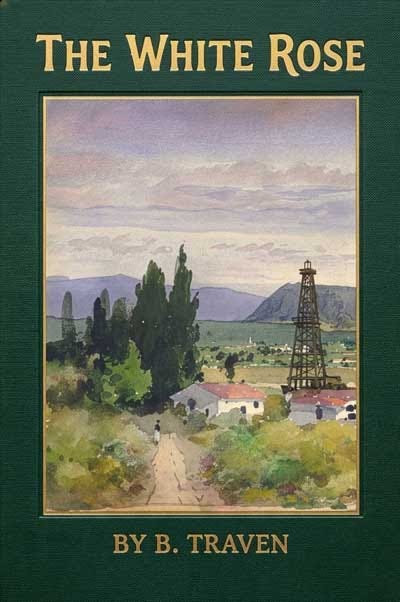
The White Rose (1929) is a novel by B. Traven, the mysterious author of The Treasure of the Sierra Madre. An American oil tycoon wants a Mexican family’s hacienda because it sits on an ocean of oil, and the owner won’t sell at any price. It hasn’t been in English print for decades, so I made a new translation from the German.
This is the fourth Deep Cut Book Club Edition. Paying subscribers can download the free ebook using the button at the bottom of this issue.
About The White Rose
The novel moves back and forth between Jacinto Yáñez, a farm owner in Mexico, and Chaney Collins, the president of an American oil company who wants Yáñez’s property because it sits on an underground ocean of oil. Yáñez refuses to sell, even for millions of dollars. The hacienda is called the Rosa Blanca, and it has been passed down to him through a long line of ancestors. He feels he has no right to sell the land, and he believes the farm is worth more than any amount of money the oil company could offer. It is literally priceless. Yáñez feels responsible for the many interrelated families who live on the hacienda and make a living growing crops and raising livestock. He thinks it’s ludicrous to trade a food-producing homestead for a sack of gold coins.
Collins is enormously rich but spends a fortune on four mistresses, and he thinks Yáñez is just holding out for a higher price. When Yáñez keeps refusing to sell, Collins sends one of his henchmen to Mexico to bring Yáñez to San Francisco, where Collins believes he’ll have a better chance of making him see why he ought to take the deal. I won’t spoil what happens next.
Collins is widely considered a stand-in for the oil tycoon Edward L. Doheny, who in 1921 sent $100,000 in cash to the U.S. Secretary of the Interior, Albert Fall, in what became the Teapot Dome scandal. Doheny’s son delivered it in a black bag. (That’s about $1.8 million in today’s money.) Fall then leased Doheny the Elk Hills naval oil reserve in California without competitive bidding. Fall went to prison for taking the bribe. Doheny was acquitted of paying it.
Who was B. Traven?
The Treasure of the Sierra Madre is one of my favorite novels, and John Huston’s 1948 movie, starring Humphrey Bogart, won three Academy Awards. A few years after reading it, I read Traven’s The Death Ship (1926), about an American sailor who loses his ship and his papers in Antwerp and gets deported from one country to the next until he ends up shoveling coal on a rotting smuggling ship. After that, I wanted to know who Traven was. The more I tried to find out, the more confused I became.
He used multiple pseudonyms, including Hal Croves, Traven Torsvan, and Ret Marut. Most Travenophiles agree that he was a German actor and anarchist who fled Germany in 1919 after he was accused of helping establish the Bavarian Soviet Republic and threatened with execution. When British police questioned him in 1923, he said he was Hermann Otto Albert Maximilian Feige. When Huston tried to meet him before filming The Treasure of the Sierra Madre, Traven showed up claiming to be Traven’s agent, a man named Hal Croves, and worked on the set as a consultant.
Traven didn’t think his identity should matter to anyone. “The creative person should have no other biography than his works,” he said.
The Mexican director Roberto Gavaldón made the novel into a film, Rosa Blanca, in 1961. The Mexican government decided its oil politics were too touchy and kept it out of theaters for eleven years. It wasn’t released until 1972.
About this translation
The White Rose wasn’t translated into English until 1979, 50 years after it was first published in Germany. Cedric Belfrage’s translation is now out of print. I found a copy of the German edition at Project Gutenberg, and as an experiment I used Claude to translate it into English. I told it to stay close to the German and avoid smoothing it into idiomatic English, and to build a glossary so the names stayed consistent. I was surprised by how well it did the translation. It’s a hell of a good read.
Download the Book Freak Edition
This is the fourth book in the Deep Cuts Reading Club, a benefit for paid subscribers. Every month, I take an interesting and obscure public-domain book and turn it into an ebook in EPUB and PDF formats, with a short introduction.
You can access a copy of The White Rose below.
If you’re reading this as a free subscriber, the club is part of a paid subscription ($5/month or $45/year). Join the club here. And if money is tight, email me at editor@cool-tools.org, and I’ll comp you…
Book Freak is published by Cool Tools Lab, a small company of three people. We also run Recomendo, the Cool Tools website, a YouTube channel and podcast, and other newsletters, including Recomendo Deals, Gar’s Tips & Tools, Nomadico, What’s in my NOW?, Tools for Possibilities, Books That Belong On Paper, and Book Freak.
10/2/2601 October 2026
Small Ring Light/Washed-up Brands/30-day Thailand Limit
Nomadico issue #226
Small Travel Clip-on Ring Light
The best trade show schwag item I’ve gotten the past two years has been a small clip-on ring light from Visit Richmond VA that I have with me now on this three-month trip. You never know what kind of lighting you’ll have on the road, so this ensures that my face is visible during a video call or something I need to record. It clips onto a phone or laptop and is rechargeable. This $17 GearLight version is almost identical to what I have, though this more expensive version from Littel has slightly better reviews overall, despite a shorter battery life.
Worse on Purpose Brands to Avoid
Is there any difference between a famous brand and a knock-off version? For too many of them, not any more. WorseonPurpose.com tells you which brands have gone down the tubes and explains why in well-researched detail. You can read how one $27 billion company—Luxottica—makes sunglasses from Costa Del Mar, Ray-Ban, Oakley, Prada, Dolce & Gabbana, and a bunch more in the same Asian factories for $6 to $16. They then sell them in mall shops they own that give a false appearance of competition: Sunglass Hut, Lenscrafters, and Pearle Vision. For apparel especially, research at Worse on Purpose before paying a premium for Brooks Brothers, Saucony, Land’s End, Eddie Bauer, Bonobos, or Body Glove: they’ve all been gutted by private equity firms and are just a licensed label now. (The site also highlights 145 brands that still stand for quality, like Patagonia, New Balance, and Darn Tough.)
USA Airport Satisfaction is Way Up
Despite a very busy year for air travel, Americans are much happier at the airport these days thanks to major capital improvements, better signage, and better food and beverage options—including ones that convey a sense of the city. The changes are literally paying off: passengers spent more than $40 per visit in the 12% of airports rated the highest, versus half that for the ones rated “Just okay.” Winners by category size were Minneapolis, Detroit, and Phoenix in the largest tier; Tampa, Portland, and Dallas Love Field in the second size tier; Charleston, Ontario (California), and Indianapolis among the smaller ones. See the full JD Power and Associates report.
Thailand Visits Back to 30 Days
We reported two years ago that Thailand had expanded the visa-on-arrival time for many nationalities from 30 days to 60. That country changes its immigration rules more often than most people change their toothbrush, however, and as of September 15 we’re back to a max of 30 days again. Tourism in the country is still down from its 2019 level and this move won’t help since some of the most reliable spenders who keep returning are the digital nomads. Their spending will drop in half now (and flow to neighboring countries instead) if they don’t have a longer visa arrangement, so we’ll see if the revenue drop causes a policy reversal again later.
A weekly newsletter with four quick bites, edited by Tim Leffel, author of A Better Life for Half the Price and The World’s Cheapest Destinations. See past editions here, where your like-minded friends can subscribe and join you.
10/1/2630 September 2026
What’s in my NOW? — Victoria Pace
issue #274
Based in NC but constantly on the move. You can find me playing trivia, rescuing dogs, or procrastinating in the name of spending time with friends. — Victoria Pace
If you’ve ever asked yourself “is there a virtual assistant who could elevate my life?” the answer is yes and he or she may be at Hey Girl Friday. HGF is seeking to “be the bar” when it comes to the world of executive assistance. You get to meet your potential EA (or, Advocate as we like to say) before committing to anything and all of our contracts are month-to-month so you will never feel (or be!) tied-in to anything long term. Check us out at www.heygirlfriday.co, we’d love to learn more about you and how we could potentially support!
PHYSICAL
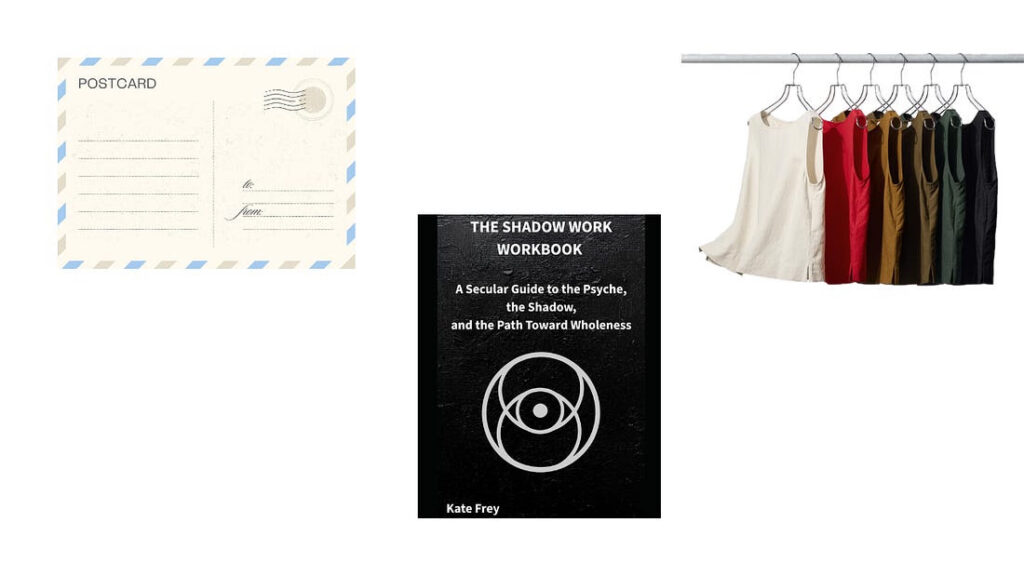
- Postcards. I’ve been on a big postcard mailing kick lately, even (or maybe especially) when I’m not traveling. I like to buy postcards when I travel (low cost, easy to pack home, beautiful) and have a hard time picking, so will come home with quite a few. I’ll keep one for myself, then will send the rest out to friends. Everyone loves getting mail, and it feels meaningful to write notes to my friends.
- Shadow Work. I’ve been in therapy for a while navigating some intense life changes and general growth. My therapist suggested exploring shadow work, and I feel ready to do so. I haven’t gotten deep into this work yet, so I can’t necessarily vouch for the methods, but I’m really enjoying the journaling and have found it very helpful to dig deeper into myself and the “why” behind my thoughts and actions.
- Uniqlo Linen. I’ve been living in their linen tops this summer. Feels amazing, looks great, reasonable price point. I do try to be mindful in mainly shopping from ethical brands, and while Uniqlo isn’t the best, it’s rated “it’s a start” by the Good On You app, which feels better than most.
DIGITAL
- Good On You. An app and a website to look up the sustainability and ethical ratings for various brands. Makes it much easier to make purchases that are better for the earth / humans / animals.
- Trusted Housesitters. This is an app that matches people looking for housesitters (usually to care for pets) with travelers. I was able to stay for free in a small French alps town in exchange for taking care of two cats. Easy job and takes care of one of the largest expenses of traveling.
INVISIBLE
Turning everything into a gratitude practice.
There have been many rough patches over the last few years, but generally I feel happier than I’ve ever been, which in turn has made me grateful for every part of this journey. Naturally, I still enjoy wallowing in a few moments of mentally stamping my feet and saying the world isn’t fair, but for the most part I try to find a way to be grateful for everything and make it something beautiful. Part of this is being the force behind doing things that I love. I love to watch the moonrise, so when I know it’s happening in the evening I’ll invite friends and bring a blanket to a field and we can just sit together. I’m grateful for every opportunity to experience life and beauty.
Sign up here to get What’s in my NOW? a week early in your inbox.
09/30/2629 September 2026
Encyclopedia Prehistorica / Minecraft: Blockopedia
Issue No. 137
SHARKS AND DINOSAURS – POP-UP BOOKS ON STEROIDS
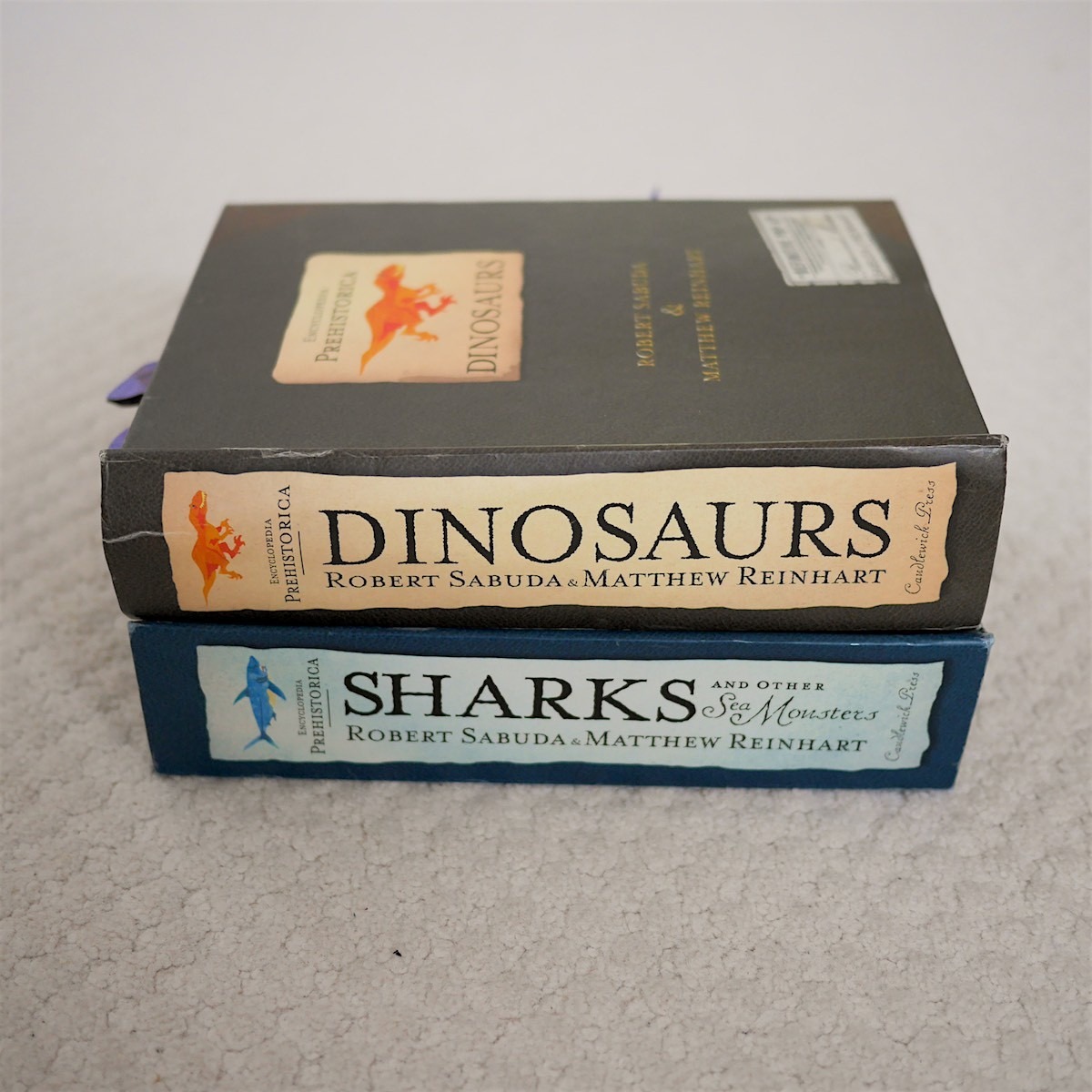


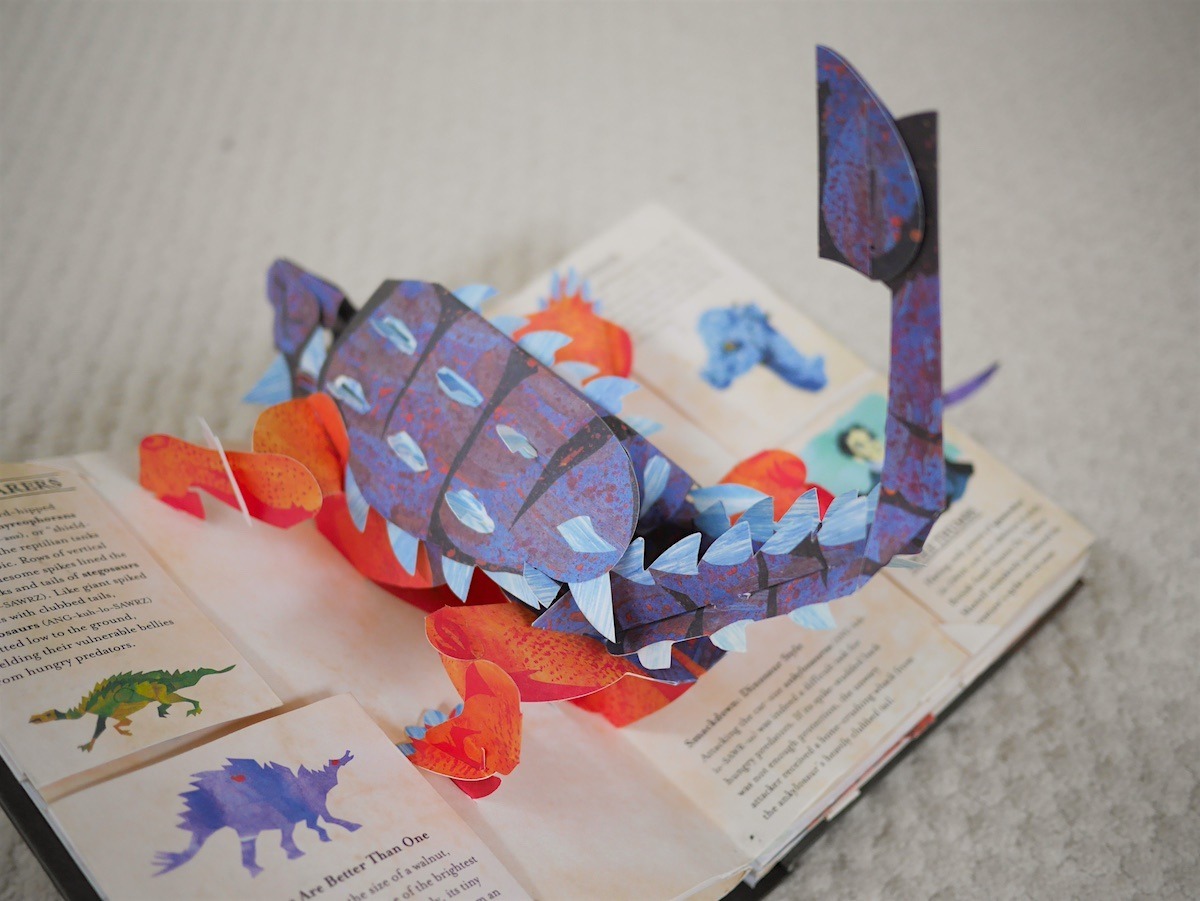

Encyclopedia Prehistorica: Sharks and Other Sea Monsters
by Robert Sabuda and Matthew Reinhart
Candlewick
2006, 12 pages, 7.8 x 9.9 x 2.1 inches
Encyclopedia Prehistorica: Dinosaurs
by Robert Sabuda and Matthew Reinhart
Candlewick
2005, 12 pages, 8 x 10 x 2.5 inches
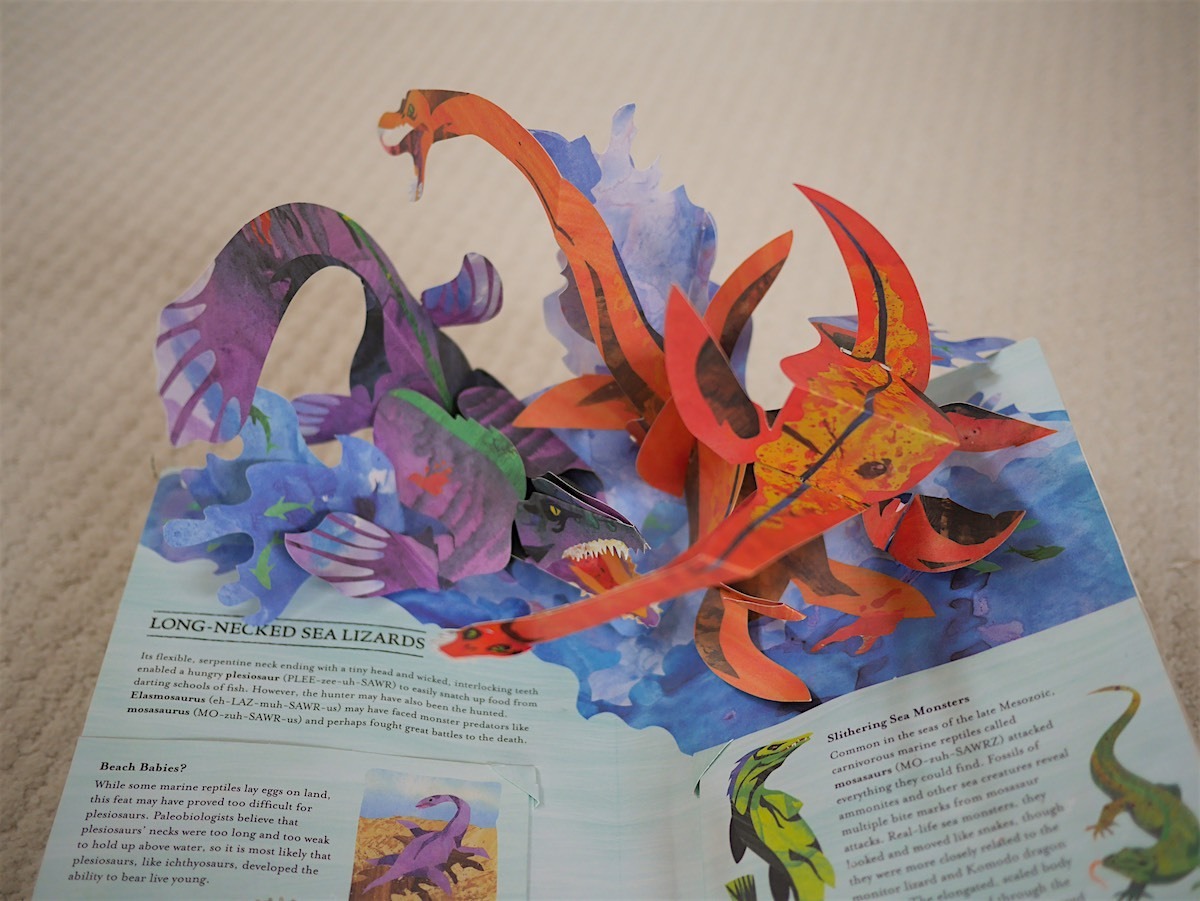
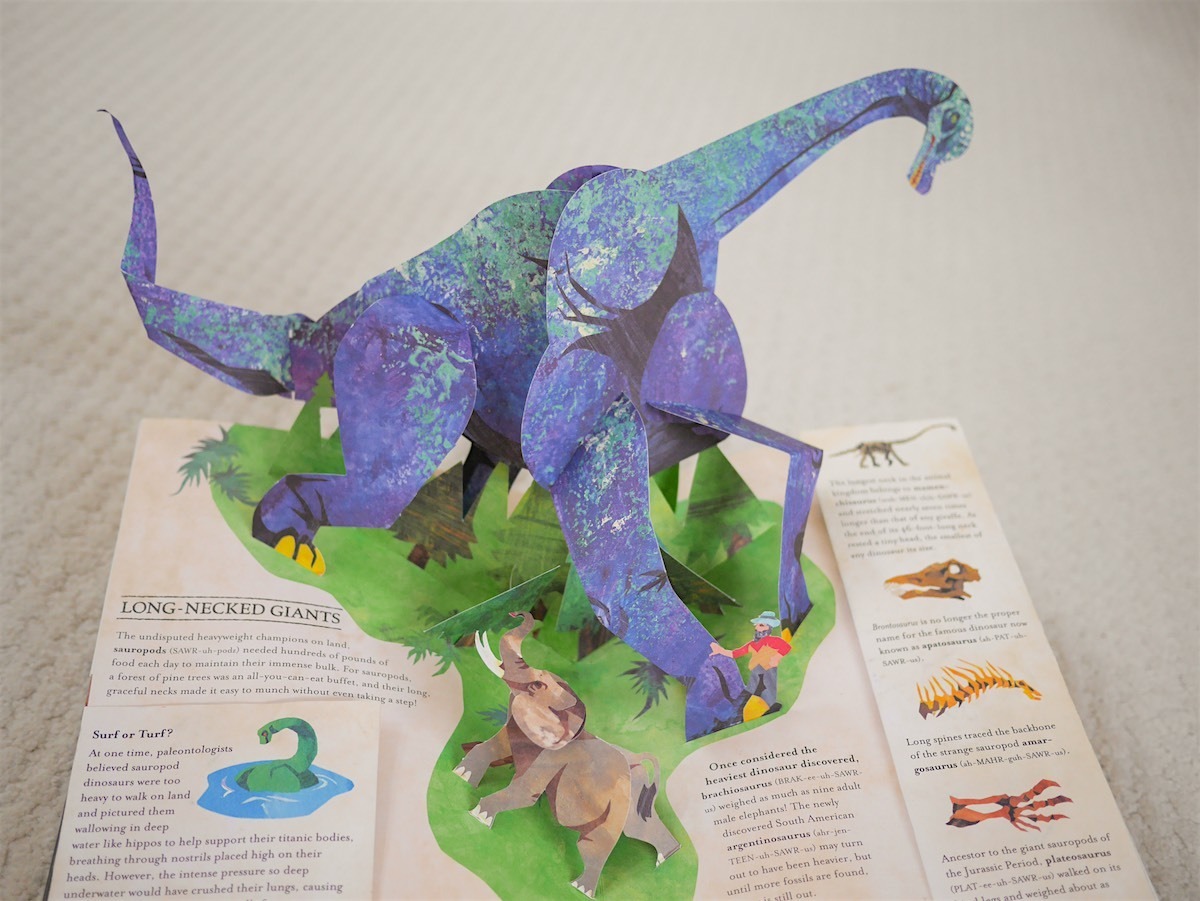
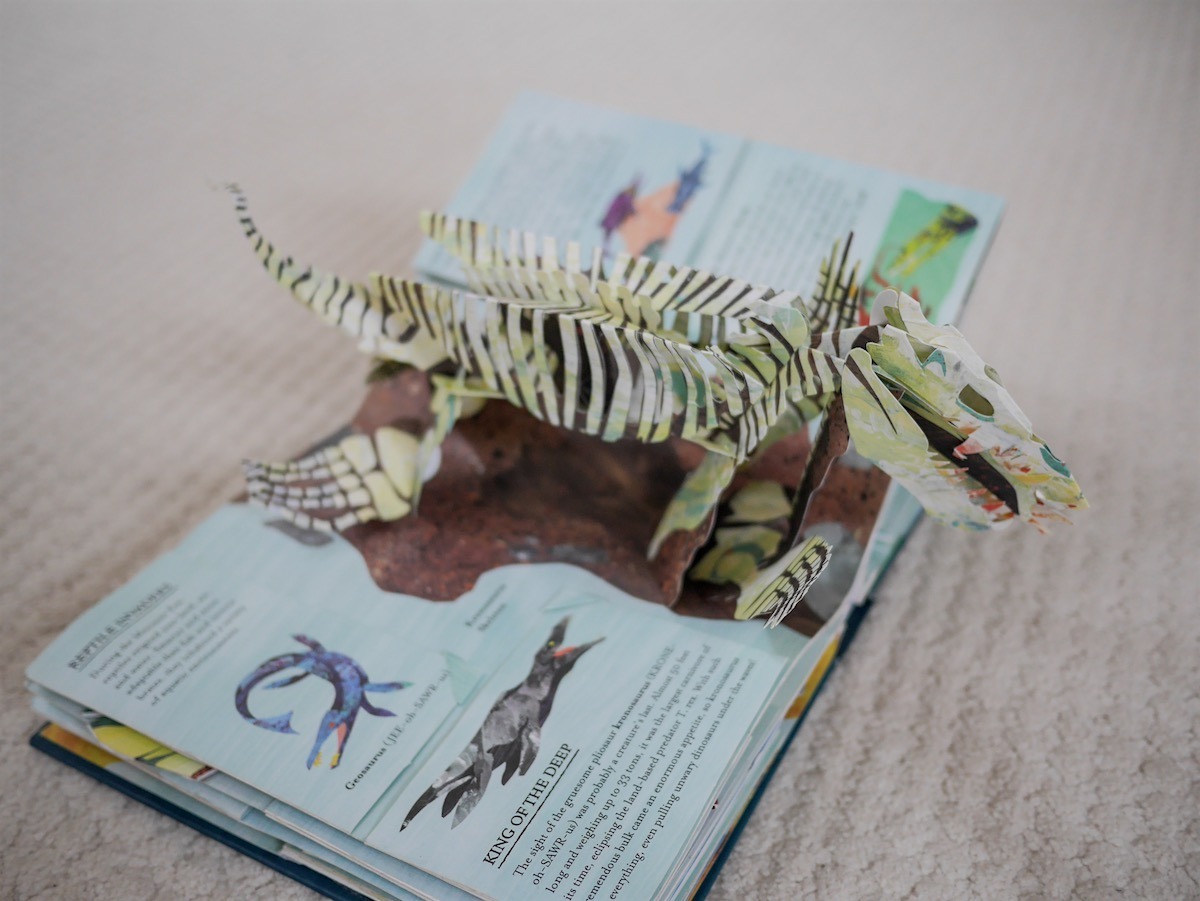
There are only five “pages” in each of these books despite their 3-inch thickness. That is because each page is stuffed with layers and layers of ingenious interacting bits of printed paper, which magically assemble themselves into an alternate reality when each page is opened. Yes, it is a pop-up book, but a pop-up raised to an exponential level. A pop-up on steroids, or acid. Pop-up as extreme sport. The engineering is astounding. As a page is opened a 3D apparition appears, often with its own narrative, first one part and then another. The resulting paper sculpture is the story made real. The textual story is minimal; all the action is in the structures. Kids love to see how they work. The only downside to these books that belong on paper is not letting children paws tear the mechanics. These two books feature all kinds of pre-historic dinosaurs, and sharks of all types. But the artist behind them, Robert Sabuda, has half a dozen other books with the same kind of extreme pop-up-ness. – Kevin Kelly
MINECRAFT: BLOCKOPEDIA – FOR FULL-ON MINECRAFT GEEKS, AS WELL AS OVER-THE-SHOULDER ADMIRERS
Minecraft: Blockopedia
by Alex Wiltshire
Scholastic Inc.
2015, 312 pages, 9.7 x 10.7 x 1.4 inches
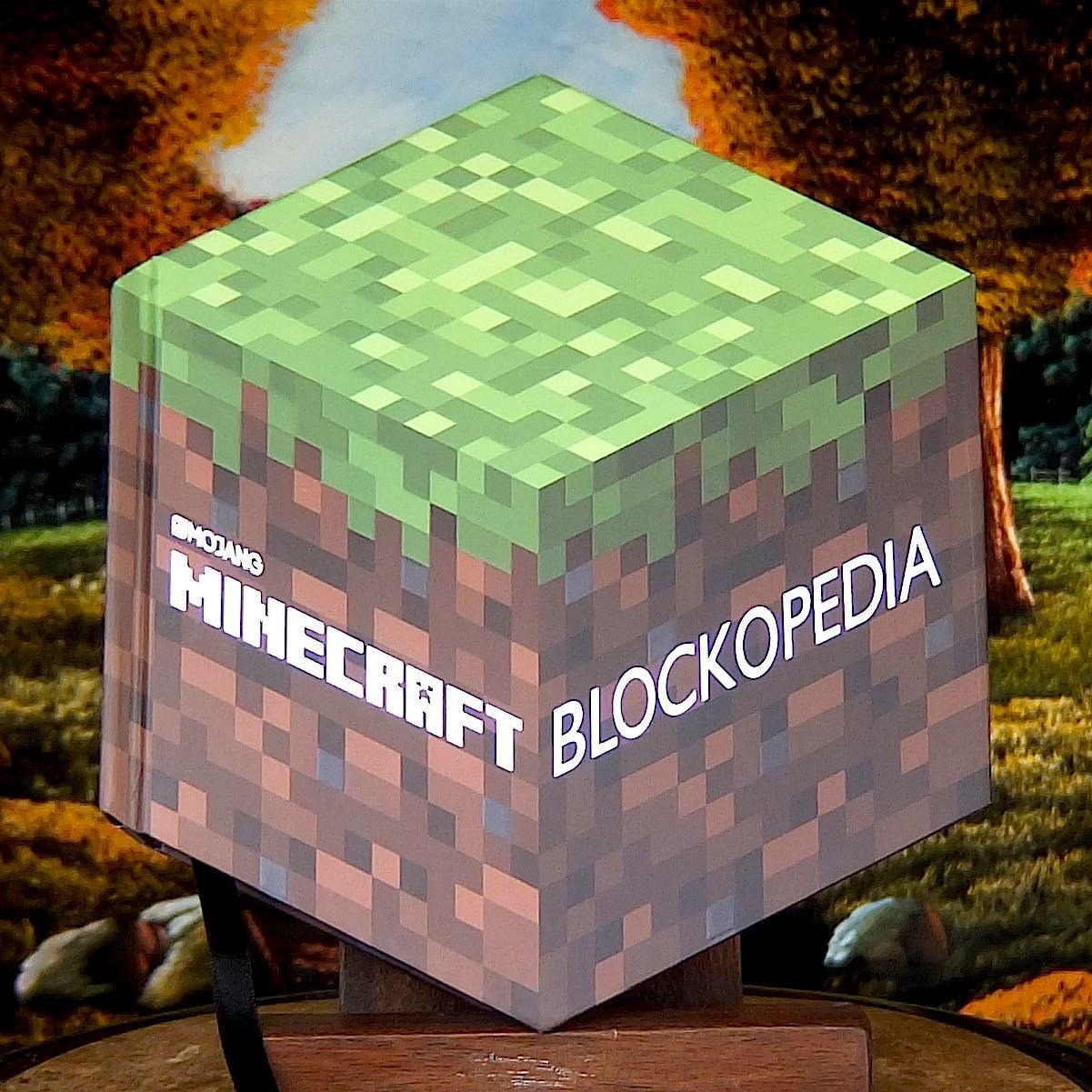
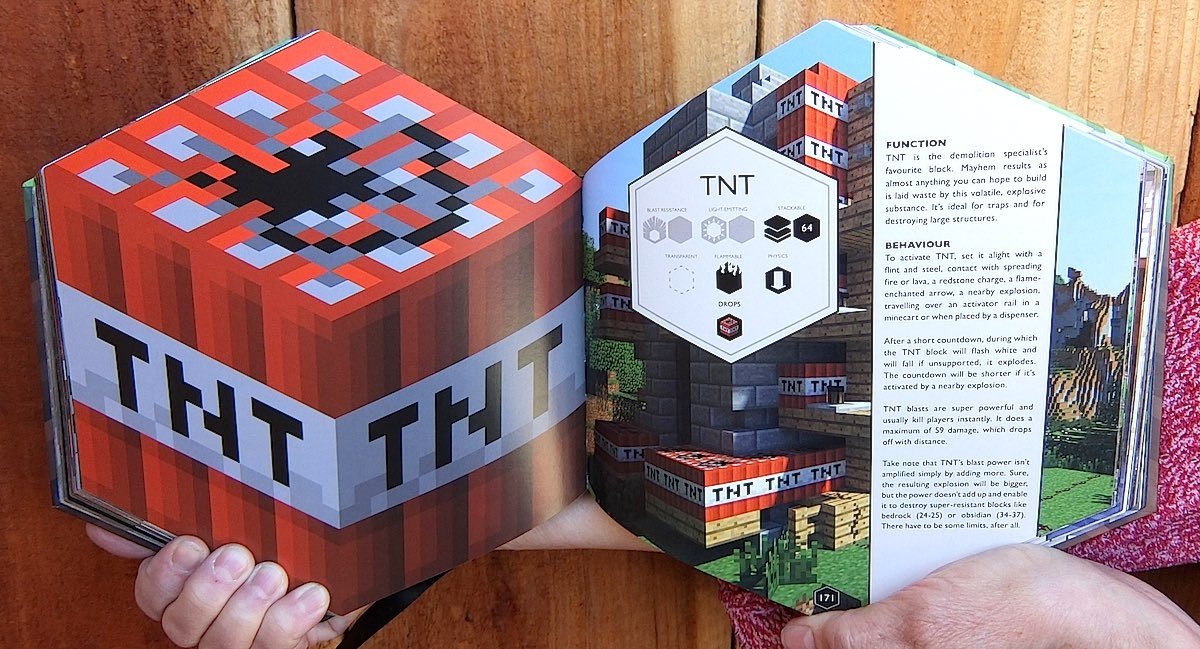
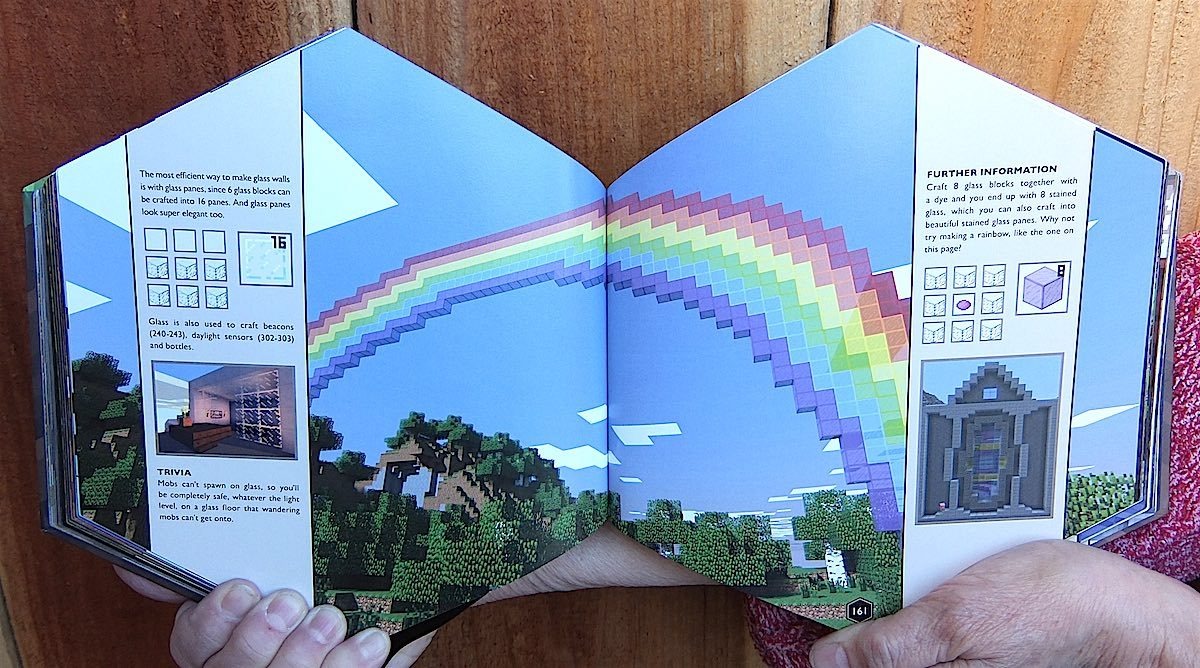
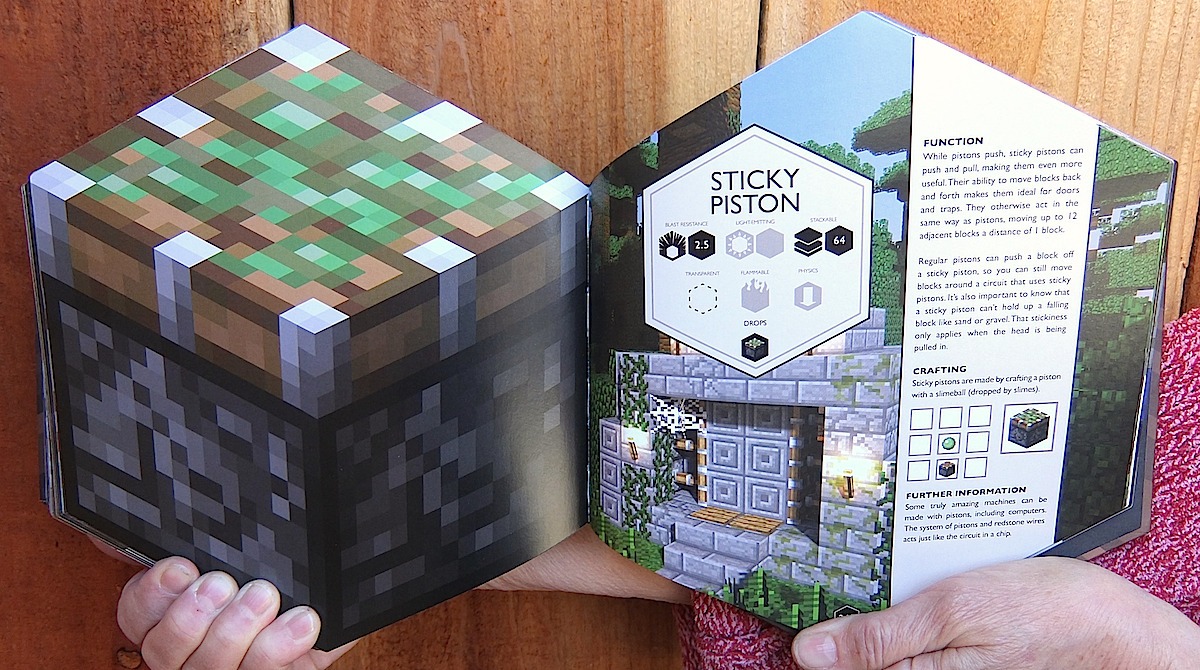
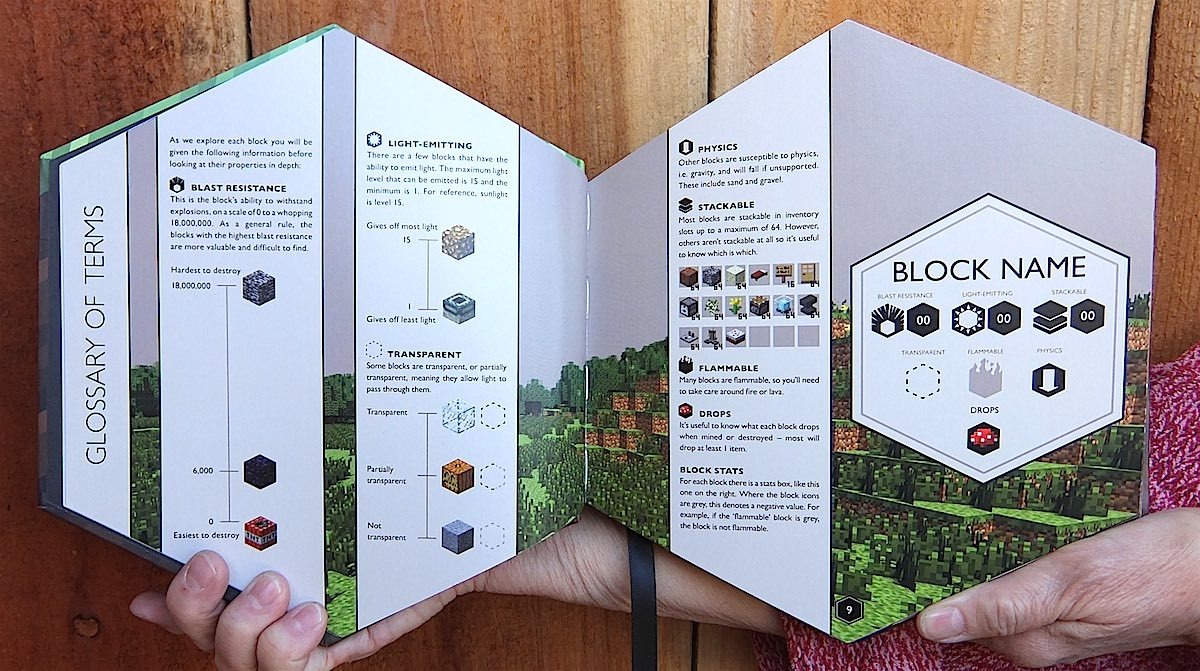
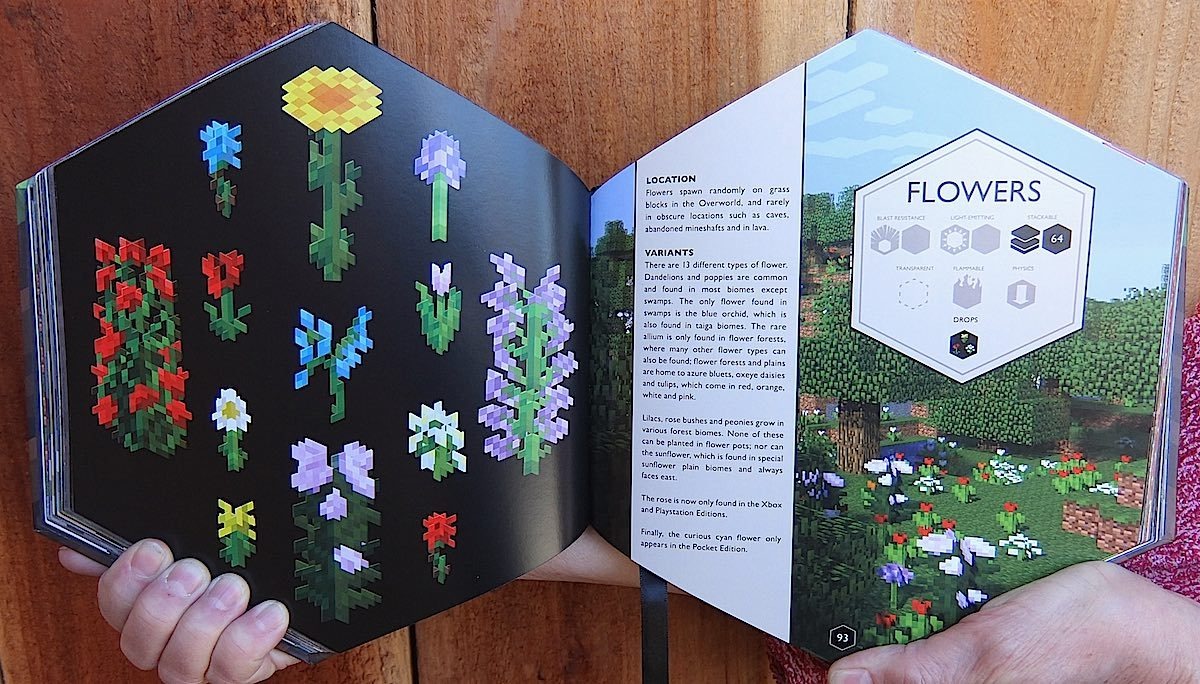
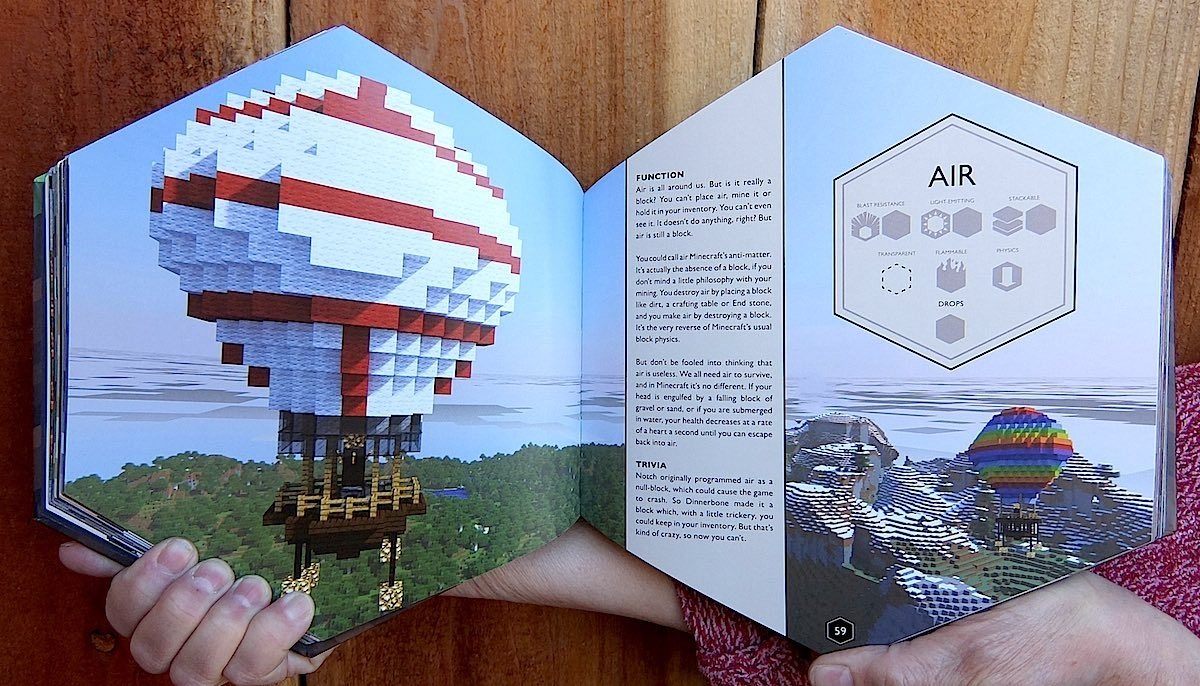
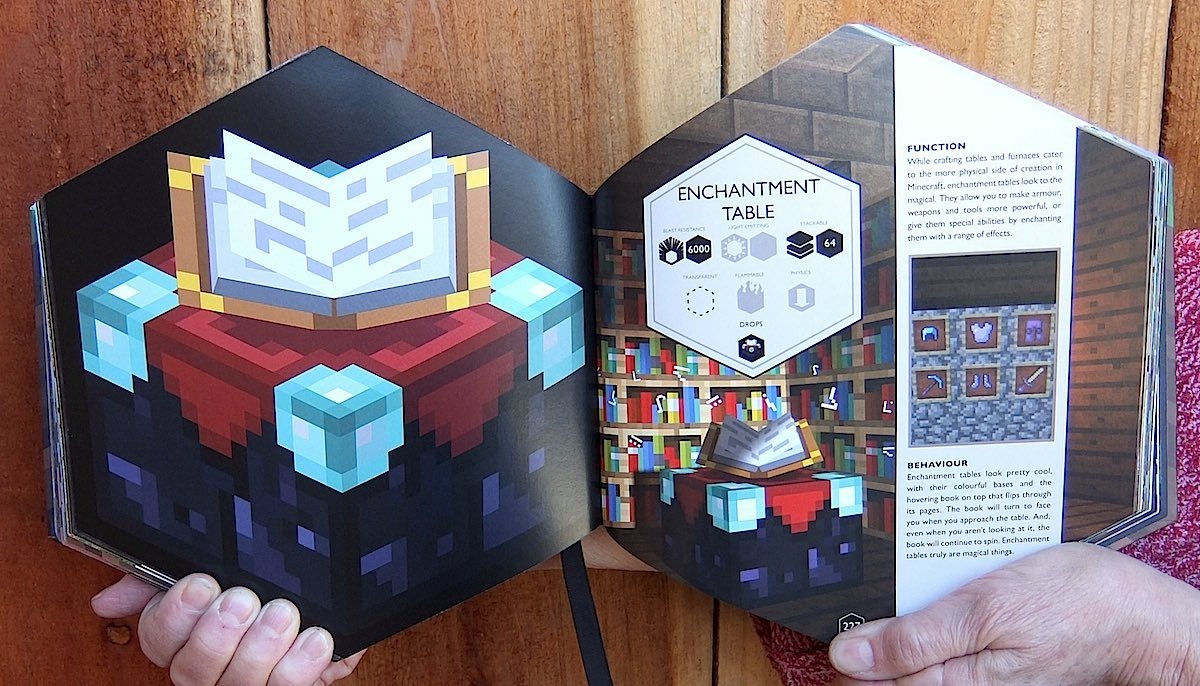
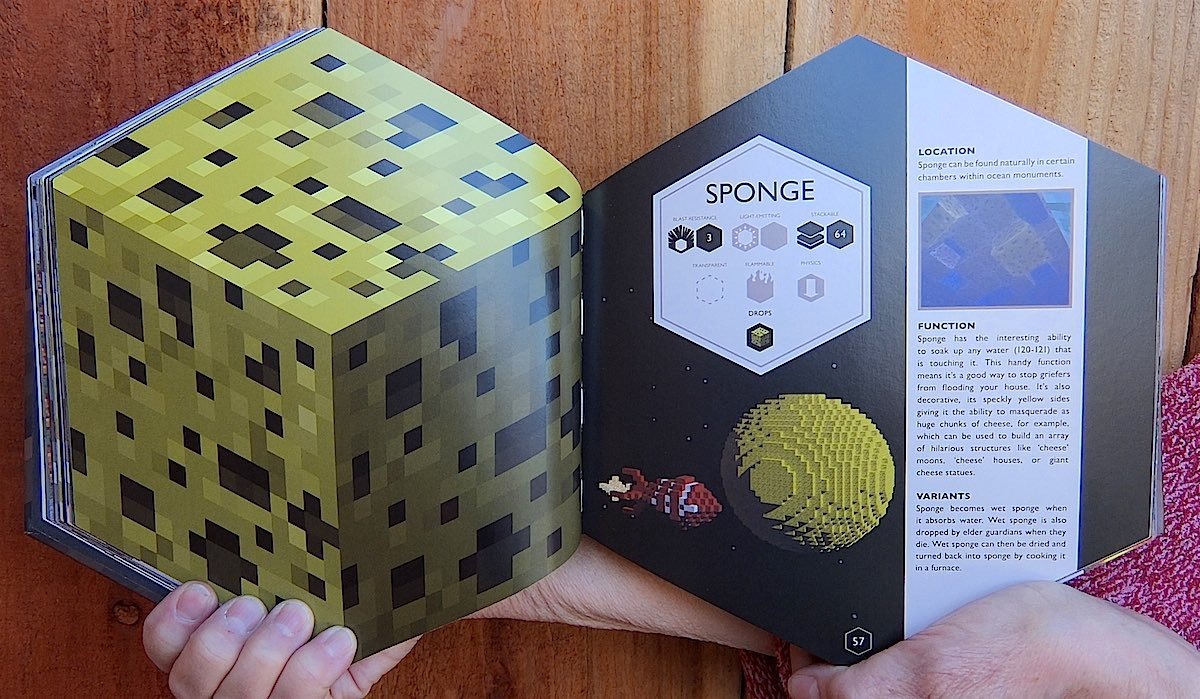
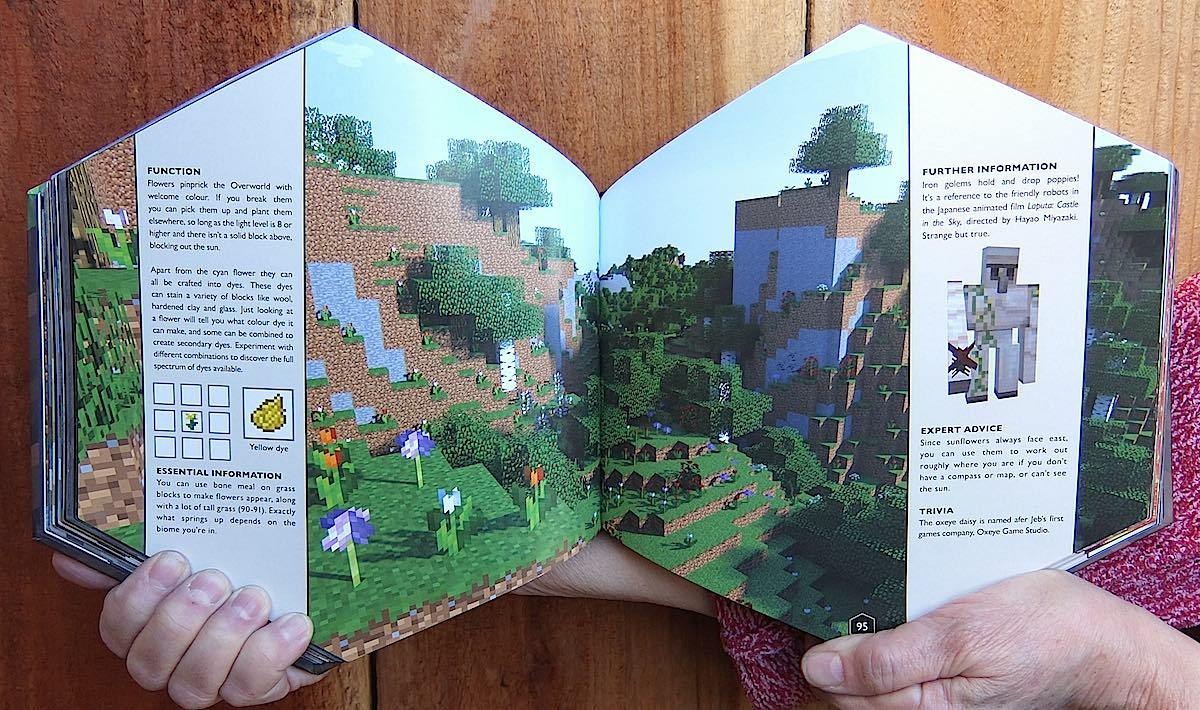
Shaped like a hexagon to mimic the dimensions of a cube, Minecraft: Blockopedia is designed for full-on Minecraft geeks, although those of us who have only watched the game over the shoulders of children and loved ones will find plenty to admire here too. After the briefest of introductions and a quick glossary to help noobs make sense of the stats that accompany each block’s name, it’s off to the races, with page after page devoted to blocks made from rocks, blocks made from plants, blocks that serve particular functions (a ladder), and blocks that do particular things (acting as a switch).
One of the coolest characteristics about Minecraft is how it chooses to observe the laws of nature and physics, or ignore them. Sand, we are told, can be a cave-in hazard, but when it’s smelted in a furnace, it turns to glass. Both statements are true, but don’t go looking for glowstone the next time you’re spelunking – it is only found in a sinister dimension of Minecraft called the Nether. And while sugar cane in both the real world and the Overworld of Minecraft can be used to make sugar, guess where it can also be used to block flowing lava?
Though the format and illustrations in Minecraft: Blockopedia are the book’s most prominent features, it’s still a book filled with lots and lots of, you know, words. Writer Alex Wiltshire mostly plays it straight (“Water is incredibly useful.”), but often he lets the language and logic of Minecraft add color, as in “Sticky pistons are made by crafting a piston with a slimeball…” and “If you dig podzol without the silk touch enhancement it drops dirt.” Got that? – Ben Marks
Books That Belong On Paper first appeared on the web as Wink Books and was edited by Carla Sinclair. Sign up here to get the issues a week early in your inbox.
09/29/2628 September 2026
Thinking Games
Tools for Possibilities: issue no. 209
Pattern recognition competition
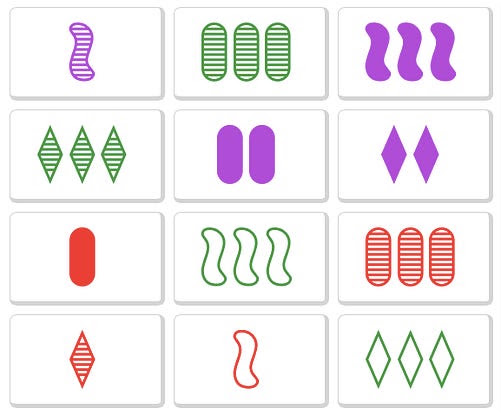
A simple game in a class by itself. You get a deck of cards with colored symbols. These are laid out, face up. To play the game you need to organize the symbols into sets of three “un-alikes” — but they can be grouped in more ways than one. Many more ways. Everyone else is trying to group them into sets faster than you. This game exercises a unique part of your brain that few other activities do. Half math, half intuition, all concentration. It’s fun, loud, fast-moving, and very challenging to do well, yet easy enough for small kids to join in meaningfully (that is, do better than you). After several years of playing the game, here is what I’ve observed:
1) It can’t be explained; it has to be shown.
2) Some folks are more gifted than others at finding patterns fast.
3) But *everyone* improves, often within the span of a game.
I hear that many schools use this game to teach sets and logic in math class, and that’s great. We use it as a raucous parlor game. Like the game Go, Set possesses the kind of simplicity which keeps expanding, never growing old. And as far as games go these days, it’s cheap.— KK
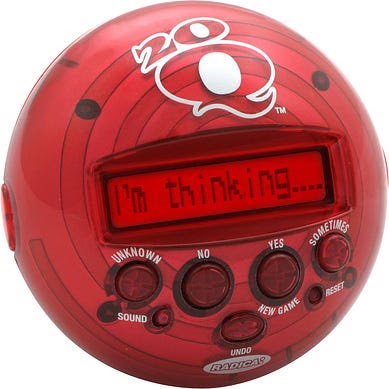
Twenty-dollar AI
This tennis ball-size orb knows what you are thinking. Most of the time it will guess what you have in mind after asking you twenty yes/no questions. It is eerily smart, and slightly addictive.
The toy is remarkable. Because it is so small, so autonomous, its intelligence is shocking to the unprepared. Most children can’t stump it, and if you stick to objects it will stump smart adults about 80% of the time with 20 questions and most of the time with an additional 5 questions. I love to watch people’s reactions when they think of a “hard” thing, and after a seemingly irrational set of questions you are convinced are dumb, the sly ball tells you what you had in mind. (For instance, it can correctly guess “flying squirrel”without asking “does it fly?”) People who play chess machines won’t be surprised, but just about everyone else is tickled. It feels like the future.
But right now, for ten bucks, you can get an amazing little artificial intelligence, about as smart as an insect — but an insect which specializes in guessing what object you are thinking of. And in that part of the brain, it’s smarter than you are. — KK

Funnest parlor game
No recent game has given me as much pleasure as the parlor game known as Werewolf.* Whenever my extended family gathers for holidays, we play Werewolf over and over. I’ve played the game on company retreats, at tech gatherings, on group vacations. At Foo Camp, a rendevouz for nerds, epic sessions of Werewolf will run all night long till dawn. It is that addictive.
Werewolf can be played with as few as 6-8 folks and as many as 30 or more. A game can last 30 minutes to an hour, and even very young kids can play. It’s a game of bluff and deduction. Think of poker, but without any cards or money. Some fans call it a “mind game.” In brief, the game assigns roles to players at random and in secret. One emergent group — the werewolves — must kill the innocent villagers, but no one knows who is who because the deed is done “at night” in a secret way. On each round of the game, the innocents will lynch a supposed werewolf as voted by the group after accusations and debate but they are never sure they have the right person. Maybe it’s the werewolfs leading the pitchforks!? Both the best and worst of human behavior is activated: lying, leadership, mob psychology, democracy, persuasion, deception, deduction logic, and imagination.
Because of the intense social dynamics, the game is eternally surprising and addictive. Werewolf is the only non-sport game I know of that is as much fun to watch as to play. Players who die early in the game will always stick around till the end, watching in fascination.
Like Charades, you don’t need any equipment, other than some index cards, or a deck of playing cards to distribute in order to assign roles in secret. But over years of playing we’ve found this dedicated deck of cards by Ted Alspach makes it much easier to introduce newbies, and to remember roles. The deck contains 40 or so cards printed with Werewolf roles and instructions. It also contains about 25 additional roles that can be added to the typical 5 main roles, which is why Alspach calls it Ultimate. As you play more often or the groups get bigger, you can keep the game exciting by experimenting with these additional roles.
A pretty good free rule set for Werewolf can be found online here. Grab a regular deck of cards, assign different picture cards to roles, and you are off. If you want a bit more help this Ultimate Werewolf deck includes a fantastic sheet of very clear rules and instructions (the best I’ve seen), with great tips on how to be a good moderator. And the rules stay handy with the ready-made cards. We’ve found that having the roles explained on each card is really helpful for new players. — KK

Game of semantic predictions
We’ve been playing this word-based card game for the last three years and it continues to be an enlightening ice breaker. There are two types of cards: nouns (red) and adjectives (green). Each player is given a small stack of nouns. The game begins when one player (the judge) draws an adjective. Each player then anonymously lays down one noun he/she believes the judge will associate with the adjective. Players can try to sway the decision, but ultimately, the judge’s power is absolute. Some people are inherently literal, sarcastic, wishy-washy, optimistic, stubborn or dryly humorous. The challenge lies in figuring out what type(s) of judges surround you and what kind of judge you want to be. Discovering who’s on the same wave length is always interesting. What’s more “magical” — a sunset, Thomas Edison, the Pyramids, surfing the net, or Barney the dinosaur? Subjectivity rules! — Steven Leckart

Evergreen strategy video game
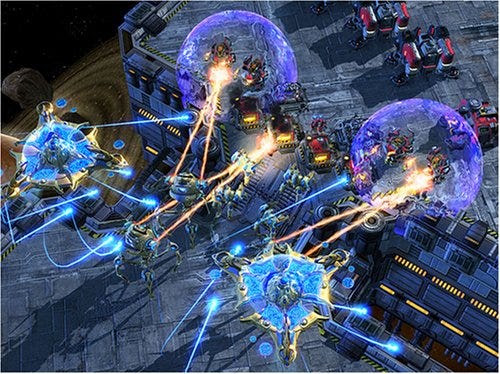
It’s best to think of StarCraft as more of a sport than a game. It’s played professionally, with televised matches, in Korea. The goal in StarCraft is to build a base, in order to create an army, which you then send over to destroy the opponent’s base. Your opponent, of course, is trying to do the same thing to you — like chess. Besides athletic reflexes you also need lots of experience to know which strategies to use immediately. For newbies the nice thing is that as you get better, the server dutifully serves up better opponents. StarCraft is probably the most popular game in the “real time strategy” (RTS) genre; it is far more strategic than just a shoot-em up game but it is much faster than any strategy board game. A typical game duration is like chess — most games probably last 30 to 45 minutes, with outliers that last more than an hour. It is so well-designed, and fast-paced that it is possibly the first real “digital sport.” It’s one of the few games I can imagine someone still playing in 5 years. Runs on Windows or Mac; requires internet connection. — Mark Hurst
Once a week we’ll send out a page from Cool Tools: A Catalog of Possibilities. The tools might be outdated or obsolete, and the links to them may or may not work. We present these vintage recommendations as is because the possibilities they inspire are new. Sign up here to get Tools for Possibilities a week early in your inbox.
09/28/26ALL REVIEWS



EDITOR'S FAVORITES



COOL TOOLS SHOW PODCAST
WHAT'S IN MY BAG?
23 September 2026
ABOUT COOL TOOLS
Cool Tools is a web site which recommends the best/cheapest tools available. Tools are defined broadly as anything that can be useful. This includes hand tools, machines, books, software, gadgets, websites, maps, and even ideas. All reviews are positive raves written by real users. We don’t bother with negative reviews because our intent is to only offer the best.
One new tool is posted each weekday. Cool Tools does NOT sell anything. The site provides prices and convenient sources for readers to purchase items.
When Amazon.com is listed as a source (which it often is because of its prices and convenience) Cool Tools receives a fractional fee from Amazon if items are purchased at Amazon on that visit. Cool Tools also earns revenue from Google ads, although we have no foreknowledge nor much control of which ads will appear.
We recently posted a short history of Cool Tools which included current stats as of April 2008. This explains both the genesis of this site, and the tools we use to operate it.
 Kevin Kelly started Cool Tools in 2000 as an email list, then as a blog since 2003. He edited all reviews through 2006. He writes the occasional review, oversees the design and editorial direction of this site, and made a book version of Cool Tools. If you have a question about the website in general his email is kk {at} kk.org.
 Mark Frauenfelder edits Cool Tools and develops editorial projects for Cool Tools Lab, LLC. If you’d like to submit a review, email him at editor {at} cool-tools.org (or use the Submit a Tool form).
 Claudia Dawson runs the Cool Tool website, posting items daily, maintaining software, measuring analytics, managing ads, and in general keeping the site alive. If you have a concern about the operation or status of this site contact her email is claudia {at} cool-tools.org.