Craft
Industrial tinkering space

Wouldn't it be great to have a full machine shop at your disposal, with dozens of industrial tools also at your disposal, and all you have to do is contribute to the upkeep? TechShop is just that -- a membership-based fabrication and invention shop. I've been a member since before TechShop really even started, back when it was just some guys passing out flyers trying to gauge interest. For $100 a month, members can use any tool in the shop on which they've received training. MUCH cheaper than buying your own gear. The list of equipment is pretty extensive, too, and new items are arriving frequently (like a new hot-wire foam cutter).
I've spent the most time with the laser cutter and the plasma cutter, and a bit of time on the mill and lathes. The laser cutters are the best "deal" since even a novice can start building really intricate objects out of plastics quite rapidly, and the fact that the laser cutters simply "print" with a laser beam makes them the most approachable for people who want to work off-line and who come in just to cut materials. The plasma cutter is a bit more picky, and requires a jump up to a 'real' CNC computer, which is not difficult and is just as rewarding. One of the first things I did at TechShop was to build a gib key puller for a particularly obstinate key on the flywheel of a 50+ year old diesel engine I'm restoring. The robotic plasma cutter made short work of cutting what would have been otherwise a difficult piece, and I learned basic CNC methods in the process. I've since progressed to fairly advanced CNC operation skills, which have been useful in more intricate object construction. I've used the lathe to finish off some custom valves, the laser cutter for cutting gasket material and making signs, and I'm itching to try the 3D material printer.
TechShop offers classes on their equipment, as well as general classes on various methods and skills. The safety classes are typically very good, focused on safety and basic operation of the equipment. Classes are required for any equipment as a 'basic' instruction set, though some equipment has advanced classes for better technique and more complex jobs. Classes typically cost between $20 and $30 dollars for the basic safety class, but that's still a bargain. This is just what I've been looking for, since most machine shop instruction I've seen has been terribly expensive, and has been geared for "lowest common denominator" instructions, which are typically agonizingly boring. The TechShop classes are taught for safety and rapid understanding to try to bring members to the point where they can start producing their own objects as quickly as possible. There is still going to be some trial and error, but the feedback loop is very short and it doesn't take long before you're comfortable and confident on the equipment. This is industrial arts instruction for people with a high level of clue.
Motorcycle customizers, automotive gearheads, robot war fanatics, electronics fabricators, modelmakers, metal benders, burning man artists, startup companies, mechanical engineering students: I've met all of these at TechShop, and I'm sure quite a few others that defy categorization. If you have any interest in making things, or modifying things, then TechShop is for you. Having spent years and a lot of dollars in outfitting my own shop, I can say that the TechShop concept beats anything I could possibly hope to have done on my own with the added benefit of the people that one meets at a shared space like TechShop.
While the tools and physical resources of TechShop are excellent, there is a hidden benefit to participating: the other members. The breadth of skills of the members and projects underway is perhaps the most impressive and fascinating part of TechShop. At any one time, there are a half-dozen people working on fantastic and innovative things, either as hobby projects or as budding startups who have found an inexpensive way to bootstrap themselves into prototyping a better mousetrap. Here's a word to the wise for smart venture capital folks: find a hobby that requires TechShop and spend some quality time in the building doing your project. You'll get amazing things done on your own project, and get to review a few hundred of the most clever projects happening as well as meet the working engineers that are often so difficult to find otherwise.
The downside to TechShop is that it is still only in Menlo Park, California. Later this summer, additional locations are scheduled to open up with the expansion. Other downsides: there are often waits for the laser cutters, since those are the most popular items in the shop. And, of course, if you are a "top-secret" inventor, you won't find much privacy -- plan on people being very interested in your project and asking lots of questions. There are also almost no places to store materials between visits -- pretty much everything needs to go home with you.
I typically am at TechShop one or two evenings a week when I'm in the Bay Area, but my work schedule has made that less frequent than I'd like (I commute between PDX and SFO for work). The good news is that with the planned expansion one of the nine prospective cities is in my home town of Portland, OR. This will be welcome, as most of my projects involve objects that don't fit well into carry-on luggage.
-- John Todd
TechShop
$30 - Unlimited Daily Access
$100 - Unlimited Monthly Access
$1200 - Unlimited Annual Access
Classes
$30+

4' x 8' CNC Metal Plasma Cutter
*

Electronics Laboratory
*

Band Saws & Presses
Related items previously reviewed in Cool Tools:

Tool Lending Libraries

Lindsay Publications

The Mobile-Shop
Precision drilling

I've been easing into more and more metal work over the last year and half (propane art, collapsible fire fans and fire hula hoops a la Burning Man), so I drill a lot of multi-size holes in aluminum tubing. This is by far the best bit I've found for drilling through such thin materials. To get precise placement and a clean hole, normally I'd drill a small pilot hole, then run a larger drill bit in that hole to get the size and placement right. With this bit, I do not need to create a pilot hole (though, a center punch can help). I simply drill until I get to the right size (1/4" and 1/2" mostly). Because the bit has a single flute (cutting edge), it makes very clean holes. It's also very accurate: the bit is very stiff, so it wanders less when starting a hole. Since I don't need to change drill bits in my drill press to successively drill larger holes or change the jig I'm using to hold the part, it's become a real time saver.
-- Sean Rutledge
IRWIN Unibit
$14
(3/6" - 1/4")
Available from Amazon
$62
(three-piece set)
Also from Amazon
$67
(four-piece set)
Also from Amazon
Manufactured by IRWIN
Related items previously reviewed on Cool Tools:

The Complete Metalsmith

Panasonic Impact Driver

Transmaterial
Re-stickable adhesive

By the same token as the Restickable Glue Stick, 3M's Scotch makes a product called Removable Magic Tape which I use extensively in doing rough page layouts of books with a lot of graphics on each page. It sticks to paper or just about any dry surface. Pulls off easily, leaves no residue. Unlike the regular Magic Tape, you can easily pick it up and move things around. I've been using it for over 10 years and find it's less messy and way quicker to use than the glue sticks. If you already have the Magic Tape dispensers, the removable refills come in a blue box (Cat. # 811).
-- Lloyd Kahn
Removable Magic Tape
$3
Available from Amazon
Manufactured by 3M
Related items previously reviewed in Cool Tools:

Transparent Duct Tape

Handband Pop-up Tape Strip Dispenser

X-Treme Tape
Saddle stapling for zines

If you like creating little DIY booklets or zines, but have been frustrated by the short arm length in standard staplers that forces you to curl up (or worse, fold) your notebook pages in order to get a center saddle staple, this two-way stapler is a terrific little solution. It looks just like your ordinary handheld personal stapler, until you twist the upper portion: it twists all the way perpendicular to the body of the stapler, so that you can easily staple booklets at the center fold. When I found it, I was kind of surprised I'd never seen this before. It's sheer genius and simple. I'm a huge pocket notebook fan. I have a boxful of Moleskines, which I love, but I've been playing around with crafting my own Moleskine-size blank notebooks for keeping notes on small projects or short trips. In the past, I've had to either fold up the pages a bit (and carefully unfold and smooth out the crease). Or I waited to go to someplace like Kinko's that offers saddle staplers. Neither was a very convenient solution and I didn't want to spend lots of money on an expensive "long reach" or saddle stitch stapler of my own. This one's not as small as a micro stapler, but it's as lightweight (plastic body) and is just a bit longer than the palm of my hand. No unnecessary bells and whistles. When you move the swinging piece, it snaps into place, and you can twist it either left or right. The loading area is very easy, not tricky at all. The only drawbacks are that it uses mini staples and can only staple 15 pages at a time. But as long as you don't have a really thick stack, it works like a charm (ed. note: for tougher jobs, you'll want to go with a larger, more robust long-reach stapler). I'm almost tempted to buy a second one to keep at home, but it's small enough I can just carry it with me.
-- Lani Teshima
Mini Booklet Stapler
$8
Available from Amazon
Manufactured by MAX
Related items previously reviewed in Cool Tools:

Forward Action Stapler

Moleskine Notebook Cover

Staples One-Touch Stapler
Knitting templates

The problem I have with regular knitting is getting started. With a hat, for example, I have a lot of trouble getting my size just right and having the first row look neat and not sloppy. Knifty Knitters completely eliminate the size problem and allow you to make the first row just as neat as every other row. Each loom is basically a round circle with pegs on it. Since you are wrapping the yarn on preset pegs, the problem of keeping the stitches the same length is eliminated. I have the round set for hats and the long set, which is mainly for scarves and blankets. Each set comes with four looms. The round set labels the looms by size: baby, child, adult and the largest is either for a big-headed adult or for other projects (like ponchos). They come with directions, which are really easy to follow. I made my first hat while watching a movie. As you work, your hat starts to build up and hang down underneath as you go, which is pretty neat to watch. When it is long enough (the directions tell you how long for different sizes), you use this plastic needle to thread a piece of yarn through the loops at the end and drawstring it tight and tie. Then you use this little hook to pop it off. Done.
I totally recommend these for the serious and the totally not serious crafter. They're pretty cheap. They're easy. And even on your first try, you end up with a really good finished product you can wear or give to someone. I have about a dozen friends who have gotten them since my recommendation and all of them are really into them. Even my husband made a hat for his sister's kid while watching a movie and it came out perfect. The looms are made for thicker yarns, but if you have tons of old thin yarn you can double it up and use two strands as one (or even three) and that makes it so you can do all kinds of color combinations.
I found the long set a tiny bit harder when I got started (i.e. figuring out the corners), but after a few minutes messing with it I was rolling out a scarf. There are other looms I have not tried from Knifty Knitters, like a flower one and a rectangle one, which all make different things. They also have pompom and tassel makers and one that lets you make tube scarves. But there are tons of other things you can do with the same hat loom, too. My friend got a great book from her library; Knifty Knitters' web site has a few ideas; and I recently found a sock pattern on the Internet and made pair using the smallest loom in the round set. It was way way way easier than it looked and they came out perfect.
-- Krista Wilson Muldoon
Knifty Knitter
$25
(round loom set)
Available from Amazon
Manufactured by Provo Craft
Related items previously reviewed in Cool Tools:

Knitting Without Tears

Brother Sewing Machine

Fresh Fruits
Superior polish for aluminum

I've been using this cream for a couple of years to get a mirror polish on all the vintage bicycles I collect. Before discovering it on a listserv about classic bikes, I tried various buffing and polishing compounds (usually automotive) and Nev'r Dull, which worked fine but requires a lot of effort. Simichrome seems to work magically, with very little elbow grease needed to dissolve/remove surface stains and oxidation (the main ingredient is aluminum oxide). The results are astounding. I've used it primarily on aluminum, and a few chrome pieces. In my experience it works best on aluminum. Recently, I revived a set of oxidized aluminum cranks in under an hour all told -- sanding and steel wool to remove scratches and then less than 10 minutes (and minimal effort) polishing with the Simichrome. For aluminum parts that don't need scratches sanded out it takes about 30 seconds to watch a small section go from dull, oxidized metal to mirror finish (that's not hyperbole). Of course it depends a bit on the finish of the underlying metal, how big and complicated the part is and so on. I've tested it on brass, and though it wasn't as easy on that as it was the aluminum, Simichrome was still much quicker than anything I'd used before (Turtle Wax, buffing compound, Ajax, steel wool).
-- Galen Pewtherer
Simichrome
$6
Available at Amazon
Manufactured by Happich
Related items previously reviewed in Cool Tools:

Bar Keeper's Friend

Tibet Almond Stick

Sheldon Brown's Online Cycling Encyclopedia
Tough analog drill

A hand-powered drill allows a subtlety and control you don't get from a power tool, so very much more direct and satisfying to use. From a sheer utilitarian perspective, my Schroeder 1/4" drill is a wonder to behold and use. The gearing is all-metal, so it's built to last. For the price, you won't find a tougher drill. I've used it for building cabinets and tables, puttering around the house and garden, pre-drilling screw holes, and mounting things to walls, etc. and it works like a champ. I used Fiskars hand drills for years but their inner gears are made of plastic and will strip out if you apply too much torque. They also can't be opened up for repair either, so once that happens it goes straight to the landfill, which is really disheartening. With the Schroeder, the solid, single gear is right there in the open. You have to hold it in your hands to appreciate it. Like the engineering in a 1970's Beemer or a piece of Shaker furniture, it's logical and simple, direct and pure. It makes me happy just to spin it.
-- Charles Henry Frieder
Schroeder Hand Drill
$21
Available from Amazon
Also $28 from Traditional Woodworker
Related items previously reviewed in Cool Tools:

McFeely's Square Drive Screws

Panasonic Impact Driver

Dovetail Markers
Easy to mix, apply bond

I've used this epoxy to attach PVC pipe to wood, wood to wood, plastic to plastic. It works great, but I mainly love the way the applicator is designed. It is basically just two plastic syringes attached side by side. It makes it easy to squirt out equal parts of the two chemicals you mix together to make the epoxy. Then you simply retract the plunger and slip on the end cap and wait until you need it again. No mess, no hassle, and less waste!
-- Joe Lyles
Loctite Epoxy
$3
Available from Amazon
Manufactured by Henkel
Related items previously reviewed in Cool Tools:

This to That

Henkel Solid Ribbon Epoxy

Gorilla Glue
Cheapest portable sewing machine

I own, use and occasionally drag around my LS-2125i sewing machine. Like the previous version of this machine reviewed and recommended in Cool Tools, it's light, small, cheap and reliable. I use it for occasional household work and mostly to make repairs to uniforms and sew on patches. It can do ten stitches and that's more than enough for me. Especially handy is the buttonholer. This little box, in combination with a beginner's sewing book, can help you do everything that you can imagine short of embroidery. It has held up most admirably considering how much I use it. I'm an old Red Cross disaster guy currently flying with the Civil Air Patrol. For some missions, CAP is the USAF Auxiliary and as a result, we have two uniform types: AF and corporate. If you're active and train moderately, you can be promoted and you also get all these dratted qualification badges. Tailors or cleaners charge around ten bucks a patch, and a uniform can have LOTS. My BDUs: ten patches each. My flight suits: only five. But it gets nuts. The unit has paid for itself by simply allowing me to avoid patch sew-on charges. All else is gravy.
-- Angus mac Lir
Brother LS-2125i
$80
Available from Amazon
Related items previously reviewed in Cool Tools:

Sewing Gauge

Kevlar Thread

X-Plane
Tough sewing line

I tend to be rough on buttons (or maybe I'm just gaining weight). I started using Kevlar thread to sew fire toys and found it is very strong. I now use Kevlar thread for all my sewing. On buttons, I don't need to use as much thread to secure them and the thread is tougher than the fabric I sew into. By weight, Kevlar is five times stronger than steel wire and is used in bulletproof vests. Do NOT try to break it by hand -- you'll just hurt yourself. The very thin thread works well with beads -- it's very abrasion resistant -- and there are thicker varieties that I use for sewing leather.
-- Sean Rutledge
Kevlar Thread
$2
Available from Amazon
(brown, orange, yellow, olive, black)
Also $16 for larger thread diameter/quantities available from McMaster-Carr
More...
Powerful, portable model part manufacturing

This handheld tool allows miter cuts from 45 to 135 degrees of small pieces of wood, plastic, rubber, and even metal. As a miniaturist and model maker, this tool has been invaluable for cutting one or a myriad of small parts at various angles and sizes -- to change the angle you slide a self-indexing metal guide that runs perpendicular to the blade. I design and build furniture, accessories and sometimes houses of the 50s, 60s and 70s in 1:12, 1:16 and 1:24 scales. When I'm in the middle of a project, such as the architectural model I'm working on currently, I use the Easy Cutter fairly constantly -- a few hours at least a couple of days each month. I have been using my cutter about three years now and a friend has been using hers well over 5 years without any trouble. You can buy new blades for this tool, but neither of us has found the need, thus far. It's also worth mentioning I have some arthritis in my hands and many tools are simply too difficult for me to use. With one hand, I can easily clamp the Easy Cutter down enough to cut through three layers of laminated Popsicle sticks. Although profoundly solid (hardened steel, rubber coated handles, stainless blades), the Easy Cutter is virtually silent -- about the same noise as a pair of fingernail clippers, but without the annoying habit of flipping the cuttings through the air. Using it while talking or watching a film is completely unnoticeable.
I have also handed this tool to my young friends (no younger than 10) when they're helping create miniature worlds alongside me, and although the spread of the handle is not geared to small hands, they have nonetheless found the Easy Cutter quite usable. I must caution, however, that the blade is VERY sharp, and that this, as with any other cutting tool, is to be handled with respect for its damage capability and for oneself when using it. There is also a smaller version called The Super Easy Cutter, but I prefer to have too much power than too little when hand cutting through wood.
I don't know of another tool that addresses the need for an accurate, handheld mitre-cutter (from 45 degree up to 135 degree) at such an affordable price. Northwest Shortline, a cottage industry out of Seattle that's been in business for over 40 years, has a series of tools that ROCK! Their Chopper series of cutters is very accurate (they're primary focus is the model train crowd). However, their cutters can be twice as expensive as the Easy Cutter. Also their Chopper requires a flat, stable surface. I prefer to carry a tray of materials and tools to a comfy spot and just work until a natural stopping point presents itself. The Easy Cutter allows me to continue working while talking and sitting on the couch or just on the porch with friends.
-- April Canady
Easy Cutter Ultimate
$21
Available from Amazon
Manufactured by Midwest Products Co., Inc.
Related items previously reviewed in Cool Tools:

SketchUp

Fiskars Rotary Cutter

Eames Design
Small, multi-functional sanding station

The word that best describes the Ridgid oscillating belt sander is "workhorse." It is one of those rare tools which ends up at the heart of your workshop -- fast, precise, durable. The belt rotates like a standard sander, but also simultaneously and automatically oscillates up and down 60 times per minute, giving you better space coverage and a wider stroke (about 1 in.); this is especially helpful with larger pieces, because you don't need to reposition or flip the piece to sand the whole thing.
I use mine almost daily to fabricate parts in wood, metal, and plastic. The metal platen provides plenty of support for serious, precision sanding. I routinely sand to the center of a 1/64 slot on an Incra ruler. Not bad. It's also very quick to swap out the belt and use it as an oscillating spindle sander, meaning you can handle both flat and curved sanding.
It's designed to sit on a bench top, but they also molded slots into the bottom so that it rests stably on a sawhorse. It has an incredibly well made tilt table, with fence, that folds down onto a molded storage bay which holds all the accessories it comes with. And a vacuum port is molded into the back of the unit for clean up.
Two things to know: I find I often have to adjust the belt tension to prevent the belt from rising or falling, but this is easy to do on account of a large, well-placed knob. Also, the belts and spindles it comes with are extremely aggressive and are meant for hogging away wood. If you want to do more delicate work, you need to get higher mesh belts from a specialty store like Rio Grande, Klingspor, or maybe Grainger or McMaster-Carr.
-- Sam Mapadatha
Ridgid Oscillating Edge/Belt Spindle Sander
$200
Available from Home Depot
Manufactured by Ridge Tool Company
Precise tracer for hand-cut woodworking

Cutting dovetails is an old art. Despite the availability of fancy (and expensive) mechanical jigs, it's hard to beat the satisfaction derived from using a marker and cutting the dovetails by hand with a backsaw. I've been using traditional dovetail markers like these for about 15 years. The actual ones I use were my grandfather's. Because he passed away before I was born, I don't know where they came from; but I've seen these markers in person and believe they're of the same excellent quality.
The nice thing about fixed, brass markers like these is that they will (unless you're really sloppy) be the same every time you trace with them. They're made of a stalwart material that can suffer the slings and arrows of most workshops. Cheaper versions will work fine and all, but there's more margin for error. Sliding bevels can be a precision tool -- in the right hands. Because there are moving parts, it's easy for things to go wrong (wing nuts are not the most secure mechanism). In my personal experience, I use the sliding bevel for non-precision work. Because you're having to match up precision cuts in two disparate pieces of wood, anything other than an exact mark (and cut) is a disaster: if the dovetails are off even just a little, so is the whole joint.


I've fixed/rebuilt my great-great-grandmother's 1860-something White Sewing Machine stand drawers using my grandfather's hand tools -- the dovetail markers, his planes, backsaw, etc. I couldn't have rebuilt the drawers w/out the dovetail markers, because the drawers are approximately 5 inches high and only about 3.5 inches wide. The dovetails had to be marked and cut very precisely or the whole job would have been botched. I also credit the markers with my zero wood waste on the project.
I find that cutting dovetails by hand (as opposed to using a joiner - a machine) is actually faster, but like anything, it requires practice. It won't be faster the first time. But if you take the care to do it correctly, it will always be better than a mechanical process. Honestly though, woodworking isn't about saving time. If you want to save time, go to Ikea. If you want to create something really, really cool and know that your grandchildren can be told that grandma/pa made that with her/his very own hands, then you use high quality tools like these and play with making stuff out of wood. Made correctly, your dovetails will be accurate and the joint will last 100+ years.
-- Christy Risser-Milne
Dovetail Markers
$36
Available from European Hand Tools*
*Orders must be placed via phone, fax or snail mail
Also available via PayPal from the manufacturer, Richard Kell
Micro-fine measures & markings

A ruler isn't something you normally think of as evolving, but that's just what Incra did with their precision line of rulers. Incra's simple solution makes precision layout literally child's play. The rulers are not only laser etched, they use a laser to cut precision holes and slots all the way through the ruler. Put the point of a sharp pencil (mechanical pencils work well, too) in the right slot or hole, and voila! Instant precision layout (unless you're a machinist). I have the T-Rule, which I like because it also gives you a perfect right angle to work with. The T-Rule has precision slots cut in 16th and 32nd increments, and precision holes drilled every 64th of an inch.

The only downside is that Incra rulers are much thinner than ordinary rulers. Like any precision instrument, you can't drop them or knock them around like a $4 ruler from a department store. That said, I've had my T-Rule for over 10 years, and it is still in perfect condition. It has its own place on a corner of my bench where it is fully supported when not in use. It's the only ruler I have in my workshop, and I rarely work in my shop without using it at least once.
-- Sam Mapadatha
$15 - 35
(depending on size: 3",6",12")
Available from Rockler
Also $17 from Amazon (6" T-Rule)
Manufactured by Taylor Design Group, Inc.
Medieval-style hand protection

If you enjoy carving wood or just working with sharp tools, this glove can save you countless boxes of band-aids as well as a nice chunk of change - and gas money -- from all the trips to the local emergency room for stitches. The chain mail (just like the type medieval knights and shark divers use) is a great safety tool that not only keeps you from slicing your hand open, but also makes you feel pretty tough while wearing it. Much more comfortable and easier to work with than any heavily-padded safety glove. These are similar to the butcher's gloves and also those advertised for shucking oysters, but they're half the price.
-- Josh G.
Chain Mail Glove
$80
(sizes S - XXL)
Available from Lee Valley
How to work metal

I've spied this book in the cluttered workshops of many amateur craftsmen, and it is frequently nominated as the best all-around introduction to light metal work. If you take an entry class in jewelry, this is often the manual. (Complete in this case does not include welding or blacksmithing; this guide is best for metal projects smaller than a bowl.). The reason I like this manual is that it is quick, succinct, clear, and dense -- sort of like metal itself. The author assumes you wield a certain level of handiness, and that you can kind of figure out things yourself if you get a general sketch of what needs to be done. It shows you with simple drawings (no fancy photos here) things you might want to do with small bits of metal -- different methods of shaping it, different textures or patinas to coat it with, ways to cast it in molds, how to set stones in it, what metals to even use. In other words, it's a quick tour of metal work possibilities. It also lays flat on the table with its thoughtful metal spiral binding. Be sure to get the revised edition.
-- KK
The Complete Metalsmith
Tim McCreight
1991, 208 pages
$11
Available from Amazon
Sample excerpts:
Drawing Wire
This simple tool will allow a craftsman to create the thickness and cross section of a wire as it is needed. It is an example of a tool whose shape and function has no changed since its invention 500 years ago.

The plate is held in a vise so it is well supported.

If a vise is not available, hold the draw-plate on a board with a hole in it, braced across your door jamb. Native American silversmiths used to anchor their plates against pegs in the ground.
*
As anyone blessed with bronze babyshoes knows, it is possible to eletroform over nonmetallic objects. The only requirement is a coating of a conductive paint. This can be painted onto a matrix of wood, plastic, paper, stone or about anything else.

Electroforming equipment
*
Gold Solder
Gold may be joined with silver solder but to achieve a color match a gold-based alloy is usually used. Gold solders are available in many colors and melting points. When buying solder, specify the metal you are joining. 14 karat yellow solder refers, not to the quality of the alloy, but means it is used on 14K gold. In fact, solder will be a karat or two lower than the metal it will join. Any gold of a lower karat can be used as a solder. 10K will be a solder for 14K; 14K will solder 18K, etc.
More...
Best knot teacher

All knots are knotty and hard to visualize the first time. This free website is the best knot teacher yet. It beats any of the beginner books I've seen, as well as all the other knot websites. The key here is the stepped animations synchronized with instructions, which you can run at any speed. Replay them till you get them right. Animated Knots is the next best thing to having old Pete next to ya. Once you get the basic ones down, try some of the harder ones. There are 75 cool knots animated in total.
-- KK
Available at Animated Knots
Stone building essentials
This book by Ian Cramb is a classic. Straightforward and elegant, everything you need to know about putting one stone on top of another. I've been through many tons of stone with only Ian's stern Scottish advice to guide me. Never looked back.
I don't remember where I heard it (this book doesn't cover drywall), but the best short course I've seen on dry-stack stonework is this:
1. Gravity always works.
2. If a stone can move, it will.
That sums up pretty much everything you need to know to ensure a wall will still be there for people born after you die.
-- Matt Thornton

The Art of the Stonemason
Ian Cramb
1992 (updated 2006), 174 pages
$17
Available from Amazon
Sample excerpts:
*
The most reliable test for stone is to examine an old building nearby that has been built of the same stone. The arrisses (edges where the surfaces meet at an angle) should be firm, fine, and the members of moulds sharp and clean. The lines of stratification should not be prominent. The faces must be hard and solid when struck with a chisel. A loose or spongy appearance would denote decomposition of the chemical constituents.
The following are some specific tests for stone.
Water test -- A few stone chippings are placed in clean water and stirred about. If the water becomes muddy, the stone should be rejected.
Chemical test -- Immerse a stone in a solution of 1 cup sulfuric acid, 1 cup hydrochloric acid, and 1 gallon of water for a few days. When taken out and dried, the grains should be sharp and firm. Loose sand would mean the stone could dissolve in a polluted city atmosphere. NOTE: These acids are very dangerous. Every precaution must be used in handling and disposal.
To detect the presense of lime -- If a few drops of acid are placed on a stone and the drops cause effervescence, carbonate or lime is indicated. Such a stone would not weather well.
Absorption -- A sandstone shell should not absorb more than 10 percent of its weight in water; a limestone not more than 17 percent.
*

*
Points to remember
All random rubble is built in courses. This is the traditional method; there is no such thing as uncoursed random rubble.
A hole for every stone, and a stone for every hold. What you lift, you build.
*
To fit your center key stone, spread mortar on each joint surface of the stone already in position ("h"). Lower the stone into the opening -- do not use a hammer -- until it rests on your sand-lime mix. If joints are too slack, adjust each joint a little to make them all look equal, then flush point the face joints, pressing the mortar in gently. The stones of the arch are now in position, with the face joints pointed. Add a touch of water to your mix, making it into a grout or slurry. Pour this into the back of your arch stones and into any voids in the joints, making sure it does not push out your stones. The lime mix the stones are resting on will prevent the grout from running through. Once your joints are filled up, insert small slivers of stone into each joint, pushing them down gently into the grout, until they are tight. These small stones act as a wedge in each joint.
*

*
In grouting stonework, I use a lime-based grout, not a strong cement grout as some recommend. Open up a wall that has been cement-grouted, and you will find little adhesion to the surrounding material. Examine any cement pointing on stone, and you will see hairline cracks between the pointing and the stone, allowing for penetration of water.
Universal farm tool

Most useful farm tool No.1 is a pair of Fencing Pliers. These little beauties cost me about $13 and represent the best value for money of any of my tools. In one device it is a wire cutter, a staple puller, a hammer and a great source of leverage on any object unlucky enough to be in it's grasp or impaled on it's horn.
While most multi-function tools tend to be a jack of all trades and master of none, the fencing pliers hardly compromise at all. They will cut high tensile fencing wire (including our famous New Zealand#8 wire) that would simply blunt most plier-design wire cutters. When it comes to removing staples, they don't only excel at pulling staples that are proud of the post. The flat hammering face can be hit with another hammer to drive the horn into a staple that has been driven too far into the wood. Once you have hooked the staple, levering it out is pretty simple. Try that with a hammer or nipper-design staple puller. The jaws can also be locked over the head of a nail for the same leverage effect. As a hammer, they work pretty well and have a nice weight balance. The only negative is the smaller striking surface, but you can't have everything!
My pair is about 5 years old and despite a few signs of wear and tear, they still function perfectly well. They rate #1 in my farm tool arsenal. When you factor in the relatively low cost, they are an absolute essential in any tool kit.
-- John Hart
Fence Pliers
10 inches
$10
Available from Amazon
Super fine sandpaper

Micro-Surface makes the finest sandpaper around: Micro-Mesh abrasives. I originally used their sanding pads to get a perfect finish on a plastic model car by sanding each layer of spraypaint I applied to the model. Their finest sandpaper is rated at an incredible 12000 grit. (Although that number isn't using the same ANSI scale as commonly available sandpaper).
I was amazed that I was able to sand a scratched plastic window to perfect clarity, although I shouldn't have been surprised: micro-mesh is used to repair the acrylic windows used on many airplanes. I've since used the same hobby kit for repairing scratches in the clear coat of my REAL car. I've even carefully polished out deep scratches in the bottom of several CDs. You can also polish out scratches on reading glasses.
Micro-Surface makes a wide variety of abrasives, in every size and type I can imagine needing.
-- Mike Gebis
Micro-Mesh Abrasives Kits
$15+
Avialable from Micro-Surface Finishing Products
Excerpt from the website:

20X Sandpaper 400 grit 20X Micro-Mesh 1500
Micro-Mesh is what we like to call a non-abrasive abrasive. It is considered a cushioned abrasive in fact. Conventional sandpaper is designed to be aggressive so that it will dig deeply. In its manufacture the crystals are electrically charged so that they will stand up. They are locked into a hard resin and when you apply the paper to a surface it will literally tear in and remove the substrate of the material you are sanding. The crystals cut in a negative raking motion, leaving inconsistent scratch patterns.
Micro-Mesh does the opposite. The backing is long lasting cloth to which an ultra-flexible cushioning layer is applied. This cushioning layer will determine how far forward you can push crystals before they will penetrate the cushioning layer. On top of this layer, we have a very resilient glue, not a hard resin, but a completely flexible glue that will hold the crystals while allowing it to move and rotate. The crystals can turn in any direction without coming loose. When you start to apply pressure to sand with Micro-Mesh, the crystals will go into the cushioning layer while beginning to cut a bit. If you push harder, they will go further into the cushioning layer, which serves as a safety valve. It determines how much pressure you can exert in a downward direction. Instead of a deep scratch that sandpaper makes, Micro-Mesh produces a refined scratch that is close to a RMS of 1.0. The cushioning layer also allows the crystals to cut with a planing motion that leaves an extremely consistent scratch pattern and allows you to achieve extraordinary levels of gloss.

HVLP means High Volume Low Pressure. It's a more efficient way of spraying. More media (paint) gets deposited than the old style sprayers. The difference is the air. It's not run with a high pressure compressor (like you use for filling up your tires) but a low-pressure blower making a large volume of air (essentially a reversed vacuum motor). Works fine, it's portable, and inexpensive. You can get a generic HVLP sprayer for $99, but some places are selling them for $79. I wouldn't paint a house with it, but for small furniture projects, it works great.
-- James Crum
Wagner Control Spray
$75
Available from Amazon
Saw different
I've been hanging out with serious craftsmen/carpenters and virtuoso builders in Canada and ended up buying 4 different Japanese saws they were using. At top is a gem of a keyhole saw. You'll never use an American keyhole saw again. Next down is a springy, elegant razor-toothed saw for flush cuts. Next is the traditional Ryoba, with two different types of teeth. It's the main saw of seasoned Vancouver Island builder Bruce Atkey, what he uses in place of an American saw. It's a joy to use. The last one, the Silky with the black handle, is the gardening saw I should have had 40 years ago. It cuts green (and dead) branches with amazing dispatch. Silky has a great catalog of gardening saws. These tools have got me fiddling around in my shop (and garden) a lot more these days.
-- Lloyd Kahn

Japanese Keyhole Saw
60T08.01
$16
Available from Lee Valley

Japanese Flush-Cutting Saw
60T19.01
$27
Available from Lee Valley

Traditional Ryoba
60T01.01
$45
Available from Lee Valley

Silky Folding Pruning Multi-Purpose Hand Saw GOMBOY 240 Large Teeth
$38
Available from Amazon
3D vertical

If you've got a bunch of 4x4 posts to install on a deck or fence or whatever, this tool is *sooooo* useful. It is a simple thing that wraps around two sides of a 4x4 so that you can level two planes at once. Big ol' rubber bands attach it to the side and wrap around it four inches or so, and it has three levels built into it so you can level in two directions at the same time. Guys I know who do this for a living carry at least a pair of these, if not several pairs. You just leave one strapped onto the far pole, or each post/corner of a deck, to make sure it remains unchanged while you jiggle the near one. I use one if I'm building shelves in a vertical position, or for anything that requires leveling on two planes at once. It's in that "why didn't I think of that?" category.
-- Paul Hoffman
Post Level
$3
Available from UNeedTools
The best paint removing method

I'm currently stripping the exterior of an 1885 vintage Victorian home. There are so many coats of paint to remove it was going to be a nasty job. I spoke to my neighbors who said they had an infrared paint remover (Silent Paint Remover) that worked great. I was hesitant to put out a lot of money for a new, unproven tool so I asked to borrow it for an evening.
I used the tool for 20 minutes and immediately went inside and placed an order! You apply the tool to the clapboard for about 20-30 seconds. Then scrape; the paint really does come off easily. I also purchased the wall attachment so I can slide the tool across the row of clapboards and have one section "cooking" while I'm scraping recently heated area. This allows me to cover twice as much area as I would without it.

Their scrapers are also superior. Unlike most pull type scrapers, their large triangular design provides a lot of open space so the scraper doesn't get clogged when scraping multiple coats of paint. They also have several different shapes of blades. I'm using the clapboard blade which is nice because it gets the underside of the clapboard, above, and the surface of the clapboard below. I also have the profile blade which is making easy work of scraping rounded corners on the house.
Their line isn't cheap, but it's well worth the money in the time you save. It also doesn't release any lead which was a concern when working with a house this old. The tool has apparently been around in Sweden for some time and there is an extensive set of accessories in addition to those I've purchased. When people walk down the sidewalk and see it they're amazed. Now if I could just stop people from wanting to borrow it before I finish the job!
-- Scott Sipiora
The Silent Paint Remover
$400
Available from Silent Paint Remover
Instructions for making your own DIY version from a quartz heater.

You've probably heard about the Sawstop table saw -- the one that instantly brakes itself to prevent its spinning blade from cutting flesh. I bought one last month, and finally got it all set up. It saws like a charm! I couldn't be happier with it's performance. In particular, dust collection is very good, the hand cranks are a dream (smooth and repeatable), and ripping or cross cutting a 2x6 board had no discernable reduction in RPM. The cuts were smoother than what I get from my surface planer, and that was with the stock blade that came with the saw. I've used a number of other table saws, and the Sawstop was relatively easy to make all the adjustments, and is very repeatable.
As for the safety features, I've haven't put the brake to the test. Like the air bag in your car, the Sawstop system includes an extensive startup and continuous self test while idle and running. And like your air bag it's very costly to "test." You get only one emergency stop per blade and brake. Besides $70 for a new brake, it's another $50-100 for a new blade. It's pretty high tech. The brake is a special aluminum block and electronic assembly with a fusible (i.e. burnable) wire holding the spring loaded brake block assembly in position. When the electronics "fires" after detecting contact with human flesh, the fusible wire is burned through by a high electric current "pulse". When the wire burns through, the spring loaded aluminum block is shoved into the spinning blade. The blade cuts deeply into the block, and the block absorbs the considerable momentum energy of the blade, arbor, belt and motor. The result is that the blade and block get hot enough near the teeth of the blade to unsolder or weaken the teeth on the blade. In short the blade is ruined 50% of the time according to one web site I found that had tested the unit. Once the emergency brake has been fired you need to replace the whole brake assembly (like the air bag), which includes the brake, spring, retaining fusible wire, firing electronics including capacitor, and brake frame assembly. Replacement only takes a couple of minutes. Despite the cost, it is still better than paying for a new finger. Two friends have lost 2.5 fingers collectively from table saws. And both were experienced woodworkers.

A hot dog proxy for a finger gets only a nick when pushed into a turning saw blade
The Sawstop has other safety features, too. The riving knife and blade guard are both first rate, much better than others I've used (the guard is small, low profile, and narrow, making narrow rips easier with the guard in place). Both are very easy to swap in and out. Lastly, the start/stop switch is a large paddle, perfectly placed for shutting off with a twist of the knee while you hold that thin strip tight against the fence, to prevent the smooth cut from being ruined while you fumble for the off button. So, so far, it is great.
I've never had a close call on a saw yet, but as I age, I know the extra insurance of having the Sawstop system might save a finger or two.
-- Ben Bishop
Sawstop Cabinet Saw
$2,800
Available from Sawstop
Precise start on metal

A simple superior tool about the size of a stubby pencil that punches a tiny depression in metal. It's used to start a hole, or mark a point. But unlike standard punches, which you need to hit with a hammer -- whose impact usually misaligns the spot you intended to punch -- this one gets its punch from a tiny internal spring that flexes as you press the tip down. You simply press the punch where you want a dent and there it is exactly. A classic.
-- KK
We in the rescue trade also use these pretty routinely to safely remove the glass in automobiles. They work particularly well on the glass in the side and rear windows and leave all of the little glass bits intact in the window frame until you gently remove them with gloved hands. The bits then go where you want (generally) and not on your patient. I assume that keeping one in your car would let you punch out your own windows in case of emergency. Just remeber that it is key to use the device on the lower corner of a window or the glass can shatter and go everywhere.
-- J. James Bono
Auto Center Punch
$4
Available from Amazon
No-sew costumes

Just in time for Halloween. A trade secret from professional costume designers: throw out your sewing kit. The way to make quick and dirty costumes is to scrounge for old clothes, cut them up creatively with your scissors, and then instantly reassemble the pieces using a hot glue gun. No measuring, no patterns, no threads. The glued clothes hold up remarkably well. Since you can even wash them, it works for local theater shows. Now that you know the secret, you don't have to buy this book -- except if you want a whole bunch of cool recipes for recombining thrift-store bargains into pretty convincing period fashions.
-- KK
Instant Period Costumes
How to Make Classic Costumes from Cast-Off Clothing
Barb Rogers
2001, 87 pages
$16
Amazon
Sample excerpt:
A glue gun and glue are the most important tools you will need. With them, you will be able to place fabric where you want, embellish your garment without sewing and seal raw edges. A glue gun produces a versatile substance that dries quickly, is washable and is a great time-saver.
I've tried several types of glue guns over the years. When they first came out, they were all "hot" glue guns. When I was beginning to wonder if I had any fingerprints left, I found the Magic Melt glue gun, which is a low-temperature gun that works just as well. It can still burn you, but it doesn't go through three layers of skin. It dries more quickly than the hot gun and is washable.
The one drawback to using this type of glue is that you cannot wash the garment in anything but cold water and either hang it to dry or use your dryer on air fluff. No heat! The glue will let go.

Directions for making Romantic Man.
For making Restoration Women: I located three dresses, which when put together make a beautiful Restoration gown. I threw all three dresses in the washer with a a mixture of brown and red dye to get the unusual color. Because the gowns were made of different fabrics and had lace on them, I achieved several shades of the same color.
 
Safe, battery-powered soldering iron
 
When I was 11, my dad got me a soldering iron for Hanukkah. After my seventh burn, I started wondering if I was being punished for something. Enter the ColdHeat Pro - I can now solder stuff without scorching myself. It's cordless, light, and heats up quickly. I love it.
-- Ian Lurie
ColdHeat Pro Soldering Iron
$30
Available from
ColdHeat
With three extra tips
$49
Think Geek
Manufactured by
ColdHeat
Cheapest portable sewing machine

In my search for a dependable household sewing machine I considered used classic models, and new fancy computer-guided gadgets, but in the end bought this no-frills boring machine from Brother. It's a great buy. This model is very compact (almost tiny), lightweight, and reliable. It doesn't take up much room so we can leave it out, always "on." It performs basic sewing chores plus other fancy stitches we've never used. Its handy removable lower "free arm" makes hemming cuffs a breeze. Best of all, at $70 new from discounters, it was cheaper than well-used heavy-duty models for sale on eBay. (I avoid garage sale machines because of a string of lemons we had that always needed tweaking, and because they are usually bulky.) This one just goes and goes, and weighs only 15 pounds. If there is a thriftier bargain for basic sewing machine, I'd like to know about it.
-- KK
Brother LS-2125
$100
(previously $70)
Available from Amazon
Manufactured by Brother
Brother
Global woven technology

Anything with a global perspective wins extra points for me. This is the world's best book on the world's textiles. In a single volume you get a taste of all the varieties of weaving, dying and cloth-making on this planet, now and in the past. It's yummy, and stunning. The book is very intelligently designed, logically organized, and magnificently printed (full color). No how-to, but a whole library of inspiring patterns and traditional loomed, tied and knitted methods from all over the world in one portable tome. There's no single volume comparable to this book. Great source material for weavers, of course, but also artists, designers, craftsmen, and anyone who makes stuff. Here are what threads can be!
-- KK
World Textiles: A Visual Guide to Traditional Techniques
John Gillow and Bryan Sentance
1999, 240 pages
$22
Available from
Amazon
Sample excerpts:
Lace
Lace is a European invention, made by the poorest of women to adorn the clothing of the rich. Probably the most recent traditional textile-making technique to come into existence, it seems to have originated in Italy or Dalmatia (the coastal region of of the Former Yugoslavia) in the 15th century, but the technique and the fashion for its use spread rapidly to countries as far apart as England and Russia.

Stripweave
It is a widespread practice to sew two separately woven pieces together to make one textile which is too large to be woven in one piece on any available loom. This is the method of construction, for example, of rugs made by the Balouch in Afghanistan or of hinggi mantles woven on Sumba in Indonesia. In a very few places textiles are made by sewing together a large number of very narrow strips. Apart from the ghudjeris, or horse blankets, of Uzbekistan virtually all stripweaves are to be found in West Africa. The best known is the kente cloth of Ghana.

Untying wefts for weft-ikat cloth at Sukarara, Lombok, Indonesia. The pattern was resist dyed into the wefts before they were woven. This may involve tying, untying, and retying the yarn several times to dye different parts of the pattern in different colours.

Women, from Uzbekistan, wearing ikat fabric known as abr or "cloud" cloth. On their laps are the tied bundles of threads for abr after dying, which they will unravel.
Tube sealer

Nozzle caps, or nozzle socks, are great for tubes of caulking and glue bottles. They have a humorous look, but they do work better than the traditional nail or wooden plug. I've used them to store latex caulk, silicone caulk, and a marine adhesive called Sikaflex. For capping silicone caulk, Lee Valley suggests to leave a small gap at the tip, which fills with a little of the caulk to form a plug. This doesn't stick to the nozzle caps. So far they have kept everything fresh.
-- Kevin Hart
Nozzle condoms also go over anything else with precious fluids you like to keep wet: markers and color pens, for instance.
-- KK
Nozzle Caps
$5/35 caps
Available from
Amazon
Manufactured by
Little Red Cap
Bootstrapping tools

You can't learn how to make friction fire by reading a book. Nor can you learn how to knap a stone edge from diagrams on a page. But you can learn what there is to learn. These two remarkable books collect what is known about primitive tool making skills. Both are compendiums of a research-intensive newsletter published by the Society of Primitive Technology. The depth of their investigations and re-discoveries are extraordinary. Using a recursive chain of simpler tools making the more complex, modern enthusiasts can create artifacts of astounding complexity and beauty entirely by hand. These hefty tomes collect recipes for stone-tool-made compound bows, razor sharp knives, bark canteens, pump drills and reed boats. I get more than survival skills from them; they are the first lessons in material hacking.
-- KK
Primitive Technology: A book of Earth Skills
Edited by David Wescott
1999, 248 pages
$16
Available from Amazon
Primitive Technology II: Ancestral Skills
Edited by David Westcott
2001, 248 pages
$16
Available from Amazon
Sample excerpts:
Fire By Friction Anywhere
Making fire by friction is a deceptively easy process once the principles are understood and the technique well practiced. It's a trip to watch a master walk over to a bush, snap off a twig and begin rubbing it on a log until smoke begins to rise from the resulting trough. Or a straight twig is cut, roughly straightened, and spun between the palms, while resting on a softwood hearth to create that magic spark. Or better yet, splitting a section of bamboo, scraping off the lacquered layer to be used as tinder, creating a notch with a slice of rock, and then rubbing the notch along the edge of the bamboo until the tinder ignites.

Tools of the trade - hearth, spindle, and blisters
*
The primary construction crew on the finished frame. Built with homemade hand tools.
The house was commissioned by the Texas Department of Parks and Wildlife for the Caddoan Mounds State Historic Site, 6 miles south of Alta, Texas. It has withstood a tornado and 10 years of exposure to the elements and vandals, however, it [was] scheduled to be burned this spring (1994).
The Caddoan house reconstruction conducted in Texas by Scooter Cheatham followed closely the methods of the past. The structure was duplicated from the post molds of Domicile #10 at the Davis Site. 3 mounds of a large Confederated Caddoan Center dating back to the 8-12th century were excavated here. The house was 25' in diameter, 30' high and contained 4 interior living levels. Tools for the reconstruction were prepared beginning in September, harvesting of the thatch took over two weeks in October, the poles cut, peeled and placed in position by the 1st of November, and the final touches were being added shortly before Christmas day.
*
Pitch [glue] sticks ready for just about any job.
21st century do-it-yourself magazine
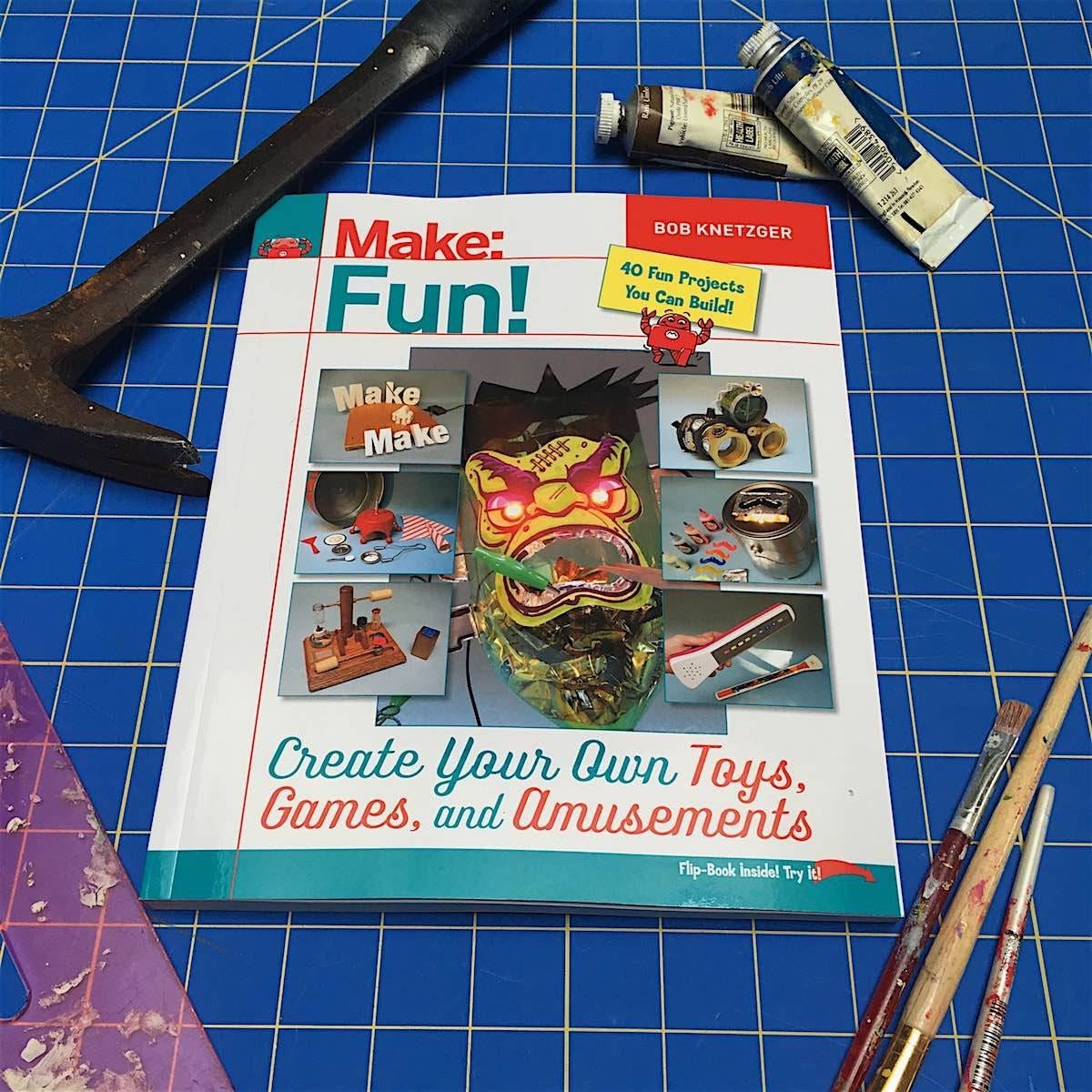
This is the magazine for us -- the enthusiasts of the world. For smart users and amateur technologists. For basement tinkerers, garage hackers, tabletop experimenters, and backyard do-it-yourselfers. Empowered hands-on fans is where it is at, and that is where Make is. It's not about picnic benches made from 2x4s, but aerial kite photography, and homemade mag stripe readers. And thankfully it's not about things that look cool or hip, but things that look dorky and are amazing. Published by O'Reilly the tech book publisher, Make is a fat quarterly in cheerful full color, stuffed with step-by-step instructions, overviews, hints and cool tool reviews. Based on the premier issue, it promises to be an unforgettable ride.
-- KK
Make
Technology on your time
Edited by Mark Frauenfelder
$35/4 issues per year
One click subscription available from Amazon
Single copies (within the first 30 days of publication) are $10 from Amazon
Make
Quick jigs
Because Lego blocks are machined to extremely high tolerances, you can use them for quick, cheap but very accurate jigs, perfect for gluing, squaring, molding, etc. Here is an example of how Jef Raskin, who taught me the trick, used them. (Sadly Jef died of cancer last week). He built up the exact jig positions by stacking bricks of various thicknesses. In the case shown below he built up a jig to square up wings on his radio control model airplanes. All you need is the large Lego baseplate glued to a heavy duty flat foundation.
-- KK
(Jef Raskin was the leader of the original Macintosh computer team, also a fabulous connoisseur of exotic musical instruments, a pioneer of radio control planes, and he had an amazing workshop. His site is still up and very useful.)

The largest Lego Baseplate is Gray, 15 inches (38 cm) square.
$10
Available from Hobbytron
Also from Amazon
The why of knitting

This book is a classic. It is a relatively small instructional book on knitting. It is wonderful because it teaches one how to construct good looking garments without the use of knitting patterns. Her hallmark is a seamless pullover sweater. This book not only delivers quality knitting instruction - it is a great read!
-- Mary Cavanaugh
This is not so much a how-to-knit book, though it excels as that, as much as it is a glorious how-to-enjoy, and how to live while knitting book, penned by a remarkable woman who found happiness at the end of her yarns. This short but famous primer is a good place to start knitting for life. I doubt I personally will suddenly pick up needles -- although my teenage kids and all their friends have -- but nonetheless I did read every page of her instructions with great pleasure.
-- KK
Knitting Without Tears
Basic Techniques and Easy-to-Follow Directions for Garments to Fit All Sizes
By Elizabeth Zimmerman
1995, 120 pages
$12
Available from Amazon
Sample excerpts:
If you are a habitually tight knitter, try to kick the habit. Loose knitting tends to make your stitches look somewhat uneven, but what of it? Are you trying to reproduce a boughten machine-made sweater? Besides, it is surprising what blocking and a few washings will do to uneven knitting.
I used to think that people in the Olden Days were marvelously even knitters, because all really ancient sweaters are so smooth and regular. Now I realize that they probably knitted just as I do, rather erratically, and that it is Time, the Great Leveller, which has wrought the change - Time and many washings.
*
The human being is so constructed that it can be completely covered by a series of shaped tubes. Tailors and dressmakers succeed excellently and skillfully in making tubes out of flat woven material; their achievements are nothing short of marvelous. But we, the humble knitters, can fabricate natural-born tubes by the very nature of our craft of circular knitting. With the techniques of increasing and decreasing at our command, we can shape or even bend the tubes as we will, without seams, gussets, or darts. It is then only a matter of uniting the various tubes by knitting them together, or sometimes weaving them together, and we could, if he desired them, make long-johns for a octopus.
*
For a small baby, take 4 ounces of baby wool, work at any GAUGE you feel like, and see what happens. Babies vary so much in size, and grow so fast, that the jacket will be gratefully worn at some period during the first year.
*
Caps are quickly made, and invaluable for using up scraps of wool for color patterns and stripes. They are excellent bazaar material, as people will pay more for them than for mittens, and they are quicker and more fun to make. (For me the great drawback to knitting mittens is that, having created one, you have to turn around and copy it exactly, for a pair.)
*
Knitting can be solace, inspiration, adventure. It is manual and mental therapy. It keeps us warm, as well as those we like and love. It has existed almost as long as the soft sheep, and in giving us wool they deprive themselves of no more than an uncomfortably warm fur coat in the heat of summer.
Elemental sewing machine

One of the world's oldest tools, but one that is often overlooked. This is a heavy-duty needle with its eye at the working end, mounted in a handle. For mending leather, shoes, bags, sewing canvas, or stitching heavy materials, there's no better tool. I don't use mine often, but it has a place in the essential toolbox. Your local Ace Hardware sells a kit with tool, extra needles, and waxed thread.
-- KK
The Speedy Stitcher Sewing Awl Kit
$15
Stewart Mfg. Co.
PO Box 643
Northboro, MA 01532
Available from Defender, among others.
Also from Amazon

|