LocalHarvest
CSA finder
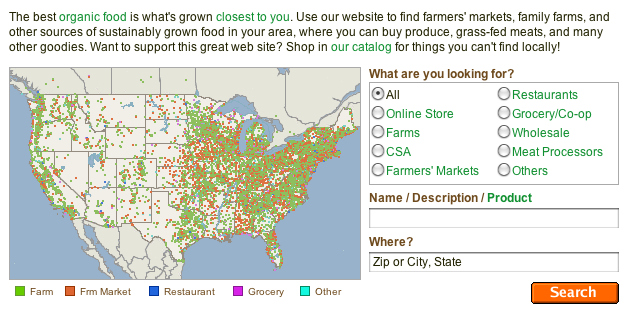
LocalHarvest is a comprehensive one-stop resource for finding locally-grown food in the continental U.S. The site provides a customizable search feature on its homepage, and a simple zip code input provides you with a description and link to your closest Community Supported Agriculture option. Other search options include farmer’s markets, grocery co-ops, and restaurants that serve food made with organic ingredients.
07/8/09Excerpt
*
Shared Risk
There is an important concept woven into the CSA model that takes the arrangement beyond the usual commercial transaction. That is the notion of shared risk. When originally conceived, the CSA was set up differently than it is now. A group of people pooled their money, bought a farm, hired a farmer, and each took a share of whatever the farm produced for the year. If the farm had a tomato bonanza, everyone put some up for winter. If a plague of locusts ate all the greens, people ate cheese sandwiches. Very few such CSAs exist today, and for most farmers, the CSA is just one of the ways their produce is marketed. They may also go to the farmers market, do some wholesale, sell to restaurants, etc. Still, the idea that "we're in this together" remains. On some farms it is stronger than others, and CSA members may be asked to sign a policy form indicating that they agree to accept without complaint whatever the farm can produce.
*
Advantages for consumers
- Eat ultra-fresh food, with all the flavor and vitamin benefits
- Get exposed to new vegetables and new ways of cooking
- Usually get to visit the farm at least once a season
- Find that kids typically favor food from "their" farm – even veggies they've never been known to eat
- Develop a relationship with the farmer who grows their food and learn more about how food is grown
It's a simple enough idea, but its impact has been profound. Tens of thousands of families have joined CSAs, and in some areas of the country there is more demand than there are CSA farms to fill it. The government does not track CSAs, so there is no official count of how many CSAs there are in the U.S.. LocalHarvest has the most comprehensive directory of CSA farms, with over 2,500 listed in our grassroots database. In 2008, 557 CSAs signed up with LocalHarvest, and in the first two months of 2009, an additional 300 CSAs joined the site.
*
Variations
As you might expect with such a successful model, farmers have begun to introduce variations. One increasingly common one is the "mix and match," or "market-style" CSA. Here, rather than making up a standard box of vegetables for every member each week, the members load their own boxes with some degree of personal choice. The farmer lays out baskets of the week's vegetables. Some farmers encourage members to take a prescribed amount of what's available, leaving behind just what their families do not care for. Some CSA farmers then donate this extra produce to a food bank. In other CSAs, the members have wider choice to fill their box with whatever appeals to them, within certain limitations. (e.g. "Just one basket of strawberries per family, please.")
LocalHarvest Free