The Tarantula Keeper’s Guide
Best tarantula how-to
I’m into very low maintenance “pets.” I’ve got my autonomous brine shrimp and have been looking for other critters I can keep and then abandon on a two-week vacation without external care or worry. I was given two tarantulas that fit the bill.
Tarantulas are big, beautiful, active and fascinating. I feed mine crickets. Since they sit on my desk basking in the warmth of the computers and electronic adapters, they’ve grown quite large. They burrow, cling, and pounce. Every once in a while they crawl out of their skins and molt. They are far more entertaining than I imagined. That’s not too hard because I knew nothing about such creatures.
This wonderful book cured my ignorance. It is the best and most complete of the few volumes on the subject, and far more organized than any of the many web sites. It got me going by answering most of my newbie questions, and hasn’t exhausted my spider curiosity since. Like many insects, tarantulas have lives that need books to explain and that can mesmerize readers for hours. This guide serves up natural history and practical how-to instructions for keeping these wonderful arachnids in your home.
— KK
The Tarantula Keeper’s Guide
Stanley A. Schultz, Marguerite J. Schultz
2009 (3rd edition), 384 pages
$14
Available from Amazon
Sample excerpts:
Picking up the tarantula
*
How can the right kind be selected? Remember, these creatures don’t live for only a few months like hamsters. They will live for years, perhaps for decades. Once purchased, it could be yours for a major portion of your life.
*
Not So Deadly Tarantulas
Virtually every reference is anecdotal with no firm medical evidence or authoritative species identification. There are also allegations that some South American species are dangerously venomous (e.g., one or more Phrixotrichus species); but again, there is little factual evidence, merely unverified anecdotal attempts to impress the gullible tourist with giant spider stories.
Too many people have cried wolf too many times. To say that these authors are skeptical is a vast understatement. With the exception of those listed above, none of the species commonly sold in pet shops are dangerous, and most make safe, reliable pets for the novice. The experienced aficionado may wish to acquire some of the rarer varieties, but is urged to take precautions when handling them until their identity is confirmed and verifiable evidence of the effects of their venom is obtainable. Other than that, neither the enthusiast, roommates, the spouse, nor the mother need worry.
*
The fresh exuvium [shed skin] of Brachypelma emilia. How much of the anatomy can you identify?*
Alternate Foods
It may be very tempting to feed ants to a tarantula. After all, ants are among the most plentiful of insects. However, there is something about ants that nearly all tarantulas abhor, formic acid or some other chemical perhaps, or their proclivity to crawl over or attack the tarantula in vast hordes. Many ants are capable of delivering a potent sting. In nature, if ants invade a tarantula’s burrow, it evacuates if it has time.
*
Cagemates
With one possible exception, which we will discuss shortly, it is best not to try to keep other pets with the tarantula. American chameleons (actually Anolis caroliniana), European wall lizards (Lacerta species) and other small lizards will only make good, though expensive, food for the tarantula.
*
Rats or mice, however, have good reason for avoiding tarantulas. Rodents, it would seem, are abnormally sensitive to tarantula venom, and therefore are notoriously unreliable as predictors of toxicity in humans. Or, stated the other way, the venom of many tarantulas seems to be intended specifically for killing rodents.
*
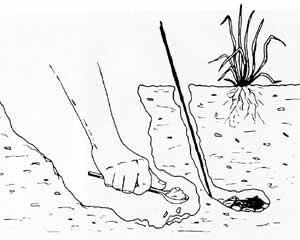
Digging out a tarantula.
*
Acquiring and maintaining a breeding population of tarantulas can be a very expensive proposition. Because of the number of tarantulas that must be individually housed and cared for, and because of the long period of time required by these creatures to mature, it is virtually impossible to turn a profit. The enthusiast must be resigned to doing it only for the love of it.
With this in mind, the enthusiast who resolves to breed tarantulas could make an inestimable contribution to their preservation. Even if unsuccessful, at the very least a greater insight into the lives of these remarkable creatures will be gained. Whatever losses incurred are well worth the risk.
06/7/06