
Street Use
Crude Technology, Recyle Surprises

Jazz on Bones: X-Ray Sound Recordings

In the USSR and Eastern Europe in the 1950s underground night spots would play music pirated from the west. The only media they had were recorders etched into discarded X-ray film. I've long sought some images. Researcher Camille Cloutier pointed me to these, collected and posted by József Hajdú. Here's what he says about them:

During the late 1930s and early 1940s the prevalent sound recording apparatus was the wax disk cutter. As a consequence of the lack of materials in the war-time economy, some inventive sound hunters made their own experiments with new materials within their reach.
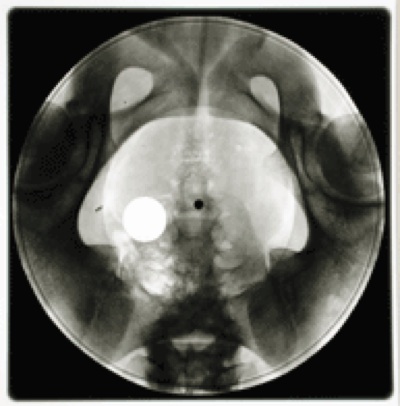
X-Ray1

I do not know the name of the inventor who first utilized discarded medical X-ray film as the base material for new record discs; however, the method became so widespread in Hungary that not only amateurs, but the Hungarian Radio made sound recordings on such recycled X-ray films.
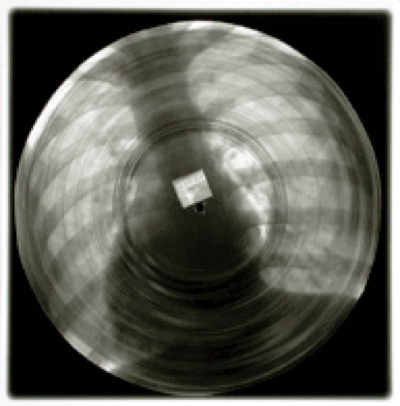
X-Ray2

I felt that those X-ray record albums relate to our contemporary lives in many ways, especially when considering such terms as 'multimedia' or 'recycling'. I copied the X-ray films with their engraved sound-grooves on photosensitive paper and made enlargements of certain details.
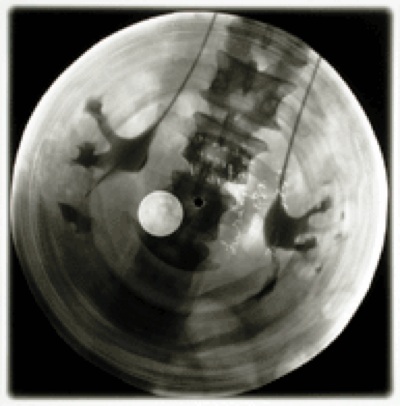
X-Ray3

I was quite lucky to find a considerable amount of similar sound records in private collections. These are also interesting from the visual aspect. By utilizing different photographic processes, I created from them pictures meant to be exhibited in galleries.

In an online paper called The Historical Political Development of Soviet Rock Music, Trey Drake, at the University of California, Santa Cruz, offers further historical perspective on this street use of technology:

Owing to the lack of recordings of Western music available in the USSR, people had to rely on records coming through Eastern Europe, where controls on records were less strict, or on the tiny influx of records from beyond the iron curtain. Such restrictions meant the number of recordings would remain small and precious. But enterprising young people with technical skills learned to duplicate records with a converted phonograph that would "press" a record using a very unusual material for the purpose; discarded x-ray plates. This material was both plentiful and cheap, and millions of duplications of Western and Soviet groups were made and distributed by an underground roentgenizdat, or x-ray press, which is akin to the samizdat that was the notorious tradition of self-publication among banned writers in the USSR. According to rock historian Troitsky, the one-sided x-ray disks costed about one to one and a half rubles each on the black market, and lasted only a few months, as opposed to around five rubles for a two-sided vinyl disk. By the late 50's, the officials knew about the roentgenizdat, and made it illegal in 1958. Officials took action to break up the largest ring in 1959, sending the leaders to prison, beginning an orginization by the Komsomol of "music patrols" that later undertook to curtail illegal music activity all over the country.

I'd love to find out more about this street use. Pointers welcomed.

Posted on August 28, 2006 at 07:29 PM | +del.icio.us +digg +reddit

Comments

I find this information infinitely interesting, well, in my case distracting since i should be working on college essays. It feels so good, as a musician, to know that through perseverance and creativity freedom can reign, and that music can be and is such a huge influence on that. as an advocate for bittorrent, and freedom of knowledge and experience, i am inspired.


bittorent is simply a convenient mode of experiencing as much as i can, artistically and musically, before i die. besides, i still have no choice but to buy vinyl and very indie cds.

Posted by Josh Malin on December 01, 2006 at 02:53 AM

keep an eye out for eduardo cadava's new book! the entire thing is about 'music on bones.' he's sopken on it too, incredible!!! --oh, &also thanks for the great pics--

Posted by j.henry.chunko on September 15, 2006 at 11:13 AM

I remember this was reported in one of the last few episodes of the famous BBC 2 documentary series The World at War - it was made in 1974, though re-aired in full more recently in Britain. Jeremy Isaacs being the main man behind it all.

Posted by Lizzy on September 11, 2006 at 02:16 PM

Great read. Incredibly interesting.

Make it spin!

Posted by Clint on September 09, 2006 at 01:47 AM

Thanks for the great stuff, readers. Doug and Dylan, sounds like you two should get together. Since I run a site for great documentary films, please notify me when your films are ready for an audience.

Maksim, that's fantastic reporting. The deliberate disruption of the bone records is very similar to the attempts by the RIAA to flood the file sharing venues with junky and broken music files in order to discourage free swapping.

Posted by Kevin Kelly on September 07, 2006 at 01:17 AM

I found this really interesting and, judging by the amount of web coverage, it doesn't appear to be widely reported.

Does anyone know the exact process that was used to copy the records onto x-ray film?

Posted by Jenny Lucas on September 04, 2006 at 09:25 AM

If anyone knows where I can get one of these please forward the link. A friend of my is a big record collector and this would be a crazy birthday present.

Posted by Luke on September 01, 2006 at 08:15 PM

What *were* they though? What bands were popular in X-ray format? I'd love to know what acts were getting big play in the USSR black market at that time.

Posted by goatchowder on September 01, 2006 at 03:56 AM

thanks, i've LONG wanted to see pictures of these, too, since i read about them probably 20 years ago. fantastic!

Posted by robin on August 31, 2006 at 11:36 PM

Kevin,
I'm producing a documentary film, now in development, "Rockin' The Kremlin," which explores the story (now even taught as a course in Russian universities) of the significant contribution Rock & Roll coming from the West had in causing the downfall of communist control of society and the eventual collapse of the Soviet Union. It entered the country (in Riga, Latvia) like a virus with no known vaccine in 1955, over illegal short wave radio sets, soon followed by a few records smuggled in by Swedish and Finnish saiors coming to ports of Riga and Leningrad. Bone Records were invented as you described, and 3,000,000 of these highly illegal records were distributed underground in the USSR in 1958 (with no artist name or song title on the record, just a scratched in number) before the KGB realized what they were. The young men in Leningrad who were arrested for making them, were sent to the Gulag for seven years. One must understand that rock music was considered a great threat to the KGB. Rock music was banned in the USSR, the Russian work `Rok' was banned from all media and press until 1986, singing in English was against the law, radios were jammed, and electric guitars could not be found in the USSR, until they were illegally invented/gerryrigged from a smuggled in photo of a Fender guitar, crudely manufactured undergrown and distributed. It took months for the teenage inventors (led by Valery Saifudinov, now owner of Flight 19 Recording Studios in San Deigo)to empiraclly discover that the wires and magnets in the municipal pay phones could work as electric pick-ups for the guitar strings. By 1969, no pay phones in the capital of Moscow were functioning because all the innards had been removed to make underground guitars. Good luck on your book. All the best, Doug Yeager

Posted by Doug Yeager on August 31, 2006 at 08:01 PM

I am the editor on a doc all about the roots of Russian Rock and Roll. Much of it can be traced back to a few people, namely "Pete "Pits" Anderson, and Valery Saifudinov, two Latvian teenagers who started the first Russian Rock band. Also of importance was a Russian bootlegger by the name of Juris Lapinskis.

Posted by Dylan Thuras on August 31, 2006 at 06:04 PM

There was an article in the Washington Post long ago, which is how I learned about x-ray film recordings in the USSR.

Listening to such recordings was called, "listening to the bones." Great phrase, isn't it?

Posted by Darth Cider on August 31, 2006 at 02:56 PM

I remember in the late 70's, a record collector friend acquired a roentgenizdat of the band "Faust", who (I believe) was a Soviet prog-rock band. So, the roentgenizdat scene was still going on into the 70's at least.

Posted by sputnik on August 31, 2006 at 12:16 PM

I found this nugget:

"In the years after World War II, Stalin attempted to extirpate every aspect of American culture from Soviet life. Jazz, which had been played publicly in the USSR as recently as the war years, was now officially regarded as decadent capitalist filth; to even speak of jazz during this period was a criminal act...

Jazz survived in the Soviet Union in some astonishing circumstances. As jazz historian S. Frederick Starr has recounted, many of the country's best musicians were actually in Siberian prison camps, but these camps were in many cases ruled by commanders who liked jazz and who organized the musicians to play for their often-lavish parties. Prison camp commanders would even exchange these jazz groups, allowing them to "tour," as it were, camps where countless prisoners were being worked, starved, and frozen to death. Other bands were exiled to remote cities, such as Kazan in the Tartar region, where they were supposed to undergo "rehabilitation." Instead, these groups, many of which had learned jazz in pre-Mao Shanghai, took advantage of the local officials' musical ignorance, and played jazz anyway. In Kazan, the courageous bands even performed on Tartar State Radio. That's how the early stilyagi kept up with the music: by monitoring Tartar broadcasts to hear exiled musicians outsmarting their cultural keepers.

But the stilyagi managed not only to hear jazz, but to assemble collections of recordings too. How? They had turntables, but they certainly couldn't buy jazz records in record stores (there weren't any). They couldn't tape what they heard on the radio. Even assuming they could get access to a reel-to-reel recorder, where were they going to get enough blank tape? The solution was a piece of genius. A jazz-loving medical student realized that he could inscribe sound grooves on the surface of a medium that was actually plentiful in the Soviet Union: old X-ray plates. He rigged a contraption that allowed him to produce "recordings" that, while obviously of low quality, at least contained the precious music and allowed its admirers to listen to it at will. He and his imitators were to make a lot of well-earned money on the black market..."

In Praise of Vulgarity: How commercial culture liberates Islam -- and the West by Charles Paul Freund

Posted by Bill Christensen on August 30, 2006 at 03:36 PM

My father used to have a pretty good collection of these. Among the records were: Beatles, Elvis, Thelonius Monk, John Coltrane, etc.

The machine for making these recordings was originally designed for making "sound postcards" where you could record a voice message to your relatives on a flexible record; it was commonly found in photography salons. The same salons produced records on x-ray film after hours.

The cost of the record is special too - it's about the same price as a 250ml, "individual-sized" bottle of vodka, and similar to the "lunch money" given to husbands by their thrifty wives (in Russia, women usually controlled the family budget). So the record could be bought by skipping lunch or not getting a drink one day - as opposed to saving money for a few days to buy an official pressing for 5 rubles. I remember my mom berating my dad for buying yet another record while she's running out of food money...

Occasionally, you could buy a record on the "tolkuchka" market, play it, and after the first few bars the music would stop, and a voice said "You want rock-n-roll? F*ck you, anti-soviet slime" followed by a few minutes of elaborate and flowering russian cursing.

These records were produced by the government in the attempt to flood the market with unplayable records and kill the demand.

What killed the "record on the bones" was not government action, but availability of the reel-to-reel tape recorders. Very soon, people were trading tapes and making copies at home, without risk of going to the market.

So, a vulnerable semi-centralized production system was replaced by a wholly de-centralized, free-for-all. The tape recorders became the BitTorrent of the 70s.

Posted by maksim2042 on August 29, 2006 at 11:59 AM


Post a Comment


Remember personal info?