A Remarkable Life Logging Project by Ben Lipkowitz
Gary Wolf
But as you watch, you can hear the "oohs" and "aahs" of the QS folks as they take in the magnitude of Ben's project, and in the humorous, somewhat nervous give-and-take you can sense the intense curiosity sparked by this glimpse of his life-logging practice.
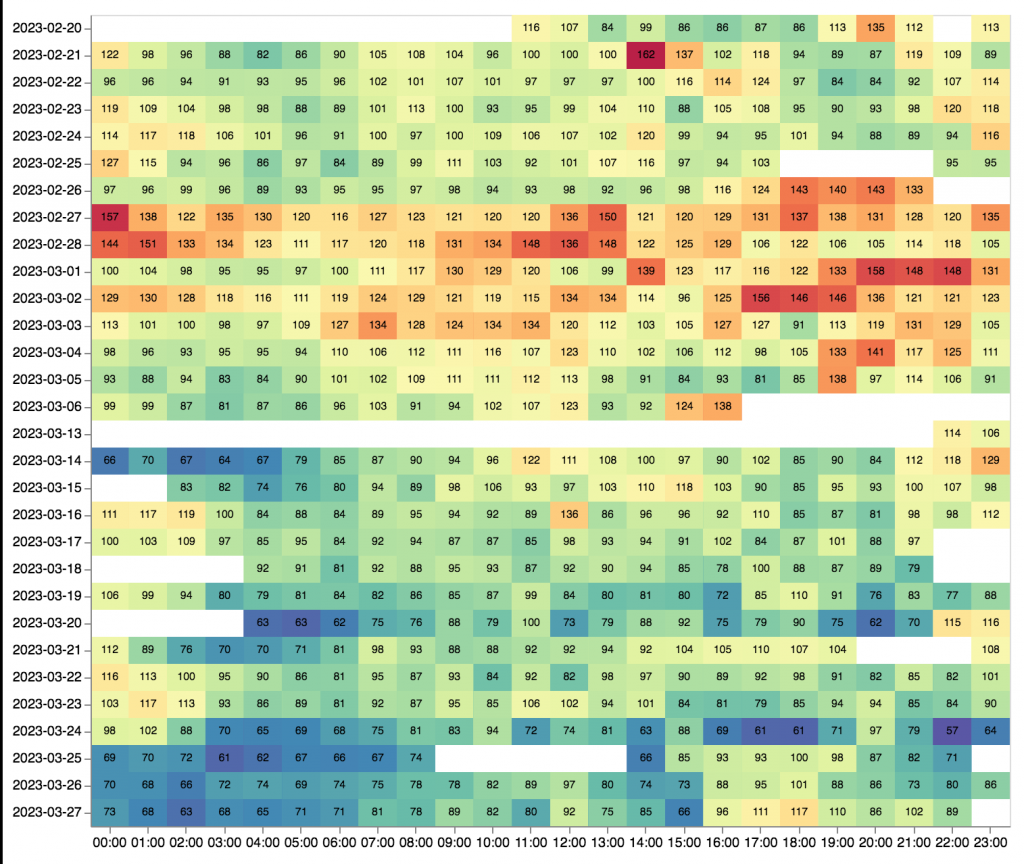
Ben started self-tracking when he wondered how much time he actually spent doing his roommate's dishes. He estimated that he spent an hour a day. (The true amount, he learned, was about 20 minutes.) This led him to track more things. This led him to track everything. Ben considers this project a scientific investigation, but is a type of science inspired by Buckminster Fuller, aka "Guinea Pig B," rather than by a more conventional academic tradition.
It is easy to imagine somebody watching this video and saying: "well, that's a full scale geek-out that has nothing to do with me." But I think this would be an error. Ben uses data to find out details about himself, such as how he sleeps. He also uses data to figure out problems in his social life, such as whether the distribution of housework is reasonable. While its true that Ben's method of data gathering is unusable by most people, the type of questions he's asking and the conviction that these questions are answerable are a preview of the coming age of self-quantification.
Ben started self-tracking when he wondered how much time he actually spent doing his roommate's dishes. He estimated that he spent an hour a day. (The true amount, he learned, was about 20 minutes.) This led him to track more things. This led him to track everything. Ben considers this project a scientific investigation, but is a type of science inspired by Buckminster Fuller, aka "Guinea Pig B," rather than by a more conventional academic tradition.
It is easy to imagine somebody watching this video and saying: "well, that's a full scale geek-out that has nothing to do with me." But I think this would be an error. Ben uses data to find out details about himself, such as how he sleeps. He also uses data to figure out problems in his social life, such as whether the distribution of housework is reasonable. While its true that Ben's method of data gathering is unusable by most people, the type of questions he's asking and the conviction that these questions are answerable are a preview of the coming age of self-quantification.
9 Comments
Leave a Comment
Read Older Posts in Archives - This site operates under a Creative Commons License.


The idea is interesting. But the video would be much better if the background sound weren’t louder than the main speaker’s voice. I could understand just about half what he said.
Gustavo - I agree. What we’ve got going here is a volunteer-based user group, so we just post what’s available from the meetings. I’d like to take this opportunity to invite anybody with an interest in video to help us improve the quality of these recordings.
Very interesting. I’m looking into similar ideas for life tracking for myself.
“preview of the coming age of self-quantification.” Totally agree. Personally self tracking & feeling the value: Self Quantification an evolutionary edge? Great work you guys do at QS! thx.
aha. I see this is up now, so I can point people to the code: http://fennetic.net/sleep/
thanks for running the QS blog, gary!
I had the fantastic opportunity to visit Buckminster Fuller’s archive in the late 1980’s when it was housed in a building on North La Cienega Blvd in Los Angeles. Whilst sitting in ‘his chair’ at ‘his desk’ I was allowed to look through his index cards and was especially taken with his tracking of the cumulative number of communications he had received throughout his life - an exponential curve. This led me to a continuing fascination with lifelogging and the tooling to achieve it.
Just measuring a phenomena changes it ? It could be argued that Heisenberg’s Uncertainty Principle is applicable here, even though that was particle physics and this is more Self-Improvement/Discovery Psychology.
Studies have shown though that just measuring/counting the frequency of a behavior which you wish to eliminate, such as cigarette consumption, will lower it’s occurrence. Just merely counting the number of cigarettes smoked, starts the number declining.
Lipkowitz’s project, for some reason reminds me of Thomas Jefferson’s prolific journals in re to botany & agricultural pusuits.
i can’t even see the vid.. and if i’m missing a plugin in certaintly doesn’t notify me.
Interesting concept but why even post the video when you can’t see his presentation or hear him?