May 2008
Xtreme Charge

I have a collector car I won't drive in the snow, so I'm forced to use a battery tender to keep the battery alive while it collects dust during the winter. In years past, I've used a variety of chargers/tenders (I also had a Harley I stored in the winter), but none has worked as well as the Xtreme Charge I've been relying on this last year. Though my battery used to die all the time within hours of being removed from previous chargers, it now holds a charge for days on end. I am certainly no expert. What I know about how the system works is from what I've read online. It's my understanding that once the battery's gotten a full charge from the unit, it switches to a "pulsating DC current" mode. Apparently this pulse technology does something to reduce and keep sulfate deposits from building up again.
What I know about whether the charger works comes from the old, off-brand battery that, by all rights, might have been relegated to the recycle bin last year but is still holding a charge like a champ. At about the same time I bought the charger, I had already bought a new battery for the '88 Rolls Royce Silver Spur. But rather than use the old battery to recover a "core" charge on the new battery, I kept it and used the Xtreme Charge on it, just to see what would happen. It brought the old battery back to life so well that today I use the charger to keep the old battery alive as a backup power source for my sump pump!
I really appreciate the charger's LED display, too, which provides a constant readout of the state of the charge. Makes it easy to monitor its progress at a glance. After it first reads the current charge, a series of small lights begin pulsing. As the battery charges, the display expresses the status as a percentage of full: 25%, 50%, 75% and 100%. Another great feature: if a battery is dead and cannot be charged, the display tells you bluntly "battery dead" (a situation I have yet to see *knock wood*). In years past, I would would waste time and effort hooking up more than one battery to a charger when it was simply impossible for the battery to take a charge. I went with Xtreme Charge's "marine" charger because it's water-proof and comes in a rubber casing. These days my battery is fresher in the spring than it is at the end of the driving season.
-- Ken Herrera
Xtreme Charge
$85
Available from Amazon
Manufactured by PulseTech
Related items previously reviewed on Cool Tools:
EMT Workshirt

I started wearing these lightweight, relatively inexpensive zip-neck pullovers after I took an EMT-B course. It's less bulky than a sweatshirt, just as comfortable as PJs and very functional. There are two side, on-seam pockets large enough for your hands, a neat large velcro-sealing chest pocket, and a D-ring on the side for attaching a key chain or lanyard. They're very durable as the elbows are reinforced with denim. And they're widely available in three colors (navy, black & gray). Too warm for the summer here in the Northeast, but perfect for the rest of the year as an everyday pullover.
-- JB Woodman
EMT Workshirt
$28-32
(depends on size)
Available from Fatigues Army Navy & Surplus
Also from Uncle Sam's Army Navy Outfitters
Related items previously reviewed on Cool Tools:
Soft Reading Lenses

I've been using the previously-untried soft reading lenses for at least 10 years -- so long, I forgot how cool they are. I used to windsurf and would spend time at the beach repairing and maintaining gear while waiting for the afternoon thermal breeze to kick in, detail work that required reading glasses or Optx 20/20s on my sunglasses. I also used the same pair of sunglasses for driving, skiing and general daily wear. The glasses have to be wet slightly to get the 20/20s to stick, so it can be a little fiddly getting both lenses parallel and then squishing out the air bubbles without moving them around (also, if your frames don't have a rim at the bottom, it's more difficult to get them aligned properly). But once that's accomplished, voila! $300 bifocal sunglasses for just 20 bucks. Once they're stuck down on the glasses they don't move unless you mess with them when cleaning the glasses or if you get them wet. Peel them off with your fingernail if you change your mind. What could be simpler?
-- Evan Marks
I've used this, to great effect. With my prescription sunglasses that I always use when outdoors, I had a problem that I couldn't read maps while driving or hiking. Sticking on just ONE of these bifocal semi-circles was a total solution. The water adhesion has held for two years, and cleaning the bifocal part has not been an issue.
-- Stewart Brand
I've used these, but not in the intended fashion. I ride a motorcycle and wear a helmet (though my state doesn't require it). In my 40's I've started wearing corrective glasses, but during the day I also need some sort of eye protection from the sun. The solution was wear regular sunglasses and use these stick-on reading lenses. But I didn't care for them being on my sunglasses all the time, so I stuck them on the face shield of my helmet. This allows me to read the gauges on my motorcycle and the GPS. The field of view is quite small because the lenses are further out than intended, but it works better than not being able to read anything. I've since purchased prescription sunglasses and retired the stick-on lenses, but these work in a pinch and, IMHO, are on par with the $12 specials from the big box stores.
-- Ken Jones
(also recommended by Michael Rasmussen, Gerald Zuckier, and Bob Zychek)
Soft Reading Lenses
$10
Available from Amazon
Manufactured by Optx 20/20
--
Related items previously reviewed on Cool Tools:
SOLAS Marine Reflective Tape

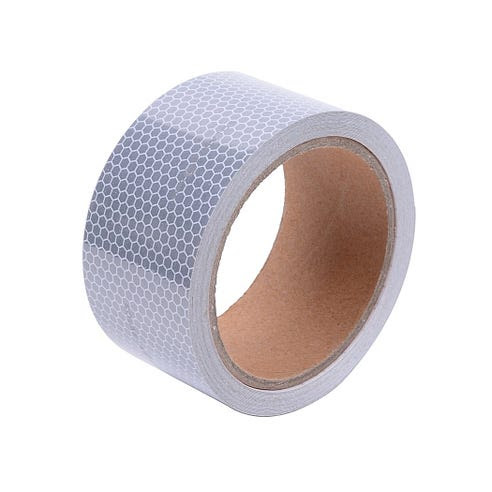
We've been using 3M's SOLAS reflective tape for several years. It was designed for the Coast Guard to use on life jackets, so you know it has to be tough and withstand time, bad weather and wet conditions (SOLAS = safety of life at sea). It is a bit expensive, but it is the brightest and most durable stuff I've ever found. We use it everywhere and have put in on just about everything: garbage cans, walking sticks, jackets, kayaks, a bicycle, a stroller, a trailer, traffic cones, automobile door jams (so oncoming traffic sees me right away), the trunk of my car (an instant safety device if I get stuck on the side of the road) and the car's mudguards. The strips on our mudguards -- which take a lot of abuse! -- are still sticking after more than seven years. Now that I've seen how effective it is, I really think it should be a law that all cars come stocked with reflective stripping on door jams.
-- Jeff Ellis


SOLAS Marine Reflective Tape
$35 (1" wide)
$50 (2" wide)
(both, 30' long)
Available from The Reflective Store
Manufactured by 3M
Related items previously reviewed on Cool Tools:

Industrial Soap Dish

A few years ago when my wife and I renovated our home, we found inspiration in some unusual places. But perhaps the oddest of all was AW Direct, a mail order catalog that sells parts and equipment for tow trucks. While browsing through the catalog one day, I noticed AW Direct offers a recessed aluminum step designed for use on service vehicle bodies. But when I looked at it, I saw something different: a soap dish!
We bought one and installed it in the shower I now use daily. This is by far the best-designed soap dish I've ever used. The open front allows water to drain away easily, while the diamond-plate surface secures and elevates the soap so that it dries without creating a lot of yucky soap-gunk. And of course, the aluminum doesn't rust or corrode.
We ended up buying quite a bit from the AW Direct catalog for use in our house, and I heartily recommend it if your domestic tastes gravitate toward the functional/industrial. In the home or on the highway (or vice-versa), AW Direct delivers!
-- Todd Lappin, from his posting on the Dinosaurs and Robots blog

Industrial Soap Dish
$35
Available from AW Direct
Related items previously reviewed on Cool Tools:
Subhead Grip Stickers

Why sacrifice style for safety? Subhead grip stickers are an attractive, very effective, functional alternative to regular, boring, anti-slip tape. For the last year, I've been using the star-shaped stickers on some wooden steps outside my home. Just recently, I affixed the skull stickers to some rattan sticks I use for martial arts. And in the near future, I'm planning to add some fleur de lis stickers to some other steps. High foot traffic areas also experience a lot of visual traffic -- walkways, pool decks, boat decks, ship ladders, etc. Most anti-slip tape is that boring rectangular stuff, long black or yellow grip strips that, to me, sometimes look too industrial or institutional for a home, garden and even some businesses. Instead, these come in fun, eye-catching designs that will also draw people's visual attention, potentially making it even more effective than standard rectangular anti-slip tape. I imagine some people would prefer to make homemade stickers/designs, but quite honestly, I lack the dexterity, patience, & hand strength to be able to create detailed, attractive & consistently-sized/shaped stickers (ironic given that I practice martial arts, I know). Still, I am certain if I tried to make the stars, my versions would look like an injured sea star or Dali-inspired Rorschach blots. It's much easier to just click and buy these.
-- Linda Matsumi

Subhead Grip Stickers
$12
Available from Subhead Grip
Related items previously reviewed on Cool Tools:
Farewell, My Subaru

These days there's a glut of first-person reportage centered on alternative lifestyles. Some narratives can come across as self-righteous and self-indulgent. This book is not one of those. When 30-something journalist Doug Fine buys a plot of land in New Mexico and vows to live as "green" as possible, his self-deprecating, humorous outlook kicks in. He never denies he's in over his head. Quite the opposite, which makes every misstep and subsequent triumph all the more gratifying. From rearing goats found on Craigslist to garnering rainwater harvesting tips via -- what else? -- http://harvestingrainwater.com, and Googling a VegOil auto mechanic, Fine's journey is exactly what it professes to be: "green, Digital Age living." No substitute for the rigorous how-to's penned by experts, this entertaining, heartfelt journey is a testament to what's possible with a Web connection and heaps of determination. Indeed, the path to alternative living truly begins at our fingertips. Even if you could care less about going green, living local or starting-up solar, there's inspiration to be had. Plus, delicious recipes highlighting some of Fine's homegrown stuffs.
-- Steven Leckart
Farewell, My Subaru
Doug Fine
2008, 224 pages
$17
Available from Amazon
Sample Excerpts:
I had been reading almost nothing but goat literature for a month, much of it contradictory. As usual, books failed to prepare me for real life. The classic goat-care bible is David Mackenzie's 1957 tome Goat Husbandry, and thanks to the line: "The nature of the goat is disciplined, co-operative and intelligent," I had started my career as a gentleman rancher naively thinking that raising dairy goats would be easy. I mean, I'd throw them some hay, breed them, and soon enough they'd be giving growth hormone -- free milk, with enough left over for me to barter locally for things like hay, buffalo meat, and massages. How hard could that be? Now, with five minutes under my belt as a goat owner, one of my kids was kicking me in the pelvis as I tried to get her into my car.
*
I relied pretty heavily on the first line of Jim Corbett's book Goatwalking, which stated definitively that "Two milk goats can provide all the nutrients a human being needs, with the exception of Vitamin C and a few common trace elements."
*
The actual vegetable oil pump, tucked between seven hundred porta johns, looked like gas station pumps used to look when my dad was little: quaintly oval, with an old-school gauge and actual physical numbers that turned as you fueled. I asked Kevin [Forrest of Albuquerque Alternative Energies] if this would be a normal fill-up. "Yeah, except if you hold the fueling handle long enough -- ow! -- it might burn your hand. Feel." I clasped the handle. "Yeah, ow! Hot," I agreed. I guessed correctly that the pump was kept at scalding temperatures to prevent artery clogging in its lines. With my palm still, I reached for the nozzle again with my shirttail as a potholder. I wanted to put the first vegetable oil into my truck even if it cost me a hand. I mean, filling up with a clean fuel from a totally old-school pump. How cool was that? I felt like ordering a grape Nechi. I unscrewed my gas cap and aimed the nozzle at my normal fuel tank. "Whoa whoa whoa!" Kevin shouted, breaking me out of my reverie. "What?" "If you put the vegetable oil in your old diesel tank, this truck'll never drive again." "Right." Just what I needed: two fuel tanks to think about. But a few minutes later, with eighty gallons of oil in the correct tank and a second-degree-burned hand, I did a little mileage calculation. If I got the same eighteen miles per gallon on VegOil that I got on diesel, I wouldn't have to fill up for the next fifteen hundred miles. That would get me halfway across North America. I was good to go for months, and I wouldn't have to fill up with actual diesel, well, almost never. With diesel prices up twenty cents per gallon in the three days since I arrived in Albuquerque due to some kind of pipeline sabotage in Nigeria, I was already rubbing my palms together. It'd be so simple: when I ran out of veggie oil, I'd simply get more at the Mimbres Cafe. That was one of two small eateries in my valley, known for its mastery of both traditional New Mexican dietary staples: fried corn products and fried flour products. I could still tool around in a car, that ultimate American symbol of freedom. My gas would be free and clean. Sure, i would have to calculate and pay my own fuel taxes on the honor system next April. But that was a lot better than that last $67 diesel fill-up I had just endured on the nearby tax-free Indian reservation. I was carbon neutral, and it felt right.
*
Sometimes having a "grid inter-tie" system, that is, a solar- or wind-power setup that is still connected to the energy company's power lines, can be even more effective than moving off the grid entirely. In many states, utilities are required to buy back any surplus energy you produce with your home solar panels or wind generator. Instead of receiving an electric bill, you can receive an electric check.
*
If the local government bought my story about trying to be a legitimate local food producer (which I was just starting to buy myself), it'd mean a savings of probably a thousand dollars per year over what the previous owner had been paying in taxes.
*
Seven hours after my vow to avoid box-store shopping, I sat atop the Funky Butte in a semi-lotus, with ubiquitous Sharp Desert Stuff turning me into one of those bed-of-nails swamis. With Arkansan chicken still in my belly, my thoughts moved through the day's events at the Funky Butte Ranch. The runaway LOVEsubee. A new herb garden. Suddenly a firm resolve hit me. I had been doing things half-baked; conducting my relationships, catching salmon, shopping for dry goods. I wanted to do things fully baked. No, wait, that didn't come out right. What I meant was I was going to dive into this experiment with everything I had. Although I didn't realize how literal that "dive in" pledge would soon prove. I would do it one project at a time. Maybe after a year, I'd see some real reduction in the oil in my life. But it wouldn't be a cakewalk. At the moment, even with solar panels, I would survive as long as crunch co-ops imported tomatoes and box stores provided preroasted protein.
*
I don't like to think about dying, either. But if I had stopped to look at my overall survival ability when I embarked on this experiment, I concede that it would look like a I had a death wish. Without any of the skill sets that allowed earlier pioneers to eke out a life here, I chose New Mexico for the project, both because I love the mellow culture and vast wilderness, and because I thought it would have some of the best solar power potential on the planet... Extremely hot weather actually makes solar panels operate less efficiently -- you get about 0.5 percent less production for every degree centigrade increase in temperature.
Related items previously reviewed on Cool Tools:
Knot Tying Cards

I'm a technical theatre professional, and being able to tie the proper knot in the appropriate situation is critical to saving time and staying safe. For a number of years, I've kept several sets of the previously-untried Knot Tying Cards around for emergencies. I keep one in my messenger bag, one in the glove box of my car, one in my tool bag, and there's likely another one in the official junk drawer in the kitchen. While there are around 10 knots I use on an almost daily basis when I'm working, there are a handful of specialty knots I know when to use, but can never retain how to start (or finish) them. One particularly bothersome knot is the Trucker's Hitch. If done correctly, it will secure an unruly load in short order (and can be tied with one hand if you're dexterous). If you do one little turn incorrectly, however, It becomes a slip knot and won't hold squat.
That's where these flash cards come in handy. They have this and other bothersome knots, and the cards provide enough of a trigger that I can execute the desired effect. More often than not, when someone 20 feet away asks me to tell them how to tie a particular knot, I end up throwing the set to them. Much easier than explaining it! And they always manage to tie the knot safely. Not all knots are created equal, and knowing how to create and properly use a variety of them is useful for everyone. On the stage, though, a poorly-tied knot can quite literally kill someone. I've seen more than one "of course I know how to tie a square knot" load crash to the floor because hubris trumped common sense and basic knowledge.
That said, these cards are handy for those who already know how to tie proper knots, but don't do so every day and need a quick reminder. For the novice knot-tier, the previously-reviewed Morrow Guide has never been equaled, IMO. I once taught a knot-tying class to a group of high school theatre students. I provided a 50-foot piece of rope and told them it could become a ladder. I showed them the page in the book and let them have at it. In about 30 minutes, they had a load-bearing 12-foot rope ladder. You can't beat that!
-- Christy Risser-Milne
Knot Tying Cards
("outdoor" variety)
$5
Available from Hit the Trail
"Fishing" knots & other varieties also available from the manufacturer, Pro-Knot
Related items previously reviewed on Cool Tools:
PedEgg

Between being over 40 and having run 14 marathons, I have feet callused enough to require "dealing with" on a regular basis. The PedEgg is a microplane type set of blades attached to an egg-shaped compartment that not only makes it very ergonomic, but also collects all the lovely "stuff." Very easy to use while seated in the living room rather than precariously perched over a sink or wastebasket, or balancing in the shower on one foot. I've tried pumice stones, rasps, and the super coarse emery boards with no luck -- those all take forever to get the job done (and none has a built-in mechanism to capture the shavings or dust). I thought I'd found the perfect answer in a microplane kitchen grater (not something most people would admit, since it makes guests wonder what other kitchen utensils have been pulling double duty). But now that I have the PedEgg, the grater has officially been retired. Ten bucks and well worth it. I use it about once every 2-3 weeks, basically when there's 1/8" or more callus to remove. It leaves a very smooth surface. Surprisingly, it's more aggressive than the fine microplane I had. And you can buy replacement blades should it ever wear out. It also has an emery board on the outside of the cover for final smoothing of your feet. Overall, I'd guess the PedEgg is at least twice as fast as the microplane and four times faster than an emery board on dry calluses. Of course, if you work on your feet after a shower when they're soft, any of these techniques are faster.
-- Yitah Wu
PedEgg
$10
Available from Amazon
Manufactured by Telebrands
Related items previously reviewed on Cool Tools:
Excalibur Food Dehydrator

I've been using this 9-tray dehydrator once or twice a week for the last three years to make dried fruit, veggies and yogurt, jerky, dog treats, and dried bread (for bread crumbs). Other uses include re-crisping crackers, cookies, chips, etc., and drying photographs and flowers. Since the thermostat is adjustable (85F - 145F), you can customize your dehydrating efforts. The removable trays allow you to experiment with sizes and quantities, but also let you combine varieties of foods by temperature range. For shorter-termed dehydrated items, you just take out those specific trays and let the other longer-term items remain. This is truly the most flexible unit I've found. Other dehydrators heat from the bottom and much less evenly, requiring you to manually rotate trays, whereas the Excalibur has a fan to help distribute heat more evenly. The Excalibur also has a timer, so it will turn off at the desired time whether you're there or not; and none of the cheaper dehydrators have temp controls. The Home Essentials and Ronco models I own have now been relegated to making dog treats exclusively; I decided to keep the Excalibur for people food. Although it is somewhat noisy (all the dehydrators I've used generate some amount of noise), I keep it in the craft room, where noise isn't much of an issue. It's very easy to clean. I enjoy not throwing out food that spoiled and we always have healthy snack alternatives for us and the grandkids -- and they enjoy contributing to the process as much as they eating the rewards. Since we moved to a property that has a variety of grapevines, we now harvest copious amounts of grapes and make our own raisins.
Bonus tips:
1) You need ParaFlexx non-stick drying sheets for fruit yogurt leathers or items particularly high in moisture content. Excalibur provides a pretty good guide on how to work with different foods.
2) If you buy direct from the manufacturer, it may be slightly more than you can get at other suppliers, but I understand they guarantee the unit for 10 years (or you can purchase a 10-year extended warranty)
-- Chris Lewis
Excalibur Food Dehydrator
$210
(9-tray model)
Available from Amazon
ParaFlexx Sheets
(14"x14")
$16
Available from Amazon
Manufactured by Excalibur
Related items previously reviewed on Cool Tools:
COOL TOOLS UNTRIED
Cool Tools Untried look cool, but -- buyer beware -- may seem cooler than they actually are. Neither I nor any of our reviewers have actually used the items below, so we can't endorse them or speak from experience. If you have used any of these and can report (positively or negatively) -- or if you have a similar item you love -- please let us know. Until then, here's some intriguing stuff.
-- Steven Leckart
Optx 20/20 Soft Reading Lenses
Reusable stick-on bi-focals

Available from Optx 20/20 and Amazon
(thanks Dean!)
****************************
Digital Nutrition Scale
Precision dieting

Available from EatSmart and Amazon
****************************
Glo Glov
Safety reflective gloves

Available from Glo Glov
(via Bike Hugger)
****************************
Dexpan
Controlled, non-explosive demolition agent

Available from Archer Company and Amazon
(thanks David!)
****************************
The Solar Food Dryer
DIY sun-powered grub dehydration

Available from Amazon
(via Mother Earth News)
****************************
Cost Controller Power Strip
Digitally displays power consumption in kilowatt hours

Available from Computer Gear
(via EcoGeek)
****************************
Knot Tying Cards
Key-ring size knot instructions

Available from Brigade Quartermasters
****************************
World Pro Instant Air
Portable pneumatic system

Available from World Tools and Amazon
See here for a video demo
(thanks Drew!)
Related items previously reviewed on Cool Tools:
Mistake-Proofing

Mistakes are NOT inevitable, but the logical consequences of remediable design. As such, it's so much easier to avoid them than to correct them, especially if each one becomes a link in a chain of events that go off the rails as a result. If I'd continued in academia, perhaps eventually chairing a department, I'd buy as many copies of this book as there were members of my department -- faculty, residents, nurse anesthetists, medical students. It's slim (72 pages) and easy to understand -- no formal process(es) to follow. Instead, the book provides several seemingly simplistic but very useful rules of thumb anyone can adopt. As Chase & Stewart write: "You don't need a Ph.D. in statistics to apply it. In reality, mistake-proofing is more like a structured form of common sense." For example: "The key to creating mistake-proofing devices and procedures is not to do too much at once. Instead, concentrate on clever, inexpensive methods to check for only one mistake at a time. If you have two possible mistakes, develop two separate devices or procedures to catch them." Right on!
-- Joseph Stirt
Mistake-Proofing: Designing Errors Out
Richard B. Chase & Douglas M. Stewart
2007, 72 pages
$16 - print
$10 - download
Available from Lulu
Sample Excerpts
*
The best way to ensure the detection of a mistake is to make sure that something in the environment makes it very obvious that one has been made. A good example of an environmental cue is the inevitable "extra" parts that remain after a do-it-yourself repair project. These parts make it very clear that you have not reassembled the item correctly.
*
Machine mistakes, being generally mechanical in nature, are better understand than human mistakes. They are, therefore, more predictable and easier to control. If we look closely at the different types of machine mistakes, we see that they fall into two categories: those mistakes we can see coming and those that catch us unaware.
*
Employees experience a continuous stream of encounters - one defect is a low failure rate. Customers experience a single defect as a 100% failure rate.
*
Toyota, which is very experienced at mistake-proofing, averages about twelve devices for each machine.
*
Go/No-Go gauges are not limited to the shop floor. Customers often use such gauges to detect and prevent mistakes. Some amusement park rides require riders to be above a certain height (so they do not slip through the safety restraints) or below a certain height (to keep larger people off of rides meant only for small children). Parks do not want customers to discover they are too small or large after waiting in a potentially very long line. By placing a gauge at he front of the line, customers can tell if they are tall enough (or short enough) to go on the ride without waiting in line.
*
Mistakes are random events and therefore we must continuously watch for them. Sampling is not good enough. It looks at only a small proportion of the outputs in a process.
*
Most importantly, mistake-proofing is the only method we know that includes customers' actions in the quality control system. The importance of this is emphasized by one study that estimates that customers of services are responsible for one-third of the problems they complain about.
*
Remember that the goal is to develop clever, simple and inexpensive devices. Don't immediately opt for the high-tech solution.
Related items previously reviewed on Cool Tools:
Nite Ize S-Biner

S-Biners are much lighter than conventional carabiners and have two attachment points, which really comes in handy when you need to quickly attach and detach things. When I stumbled on these at Frys recently, I picked them up right away. I'm a product design engineer so whenever I see a simple elegant design, I just have to get it. I now use a #2 for my backpack and a #1 for my keychain; I like to clip just my motorcycle key to my jacket, so I don't have to root through my pockets, and I also like to separate my car key when I take it in for service. The two attachment points really makes this easier. On a recent bike camping trip, we also used them in a pinch to hold my friends panniers in place. In addition to various sizes, S-Biners even come in a variety of colors. Just don't use 'em for climbing.
-- Cormac Eubanks

Nite Ize S-Biner
$5
(size 2, black)
Available from Amazon
Other sizes/colors also available from Amazon
Manufactured by Nite Ize
Related items previously reviewed on Cool Tools:
Moving Tips

Since I seem to move house every six months or so, I have ample opportunities to test new strategies. This time around I experimented by putting plastic storage totes through FedEx Ground, and for the items I moved myself I used cardboard boxes with the addition of nonadhesive strapping tape and tubular handles. Much quicker and easier, less effort, no breakages, big success.
-- Charles Platt
Plastic Totes via FedEx
Wal-Mart sells them for storing items such as bedding and clothes in the home, but their semi-rigid construction makes them ideal for moving fragile possessions such as dishes and stereo components. They are stackable, waterproof, easy to pick up (recessed handle at each end), reusable (can be nested during storage), and will pass unscathed through FedEx ground. Best of all they barely cost more than cardboard boxes! My local FedEx-Kinko's was skeptical about accepting them for fear that the lids would pop off during transport. I allayed their fears by putting 2-inch tape around the perimeter of the lid and folding it under the rim. I had to make little notches in the tape so that it would seal properly either side of plastic strengthening ribs under the rim, but this was still much easier, quicker, and safer than using cardboard. Wal-Mart sells gray Sterilite brand totes (the type I prefer) through its stores, but not online. Models 1830 and 1835 are the ones I have tested through FedEx without any problems. You can pay a little more and get "latch totes" (models 1940 and 1945 with a flip-up latch at each end) but since you'll still need to add tape, I feel the latches are unnecessary. (NOTE: One reader pointed out that plastic totes may buckle if they are stored in a very hot place with heavy objects on top of them. I haven't encountered this problem myself, but I do follow the standard practice of filling each container to minimize empty space inside it)
Strapping Tape

If you still want to use cardboard boxes for items you move yourself, or if you are moving stacks of books secured with cling wrap (as I have suggested previously), consider adding half-inch nonadhesive plastic strapping tape. This is the stuff you sometimes see wrapped around boxes containing big items such as refrigerators being transported as freight. Often it's yellow in color. Shipping departments have a tensioner that they use to pull the tape tight, but you don't need that. You can get 3000 feet of half-inch strapping and a lot of little buckles, with a manual tensioner, for $36. You thread the tape through the buckle, pull up on it while bearing down on the box, and you have it as tight as you need it. You trim the tape near the buckle. The advantages are that it greatly strengthens the box while giving you something to grab it by, especially if you augment it with a handle (described below). Also you can link two or three boxes together so that you can carry them easily with one hand, especially up and down stairs. Much more efficient and secure than cradling boxes in your arms, less hazardous (you can see your feet and obstacles in your path), and less risk of back injury, since you don't have to stoop to pick them up. Note that FedEx and UPS don't like string or strapping that can snag their package processing machinery, so strapping is for transporting packages yourself or with assistance from movers.
DIY Box Handles
Make handles from half-inch plastic water pipe sawn into 5" lengths. My local Lowe's sold me six feet of pipe for around $3 and you can use any wood saw to cut it. You may feel this is a luxury, but if you want to protect your hands from the edges of the plastic tape, handles are nice to have.
Thread tape through handle.

Turn box upside-down and cross the tape ends.

Turn box right-side-up and thread one of the returning tape ends through the handle.

Add the buckle.

After pulling the tape tight, your box is now very easy to carry.

Related items previously reviewed on Cool Tools:
eGO Cycle

For the last year, I've loved commuting to work on this electric scooter because it's powerful enough to ride in traffic, but doesn't feel like a motorcycle. Before settling on the eGO Cycle 2 SE, I test drove a bigger bike and smaller one from a different manufacturer, but I liked the eGO best, which has turn signals in front and back, a headlight, and a horn. There are two settings: "Go Far" and "Go Fast." I find I can get up to 23 mph or so with Go Fast, though I usually use Go Far, which has a max speed of about 18 mph. The guy who sold it to us said it has a range of about 20 miles and takes about an hour to recharge. I keep it plugged in regularly and have not let it run down much since I got it. I am fortunate to have locked, indoor parking with an outlet at my work, so this is easy. My commute to work is 1.6 miles, but I have ridden the bike up to 10 miles with plenty of charge left. In Oregon, this qualifies as a bike, even though it's motorized, so it does not require a motorcycle license. I had not ridden a motorcycle before, so I had to train myself that "go" was controlled by my right hand and that the handle motion was toward me, not away from me (away was more intuitive to me for some reason). I wear a motorcycle helmet with a face screen. I prefer the protection while riding in traffic and like the face protection from wind, rain and bugs. I have ridden in light to medium rain but not downpours. In those conditions, I've found the traction fine and just slow down a bit. I have ridden only on surface streets -- in bike lanes or with traffic (the bike does not do well in gravel). Since I put a milk crate on the back, it's easy to haul stuff. I've noticed I get lots of thumbs up and smiles when I ride, too -- pretty certain they're directed at the bike. I remind my husband regularly that in addition to being a fun ride, it seems to be a guy magnet.
-- Mary Gear
eGO
$1550+
(depends on model)
Available via US & Overseas Dealers
Previously available from Amazon
Related items previously reviewed on Cool Tools:
Pilot's Pen

I'm an aircraft owner and use this very powerful LED-powered pen during night flying, but also while traveling on commercial flights and mostly at odd times: crosswords, fishing for something in the car at night, etc. The lighting and ink are independently controlled, so in addition to being effective, it's easy to use: the button on top is on/off for the light and the pen rotates to retract the ink. I've had some promotional-type LED pens in the past, but the button cells burn out and then it's difficult to replace them. This pen runs on a single AAA cell, which is easy to find and replace. The pen also comes with an extra battery and ink cartridge for $20 (with shipping) -- not too bad.
-- Robert Cullinan

Pilot's Pen
$20
Available from Amazon
Manufactured by Britta Products
Related items previously reviewed in Cool Tools:
Zulu Watch Bands

I never take my watch off, and this watch band has held up through two years of hiking, yard work, showers, swimming, etc. The original british grey nylon has weathered a bit, but the stainless steel hardware still looks great, and there is no fraying or visible wear on the tough nylon strap. I have the two-buckle version, but there is a a four-buckle version for extra security. The long tail of the strap doubles back through the keepers and stays out of the way. I never liked the way rubber straps feel on my skin, but the nylon in this band has never irritated or chafed.
-- Brad Reese
They take a licking and keep on ticking. Much more comfortable and uncluttered than traditional watchbands, especially for those that work on keyboards all day. Sun, snow, salt: they handle it all. And when they finally wear out, a new one costs $17.
-- PJL
Zulu Watch Bands
$17
(various colors/sizes/buckles)
Available from County Comm
Manufactured by Maratac Extreme
NOTE: CountyComm has adapters and straps for most regular G-SHOCK wearers, but they do NOT have adapters and straps to suit BABY G-SHOCK models worn by those who prefer a smaller watch! -- Jeannie Lu
Related items previously reviewed in Cool Tools:
Eye-Fi

I am a dermatologist and often take clinical photos of my patients with a digicam to add to their electronic medial records. With the Eye-Fi, a wireless 2GB SD memory card, I can take a photo and by the time I return to my computer the photo is waiting for me. Set up is very easy. You just plug the card in like you would any other memory card, do some basic configuration (the software works with Mac/PC) and you can send photos to the computer via the wi-fi you configure, or send direct to an online site like Flickr. You can also set the card up so several wi-fi are recognized (home or office, for instance), although you must program each individually. If you are using remote wi-fi access (that you have set up), needless to say, you will only be able to put photos online. In the office, we use the Eye-Fi to send to a local computer only. For someone with a built-in or USB SD card reader or Bluetooth, the Eye-Fi may have less benefits. For my purposes, it's spectacular. Previously, all patient photos would be downloaded as a batch and then each would be tediously attached at the end of the day. With the Eye-Fi, the photos are made available right away and they can be attached right when we write each patient's note. The flow is much better. Surprisingly, I haven't noticed any issues with the card draining the battery either. A few caveats: at any one time, one card can communicate with only one computer and one online site. You can, however, set up your account so your card can communicate with multiple computers. In order to switch computers, you go into the Eye-Fi manager on your computer and change the settings (i.e. if you're switching from work and home). While my use and situation may be unique, I also started my somewhat technophobic father-in-law on an Eye-Fi several months ago and it's been working well for him. Previously, he used to just fill up cards and then buy a new one (luckily, with the price of SD cards, that was still cheaper than film, but this is much better!). All he has to do is remember to keep both the camera and computer on, and the Eye-Fi enables him to share his photos online with us with virtually no trouble. At first, he had a few issues and concluded the card was broken. However, I showed him all he needed to do was make sure the computer was on with the Eye-Fi manager running (it can be set up to automatically run when you boot your computer). Undoubtedly, this technology has major potential to revolutionize digital photography as we know it. I look forward to future drivers that could support instant upload via any unlocked wi-fi your camera wanders near.
-- Jeff Ellis
$100
Available from Amazon
Manufactured by Eye-Fi
Related items previously reviewed in Cool Tools:
Unger Trim Scraper

I work in the beverage industry and use this scraper for removing stickers from cooler doors that other guys with pocket knives, razors, car keys, etc. couldn't budge. The Trim 10 has wide, super thin, very flexible blades about 4 inches long that really conform to the surface of the work. I find it picks up more material per stroke and gets down to the bottom of things better than a single-edge razor blade. The holder has a very elegant folding design that allows for safe, touchless blade changes and compact, safe transport -- a much smaller, flatter package than a lot of utility knives. The scraper comes in a nifty case that holds a few extra blades, which can be purchased separately. A modular handle is also available for heavier work, but I never need it. I get mine from a janitorial supply company in Austin. I believe the scrapers are popular with window tint installers, too.
-- Christian Taylor
Unger Trim Scraper
$6
(Trim10)
Available from ReStockIt.com
Manufactured by Unger
Related items previously reviewed in Cool Tools:
Pelican Memory Card Cases

These durable cases protect your memory cards from getting wet, contaminated with dirt, or in my case lost. I have misplaced numerous memory cards due to their small size. With these cases not only do I not lose the cards, but I use the cases to organize them. The cases are small and compact (about 4.25" x 2.25") and only about 1" thick. They're available for almost all media types: SD/Mini SD, XD, Compact Flash and for MS (Memory Stick) cards. Each holds anywhere from 4 to 16 memory cards. I now use them to organize all of my media. So my wife has hers (I am not allowed to touch them since I have lost some of her photo flash cards), some for work (sorted by major projects) and then my own personal use cards. All I have to do now is grab the case I need for work, for instance, and I know I will have everything I need. These card cases have an o-ring seal Pelican says is "water-resistant." Though I wouldn't want to find out if they're waterproof, I think they only back off that claim to protect their tail. I have owned Pelican cases for my cameras for years and have found they're pretty much bulletproof. I also have one case for my laptop and use Pelican's cases for work to ship expensive equipment. My only complaint with their card cases is I wish that they had different colors to chose from so I wouldn't have to label them.
-- Scott Newton
Pelican Cases
$22
(stores 8 SD cards)
Available from Amazon
Manufactured by Pelican
Related items previously reviewed in Cool Tools:
Getting Paid

Scott Kirsner has compiled an online list of the best ways to sell your video creations online. Everyone is making video, but few figure out how to sell them. Kirsner gives you 21 different sites that pay videomakers and dissects the monetary deal each one offers. I haven't found anything as useful anywhere else. It is the equivalent of the first version of a "Writer's Market" for digital video producers. This list is free, part of a longer downloadable e-book he hopes you will buy, the Future of Web Video. I did; the rest of the book is a bargain for anyone serious about peddling a video of whatever length. I hope he keeps the list updated.
-- KK
Getting Paid: Sites that Help Filmmakers and Video Producers Make Money
Free
Available from Scott Kirsner
Related items previously reviewed in Cool Tools:
Mac Laptop Power Cord Tip

Every Mac comes with a long, bulky power cord and a small 2-prong nub. You can interchange them, but both are far from optimal for travel and field work (i.e. conference/convention blogging). Here's my fix: use a power cord from a Sony PlayStation. There are other cords that will also fit into the Mac power brick, but the PlayStation cord is easy to find. Where the Mac power cord is too thick to easily coil or toss in a bag -- and has a ground prong* so it's limited to those types of AC outlets -- the PlayStation cord is ostensibly perfect. It fits into the Mac power brick, coils up nice and small and has two prongs. Plus, you can leave your giant Mac cord at your desk back home and don't have to deal with dust bunnies every time you get ready to go out the door. I always keep one PlayStation cable stashed in my bag, so I only have to transfer the brick to the bag. This trick's good for any Mac laptop from the last 4-5 years, I'd guess, if not longer. In the last four years, I've used it on a 12 inch PowerBook, 13 inch MacBook, MacBook air and 2 MacBook pros. There used to be a video game where you had to fit shapes into brackets before an entire rig blows up. Can't remember what it's called, but that mindset is kind of how I first recognized the shape on the Mac plug.
-- Brian Lam
*NOTE: using a ground prong is a safety precaution; although it's generally not advisable to switch to a two-prong, this has worked fine for me for years and if you're in a pinch, I highly recommend it.

Sony PlayStation Power Cord
$6
Available from Amazon
Manufactured by Sony
Related items previously reviewed in Cool Tools:


Favorite (15)