July 2003
Sealing Tape Dispenser

I don't know how households get by without one of these. It quickly dispenses wide sealing-tape around a box securely and accurately. You can wrap up a package in seconds. We use it many times a week. Mine is at least 15 years old and will probably last another 15. Wide tape is often much better than the ordinary stuff, so we often find ourselves snipping off small bits from the dispenser.
Pistol-grip Sealing Tape Dispenser
$10
Amazon
Dynamism.com

The Japanese consumer often gets futuristic gadgets years before the American does. For those who can't wait, Dynamism.com imports advance Japanese goods. Their prices include appropriate duties, warrantees and modifications for the US market; for that service they charge about 30% more than the same device would demand in the Akihabara electronics mall of Tokyo. Dynamism.com specializes in ultra-lightweight laptops (like the coveted Libretto) and ultra-small digital cameras. Tomorrow's technology today.
-- KK
Dynamism.com
800-711-6277
312-587-0402
The Cubik is the world's smallest megapixel digital camera. Its 1.3 million pixel CMOS captures images at 1280x1024. Its on-board 16mb RAM stores 50 1280x1024 or 99 640x512 low-res pictures. You can even capture a 90 second movie (no sound, though). Although not as small as the Spyz, the Cubik is small enough to fit unobtrusively into your pocket. And, thanks to an aluminum alloy casing, it can also survive your pocket. The Cubik also works as a web cam. The standard package is only $169 and includes the Cubik camera, USB connection cable, English software and manual, and a 1 year warranty through Dynamism. We have the Cubik in-stock and available for same-day shipment.
Fruits

Anti-fashion snatched off Tokyo's streets. Pages and pages of exuberant color and wild forehead slapping design. Clothes made at home, altered from the store (called "kustom") or piled on without regard to previous styles. You get the ugly and the brilliant. There's little text, just full-page snapshots of real kids with other-wordly outfits unfettered by normalcy. This is one of our favorite books at my house. We open it up every month or so, giggle, and feel inspired to loosen up a bit. Blue, yellow, and pink? Why not, color is free. This is what clothes could be, or ought to be.
-- KK
Fruits
Shoichi Aoki
2001, about 200 pages
Phaidon
$20, Amazon
G4 Pack

Alexander Rose writes:
My girlfriend Gwen got one of the super-ultra-light G4 packs by GVP (as used by 'Flyin Brian' in his triple crown hike).
It is truly an ingenious pack. It takes all the lessons of the Go-Lite Breeze and goes a step further. It is a 4000+ cu pack that looks like 3000cu pack and has a waist belt (which many of the ultralights don't have) and still comes in at 16oz.
The most ingenious part of it is that it uses a Z-Rest sleeping pad as the "frame." This feature is shared with the Go-Lite Breeze but the G4 allows you to load it from the outside of the bag so you don't have to unload everything out of the way.
The other key advantage is its configurability. The straps are set up to allow you to add only the bare minimum of foam (or unused clothing) needed for your body type. And you have the option of ordering it made to your specs with various loops, dividers and pockets according to your preference.
The real proof of it being a great pack however is that even with the pack loaded down with camping and climbing gear Gwen, weighing in at 120lb, said it was the most comfortable she had ever worn. (She was a bit skeptical of the whole thing at first and thought it was too light to work at all.)
GVP Gear G4
$85
University Products

This is the serious industrial strength stuff that librarians use. Vastly better than the consumer-oriented lightweight and fussy stuff others offer.
I buy my favorite journals (acid-free journal 8-1/2x11 cat. no. 678-0004) from them -- have been using them since 1993 and have found none better. But I also buy tons of other supplies from them regularly, including:
* Monel metal staples (won't rust, ever)
* acid-free boxes for slides and photos
* archival corrosion-intercept zip-lok bags for metal artifacts (item 034-8010-10)
* small Poly zipper bags (500-2030) -- they have every size you could want, useful for endless stuff around the house and while backpacking
--Paul Saffo
University Products
Catalog free
*
Drop Front Herbarium Boxes
An excellent choice for either specimen storage or for transporting groups of specimens. These durable boxes have metal edges at all corners for stacking strength (no adhesive used) and drop front bottoms (short side) so items can be removed without damage. Will accommodate genus folders or specimens mounted on Herbarium Mounting Sheets. The acid-free (pH 8.5) blue/grey board has 3% calcium carbonate added to buffer migrant acidity. Price per box. $8.85
Size: 17" x 12-1/4" x 5"
Light Impressions

The best source for archival storage aids. If it's flat and analog, Light Impressions can help. I finally got my 10,000 Kodak slides organized in their fantastic slide cabinets. Beginning with photographs (hardest to keep stable), and ending with archival materials and presentations for old magazines, scrapbooks, papers, and prints. Future generations will thank you.
Light Impressions
Catalog free
800-828-6216
714-441-4539
Wonders of the African World

Most reports about Africa emphasize one of two well-worn themes: a) Africa's awesome natural environment, or b) its titillating variety of tribal life. This 6-hour video series illuminates a third, refreshing, little-seen dimension: African civilizations. Harvard professor Skip Gates narrates his very personal investigations into the overlooked black civilizations that blossomed on the African continent. Sometimes Gates is a little too full of himself, but other times his intensely idiosyncratic road show works perfectly in conveying the magic of ancient civilizations few Westerns are aware of. This video series is oddly better than any book about this overlooked subject -- perhaps because the film succeeds in reflecting the tremendous oral and visual nature of these cultures. I had my mind changed.
-- KK
Wonders of the African World
Henry Louis Gates Jr.
1999, 6 hours
$50 VHS
The Fluke Ukulele

There used to be two kinds of ukuleles: pressed cardboard junk for less than $50, and professional quality beauties for over $500. Now there is a third option - the Fluke, a half-plastic, half-wood ukulele that costs $190. As soon as my fingers hit the cute-as-a-bug instrument, I fell in love with it. It's a pleasure to play and the sound is strong and chipper. Its radical design reminds me of the iMac or New Beetle. One fellow uker told me his Fluke sounds and plays better than his $3000 vintage Martin ukulele. He was almost mad about it. Jim Beloff, co-creator of the Fluke also publishes a bunch of excellent ukulele songbooks. My favorite is Jumpin' Jim's Gone Hawaiian
-- Mark Frauenfelder
The Fluke: $190+
The Flea (smaller than The Fluke): $160+
Jumpin' Jim's Gone Hawaiian: $13
Flea Market Music
800-459-5558
860-496-1508
Centennia Software

As a kid I dreamed of maps that would move; I got what I wanted in Centennia. This colorful political map of Europe and the Mid-East redraws itself at yearly intervals from the year 1000 to present. It's a living map, an atlas with the dimension of time. I can zoom around history, pause at particular dates, or simply watch how nations melt away, or disintegrate into tiny fragements, or unite! Year by year the outlines of tribes and nations spread, retreat, and reform almost as if they were tides or infections. The resolution of detail (almost at the "county" level) is astounding; the breadth of time (ten centuries) thrilling. It rewards hours and hours of study. I hope it inspires others to tackle the rest of the world.
It works on both the Mac and Windows.
-- KK
Centennia Software
CD-Rom, Mac or Windows, $89
888-281-3132
Available from Centennia Software
Sculpey

Artists know about this stuff. It�s flexible polymer clay that hardens into rigid plastic after a spell in your kitchen oven. Bright steadfast colors. Or you can paint, drill, and polish it. Great for making toys, models, small sculptures, modern jewelry, and weird stuff � anything that demands that colored plastic look. SuperSculpey is a translucent beige-colored (skin like) variety sold in bulk that dollmakers and hollywood special effects swear by. Most good art suppliers will stock it.
Figurine by Jenny Fields
Sculpey
manufactured by
Polyform Products
$10 for 2 lbs. The Compleat Sculptor
Also from Amazon
Videohounds World Cinema

Great movies, maybe the best movies, are made in other countries, often in a language other than English. With the advent of DVDs, there is no need to wait until they show up in an art film house � if they ever do. This is the best guide to non-English movies in print. I prefer it because unlike other anthologies of �foreign� films, this one was written by a single author, and therefore has the benefit of comparative reviews and context.
Videohound�s World Cinema:The Adventurer�s Guide
to Movie Watching
Elliot Wilhelm
1999, 559 pages
$20
Visible Ink Press
Amazon
Tube Wringer

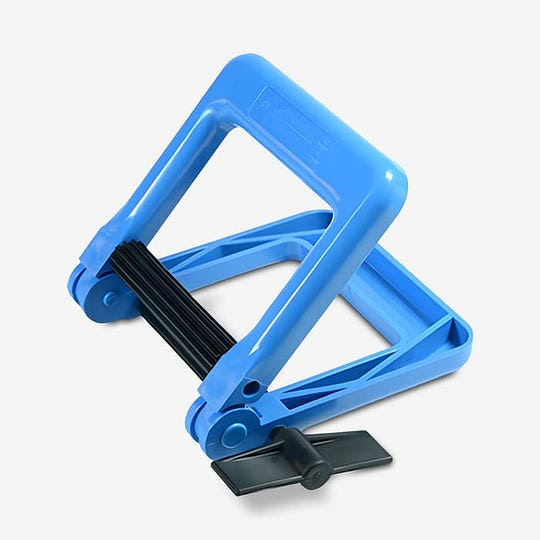
My new favorite tool is the Tube Wringer, from Gill Mechanical.
From their website: "The Tube-Wringer efficiently squeezes the contents from tubes of caulk, glue, medical compounds, adhesives, and toothpaste. Nearly indestructible, the Tube-Wringer will last a lifetime under normal use and pay for itself in short order."
In addition to sqeezing every little bit out of just about any tube, the squeezed part is left with a zig-zag texture so future usage doesn't undo the squeezing. Tubes are left efficiently squeezed, and cool looking. My only problem is that I wish I had more partially-used tubes available because it's so satisfying to squeeze every last bit out of them.
They come in light, medium, and heavy duty versions.
-- Sally Rosenthal
Light duty (Household use. Model 202-N)
$12
Available from Tube-Wringer
Also from Amazon
SureFire LED Light

I've been getting into higher-end LED lites, via a friend in the LAPD. LED flashlights are a powerful improvement on existing technology. My favorite for pocket carry is the amazing SureFire Executive, but fitted with the more expensive high-power head. Needs pricey lithium batteries but the amount of light thrown by these things is astonishing. I didn't really understand what it could do until I used it alone in pitch-dark Canadian woods. I was amazed. You can navigate very difficult terrain with it; gives you the big picture in a way the others don't.
The SureFire with the power head has a unique ability to semi-illuminate a huge volume of space. I have a skinny black 5-LED Inova that's as powerful, but the shape and quality of the light thrown are different. For the desert island, I'll take the SureFire (with a crate of lithiums!).
BTW, its "milspec hard anodyzed" finish is great. Probably an offshoot from small-arms manufacture. I love the look, like dull machined bronze. If I were a car designer I'd use it in place of chrome.
There's a whole universe of this stuff on the web, it turns out:
Candle Power Forums
-- William Gibson
SureFire Executive KL1 LED Head
$100 (street price) from, among others
The LED Light.com
MAC Hollow Ground Chef Knife

Two suggestions for best kitchen knives by foodie and CT reader Adam Fields:
This knife is extremely sharp. I use it mostly for vegetables which need a clean cut (carrots, parsnips, etc...) but which are soft enough that they won't damage the blade (I'll cut through chicken bones with the others below, but not this). The kullens and thin blade also make it uniquely suited for very thin slices.
MAC Hollow Ground Chef Knife 8"
$76
Northwestern Cutlery
*
Messermeister Meridian Elite 8"
![]()
This is my workhorse. It's big, heavy but well balanced, and very sharp. The Meridian knives have a German shape but a Japanese-style edge, which means they cut very well. I use this for anything too large for my other knives, and when the mood strikes.
Messermeister Meridian Elite 8"
$70
Distinctive Decor
XM Satellite Radio

Do you know about XM satellite radio? I basically stopped listening to radio about 10 years ago, because I was so dissatisfied with the range of music. Now I listen to the radio more than I listen to CDs, because of the advent of XM. It costs $9.95 per month for the service, and of course you have to buy a dedicated receiver ($150 to $300 depending on features). Because the satellites are so powerful, you don't need a dish antenna; my Sony system uses an antenna the size of a travel iron. Supposedly you place it on the roof of your car (it has a magnetic base) but I find I get flawless reception if I place it inside the car, under the windshield. The Sony receiver can be moved in and out of various vehicles, or your home. The antenna *just* manages to pick up the satellite signal from inside a wooden-framed house.
You get 101 channels, many commercial-free. Highlights for me have included a 10-hour special on John Lennon (created by the BBC), the blues channel (amazingly wide ranging eclectic selection), and "Music Lab" which ranges from Phish to Frank Zappa. You also get news stations (audio versions of CNN and Bloomberg), CSPAN, BBC World Service, oldtime radio dramas, readings of classic novels (more BBC material, excellently produced), and E! stuff which can be entertaining (they specialize in chronicling troubled lives of celebs). Of course there is a full range of new rock/pop/country/hiphop/oldies. You can send email to the DJs and get intelligent replies. If it is successful it may go the way of MTV, but right now it is still new and adventurous. Full programming details and signup info on their web site.
I play my XM radio in my car through a beautiful little headphone amplifier which I found after a great deal of digging online. It's the PHA-1 by Raven Labs, delivering great sound from a couple of 9v batteries (which give you about 50 hours). (I have no idea whether listening on headphones violates some state law, but since motorcycle riders have headphones inside their helmets these days, why not car drivers?)
My current job entails driving from my home in Northern Arizona to Phoenix and back, each week (150 miles each way). Headphones coupled with XM radio have erased the boredom and irritation of the journey, and I don't find the headphone experience any more distracting than a regular car radio. It's just more restful.
-- Charles Platt
Shortwave Radio

I remain skeptical about my news sources. I feel that the only way to glimpse the truth is to listen to as many POVs as possible. I don't watch TV, and domestic radio is limited in POV. Shortwave radio, however, is rich in POV. American Christian Right Wing, Radio Havana, The Beeb, Deutche Welle, Radio Taiwan, North Korea Radio, Radio Moscow, VOA, CBC, even Radio Albania and Radio Estonia -- all have English language broadcasts.
I find radio much more satisfying than webcasting news. Something about the magic of wringing distant magnetic emanations out of the ether. By listening to enough points of view, you begin to see that they all circumscribe the truth - in the middle somewhere is the Real Truth.
I use a Sony ICF 2010 and a Grundig Yacht Boy 400, connected to a 40 meter dipole. The Sony ICF 2010 is a classic - it's the Ford F-150 of shortwave radios. (see: DXing, scroll down). It was continuously produced by Sony for 16 years - a very, very long time in consumer electronics terms, but has recently been discontinued. You can easily find used ones between $225 - $300.
I always use the Sony when at home, but when I travel I use the Grundig Yacht Boy 400 (silly name!). The Grundig is smaller and lighter, fairly compact, and has a retractable antenna in a little reel that I use when I'm on the road. Works much better than the telescoping antenna on the radio. see: Grundig. However the Grundig is not as easy to operate, nor does it have quite the selectivity and filters that the Sony has. The Grundig is relatively inexpensive
(current price around $130).
There are many other capable receivers available, starting from under $100. Radio Shack sells Sangean receivers, which are decent. Sony and Grundig produce a range of consumer priced models. You would probably do OK with any of the models in the $100 price range. Unless you buy a model that has DSP (digital signal processing) built in, the newest technology isn't much different from the 15 year-old technology. The primary differences between inexpensive and expensive receivers are in the filters. Filters are what allow a receiver to have "selectivity" - the ability to discriminate between adjacent signals. I have a 50,000 watt AM station a few miles from my house. Their signal (or harmonics of their signal) show up all over the spectrum. Filters allow me to hear the weak signals from Radio North Korea and block the adjacent interference from my 50 KWatt neighbor.
DSP models are available now, but are currently expensive. That will change significantly over the next couple of years. In fact, the trend is toward SDR - software defined radio - where the radio itself is a highly flexible, programmable device that is configured in software. This would allow, for example, your AM/FM radio to become a cell phone, a GPS receiver, an aircraft band receiver, or a police scanner simply by running different "programs" on the device. The other new type of radio to emerge is a black box that interfaces to your PC. The box receives the radio signals and converts them into audio, which is then processed by your PC's sound card. All control over the radio is via a user interface on the PC. Sophisticated filtering algorithms can be run on the signal with the sound card. You can download frequency lists from the internet, and scan those frequencies for signals of interest, and even record the audio to your hard drive for later listening or analysis. An example of this type of radio can be seen at Winradio.
-- Michael Clark
Maya Wrap Baby Sling

There are a lot of tools that make our life easier. Many of them introduce their own complications, and I'd put baby strollers in that category. The various baby slings and backpack alternatives help out without circumscribing normal activity. The Maya Wrap's advantage lies in its simplicity -- it's just a piece of fabric with a metal loop -- yet it's functionally equivalent to more complicated babypacks. So it's the elegance of the thing that grabs me. My wife somehow managed to carry both twins this way. So you can count it as entertainment, too. This tool was absolutely essential to us in transporting all three of our children.
The Maya Baby Sling beats a stroller on size, cost and bulk alone. Since it is more compact and mobile than a stroller, it's much easier to walk and move around when you're carrying a child, especially when it keeps your hands free. Most stores aren't really set up for strollers, since wider aisles take up precious shelf space. American-style supermarkets may be the only exception, and even then it's difficult to push a stroller and a shopping cart at the same time. (I'm still looking at it through the lens of our experience with twins). Commerce aside, there's plenty of rough terrain out there where a stroller is more trouble than it's worth. The sling keeps your hands free and child close, so it's convenient to do just about everything except bend down. Finally, when it comes time to pack everything up we could fit both slings in a backpack, which trumps the trunk requirement of most strollers.
For hiking trips Kelty-type baby backpacks tended to work out better, but they're not as comfortable for napping children, and the metal frame is almost as inconvenient as a stroller in tight situations. Our kids stayed happy longer in the slings, too. The slings win again when packing everything into a car, or on a bike or a plane, for that matter.
The Baby Bjorn-class rigs are similar in some ways, but they are much more limited in terms of the size of the child and the position you can carry them. Other than that Baby Bjorns have the same benefits, although I'd have to say they're also the ugliest way to carry your child; It reminds me of the 747 they use to transport the Space Shuttle. I quickly mastered putting down a sleeping child in a sling (instant blanket), but the boat-like rigging of the Baby Bjorns usually spelled trouble.
For my wife, of course, it's a no-brainer. The slings were the best for breastfeeding, since she could do it while moving around.
-- Marcel Levy
Maya Wrap Baby Sling
$40
Maya Wrap Baby Slings
Snow Peak Stove and Cookset

This is a super-light high-performance cook set. I've been hiking since the late '60s and this is far and away my favorite combo. The stove is tiny and it and the gas canister fit inside the nested pots of the cookset. Add a titanium spork and you have a complete cookset weighing under 8 oz and fitting in a space smaller than a jacket stuffsack. It is so light that I use it for more than overnights: I often take it on day hikes instead of a thermos -- I pack some powdered green tea, a bamboo whisk and a second cup. In a few minutes, I can whip up tea ceremony style green tea for myself and my hiking companion.
-- Paul Saffo
Snow Peak Gigapower Titanium Stove (3.oz)
$80
Available from Amazon
or $65 from Campmor

Snow Peak Mini-solo Cookset (5.5 oz)
$60
Available from Amazon

Snow Peak Titanium Spork (1/2 oz)
$9
Available from Amazon
Manufactured by Snow Peak
A Guide to Oriental Classics * The New Lifetime Reading Plan

Now that you have finished reading all the great books of the West, you might want to turn your attention to the rest of the world. There is an equally vast and equally great classical literature in what is known as the East. Few of these works make it onto the lists of Best Books Ever; furthermore, guides to this wing of the universal library are rare. Given our interdependence with other cultures, introductions to this literary realm are vital and urgent.
For simple reading lists (sometimes the most enjoyable way to enter) I direct you to Robert Teeter's Great Books Lists, a handy website which convenes in one spot all the published lists of oriental (and western) classics. For a more annotated guide, with proper orientation of where you might want to head, I would start with A Guide to Oriental Classics, from Columbia University Press. The third edition of this indispensable work incorporates many works only recently translated into English, as well as an expanded number of secondary readings and glosses. I can�t think of any major works in the four regions of the Islamic world, India, China, and Japan that are not covered here. With each work you get a very short description and � very handy! � annotated pointers to available translations.
For a more contextual inclusion, I find The New Lifetime Reading Plan by Clifton Fadiman to be superb. This revised and expanded fourth edition of his venerable book now covers many more eastern classics than in his previous editions. The list of eastern works is still way too short, but he offers them with two advantages. Because his plan is organized chronologically, one gets a better sense of how an eastern work relates to the West, and secondly, for each work he spends a few pages outlining to the reader its importance and a summary of its content, which A Guide to Oriental Classics does not. You�ll get a better perspective from his select list, but you�ll have more of an adventure with the Columbia University roster.

A Guide to Oriental Classics
Edited by Theodore De Bary
1989, 325 pages
$79
Columbia University Press
Amazon

The New Lifetime Reading Plan
The Classic Guide to World Literature, Revised and Expanded
Clifton Fadiman and John S. Major
1998, 378 pages
$11
Harper Perennial
Amazon
Dymo Labeler

These have been around since the age of dinosaurs, but they still work better than most gadgets. We use them for labeling almost anything that needs a name or number. The labels adhere well and have a clear retro look. The inexpensive plastic device is mercifully idiot-proof. Cheap too.
Dymo Compact Label Maker
Item#: 653611, $4
Frys Electronics Outpost.com
877-688-7678, 860-927-2050
Or try the Pro version from Amazon
Micro-Mark

The target audience seems to be HO railroaders and model builders, but there are tons of things in here useful to anyone who fixes stuff, especially small stuff. Every Dremel bit and attachment you could imagine. Tiny vacuums, gram scales, grippers, dental piks, tiny saws and sanders. And every flavor of small organizer container one could imagine. I bought a bunch to organize electronics parts and small screws.
-- Paul Saffo
Micro-Mark
"The small tool specialists"
800-225-1066


Complete Walker IV

Colin Fletcher is back (at 80 years old!) with a brand new fourth edition of his landmark 1968 book. It was last updated in 1984 � the Iron Age in terms of technological gear. A lot has changed, but the pleasures of walking haven�t. While Ray Jardine stresses efficiency and accomplishment, Fletcher and co-author Rawlins toast comfort and enjoyment. Like all past editions, The Complete Walker IV is astoundingly informative and insanely complete (843 pages, including 62 marvelous ones on the varieties of backpacks). These grey beards not only tell you about gear, they give you its history, and the history of its makers, and the current skinny on their prospects. You feel educated. They consider everything and anything remotely portable, and tell you what else a tool might be used for, where it comes from, and whether it could be improved or left behind. They get you to think about everything too. It�s wonderful to read, sly and humorous as the first edition. We don�t often associate civilization with backpacking, but that�s what Fletcher is trying to do. He�s offering wisdom on how to live on the trail, with the emphasis on live. I use the guide to help me.
-- KK
The Complete Walker IV
Colin Fletcher & Chip Rawlins
2002, 845 pages
$23
Alfred A. Knopf
New York
Amazon
2nd Largest World Map

Most homes have limited uninterrupted wall space, so I've found this wall map from National Geographic to be the largest practical map of the world. Sized: 70 by 49 inches. Contains adequate political detail, crisp geographic printing, and is current as of 2001.
-- KK
World Political Map, Enlarged
ID # RE00622008
69" x 48"
$30
National Geographic
800-437-5521
Making Your Own Digital Topo Maps These Days

Cartography is a once-exotic specialty that is about to hit the mainstream. Making maps used to be supremely daunting. It required ultra-precise instruments and advance technical knowledge. A map could take thousands upon thousands of man-hours to build. And few might ever see it.
Three technologies are overturning this profession: GPS, digital imaging, and the web. An inexpensive GPS device allows almost anyone to generate cartographic data. Plotting software allows almost anyone to map that data out. And web technology allows almost anyone to distribute and view these maps.
Most of this recent amateur digital cartography is taking place upon the solid foundations of government-funded topographic mapmaking. The story begins by digitizing the current set of government topo maps. A number of agencies, including the National Geographic Society have completed this heroic task. They employed huge scanners which devoured entire maps at once, and software that stitched all the maps together seamlessly into one huge digital map. Once you have a digital topo map, you can port that stream of bits into a GPS device. Now as you hike or bicycle or drive with your GPS on, your path is traced onto the topo map automatically, or you can pinpoint particular spots. Back at your PC you can annotate your data.
For instance, let's say you are trailblazing a new path in second-growth forest in Vermont. Your trail can become a new layer on the standard topo for that area. You can indicate "spring here" or "cave there" or "bridge missing" and so on right on the map. You could survey the spreading meadow on a lakebed; this would appear on your digital map.
You can now share that map by posting it on the web. Someone else can download it, and continue to add their own data - maybe they mapped all the ruined remains of former farmhouses in the area. Over time the map begins to accumulate many layers of new and additional information. It might start off as the bare topo with contours and end up with amazing loads of data. Each layer easily repressed so you can select your view.
That first step - the digitization of the foundational topographic maps of the entire US - has just been completed by the United States Geological Survey. All 50 states are now available in digital form. The USGS licenses this full-country data to various companies. In parallel, National Geographic has recently re-scanned all 50 states topo maps themselves, claiming higher accuracy, higher resolution, and better interface tools. So now there are two basic pools of digital map services. Those depending on the USGS files are less expensive, more fragmented, and more like open source. On the flip side, National Geographic's data is easier to use, more expensive, more integrated, and less opened.
Mytopo.com

Mytopo.com is very similar to Offroute, but with a less friendly interface. I find them harder to order from, but their prices are cheaper, especially for larger maps. You can order folded maps which are cheaper to ship. Compared side by side with Offroute, their map quality was a notch lower: colors less subtle and no relief shading. But their prices are hard to beat.
-- KK
Mytopo
18" x 24" topo map
$10
Offroute.com

A topo map from Offroute (which uses National Geographic's version of USGS's topographic maps) is a little more expensive ($9 vs. $6) than buying a "quad" from the USGS, but offers five great advantages: 1) you don't have to buy four sheets to get your spot covered, you can just get one custom one centered on your coordinates; 2) you can print it out in several different sizes, including larger display-sizes; 3) you can select relief shading which add shadows to the hills as a great aid to visualizing the terrain; 4) you can get it in waterproof, untearable teslin, which is fantastic if you'll be folding and unfolding a lot; 5) you can get it from home.
Offroute offers custom centered topo maps of anywhere in the US. Their website is easy to navigate and delivery is prompt. They mail them rolled in tubes. Here in the Bay Area, I get maps three days after I order. It's a great service. Friends who use it say the same.
-- KK
Offroute
13' x 18' topo map
$9

Favorite (15)